
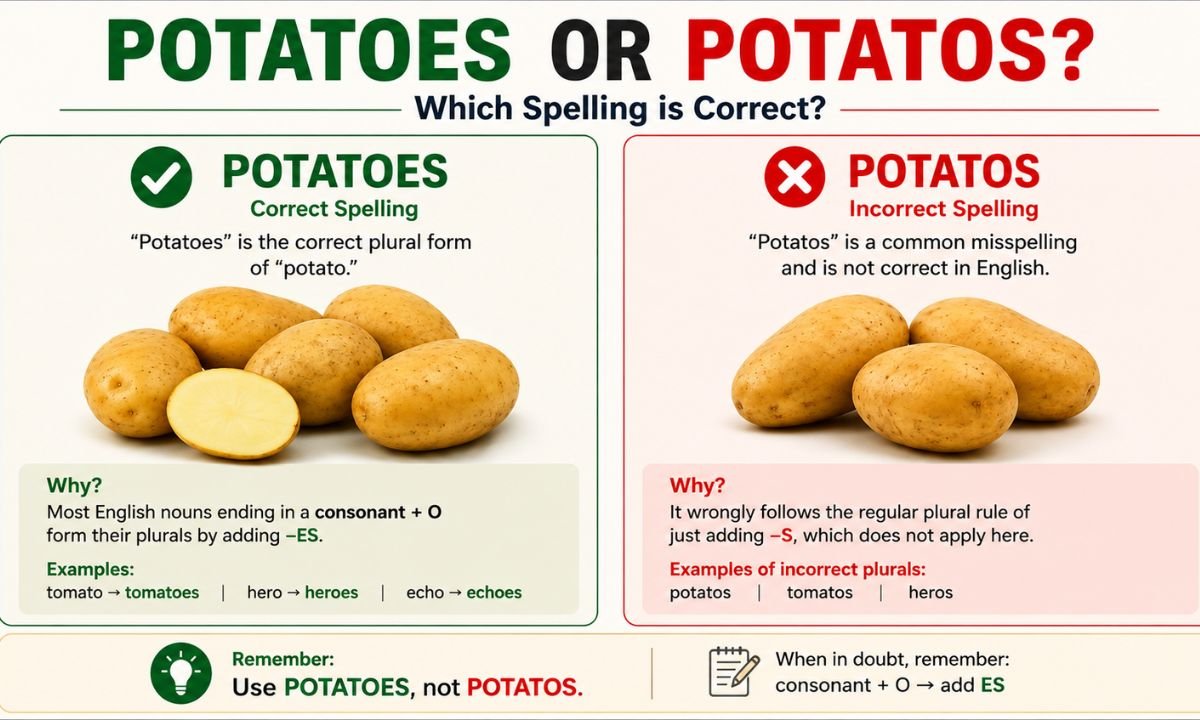
Type “potatos” into any document and watch a red squiggly line appear almost instantly. That little glitch has sparked a genuine, ongoing question for millions of English speakers and learners: is it potatoes or potatos?
The short answer is that only one spelling is real. “Potatoes” is correct in every form of English, and “potatos” is a spelling mistake, not an accepted variant. But knowing the answer isn’t the same as knowing why, and that’s where most people get stuck.
This guide breaks down the difference in plain language, explains the grammar rule behind it, and gives you enough examples that you’ll never second-guess yourself at the grocery list again.
Comparison Overview
Before digging into grammar rules, here’s a quick side-by-side look at how these two spellings stack up.
| Feature | Potatoes | Potatos |
|---|---|---|
| Correct spelling | Yes | No |
| Accepted in dictionaries | Yes | No |
| Used in formal writing | Yes | Never |
| Passes spell-check | Yes | Flagged as an error |
| Plural rule followed | Consonant + o → add “es” | Incorrectly adds only “s” |
| Common in | Books, articles, recipes, everyday speech | Typos, fast texting, casual mistakes |
The table makes it obvious: there isn’t really a debate here, just one word that’s easy to misspell.
Definition of Potatoes
Potatoes is the plural noun form of “potato,” the starchy vegetable that grows underground as a tuber. When you’re talking about more than one of these vegetables, “potatoes” is the word you reach for.
It shows up everywhere in everyday English: on menus, in recipes, in grocery lists, and in casual conversation. A farmer grows potatoes. A cook peels potatoes. A family eats potatoes for dinner. Every one of those sentences uses the standard, dictionary-approved plural.
You May Like: Requester or Requestor: What is the Difference & Which is Correct?
Definition of Potatos
“Potatos” isn’t a word. It doesn’t appear in Merriam-Webster, the Oxford English Dictionary, or Cambridge Dictionary. It’s simply a misspelling that happens when someone applies the wrong plural pattern to the word “potato.”
The mix-up makes sense on the surface. Plenty of English nouns become plural just by adding “s” — think “photos,” “pianos,” or “kilos.” “Potato” looks like it should follow the same pattern, but it doesn’t. There’s no context, formal or informal, where “potatos” is the accepted spelling.
Main Differences Between Potatoes and Potatos
Here’s a clear breakdown of what separates the correct spelling from the mistake.
- Grammar status: “Potatoes” is a recognized plural noun. “Potatos” has no grammatical standing.
- Letter pattern: “Potatoes” adds “-es” after the final “o.” “Potatos” wrongly adds only “-s.”
- Dictionary presence: “Potatoes” is listed in every major English dictionary. “Potatos” is not listed anywhere as a valid word.
- Usage in writing: “Potatoes” is safe for essays, emails, articles, and books. “Potatos” will get flagged in any professional or academic setting.
- Root cause of confusion: Many “-o” words pluralize with just “s,” so writers guess the same rule applies to “potato.” It doesn’t.
Why Is “Potatoes” Correct?
English pluralization for nouns ending in “-o” splits into two general patterns, and which one a word follows usually depends on the letter right before the final “o.”
- Nouns ending in a vowel + “o” (like “radio” or “video”) typically just add “s”: radios, videos.
- Nouns ending in a consonant + “o” (like “potato,” “tomato,” or “hero”) typically add “es”: potatoes, tomatoes, heroes.
“Potato” ends with “t,” a consonant, right before the final “o.” That places it firmly in the second group, which is why “potatoes” carries the extra “e.” Language historians trace this pattern back through how English absorbed and standardized loanwords from Spanish and Italian, where similar endings were common. Over time, dictionary compilers such as Noah Webster helped lock “potatoes” in as the accepted spelling, and it has stayed that way ever since.
Grammar Guide
If you’ve searched around this topic, you’ve probably seen related questions pop up again and again: plural of potato and tomato, potatos or potatoes spelling, mashed potatoes or potatos, why is the plural of potato potatoes, potatoes potatos saying, tomatos or tomatoes, tomato plural form. All of these point back to the same underlying grammar issue, so let’s walk through it properly.
How Each Term Is Used in Sentences
“Potatoes” fits naturally into everyday sentences:
- I bought five potatoes at the market.
- The chef roasted the potatoes with rosemary.
- Potatoes are one of the most widely grown crops in the world.
“Potatos” doesn’t fit into a correct sentence at all, because it isn’t a real word. Any sentence using it, such as “I bought five potatos,” contains a spelling error that needs to be fixed before publishing or submitting the writing.
You May Like: Hoodie or Hoody: Which Spelling Is Actually Correct?
Common Mistakes Learners Make
- Assuming every “-o” noun adds only “s” for its plural.
- Relying on how the word sounds when spoken, since “potatoes” and “potatos” are nearly identical in pronunciation.
- Typing quickly on a phone and skipping the “e” out of habit.
- Confusing “potato’s” (possessive) with “potatoes” (plural) or the misspelled “potatos.”
Simple Rules to Remember
- One potato, many potatoes — never many potatos.
- If the word ends in a consonant before the final “o,” lean toward “es.”
- When unsure, picture the singular form first, then add “es,” not just “s.”
Quick Tips for Writing and Speaking

- Read your sentence aloud slowly; if you’re unsure, spell it out letter by letter.
- Keep a short mental list of consonant + “o” words that take “es”: tomatoes, heroes, echoes, potatoes.
- Trust spell-check, but don’t rely on it entirely — proofread manually for important documents.
When to Use Each One
Use “potatoes” any time you’re referring to more than one potato, in any setting: formal writing, casual texting, recipes, business reports, or conversation. There’s no exception where the plural form changes.
“Potatos” should never be used. There isn’t a context, dialect, or writing style where it becomes acceptable.
When NOT to Use Each One
Avoid “potatoes” only when you actually mean the singular “potato,” or when you need the possessive form “potato’s” (as in “the potato’s skin”). Mixing up plural and possessive forms is a separate but related mistake worth watching for.
Avoid “potatos” entirely, in every situation. If you catch yourself typing it, that’s your cue to add the missing “e.”
Which One to Use (Decision Guide)
Ask yourself these quick questions when you’re unsure which word to type:
- Am I talking about more than one potato? If yes, you need the plural.
- Does the word end in a consonant before the final “o”? For “potato,” yes — it’s “t.”
- Does the plural rule for consonant + “o” nouns call for “es”? Yes.
- Therefore, the correct spelling is “potatoes.”
If you ever land on “potatos” after following these steps, go back and check step three. That’s usually where the mistake creeps in.
Common Plural Rule Behind Potatoes
The rule isn’t unique to “potato.” Several everyday English nouns that end in a consonant plus “o” follow the same “-es” pattern:
| Singular | Plural |
|---|---|
| Potato | Potatoes |
| Tomato | Tomatoes |
| Hero | Heroes |
| Echo | Echoes |
| Volcano | Volcanoes (or volcanos, both accepted) |
| Torpedo | Torpedoes |
Note that English isn’t perfectly consistent. Words like “photo,” “piano,” and “logo” end in a vowel before the final “o,” so they just add “s”: photos, pianos, logos. That inconsistency is exactly why so many writers second-guess the plural of “potato” in the first place.
Real-World Practical Examples
Potatoes Examples
- She peeled the potatoes before boiling them.
- Farmers in Idaho grow potatoes on a massive scale.
- We’re having mashed potatoes with dinner tonight.
- The recipe calls for two pounds of potatoes.
- Potatoes are rich in potassium and vitamin C.
Potatos Examples
There are no correct examples of “potatos” in proper English, because the spelling is always wrong. Any sentence containing it — for instance, “I need to buy more potatos” — needs to be corrected to “potatoes” before it’s considered accurate writing.
Self-Assessment (Fill in the Blanks)
Test what you’ve learned. Choose “potatoes” or “potatos” for each sentence.
- I roasted some __________ for dinner.
- The market had fresh __________ on sale.
- My grandmother grows __________ every summer.
- He mashed the __________ with butter and garlic.
- These __________ are perfect for frying.
Answers
- Potatoes
- Potatoes
- Potatoes
- Potatoes
- Potatoes
Every answer is “potatoes,” because that’s the only correct spelling in standard English, no matter the sentence or context.
Frequently Asked Questions
Is it spelled potatoes or Potatos?
It’s spelled “potatoes.” “Potatos” is always a misspelling in standard English.
How do Mexicans say potatoes?
In Mexican Spanish, potatoes are called “papas,” while “patatas” is more common in Spain.
Which is correct, tomatos or tomatoes?
“Tomatoes” is correct, following the same consonant + “o” plural rule as “potatoes.”
How do you spell potatoes in the UK?
The same way as in the US — “potatoes.” There’s no regional spelling difference for this word.
Conclusio
The choice between potatoes and potatos really isn’t much of a choice at all. “Potatoes” is the correct, dictionary-recognized plural of “potato,” while “potatos” is a common but avoidable spelling mistake. The rule comes down to one simple pattern: when a noun ends in a consonant right before the final “o,” English typically adds “es” to form the plural, not just “s.”