
If you’ve ever typed this word into a search bar mid-sentence, you already know the problem: it sounds like “divet,” but something about that spelling looks off once it’s on the page. You’re not alone. This mix-up shows up constantly in golf forums, lawn care blogs, and everyday emails, and it’s one of those small errors that quietly chips away at a writer’s credibility.
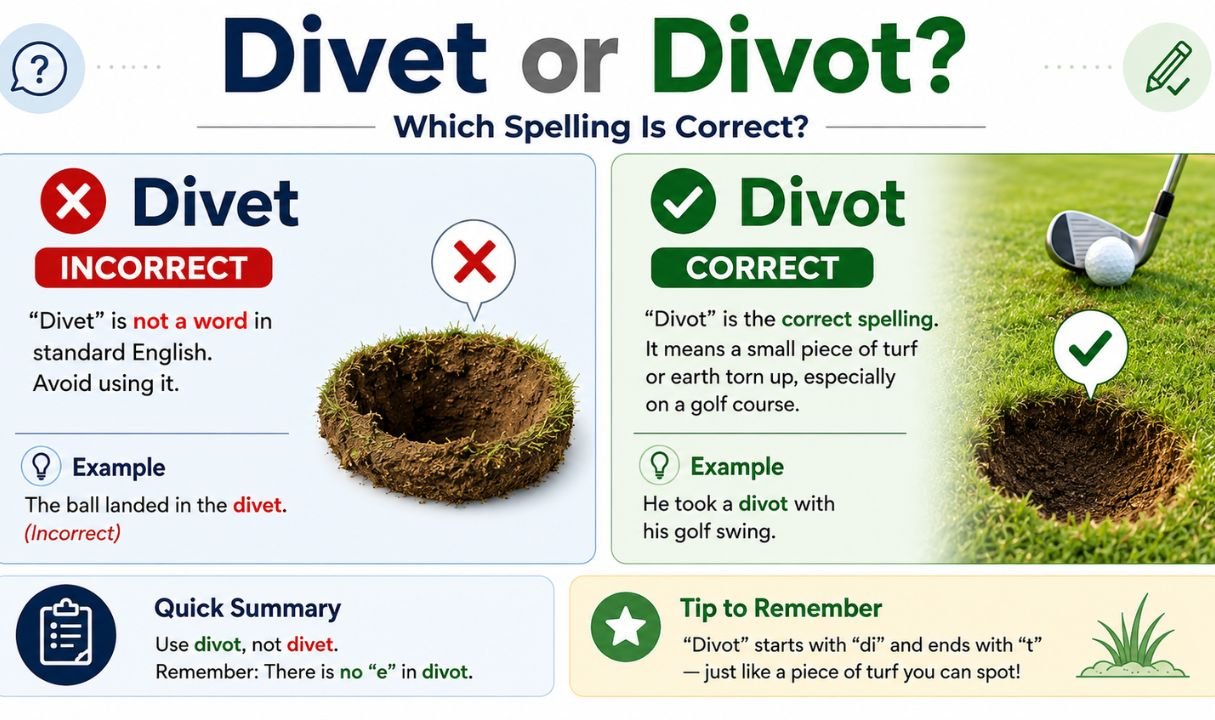
Here’s the short version before we get into the details: divot is correct. Divet is not a recognized word in modern English. Let’s look at why this mistake happens so often, where the word actually comes from, and how to make sure you never second-guess it again.
Divet or Divot – Quick Answer
Divot is the only spelling accepted by major dictionaries, including Merriam-Webster and Cambridge. Divet is a misspelling, plain and simple, and it doesn’t appear as a standard entry anywhere that matters for formal or professional writing.
The confusion almost always comes down to how the word sounds when spoken quickly. Say “divot” out loud in casual conversation and the final syllable can blur into something closer to “-et” than “-ot.” That small slip in pronunciation is enough to send the wrong spelling into a text message, a golf recap, or a work email.
Divot or Divet Meaning
A divot is a small chunk of turf, grass, or soil that gets torn out of the ground, usually from an impact of some kind. In golf, it’s the patch of turf a club displaces when a player strikes the ball or the ground beneath it. Outside sports, the word has stretched to cover any small dent, gouge, or depression in a surface, whether that’s a lawn, a car door, or a hardwood floor.
“Divet” carries no separate meaning of its own. It’s simply an incorrect spelling of divot, and using it in place of the real word can make writing look careless, even when everything else about the sentence is polished.
The Origin of Divet or Divot
The word traces back to Scots dialect, where it appeared in forms like “divot,” “divat,” and “duvat” as far back as the 1500s. Most language historians link it to the Scottish Gaelic term dubhad, a shortened form of dubh-fhàd, which translates roughly to “black sod” or “black turf.” That makes sense given the word’s original meaning: a strip of turf, often cut with the roots and soil still attached, historically used for roofing or patching ground.
Over the following centuries, the term made its way into English usage, eventually landing in golf terminology sometime in the 1800s. Golfers needed a word for the clump of grass their clubs kicked up on impact, and “divot” was already sitting there in regional vocabulary, ready to be adopted.
“Divet” never had this kind of documented history. It doesn’t show up as an accepted regional variant or an older form in etymological dictionaries. It’s best understood as a spelling error that spread through repetition rather than through any legitimate linguistic root.
British English vs American English Spelling
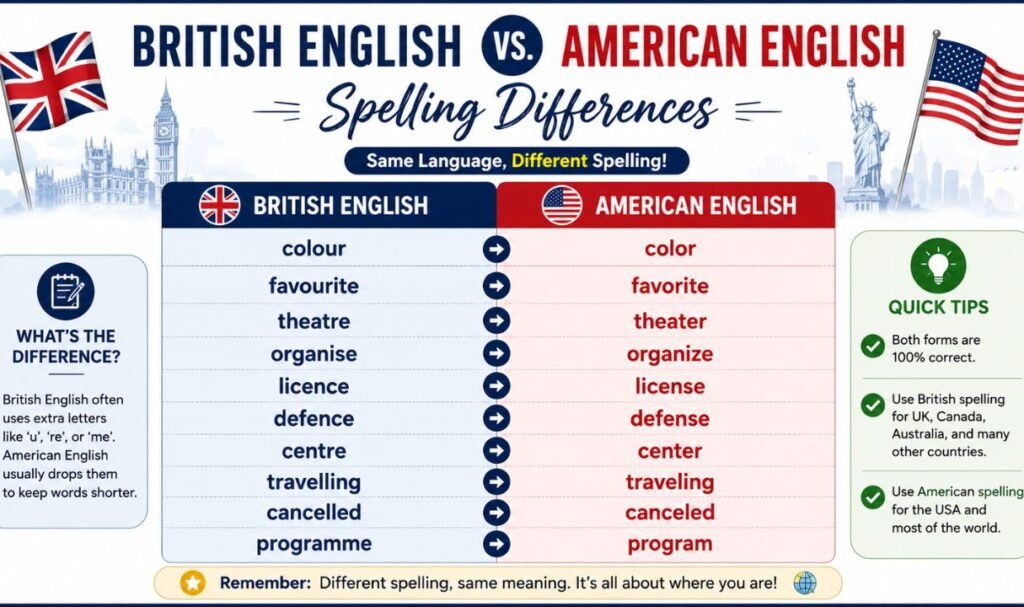
This is one area where people often expect a transatlantic split, similar to “colour” versus “color” or “organise” versus “organize.” Divot doesn’t work that way.
| Region | Accepted Spelling | Notes |
|---|---|---|
| American English | Divot | Standard in Merriam-Webster |
| British English | Divot | Standard in Cambridge and Oxford dictionaries |
| Australian/Canadian English | Divot | Follows the same convention |
There’s no regional variant that legitimizes “divet.” Whether you’re writing for a US golf magazine, a UK sports column, or a landscaping blog based in Toronto, the spelling stays the same. That consistency actually makes this word easier to handle than many others in English, once you know the rule.
You May Like: 22th or 22nd: Which One Is Correct? Grammar Guide (2026)
Which Spelling Should You Use?
Use divot every time. There’s no context, formal or casual, where “divet” is the preferred or accepted choice. That said, it helps to understand how people search for and misuse this word, because the confusion tends to cluster around a few recurring patterns.
Divet or divot meaning People searching this phrase usually want a quick definition. The answer is always tied to the correct spelling: divot means a piece of turf or a dent in a surface.
Divet or divot synonym Common alternatives include “gouge,” “dent,” “hollow,” “pit,” or “divotted turf” in landscaping contexts. None of these synonyms use the “-et” ending, which is a useful memory trick.
Is divet a word No. It doesn’t appear in standard dictionaries as a headword, only sometimes as a note under “divot” pointing out that it’s a common misspelling.
- Divot dent: This phrase usually refers to the non-golf meaning of divot: a small dent or depression in a surface, like a scuff on a car panel or a low spot in a yard.
- Divot in a sentence Example: “The golfer replaced his divot before walking to the next hole.”
- Divot in French: The closest French equivalent is motte de gazon, which literally means “clump of turf.” There isn’t a direct one-word borrowing of “divot” into standard French.
Divot pronunciation: It’s pronounced DIV-ət, with the stress on the first syllable and a soft, almost swallowed second syllable, which is exactly why it gets misheard and misspelled so often.
Divet spelling: This search almost always leads back to the same answer: it’s not a valid spelling, and “divot” is what you want.
For different audiences:
- Golfers and sports writers need “divot” for accuracy in rulebooks, etiquette guides, and match commentary.
- Landscapers and homeowners use it to describe lawn damage from foot traffic, machinery, or weather.
- Students and professionals benefit from knowing the correct spelling for resumes, reports, and formal writing where small errors get noticed.
- Casual writers and social media users can still use it correctly without sounding overly formal; “divot” reads naturally in any tone.
Common Mistakes with Divet or Divot
A few patterns show up again and again when people get this word wrong:
- Phonetic spelling – Writing the word the way it sounds rather than the way it’s actually spelled is the single biggest cause of this error.
- Autocorrect gaps – Some devices don’t flag “divet” as incorrect, especially if it’s been typed and accepted once before on that device.
- Copying casual sources – Forums, comment sections, and unedited blog posts sometimes use “divet,” and readers pick up the habit without checking a dictionary.
- Confusing it with similar-sounding words – Words like “rivet” or “trivet” end in “-et,” and that pattern can bleed into how people spell “divot” by association.
- Assuming a British/American split – As covered above, there’s no regional variant here, so guessing based on dialect leads people astray.
A simple fix: connect “divot” with “golf.” Both words contain the letter “o,” and that small link can anchor the correct spelling in your memory.
You May Like: Who’s vs Whose: What is the Difference & Which is Correct?
Divot in Everyday Examples
Seeing how the word functions across different types of writing makes the correct usage stick.
Emails
“Please note that the maintenance crew will be repairing the divots near the ninth green tomorrow morning.”
News
Sports journalists often describe player conduct through this lens: “Course officials praised the players for consistently replacing their divots throughout the tournament.”
Social Media
A casual golf post might read: “Worst divot of my life on that last swing. Guess the fairway’s getting a new haircut.”
Academic Writing
In turfgrass management papers, you’ll see phrasing like: “Divot recovery rates depend heavily on grass species, soil temperature, and traffic frequency.”
Sports Writing
Beyond golf, the word shows up in soccer and rugby commentary too: “The pitch was littered with divots after ninety minutes of heavy play, making footing treacherous in the final stretch.”
Divot or Divot – Google Trends & Usage Data
Search interest around this word spikes in predictable, fairly narrow patterns.
Why people search this keyword:
- Uncertainty over spelling while writing an email, essay, or article
- Golf enthusiasts checking terminology before posting online
- Writers and editors double-checking a word before publishing
- Curiosity after hearing the term used in a sports broadcast
Popular regions:
Search volume tends to concentrate in countries where golf carries strong cultural weight, particularly the United States, the United Kingdom, Australia, and Canada. Scotland, given the word’s linguistic roots, shows steady interest as well.
Usage contexts:
| Context | Typical Frequency |
|---|---|
| Golf and sports | Highest usage overall |
| Landscaping and turf care | Moderate, seasonal spikes |
| General “dent” meaning | Occasional, non-sports contexts |
| Spelling/grammar queries | Consistent year-round |
Comparison Table (Keyword Variations)
| Term | Status | Common Use |
|---|---|---|
| Divot | Correct spelling | Golf, turf, dents |
| Divet | Incorrect spelling | Common typo |
| Divot dent | Correct phrase | Describes a surface dent |
| Divet dent | Incorrect phrase | Misspelled variant |
| Divotted | Correct (adjective form) | Turf damaged by divots |
| Divetted | Incorrect | Misspelled variant |
Frequently Asked Questions
Is a divet a hole?
No, “divet” isn’t a standard word at all. The correct term, “divot,” refers to a torn piece of turf or a small dent, not a hole in the ground itself.
What is a divot dent?
It’s a small depression or gouge in a surface, often used outside golf to describe dents in lawns, floors, or other materials.
What is divet?
“Divet” is simply a common misspelling of “divot” and has no independent meaning or dictionary status.
What is a divot?
A divot is a piece of turf displaced by impact, such as a golf swing, or more broadly, any small dent or depression in a surface.
Conclusion
The rule here is refreshingly simple compared to most English spelling debates: divot is right, divet is wrong, and there’s no regional exception hiding anywhere to complicate things. The word’s roots stretch back to Scots dialect and Gaelic language, and it settled into English through golf and general usage without ever splitting into competing “correct” forms.