
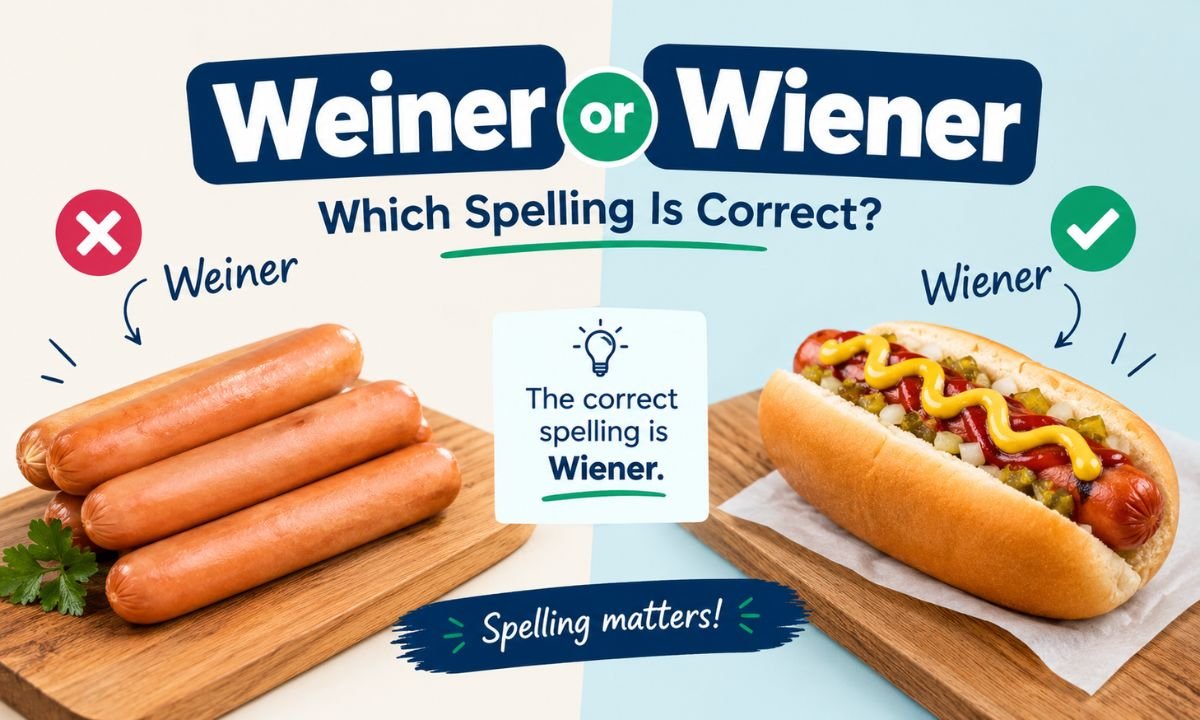
You are typing a menu, a caption, or a school assignment, and you stop. Is it weiner or wiener? The two spellings look almost identical, and spell check does not always flag the wrong one. That is exactly why this question gets searched so often.
The short version: wiener is the standard spelling for the sausage, the dog nickname, and anything linked to Vienna. Weiner is mostly a surname, although it also shows up as a variant spelling in some dictionaries and in a few regional food names.
What Is the Difference Between Weiner and Wiener?
The difference comes down to letter order and meaning. Wiener is spelled W-I-E-N-E-R. Weiner is spelled W-E-I-N-E-R. One swap of two letters changes the word from a common noun to, in most cases, a family name.
Wiener is the English form of a German word that means “of Vienna” or “Viennese.” It names a type of sausage, a person from Vienna, and many Vienna-related foods and places. Weiner is a surname with two separate roots, one German and one Yiddish. Dictionaries also record it as a less common variant of the sausage word.
Quick Answer
- Wiener (ie): the sausage, the hot dog, the dachshund nickname, and “from Vienna.”
- Weiner (ei): a surname in nearly every case, plus an occasional variant spelling of the sausage word.
- Safe rule: if you mean food or Vienna, write wiener. If you mean a person named Weiner, copy the spelling that person uses.
Why Do People Confuse Weiner and Wiener?
Mixing up these two words is not a sign of weak spelling. Several ordinary habits push writers toward the wrong version. Understanding them makes the error easier to catch.
Similar Pronunciation
In everyday American speech, most people say the sausage word as “WEE-ner.” That sound does not tell you whether the vowels are written ie or ei. Both spellings can be read aloud the same way, so your ear gives you no clue about the page.
This gets more tangled with the surname. Some people named Weiner say “WINE-er,” while others say “WEE-ner.” A listener can hear the name one way and the sausage another, then assume the spellings should match.
Typing Habits
Fast typists often flip adjacent letters. The letters i and e sit close together in the middle of the word, and swapping them is one of the most common slips on a keyboard. If you type quickly on a phone, the slip is even more likely.
Once a typo gets published, it spreads. Someone sees it, assumes it is right, and copies it into the next post.
Surname Recognition
Many readers know a person or public figure with the surname Weiner. Because that spelling is familiar, it can feel more “normal” than the sausage spelling. The brain recognizes a shape it has seen before and accepts it without checking.
Dictionary.com notes that confusion between the surname and the sausage word is a main driver of misspellings. That matches what most editors see in practice.
Internet Searches
Search engines are forgiving. Type either spelling and you will usually get results for both. That convenience also removes the pressure to learn the correct form, since the search works anyway.
Product names, captions, and hashtags add to the mess. When a brand or a joke account uses the variant spelling on purpose, readers pick it up without knowing the choice was deliberate.
Meaning of Wiener
Wiener carries three main meanings in English. Each one traces back to the same German root, which is why the spelling stays consistent across all of them.
A Sausage or Hot Dog
The most common use is food. A wiener is a smoked, seasoned sausage, usually made from beef, pork, or a blend, and served in a bun. In everyday American English, wiener, frankfurter, and hot dog are often treated as near synonyms. Some speakers see small style differences, with “frankfurter” sounding more formal and “wiener” and “hot dog” sounding more casual.
The word also appears in set phrases. A wiener roll can mean a bun made for a sausage or a roll with a sausage baked inside. Context decides which. A wiener dog is a playful name for the dachshund, a breed whose long body resembles the sausage.
Regional usage adds color. In parts of Rhode Island, “hot wieners” refers to a local style of small sausages served with a seasoned meat sauce. Even in that dish, the standard spelling is not always the one printed on the sign, which is part of the confusion.
Someone or Something from Vienna
In German, Wien is the name of Vienna, and Wiener is the adjective or noun meaning “of Vienna.” A Wiener is a person from the city. The same word appears in many food and culture terms:
- Wiener Schnitzel, a breaded veal cutlet associated with Vienna
- Wiener Walzer, the Viennese waltz
- Wiener Melange, a Viennese coffee drink with milk foam
The sausage word follows the same logic. It began as Wienerwurst, which means “Vienna sausage.” English shortened it to wiener.
A Family Name
Wiener is also a surname. It can signal a family origin in Vienna, or it can be a variant of related names. One well-known bearer is Norbert Wiener, the mathematician who founded the field of cybernetics. His surname is spelled with ie, and anyone writing about his work should keep it that way.
Is Weiner Ever Correct?
Yes. The word is not a pure mistake in every setting. It is correct in two situations: as a surname, and as a recognized variant in certain references. Knowing the difference keeps you from “fixing” something that was right.
Correct Examples
- As a surname: “Jennifer Weiner is a bestselling novelist.” The name is spelled with ei, so the spelling stays.
- As a surname in a list: “The Weiner family moved to Chicago in 1952.”
- As a documented variant: Some dictionaries list weiner as a variant of wiener. Dictionary.com treats weiner as an alternate form, and the Oxford English Dictionary records it as a variant with citations from the 1960s onward, according to linguist Arnold Zwicky.
- In a brand or local menu name: If a business spells its name “Weiner” on purpose, you copy it exactly when you cite the business.
A surname with this spelling has two known origins. One is a German name linked to dialect pronunciation. The other is a Yiddish name, Vayner, which means “wine merchant” and connects to the German word Wein, meaning wine. Over time, families switched between Weiner and Wiener, so both spellings can belong to the same family history.
Incorrect Examples
- “We grilled weiners at the cookout.” Standard usage calls for wieners.
- “My weiner dog loves walks.” The nickname is wiener dog.
- “She ordered a Weiner schnitzel.” The dish is Wiener Schnitzel, named for Vienna.
- “The Weiner Philharmonic performed tonight.” The orchestra is the Wiener Philharmoniker, from Vienna.
Common Contexts Where Wiener Is Used
You will meet the correct spelling in food writing, history, and reference works. In each area, the ie form is the expected one.
Food and Cooking
Recipe sites, grocery packaging, and restaurant menus use wiener for sausages and Viennese dishes. A few contexts to know:
- Wiener sausage: a small, mild, skinless or natural-casing sausage
- Wiener Schnitzel: a thin cutlet, breaded and pan-fried
- Wiener roll: a bun for a sausage, or a roll wrapped around one
- Wiener dog: a nickname for the dachshund
Professional food writers keep the spelling consistent across a menu. A single weiner in a list of wieners looks careless.
Historical References
Historical writing uses Wiener whenever it refers to Vienna or Viennese people. You will see the Wiener Kongress (Congress of Vienna), Wiener Werkstätte (a design workshop), and Wiener Secession (an art movement). In English texts, these names often appear in their German form.
Biographies of individuals follow the person’s own spelling. Writing about Norbert Wiener means ie. Writing about a different public figure named Weiner means ei. Check the source and match it.
Dictionaries
Major dictionaries list wiener as the headword. Merriam-Webster, Dictionary.com, and the OED all treat it as the main entry. Some of them include weiner only as a variant, which signals that it is secondary.
Use a dictionary when you are unsure. Style guides for newsrooms and publishers generally prefer the main entry spelling.
The Origin and History of “Wiener”
The word starts in Austria. Wien is the German name for Vienna. Adding the -er ending turns the city name into an adjective or a noun for someone or something from there. Put it before Wurst, the German word for sausage, and you get Wienerwurst, the “Vienna sausage.”
The sausage tradition crossed into the United States with German-speaking immigrants in the nineteenth century. As the food spread, speakers shortened the long compound to one word. According to Dictionary.com, wiener entered English by about 1900 and was pronounced “WEE-ner.”
The nickname wiener dog grew out of the dachshund’s shape. The breed’s long body made the sausage comparison easy, and the label stuck. A 2016 film about the breed used the title Wiener-Dog.
Timeline of the Word “Wiener”
| Period | Development |
|---|---|
| Early German usage | Wien names Vienna; Wiener means “of Vienna” |
| 1800s | Wienerwurst (“Vienna sausage”) spreads through German-speaking communities and reaches the United States |
| By about 1900 | Wiener is used in English as a shortened form, pronounced “WEE-ner” |
| 1900s | Wiener becomes common in American food and casual speech; “wiener dog” gains popularity for dachshunds |
| 1960s onward | Citations for the variant spelling weiner appear in reference works |
| 2010s | Wiener-Dog (2016) brings the nickname to film |
| 2020s | Search interest in the spelling question continues, driven by food content and name recognition |
Why Do People Spell Wiener as Weiner?
The mistake has more than one cause. Each cause is small, but together they keep the error alive.
The “I Before E” Rule Isn’t Always Helpful
The old rhyme says “i before e, except after c.” Applied here, it points to ie, which gives you the right answer for wiener. So why does it not settle the matter?
Because everyone also remembers the exceptions: weird, neighbor, seize, height. Once a writer starts thinking about exceptions, doubt creeps in. The rule works in this case, but the doubt it triggers can push people toward the wrong spelling.
German adds one more wrinkle. In German spelling, ie sounds like English “ee,” and ei sounds like English “eye.” So the German form Wiener, said “VEE-ner,” is perfectly regular in its own language. The English habit of saying “WEE-ner” actually matches the ie spelling.
Pronunciation Doesn’t Reveal the Correct Spelling
As noted above, the English pronunciation “WEE-ner” does not tell you which letters to use. Standard English has many words where the same sound can be written in several ways, such as sea, see, and scene.
The surname adds more noise. People named Weiner sometimes say their name with a long i, as in “wine.” A writer who hears “WINE-er” might assume that matches the spelling ei, then carry that spelling over to the food word.
Autocorrect Doesn’t Always Catch It
Both spellings exist in most digital dictionaries. A spell checker sees a valid word and moves on. It cannot tell that you meant a sausage and typed a name.
Predictive text can make it worse. If your phone has learned the surname because you often type it, it may suggest that spelling in the wrong place. Always reread food and Vienna-related terms by eye before you publish.
Weiner vs Wiener: Side-by-Side Comparison
| Feature | Wiener | Weiner |
|---|---|---|
| Spelling | W-I-E-N-E-R | W-E-I-N-E-R |
| Main meaning | Sausage, hot dog, “of Vienna” | Surname |
| Origin | German Wien (Vienna) | German dialect name; Yiddish Vayner (“wine merchant”) |
| Standard in dictionaries | Yes, main entry | Variant only, if listed |
| Used for dachshund nickname | Yes (“wiener dog”) | Appears as a misspelling |
| Used in Vienna terms | Yes (Wiener Schnitzel) | No |
| Typical English pronunciation | WEE-ner | WINE-er or WEE-ner, depending on the family |
| Safe for food writing | Yes | No |
| Use for a person’s name | Only if the person spells it that way | Only if the person spells it that way |
Quick Memory Trick
Look at the middle of the food word. Wiener has IE right after the W. Now say “I Eat Excellent sausages from Vienna.” The letters I and E come in that order in Vienna too: V-IE-nna. If the word comes from Vienna, it carries IE.
How to Use Wiener Correctly in Sentences
Seeing the word in context helps the spelling stick. Here are examples sorted by use.
Food Examples
- “He grilled a dozen wieners for the neighborhood party.”
- “The wiener was steamed and served in a soft, warm bun.”
- “We ordered Wiener Schnitzel with a squeeze of lemon.”
- “A wiener roll is cheaper here than a full sandwich.”
- “Hot wieners are a local favorite in parts of Rhode Island.”
Cultural Examples
- “A Wiener by birth, she grew up beside the Danube canal.”
- “The Wiener Philharmoniker plays the famous New Year’s concert.”
- “The wiener dog race drew a loud, cheerful crowd.”
- “Wiener Melange is a coffee drink popular in Viennese cafés.”
Name Examples
Names follow the owner’s spelling, so these two work differently:
- “Norbert Wiener developed the ideas behind cybernetics.” (ie, because that is the mathematician’s spelling)
- “Jennifer Weiner has written many popular novels.” (ei, because that is the author’s spelling)
When you write about a person, check a reliable source for the exact spelling. Do not guess and do not “correct” it to match the food word.
When Should You Use Weiner?
Use Weiner when you refer to a person, family, or organization that spells its name that way. It is a proper noun in that setting, and proper nouns keep their own spelling.
Correct
- “Dr. Irving Weiner wrote several psychology textbooks.”
- “The Weiner family reunion is in July.”
- “Matthew Weiner created the television series.”
- “Weiner & Sons Hardware has been open for forty years.”
Incorrect
- “Please pass the weiner.” (Food word, so wiener.)
- “Her weiner dog won the costume contest.” (Nickname, so wiener dog.)
- “The Weiner Opera House is in Austria.” (Vienna reference, so Wiener.)
- “I bought a pack of beef weiners.” (Food word, so wieners.)
Common Mistakes to Avoid
Most errors fall into a handful of patterns. Learn them once and you will spot them quickly.
Mistake 1: Assuming Both Spellings Mean the Same Thing
Some variants are listed in dictionaries, but that does not make the two spellings interchangeable in good writing. Wiener is the standard form. If you are writing for school, work, or publication, use it for the food word and leave weiner for names.
Mistake 2: Copying the Wrong Spelling From Social Media
A viral post can use the wrong spelling thousands of times. That volume does not make it correct. When a caption or menu photo looks wrong, check a dictionary before you borrow it.
Mistake 3: Forgetting the German Origin
The word is borrowed from German, and German spelling rules explain it. Wien gives you Wiener. If you remember the city, you remember the word. Skipping that link is the fastest way to guess wrong.
Mistake 4: Trusting Spell Check Completely
A spelling tool checks whether a word exists, not whether it fits. Both forms exist. Read the sentence yourself and ask one question: am I talking about food or Vienna, or a person’s name?
Pronunciation Guide
Pronunciation varies by speaker, region, and family. Here is a practical guide:
| Word | Typical English | German-style |
|---|---|---|
| Wiener (sausage, general English) | WEE-ner | VEE-ner |
| Wiener (Vienna) | WEE-ner | VEE-ner |
| Weiner (surname, one common version) | WINE-er | VINE-er |
| Weiner (surname, another common version) | WEE-ner | not applicable |
In German, the letter W sounds like an English V. Standard American English drops that rule and uses the “W” sound, so most speakers say “WEE-ner” for the sausage.
For surnames, always ask or check. A person named Weiner might say it either way, and the right pronunciation is the one the person uses.
Example
- “Please pass the wiener” is said WEE-ner.
- “Mr. Weiner will see you now” might be said WINE-er or WEE-ner, depending on Mr. Weiner.
Real-Life Example: A Restaurant Menu Error
The following is an illustrative example built from common situations, not a report about a specific business.
Picture a small diner that prints its menu in-house. The owner types “Weiner Schnitzel” in the entrées section and “Hot Weiners” in the sides. Nobody catches the swap before printing two hundred copies.
A food blogger visits and mentions the spelling in a review. A few regulars notice it too. The owner is embarrassed, reprints the menu, and loses a little money and a little goodwill.
The lesson is simple. Menu text is public, long-lived, and often photographed. A two-minute check against a dictionary would have saved the reprint. If you work in food service, keep a short list of tricky words near your computer: Wiener, Schnitzel, sauerkraut, and a few more.
2025–2026 Search Trends and Language Data
I could not verify exact search-volume numbers for this article, so I am not quoting any. For current figures, check Google Trends yourself and compare the two spellings over your own date range.
What can be said with confidence is the pattern. Interest in food spellings tends to rise during grilling season and around summer holidays in the United States. Dachshund events, such as wiener dog races, add smaller bumps. News stories that mention a person with the surname Weiner can also lift searches for the spelling question.
Reference works tell a steadier story. Major dictionaries still list wiener as the main form. Variant entries for weiner exist, but they remain secondary. If you want to track language change over time, tools such as Google Books Ngram Viewer let you compare how often each spelling appears in published books.
For writers, the takeaway is practical. Even if the variant spelling shows up often online, the standard form is the safer choice for professional work.
Expert Tips to Remember the Correct Spelling
Editors and teachers use a few simple tricks. Pick the one that fits your memory.
1. Think of Vienna
The word comes from Wien, the German name for Vienna. The city name and the sausage name share their first letters: W-I-E. Link the two in your mind and the ie order follows.
2. Remember the Family Name
Treat Weiner as a name tag. When you see a capital letter and a real person attached, the ei spelling is probably intended. When there is no person and the word is lowercase, use wiener.
3. Check the Context
Ask what the sentence is about. Food, a dog nickname, or Vienna means ie. A person or a business name means check the exact spelling and copy it.
4. Use a Trusted Dictionary
Look the word up in Merriam-Webster, Oxford, or Dictionary.com. If you are writing for an employer or a publisher, follow their style guide. A thirty-second lookup beats a public correction.
Quick Recap Checklist
Before you publish, run through this list:
- Am I writing about food, a dachshund, or Vienna? Use wiener.
- Am I writing about a specific person or business? Copy the exact spelling they use.
- Does the word begin with W-I-E? That is the standard spelling for the food and Vienna terms.
- Did I check the spelling by eye, not only with spell check?
- Did I confirm unusual names against a reliable source?
Mini Quiz: Weiner or Wiener
Test yourself. The answers are listed after the last question.
Quiz 1: Which Spelling Is Correct?
Which spelling names the sausage served in a bun?
a) Weiner b) Wiener
Quiz 2: Fill in the Blank
“We packed hot dogs and ______ for the picnic.” (Choose wieners or weiners.)
Quiz 3: True or False
Wiener comes from the German word Wien, which means Vienna.
Quiz 4: Choose the Correct Sentence
a) The Weiner dog ran across the yard. b) The wiener dog ran across the yard.
Quiz 5: Fill in the Blank
“Our guests ordered ______ Schnitzel.” (Choose Wiener or Weiner.)
Quiz 6: Quick Knowledge Check
Which Yiddish name is one source of the surname Weiner?
a) Vayner b) Wiener Walzer c) Wienerwurst
Quiz 7: Fill in the Blank
“Norbert ______ is known as the founder of cybernetics.” (Choose Wiener or Weiner.)
Quiz 8: Spot the Mistake
Find the error: “The diner sells wieners, weiners, and chili dogs.”
Quiz 9: True or False
Spell check will always catch a weiner/wiener mix-up.
Quiz 10: Fill in the Blank
“The Vienna orchestra is called the ______ Philharmoniker.” (Choose Wiener or Weiner.)
Quiz 11: Pick the Correct Option
Which is the best rule when you are unsure about the food word?
a) Pick whichever looks nicer b) Link it to Vienna and use wiener c) Use the spelling you saw most recently on social media
Quiz 12: Final Challenge
Which sentence uses both spellings correctly?
a) Mr. Weiner served wieners at the party. b) Mr. Wiener served weiners at the party. c) Mr. Weiner served weiners at the party.
Quiz Answers
- b) Wiener
- wieners
- True
- b) The wiener dog ran across the yard.
- Wiener
- a) Vayner
- Wiener
- “weiners” should be “wieners,” so the list should read “wieners and chili dogs.”
- False
- Wiener
- b) Link it to Vienna and use wiener
- a) Mr. Weiner served wieners at the party. (The name keeps its own spelling, and the food word uses the standard spelling.)
References
These sources informed the facts and context in this article. Please check them directly for the full entries.
- Wikipedia, “Weiner” (surname origins, German and Yiddish roots, and name variants): https://en.wikipedia.org/wiki/Weiner
- Dictionary.com, “wiener” (origin in Wienerwurst, entry into English by about 1900, usage notes): https://www.dictionary.com/culture/slang/wiener
- Arnold Zwicky’s Blog, “Wieners” (variant spelling in the OED, regional usage in Rhode Island): https://arnoldzwicky.org/2010/10/31/wieners/
- The Straight Dope message board, “Wieners and weiners” (reader discussion of pronunciation and variant spellings; informal source): https://boards.straightdope.com/t/wieners-and-weiners/523216
- For a current check, consult Merriam-Webster, the Oxford English Dictionary, and Google Trends directly.
Frequently Asked Questions
Q1: Is Wiener the correct spelling?
Yes. Wiener is the standard spelling for the sausage and for anything linked to Vienna.
Q2: Is Weiner a real word?
It is a real surname, and some dictionaries list it as a variant of wiener. For food writing, stick with wiener.
Q3: Why do people spell Wiener as Weiner?
The two spellings sound alike in English, and the surname Weiner is familiar. Fast typing and spell check also let the swap slip through.
Q4: Does Wiener always mean a hot dog?
No. It can also mean “from Vienna,” as in Wiener Schnitzel, or it can be a family name.
Q5: How do you pronounce Wiener?
Most English speakers say “WEE-ner.” In German it sounds closer to “VEE-ner.”
Conclusion
The weiner or wiener question has a clear answer for most writers. Use wiener for the sausage, the dachshund nickname, and Vienna-related terms. Use Weiner only when a person or business spells its name that way.
The confusion makes sense. The two words sound alike, the letters are close, and spell check treats both as valid. But a few habits fix the problem. Think of Vienna, check the context, and open a dictionary when you doubt yourself.