
BlueFlamePublishingBlog.com is a multi-topic blog that publishes articles on health, travel, business, and technology, even though its name points toward book publishing. It also appears on a third-party marketplace as a paid guest-post option. That mix of name, content, and sales listing is why so many people search for it.
If you found the domain in a link, an email, or a placement offer, you probably want plain answers. Is it a real publisher? Who is behind it? Can you rely on what it posts? This guide covers each question using publicly reported details and tells you where the facts stop.
BlueFlamePublishingBlog.com at a Glance
| Question | Short answer |
|---|---|
| What type of site is it? | A general content blog with several topic categories |
| Main menu categories | Business, technology, health, and travel |
| What does the name suggest? | Book publishing and writing help |
| Is it a publishing house? | Nothing public shows that it is |
| Is it sold as a guest-post site? | Yes, through a third-party marketplace listing |
| Is ownership clearly stated? | Not in the footer details reported by reviewers |
| Is health content reviewed by experts? | No clear expert review was visible on the pages reviewed |
What Is BlueFlamePublishingBlog.com Actually About?
The short answer is that it works as a general-interest blog. Its visible menu groups posts into business, technology, health, and travel. The homepage, at the time of the August 2026 review, leaned heavily toward wellness and trip ideas rather than anything about books or authors.
That gap between the name and the content is the main thing to understand. It does not make the site fake. It does mean you should read the pages themselves instead of trusting the label.
What the Site Says About Its Purpose
The footer describes the site as a platform that shares content about publishing, writing tips, digital content, and creative growth for authors and creators. That is a clear statement of intent, and it matches the name.
The articles tell a different story. Reported homepage topics included nutrition, mental health, exercise, vitamin deficiency, yoga retreats, holidays in India, wildlife safaris, and romantic travel spots. A few posts also covered websites and online platforms in general.
So the stated purpose and the real content do not line up closely. One reviewer summed it up as a general health, travel, and lifestyle publication using publishing-style branding. That reading is fair, and it is a useful starting frame.
So, What Should You Understand About the Name?
A domain name is a label, not a promise. Many blogs carry names that reflect an older plan, a brand idea, or a marketing choice. The words “publishing blog” here describe the owner’s branding, not a service you can buy.
Do not expect manuscript reviews, book printing, literary agents, or author coaching. Nothing in the public details suggests those services exist on this domain.
Think of it as a content site with a publishing-flavored name. That framing keeps your expectations realistic and protects you from wasted time or money.
Why Does the Site Cover Health, Travel, Business, and Technology?
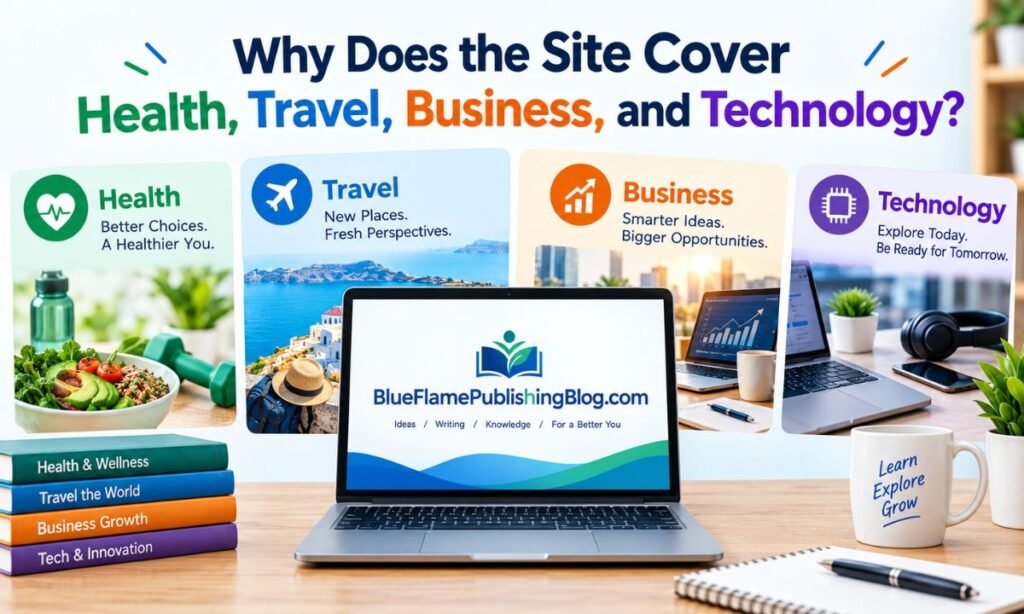
A mix this wide is common on blogs that accept outside contributions. Broad categories let the site take submissions from many industries without needing a narrow focus. That is a pattern across the web, not a confirmed reason for this particular site, so treat it as context rather than fact.
The range also affects how you should read each post. A single site can hold strong articles and weak ones side by side. Judge each topic on its own merits.
The Business and Technology Content
Business and technology appear in the main menu, though reviewers noted they were less visible on the homepage than health and travel. That suggests the archive in these categories may be smaller or less recent, but only the live site can confirm it.
Some posts in the general blog area explain online platforms and domain-style topics. These read more like web guides than industry analysis.
For business and technology readers, the practical test is simple. Look for named sources, dates, and concrete details. If a post makes a claim about a tool or a market, it should say where the claim comes from.
The Health Content
Health is the heaviest category on the pages described in the review. Reported subjects included vitamin D, cholesterol, vegetarian diets, immune system habits, mindfulness, gut health, sleep, workout nutrition, women’s health, and intrusive thoughts linked to obsessive-compulsive disorder.
Those topics can affect real decisions. Search engines treat this kind of content with extra care, and so should you. Health pages work best when a qualified professional writes or reviews them and says so openly.
According to the review, many health posts carried a generic account name instead of a named clinician or dietitian. The same review did not find visible expert credentials on the homepage. Some individual articles may differ, so check each byline.
The Travel Content
Travel posts reportedly covered yoga retreats in India, temples in India, romantic destinations, wildlife safaris, backpacking, solo trips, family holidays, and a guide to Bordeaux. These are idea-style articles meant to inspire a trip.
Travel guides age quickly. Prices, opening hours, entry rules, and seasonal conditions all change. An article can be well written and still be out of date.
Use travel posts to spark ideas, then confirm costs, schedules, and local rules with official tourism pages or the venues themselves.
What This Means for You
The table below shows how to treat each category when you read the site.
| Category | Good use | What to verify elsewhere |
|---|---|---|
| Health | General background reading | Symptoms, doses, diets, and treatment advice |
| Travel | Destination ideas | Prices, entry rules, opening times, safety notes |
| Business | Basic concepts and starting points | Figures, legal points, and tax details |
| Technology | Simple explanations | Product specifications and software versions |
In every category, the site works best as a first look. It rarely works as a final word.
Is BlueFlamePublishingBlog.com a Publishing Company or a Content Website?
Based on what has been publicly reported, it is a content website. It posts articles for readers. Nothing visible shows that it signs authors, prints books, assigns ISBNs, or distributes titles to bookstores.
This question matters because the word “publishing” means very different things in different contexts. Mixing them up can lead to a bad decision.
Why the Difference Matters
A publishing company takes on manuscripts, edits them, designs covers, and gets books to market. Some charge authors fees, and some pay advances. The legal and financial terms are serious, and a contract is usually involved.
A content website only posts articles. It may accept guest writers, run ads, or sell link placements. It does not offer a book deal.
An author who mistakes one for the other could send a manuscript to the wrong place or pay for services that do not exist.
| Feature | Publishing company | Content website |
|---|---|---|
| Main product | Books and related services | Articles and web pages |
| Typical contract | Publishing agreement | Usually none, or a guest-post agreement |
| Reader outcome | Printed or digital books | Blog posts |
| What authors expect | Editing, cover design, distribution | A published article with a byline |
| Fit for BlueFlamePublishingBlog.com | Not shown publicly | Matches the visible content |
What the Current Website Actually Shows
The visible site has working menus, category pages, dated posts, author names, and a footer with contact details. It uses a secure connection, and articles open without any sign-up.
Nothing in the reviewed pages asked visitors to install software, create an account, or enter payment details. That is a good basic sign for casual readers.
The same review noted that a site being active does not prove it has a large audience, expert authors, or a registered business behind it. Activity and credibility are separate questions.
What You Should Not Assume
Keep these points in mind before you act on the domain name alone:
- It is not proven to be a book publisher.
- It is not proven to offer author services.
- It is not proven to be linked to any similarly named company.
- Its articles are not proven to be expert reviewed.
Are BlueFlamePublishingBlog.com and Other BlueFlamePublishing Domains the Same?
No public evidence shows that they are. A shared name does not prove shared ownership. Treat each domain as a separate website until you can confirm otherwise with solid proof.
Search for the name and you will find other pages that use “Blue Flame Publishing” in their titles. Some describe a publishing house for authors. Others read like general promotional pages with very similar wording from one page to the next. None of them settles who owns what.
Why Similar Names Can Be Confusing
Domain endings such as .com, .net, and .org are easy to mix up. Adding or removing the word “blog” changes the address but not the way a person remembers it. Many readers recall only the core brand words.
Some pages online also describe a brand in glowing, generic terms without naming a team, an address, or a book list. When two sites share a name, those vague descriptions can blur the picture further.
The result is that a person searching for a book publisher may land on a blog, and a person researching a blog may end up reading about book services. Both are honest mistakes, and both are avoidable.
How to Tell Which Website You Actually Found
Use this short checklist when you are unsure:
- Read the full address in your browser bar, including the ending.
- Check the footer for an About page, a contact method, and a business name.
- Look at the real articles. Do they match the services described in the title?
- Run a domain lookup to see registration details, when they are public.
- Compare the contact email. A domain-based address is easier to trace than a free webmail address.
- Search for the exact domain in quotation marks and read what independent sources say.
| Clue | What it can tell you |
|---|---|
| Full domain ending | Whether you have the right site |
| Footer and About page | Who claims to run it |
| Article topics | What the site really does |
| Domain lookup | Registration age and, sometimes, the registrant |
| Contact method | How easy the owner is to reach |
The Simple Rule
Same name, different address, different site. Until a page clearly states a link between two domains and you can verify it, treat them as unrelated.
Who Appears to Be Behind BlueFlamePublishingBlog.com?
The public answer is limited. The site does not clearly name a company, an owner, or an editor in the footer details that reviewers saw. That leaves readers with bylines and a contact address as the only visible clues.
Limited information is not a crime, and it is not proof of bad faith. It simply means you cannot confirm who stands behind the content.
What You Can See From the Site
According to the August 2026 review, the homepage showed two author identities. One looked like a generic account username rather than a person’s name. The other was a named author linked to posts on intrusive thoughts in obsessive-compulsive disorder and on traveling in Bordeaux.
The footer reportedly listed a free webmail address for contact and no registered company name or registration number. It also stated that the site’s community is not responsible for content on outside websites.
These details come from one source and may have changed. A quick visit to the footer and author pages will show the current state.
What You Should Not Guess
Avoid naming an owner, a country, or a business model unless a trustworthy source states it. Guessing can spread false claims and hurt real people.
Also avoid the opposite error. A missing owner name does not automatically mean a scam. Many small blogs run quietly under a pen name.
The sensible position is to say the ownership is not clearly stated and to decide how much that matters for your purpose.
Can You Trust Everything Published on BlueFlamePublishingBlog.com?
No. You should not fully trust any single website, and this one gives you a few reasons to be careful. That said, you do not need to dismiss it either. The best approach is to match the level of trust to the stakes.
Start With the Article, Not Just the Website
Trust lives at the page level. A good article names its author, shows a date, cites sources, and explains how it reached its claims. A weak one makes confident statements with nothing behind them.
Before you rely on a post, ask four questions:
- Who wrote it, and what qualifies them?
- When was it published or updated?
- Does it link to or name credible sources?
- Do other reliable sites agree with it?
If the answers are unclear, treat the post as an opinion piece.
General Information Is Different From High-Stakes Advice
Light reading carries little risk. High-stakes topics carry a lot. Search engines apply stricter standards to pages that could affect health, money, or safety, and readers should apply stricter standards too.
| Content type | Risk level | How to use it |
|---|---|---|
| Broad travel ideas | Low | Read for inspiration, then verify details |
| Basic business concepts | Low to medium | Use as a starting point |
| Technology explainers | Low to medium | Check against official documentation |
| Nutrition and sleep tips | Medium | Compare with public health bodies |
| Mental health and medical topics | High | Rely on qualified professionals |
A Simple Example
Imagine two posts from the site. One suggests a weekend city break. The other explains how to lower cholesterol.
If the travel post is slightly outdated, you lose a little time. If the cholesterol post is wrong or incomplete, you could make a poor health choice. The same website, the same tone, and very different consequences.
For the second post, check the claims against a national health service or a licensed doctor before you change anything.
The Practical Answer
Use the site for general reading and idea gathering. Do not use it as your only basis for medical, legal, or financial decisions.
Look for named experts, dates, and sources on each page. When those are missing, give the post less weight and look for a stronger source.
What Is BlueFlamePublishingBlog.com Useful For?
It can be useful as a light reading source. It is a free, open site with posts on everyday topics, and you can read it without registering. That makes it handy for early curiosity.
Its value drops as your need for accuracy rises. Think of it as a doorway rather than a destination.
Use It as a Starting Point for Research
If you are new to a subject, a plain-language article can give you vocabulary and a rough outline. That helps you ask better questions later.
For example, a general post on sleep habits can help you learn the basic terms. You can then search those terms on a health authority site for verified guidance.
The key is to treat the first read as orientation, not as proof.
Use Topic-Specific Articles for Ideas
Travel and lifestyle posts work well for brainstorming. A page on yoga retreats or wildlife safaris can suggest places and activity types you had not considered.
Business and technology posts can suggest angles for further reading. Note the names and terms you find, then research them elsewhere.
Ideas are cheap to collect and easy to check, which makes them a safe use of the site.
Know When to Move to Another Source
Switch to a stronger source when you need facts you will act on. That includes medical dosing, legal rights, tax rules, visa requirements, and product safety.
Good replacements include government pages, professional associations, peer-reviewed research, and official company documentation.
A simple habit helps: whenever an article makes a claim you would hate to get wrong, find a second source before you rely on it.
What If You Found BlueFlamePublishingBlog.com Through a Guest-Post Offer?
This is a common route to the domain. A seller or marketplace lists the site as a place where you can pay to publish an article with links back to your own page. The listing is a sales page, so read it with that in mind.
Two separate questions are tangled together here. One asks whether the site is real. The other asks whether the placement is worth the price. You should answer them one at a time.
What a Guest-Post Listing Can Tell You
At the time of the August 2026 review, a marketplace named Vefogix listed the site with these terms:
| Listed term | Reported detail |
|---|---|
| Price | $64 per placement |
| Links allowed | Up to two do-follow links |
| Article length | 1,000 to 2,500 words |
| Turnaround | About two days |
| Link duration | Advertised as permanent |
| Content not accepted | Adult, CBD, and casino topics |
| Footer and sidebar links | Not accepted |
The listing also showed third-party scores: Domain Authority 43, Page Authority 39, Domain Rating 28, and a Semrush traffic figure of 841. Those scores come from different tools and measure different things. Google does not use them directly.
What You Should Consider Before Paying
The biggest trap is a traffic number. The review reported an estimate of about 58,700 monthly visits, but that figure belonged to the marketplace’s own sales page for the site, not to BlueFlamePublishingBlog.com. The marketplace’s own listing for the publisher showed far lower traffic.
Keep these points in mind:
- A traffic estimate for a sales page says nothing about reader numbers on the blog itself.
- Public view counters on articles are not independently verified analytics.
- Google’s guidance says paid links should carry a sponsored or nofollow attribute when they are meant to pass ranking credit.
- A “permanent” link means the placement is meant to stay, not that it will keep any search value.
- Health-focused placements need a clear fit with the site and credible authorship.
Check a few existing articles on the site before you buy. See whether they are indexed in search, whether they appear on the homepage, and whether they receive internal links.
Keep the Two Questions Separate
The first question is simple: does the site exist and publish real articles? Based on the review, yes, it does.
The second question is harder: will a paid placement give you what you want? That depends on your goal, the topic fit, the page’s indexing, and how the link is labeled.
A site can be real and still be a poor purchase. Judging them separately keeps your decision clear.
What Should You Understand About BlueFlamePublishingBlog.com?
Here is the short version of everything above:
- It is a general content blog, not a confirmed book publisher.
- Its main categories are business, technology, health, and travel, with health and travel most visible.
- Its name and footer talk about publishing, while its posts mostly cover other subjects.
- Ownership is not clearly stated in the details reviewers could see.
- Health articles need checking against qualified sources before you act on them.
- A guest-post listing is a sales page, and its traffic claims need separate proof.
Used with care, the site is fine for light reading and idea gathering. Used as the only source for a serious decision, it falls short.
Before you rely on it, open the live pages, read the author and footer details, and test any important claim somewhere stronger. That small effort protects your time, your health choices, and your budget.
Frequently Asked Questions
Is BlueFlamePublishingBlog.com still active?
It was active with recent posts at the time of an August 2026 review. Open the homepage to see the latest post dates.
Does BlueFlamePublishingBlog.com only cover publishing?
No. Its visible categories are business, technology, health, and travel, and most reported posts focus on health and travel.
Is BlueFlamePublishingBlog.com the same as BlueFlamePublishing.org?
No public evidence confirms that they are the same. Treat them as separate sites until a verified source links them.
Does BlueFlamePublishingBlog.com provide health information?
Yes, health is one of its main categories. Verify medical claims with a doctor or a national health authority before acting.
Does BlueFlamePublishingBlog.com accept guest posts?
A third-party marketplace lists it for paid guest posts. Confirm current terms directly with the site, because listings can be outdated.
Should you use the website as your only source?
No. Use it for general reading, then confirm important facts with official or professional sources.