
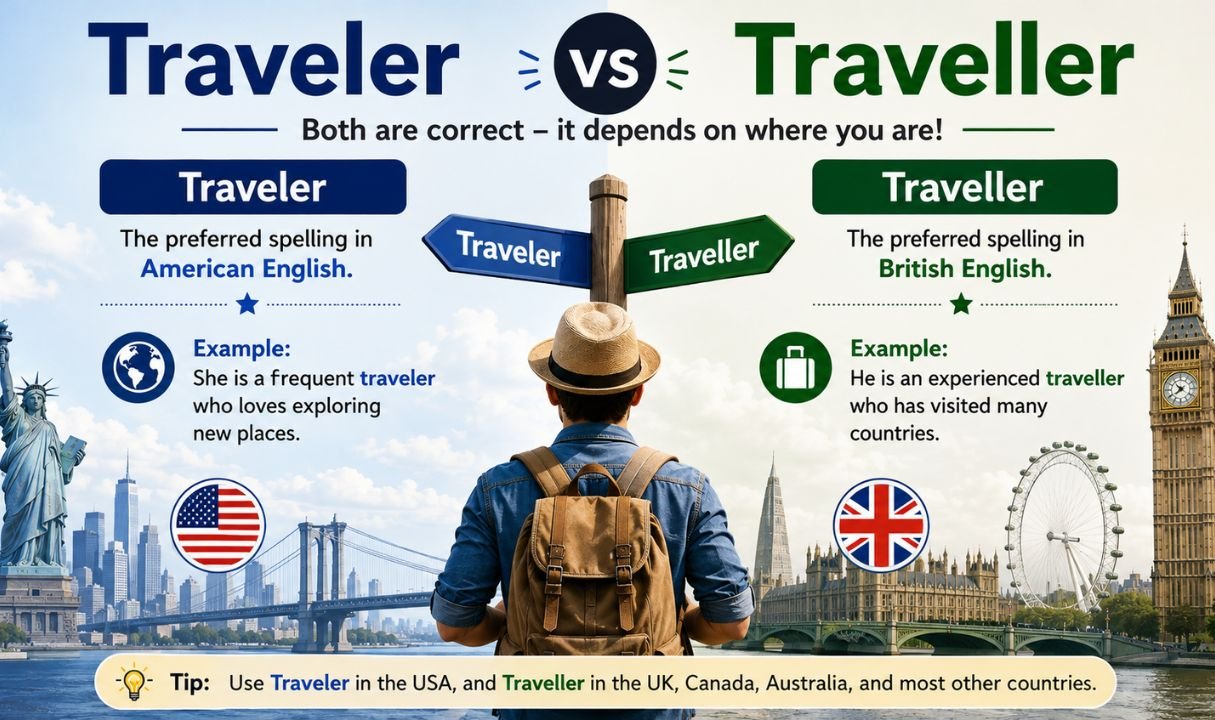
Traveler and traveller mean exactly the same thing. The only difference is spelling: traveler (one L) is standard American English, and traveller (two Ls) is standard British English. Pick based on your audience, not on which one “looks right.”
Traveler vs Traveller at a Glance
| Form | Region | Example |
|---|---|---|
| Traveler | United States | “The traveler checked her bag.” |
| Traveller | United Kingdom, Australia, Canada, most of Europe and Asia | “The traveller checked her bag.” |
| Traveling / Traveled | US | She is traveling to Rome. |
| Travelling / Travelled | UK, Commonwealth | She is travelling to Rome. |
Both spellings are dictionary-correct. Neither is a typo. The choice comes down to who is going to read what you write.
The Grammar Rule Behind the Difference
The Base Word
Everything starts with travel, a two-syllable verb stressed on the first syllable: TRAV-el. When you add a suffix like -er, -ing, or -ed, American and British spelling rules handle the final consonant differently, and that single choice creates the whole traveler/traveller split.
American English Rule
American English only doubles a final consonant before a suffix if the word’s stress falls on the last syllable, as in permit → permitted. Because travel is stressed on the first syllable, the L stays single. That gives you traveler, traveling, and traveled.
British English Rule
British English doubles the final L regardless of where the stress falls, as long as the word ends in a single vowel plus L. This older rule predates the American simplification, so it applies to travel even though the stress sits on the first syllable. That gives you traveller, travelling, and travelled.
Where the Split Came From
The divide traces back to Noah Webster, the American lexicographer who published his dictionary in 1828. Webster wanted American spelling to be more phonetic and less cluttered than the British forms he grew up with, so he trimmed extra letters from dozens of common words, travel included.
British English never adopted those changes. It kept the older doubling convention that had been standard since at least the 1700s, and that convention is still taught in UK schools today. Neither side is more “correct.” They simply froze the rule at different points in English’s history.
You May Also Like: Drier vs Dryer: Which One Should You Use in Writing?
American English vs British English Spelling Patterns
1. American English
American spelling generally favors fewer letters and simpler patterns. Beyond traveler, you’ll see this in words like color, center, and organize, all trimmed down from their British counterparts.
2. British English
British spelling tends to preserve older forms and follow stricter consonant-doubling rules on suffixes. That same pattern that gives you traveller also produces colour, centre, and organise.
Comparison Table
| Category | American English | British English |
|---|---|---|
| Noun | traveler | traveller |
| Plural | travelers | travellers |
| Verb (present) | traveling | travelling |
| Verb (past) | traveled | travelled |
| Related word | counselor | counsellor |
Which Spelling Should You Use
If Your Audience Is in the United States
Use traveler. This is what US news outlets, airlines, government sites, and style guides like AP and Chicago expect. Switching to traveller mid-document will look like an error to American readers, even though it isn’t one.
If Your Audience Is in the United Kingdom
Use traveller. This holds for the UK plus most Commonwealth countries, including Australia, New Zealand, Ireland, South Africa, and India, where British spelling conventions are taught in schools and used in official writing.
If Your Audience Is Global
Pick one spelling and stay consistent for the entire piece. Many international brands default to British spelling because it’s used more widely worldwide, but American spelling dominates search volume online. Consistency matters more than which one you choose.
Why People Confuse Traveler vs Traveller
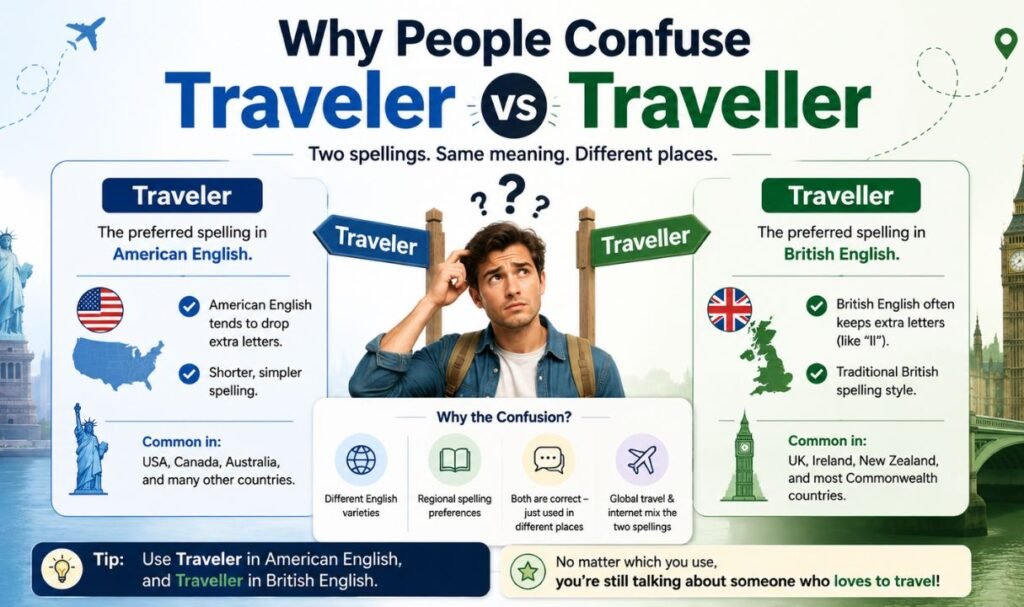
Both Spellings Appear Online
Search results mix American and British sites constantly, so readers see both forms side by side without any regional labeling. That constant exposure makes it easy to assume one version is a mistake when it’s really just a regional variant.
Spell Check Settings
Most software defaults to US English, which flags traveller as wrong even though it’s standard everywhere outside the United States. Writers who trust spell check without checking their language settings often “correct” perfectly valid British spelling by accident.
Copy and Paste Writing Habits
Content pulled from multiple sources, some American and some British, often gets pasted together without anyone standardizing the spelling. The result is a single article using traveler in one paragraph and traveller three lines later.
Weak Awareness of Regional Differences
Many writers simply haven’t been taught that American and British English diverge on dozens of common words. Without that context, the two spellings just look like inconsistent choices rather than two separate, valid systems.
You May Also Like: Infact or In Fact? The Correct Way to Write It (With Examples)
Traveler vs Traveller in Real World Usage
In News and Media
US outlets such as The New York Times and CNN consistently print traveler. UK outlets such as the BBC and The Guardian consistently print traveller. Neither publication mixes the two, which is a useful signal for how strictly professional writing should treat this choice.
In Books and Literature
British authors from Jane Austen’s era through modern UK fiction have used traveller throughout. American publishing houses standardize on traveler, and this holds even when a British author’s book is re-edited for a US release.
In Government and Official Documents
The US State Department and TSA use traveler across passport, visa, and airport signage. The UK Home Office and NHS use traveller in immigration and health guidance. Government style guides are strict about this because inconsistency in legal documents can look sloppy or even confusing.
In the Tourism Industry
International hotel chains, airlines, and booking platforms often localize their spelling by region automatically. A UK version of a travel site will show traveller in its copy, while the US version of the exact same page shows traveler.
Traveler vs Traveller in Sentences
American Style Examples
- The solo traveler booked a one-way ticket to Lisbon.
- Frequent travelers know to pack a portable charger.
- She has been traveling through South America since March.
British Style Examples
- The solo traveller booked a one-way ticket to Lisbon.
- Frequent travellers know to pack a portable charger.
- She has been travelling through South America since March.
Common Mistakes and How to Fix Them
- Mixing spellings in one document. Pick American or British English at the start and run a find-and-replace before publishing.
- Trusting spell check blindly. Check your document’s language setting rather than assuming red squiggly lines mean an error.
- Forgetting related forms. If you use traveller, also use travelling and travelled, not travelling paired with traveled.
- Ignoring your audience. A UK-based travel blog aimed at American readers should still use traveler, since audience location matters more than the writer’s own dialect.
Related Word Pairs With the Same Pattern
The traveler/traveller split isn’t unique. Several everyday words follow the identical single-L versus double-L rule when a suffix is added:
| American | British |
|---|---|
| canceled / canceling | cancelled / cancelling |
| labeled / labeling | labelled / labelling |
| modeling | modelling |
| counselor | counsellor |
| fueled | fuelled |
Traveler vs Traveller in Pop Culture
Video games and entertainment franchises usually pick one spelling and stick with it globally, regardless of a player’s location. In Genshin Impact, the protagonist’s official title is Traveler, spelled the American way, in every English-language version of the game worldwide. This matters for fan wikis, walkthroughs, and search queries, since writing “Traveller” when referencing the character technically deviates from the game’s own branding, even for UK-based players.
Traveller vs Tourist: Are They the Same
Not quite. A traveller (or traveler) is a broad term for anyone moving between places, often for extended or open-ended trips. A tourist more specifically implies short-term leisure travel with a return date already planned. In tourism industry writing, “traveller” often signals a more independent, experience-driven trip, while “tourist” leans toward package holidays and sightseeing.
Google Trends and Usage by Region
Search data consistently shows traveler outperforming traveller in overall global volume, driven largely by the size of the US search market. But traveller pulls ahead in the UK, Australia, Ireland, and India, which confirms that regional targeting, not global popularity, should guide your spelling choice for any specific audience.
Practice Exercises
Fill in the Blanks
- The seasoned __________ never checks a bag. (US spelling)
- She spent a year __________ across Asia. (UK spelling)
- Every __________ needs a valid passport. (US spelling)
Choose the Correct Spelling for US English
A) traveller B) traveler A) travelling B) traveling
Choose the Correct Spelling for UK English
A) traveler B) traveller A) traveled B) travelled
Frequently Asked Questions
Does traveller have one L or two?
Traveller has two Ls in British English. The American spelling, traveler, uses only one.
Should I use traveller or traveler in my writing?
Match your audience. Use traveler for US readers and traveller for UK or Commonwealth readers, and stay consistent throughout.
How do British spell traveler?
British English spells it traveller, with a doubled L, along with travelling and travelled.
What does “traveller” mean?
It means a person who travels, especially someone moving between places for tourism, work, or an extended journey. The meaning is identical to “traveler.”
Conclusion
Traveler and traveller are the same word wearing two regional outfits. One L belongs to American English, two Ls belong to British English, and both are correct in their own context. The only real mistake is mixing them in the same piece of writing.
Before you publish anything, decide who you’re writing for. American readers, use traveler, traveling, and traveled. British or Commonwealth readers, use traveller, travelling, and travelled. Lock that choice in early, run a quick consistency check before you hit publish, and you’ll never have to second-guess this spelling again.