
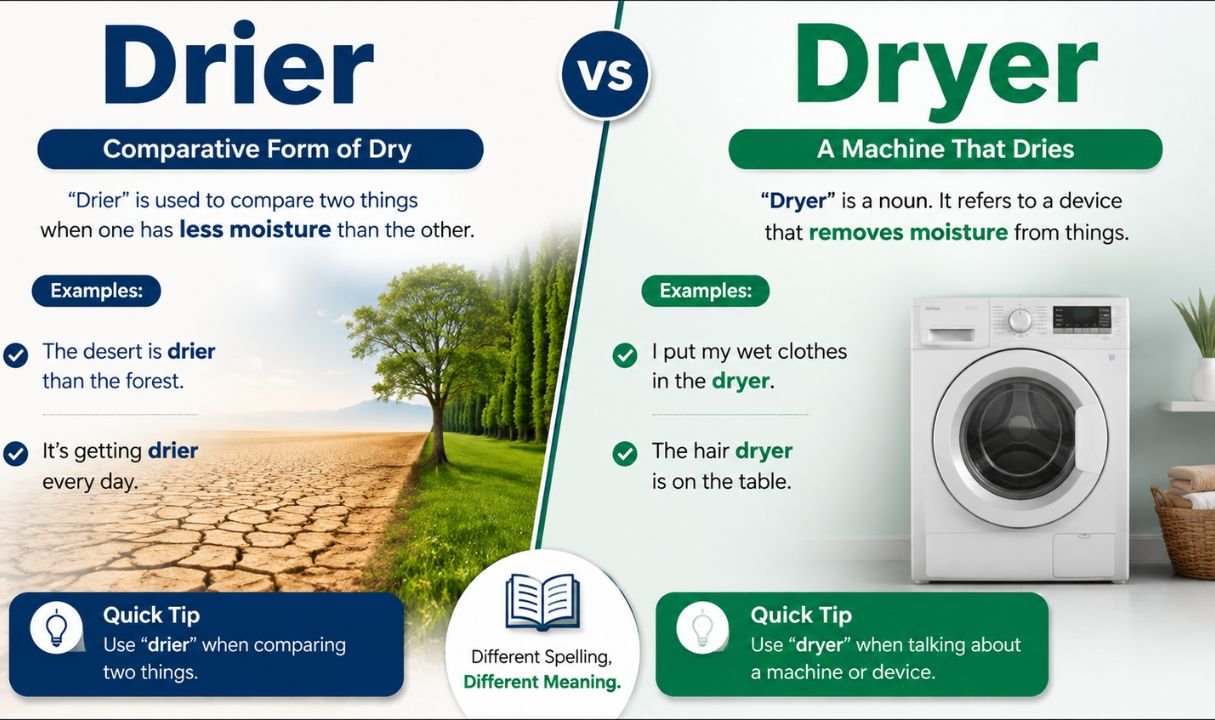
Drier is the comparative form of the adjective dry, meaning “more dry.” Dryer is a noun for a machine that removes moisture. If you’re comparing two things, write drier. If you’re naming an appliance, write dryer.
Quick Answer
| Word | Part of Speech | Meaning | Example |
|---|---|---|---|
| Drier | Adjective | More dry (comparative) | The towel felt drier by noon. |
| Dryer | Noun | A machine that removes moisture | She put the towel in the dryer. |
Both words trace back to the same root, dry, but modern English keeps their jobs separate. Mixing them up won’t confuse a reader for long, but it will make your writing look careless.
Examples
- The desert air was drier than I expected. (adjective)
- Turn off the dryer before you leave the house. (noun)
- My hair dries faster since I bought a new dryer.
- This climate is drier than the coast we visited last year.
Meaning
Drier
Drier describes a comparison. It tells you that one thing holds less moisture than another. It follows the standard rule for short adjectives: add -er to form the comparative. Dry becomes drier, the same way happy becomes happier.
Dryer
Dryer is a person or thing that dries something. Most often it names an appliance, a clothes dryer, a hair dryer, a food dehydrator marketed as a dryer. Less commonly, dryer describes someone who dries things, though this usage is rare outside older or technical writing.
Drier vs Dryer Difference
The core distinction is grammatical function, not sound. Say them aloud and you’ll hear no difference at all, since both are pronounced identically in nearly every English accent. The spelling is the only signal a reader gets, so getting it right matters more in writing than it ever would in speech.
Think of it this way: drier answers the question “how dry is it compared to something else?” Dryer answers the question “what is this object?” One is descriptive, the other is a label.
Grammar Rule Depth
1. Drier as Comparative Adjective
English forms comparatives two ways. Short adjectives, generally one or two syllables, take -er directly: fast becomes faster, dry becomes drier. Longer adjectives use “more” instead, like more beautiful. Dry is short enough to take the suffix, and the y changes to i before -er, matching the pattern seen in happy/happier and easy/easier.
2. Dryer as a Noun
Dryer functions as an agent noun, built from the verb dry plus -er, the same pattern that turns teach into teacher or paint into painter. It names something that performs the action of drying. This is why appliance names default to dryer rather than drier, even though both spellings existed historically.
3. Alternative Form “More Dry”
Some writers reach for “more dry” instead of drier, assuming it sounds safer. It’s grammatically valid but unnecessary and reads as clunky. <cite index=”8-1″>Dictionaries and grammar guides consistently point out that “more dry” isn’t the preferred form when a standard comparative already exists.</cite> Stick with drier for anything short and native to English.
Verb Forms and Related Words
Dry as a Verb
Dry also works as a verb: I dry my clothes, she dried her hair, the paint is drying. None of these forms overlap with drier or dryer, but they share the same root, which is part of why the three words get tangled together in casual writing.
Related Words
- Dried (past tense/adjective): dried fruit, the paint dried overnight
- Dries (third person singular): the sun dries the laundry fast
- Drying (present participle): drying rack, drying time
- Driest (superlative): the driest month of the year
You May Also Like: Tying vs Tieing: Learn the Correct Spelling in Minutes
The Origin of Drier and Dryer
Drier and dryer both descend from the Old English word for dry, and the two spellings were once used more or less interchangeably. The split hardened as manufactured appliances became common household items. Once companies started selling machines that dried clothes and hair, “dryer” attached itself firmly to the object, leaving “drier” to handle comparison duty. That separation solidified mostly over the last century, and it now holds firm across nearly all edited English.</cite>
Some older British texts used drier for the appliance too, and a handful of dictionaries still list the two as loose variants. In practice, almost no professional publication treats them as interchangeable today.
Why People Confuse Drier and Dryer
1. Same Pronunciation
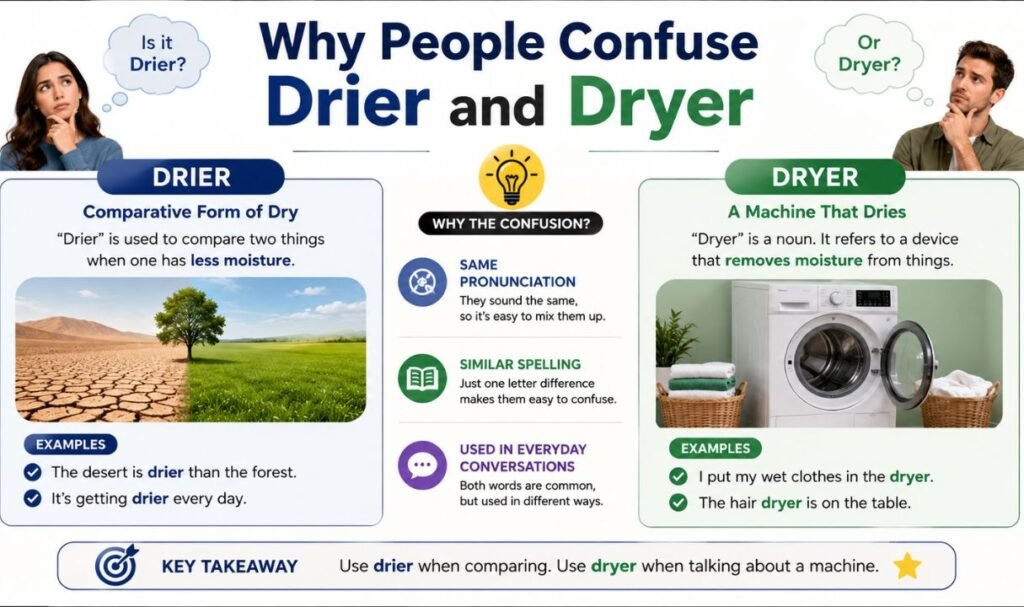
There’s no audible difference. Anyone learning English by ear alone has no clue which spelling to reach for.
2. Similar Spelling
One letter separates them. A single swapped vowel is an easy typo, especially when typing fast or on a phone keyboard.
3. Lack of Grammar Awareness
Comparative adjectives and agent nouns aren’t concepts most people think about daily. Without that background, the two words look like arbitrary spelling variants rather than different parts of speech.
4. Auto-Correct Errors
Phone keyboards and some editing tools autocorrect based on frequency, not grammar. If “dryer” appears more often in a person’s typing history, autocorrect may swap in dryer even where drier belongs.
Real World Usage of Drier and Dryer
At Home
Household writing leans heavily on dryer: the dryer broke, buy a new dryer, the dryer vent needs cleaning. Drier shows up when comparing conditions, like “the basement feels drier since we fixed the leak.”
Weather
Weather reporting is where drier appears constantly. Forecasters compare conditions day to day or region to region, so “drier than average” and “a drier week ahead” are standard phrasing.
Beauty and Personal Care
Hair dryer, skin drier or oilier depending on season, drier scalp in winter. Beauty writing mixes both words often, since it discusses both appliances and comparative states of skin or hair.
Dryer or Drier Weather
Weather is drier or wetter than something else, so drier weather is correct. “Dryer weather” is a common mistake, since weather is a condition being compared, not a machine.
Drier Than or Dryer Than
Always drier than. The word “than” signals a comparison, and comparisons take the adjective form, never the noun.
Dryer or Drier UK
British English follows the same split as American English. UK style guides use drier for the adjective and dryer for the appliance, with no regional exception worth noting.
Dryer Machine
Redundant but common in speech. The correct standalone term is simply dryer, since the noun already implies a machine.
Drier Meaning
When drier appears alone, it means “more dry,” functioning as the comparative form of the adjective dry.
Tumble Dryer or Drier
Tumble dryer is correct. This is the standard British term for a clothes dryer, and it follows the appliance-noun rule.
More Dry on Dryer
“More dry” and “dryer” aren’t interchangeable. More dry is an alternative (and less common) way to express the comparative, while dryer names the appliance. They serve different grammatical roles entirely.
Dry Drier Driest
This is the full comparison chain: dry (base), drier (comparative, “more dry than one other thing”), driest (superlative, “most dry among three or more”).
Agriculture
Farmers and agronomists talk about drier soil, drier growing seasons, and grain dryers used to reduce moisture content after harvest. Both words appear naturally, drier for conditions, dryer for the machinery that processes crops.
You May Also Like: Seeing or Seing: Which Spelling Is Correct?
Drier vs Dryer in Everyday Examples
Emails
“Please note the office will feel drier once the new humidifier settings kick in.” Professional email tends to favor drier for describing conditions and dryer only when literally referencing equipment.
News
Weather and climate journalism uses drier constantly: drier summers, drier reservoirs, a drier outlook for the region. Product coverage uses dryer: reviewing the latest heat-pump dryer models.
Social Media
Casual posts blur the line more than any other context. “This weather is so dryer than last week” is a common error that would never pass an editor but shows up regularly online.
Formal Writing
Academic and business writing rarely misuses these words, since editing catches the slip. When it does appear, it’s almost always drier used correctly for comparison and dryer for the noun.
Common Mistakes with Drier vs Dryer
Mistake 1: Using Dryer for Comparison Wrong: The towel is dryer than the rug. Right: The towel is drier than the rug.
Mistake 2: Using Drier for Machine Wrong: Put your clothes in the drier. Right: Put your clothes in the dryer.
Mistake 3: Confusing Grammar Roles Writers sometimes swap the words simply because they look similar, without checking whether the sentence needs an adjective or a noun. A quick test: if you can replace the word with “more dry,” use drier. If you’re naming a thing, use dryer.
Drier vs Dryer in Different Contexts
Weather
Forecasts, climate reports, and seasonal comparisons almost always call for drier: a drier autumn, drier conditions than last year.
Technology
Appliance reviews, product descriptions, and manuals use dryer: a dryer with a moisture sensor, energy-efficient dryer models.
Health
Skin, scalp, sinuses, and airways get described as drier when comparing symptoms or seasons: drier skin in winter, a drier throat after the flight.
Household
Both appear side by side here more than anywhere else: the dryer is broken, and the laundry room feels drier since we added ventilation.
Related Words and Expressions
Drier Related
Driest, dry spell, bone-dry, dry as a bone, drying out
Dryer Related
Tumble dryer, hair dryer, clothes dryer, dryer sheet, dryer vent, dryer balls
Usage Trends
Search and publishing data consistently show dryer as the more frequently typed word overall, largely because appliance references outnumber comparative-adjective references in everyday writing. That frequency gap is exactly why autocorrect tools default to dryer, and why drier gets flagged as a possible typo more often, even when it’s the correct choice.
Exercise 1: Choose the Correct Word
- The Sahara is much _____ than the Amazon. (drier)
- Our new _____ finished the load in 40 minutes. (dryer)
- This scarf feels _____ than the other one. (drier)
- The salon has three hair _____ stations. (dryer)
- Expect _____ air once the cold front passes. (drier)
Exercise 2: Correct the Sentence
- “My socks are dryer than my shoes.” → My socks are drier than my shoes.
- “The clothes drier squeaks when it spins.” → The clothes dryer squeaks when it spins.
- “This summer has been much dryer than last.” → This summer has been much drier than last.
- “I need to buy a new hair drier.” → I need to buy a new hair dryer.
Frequently Asked Questions
Is it a dryer or drier?
Depends on the role. Dryer is the noun for the machine; drier is the comparative adjective meaning more dry.
When to use dryer or drier?
Use dryer when naming an appliance. Use drier when comparing how dry two or more things are.
Is it more dry or drier?
Drier is the standard, preferred comparative. “More dry” is technically valid but rarely used in polished writing.
Is it a hand dryer or drier?
Hand dryer. The appliance always takes the noun spelling, regardless of what it dries.
Conclusion
The rule never really changes: drier compares, dryer names. If you can swap in “more dry,” write drier. If you’re pointing at a machine, write dryer. Keep that one test in mind and you’ll never second-guess this pair again, no matter how casual or formal the writing gets.