
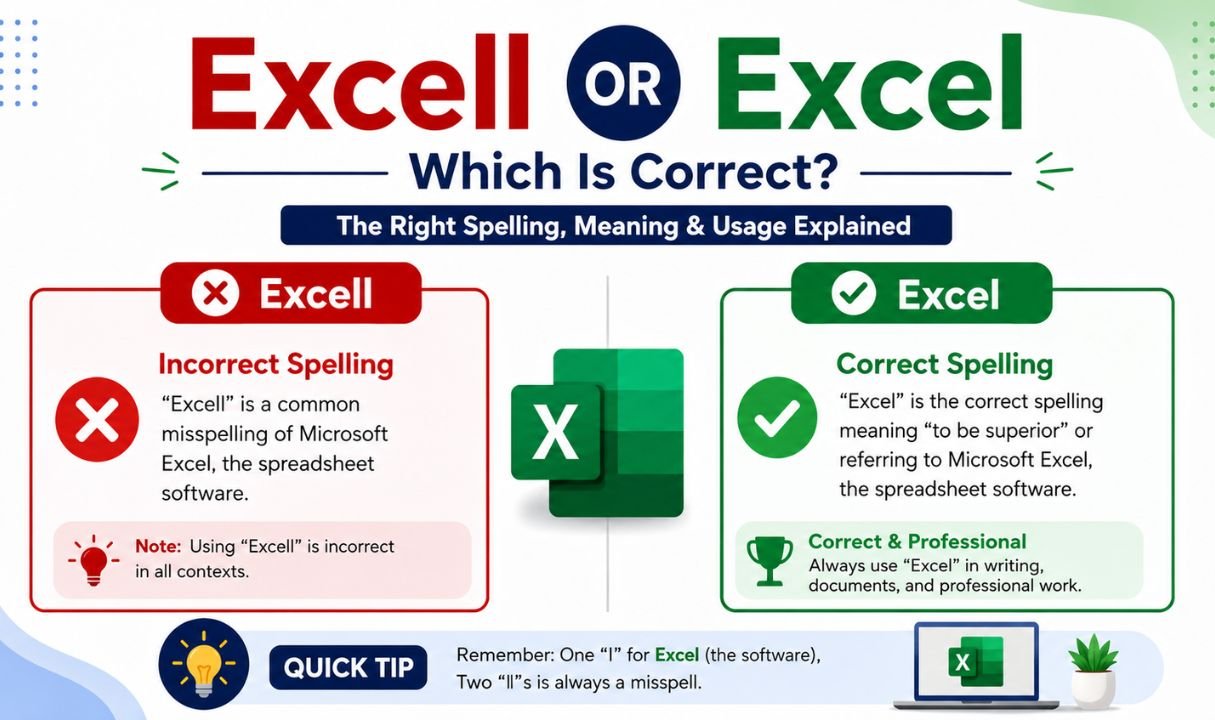
Most people who type “excell” pause halfway through the word and wonder if they got it right. This happens more often than you’d think, especially since the past tense of the word actually does carry a double L. If you’ve ever second-guessed yourself while writing a resume, an email, or a school assignment, this guide clears up the confusion for good.
By the end of this article, you’ll know exactly which spelling to use, why the mistake happens so often, and how the rule applies whether you’re describing someone’s performance or opening Microsoft’s spreadsheet software.
This mix-up isn’t limited to casual texting either. It shows up in cover letters, university essays, and workplace reports, places where a small spelling slip can shape how a reader judges the writer’s attention to detail. Getting this one right takes only a minute to learn, and it sticks once you see the logic behind it.
Comparison Overview
| Feature | Excell | Excel |
|---|---|---|
| Correct spelling | No | Yes |
| Part of speech | None (misspelling) | Verb, noun |
| Standard dictionary entry | Not listed | Listed in Oxford, Merriam-Webster, Cambridge |
| Common use | Surnames, brand names | Performance, Microsoft software |
| Example | “Excell Industries” (brand) | “She excels at chess.” |
Definition of Excell
“Excell” is not a recognized English word. It shows up so frequently because writers copy the double-L pattern from “excelled” and “excelling” and mistakenly apply it to the base form. Outside of proper nouns, such as a company name or a family surname, “excell” has no standing in formal or informal writing. Spell-checkers sometimes let it slide because it resembles a real word closely enough to avoid detection, but dictionaries never list it as an accepted spelling.
Definition of Excel
“Excel” carries two separate meanings depending on context. As a verb, it means to perform extremely well, to surpass others, or to stand out in a particular skill or activity. As a proper noun, it refers to Microsoft Excel, the spreadsheet program used worldwide for calculations, budgeting, and data analysis. Both uses trace back to the Latin word excellere, meaning “to rise above” or “to surpass,” which later passed through Old French before settling into English.
Main Differences Between Excell and Excel
- Spelling: Excel has one L in its base form; excell adds an extra letter that doesn’t belong there.
- Recognition: Excel appears in every major English dictionary. Excell does not.
- Function: Excel works as a verb and a proper noun. Excell has no grammatical function of its own.
- Context: Excel applies to performance and software. Excell only applies when it’s part of a name or brand.
- Formality: Excel is safe in academic writing, business communication, and casual conversation. Excell is a spelling error in nearly every context.
You May Like: Hoodie or Hoody: Which Spelling Is Actually Correct?
Grammar Guide
The confusion around this word usually comes down to one grammar rule most people never learned by name: consonant doubling. English doubles the final consonant of certain short verbs when adding suffixes like -ed or -ing, but only in the inflected forms. The base word stays untouched.
Excell or excel grammar: The base verb is always spelled with one L. Doubling only happens when a suffix is added, turning “excel” into “excelled” or “excelling.”
Excell or excel examples: “He wants to excel in his new role” is correct. “He excell in his new role” is not, since the verb needs proper conjugation and the correct base spelling.
“In Excel” meaning and examples: When someone says “I built this in Excel,” they’re referring to the spreadsheet software, not the verb. Example: “The finance team tracks expenses in Excel every month.”
Is excel a word?: Yes. It has functioned as a standard English verb for centuries, long before Microsoft borrowed the name for its software in the 1980s.
Excel verb: As a verb, it means to be exceptionally skilled or to outperform others. Example: “The students excel in mathematics.”
Excel pronunciation and meaning: It’s pronounced ik-SEL, with stress on the second syllable. The meaning shifts slightly depending on stress and context, but the core sense of “surpassing” stays constant.
Excel adjective: There’s no true adjective form of “excel” itself, though “excellent” (from the same Latin root) fills that role in everyday speech.
Excel synonym: Common alternatives include outperform, surpass, shine, dominate, and thrive, depending on the sentence.
How each term is used in sentences
Excel works smoothly in almost any sentence describing achievement:
- “Maria continues to excel in her coursework.”
- “Our sales team excelled last quarter.”
- “I use Excel to manage the company budget.”
Excell, by contrast, only belongs in a sentence when referring to a name:
- “Excell Communications handles our phone lines.”
- “Richard Excell composed several well-known hymns.”
Common mistakes learners make
Non-native speakers and even experienced writers slip up in a few predictable ways. Some assume the base word doubles the L because “excelled” does. Others confuse “excel” with similarly spelled words like “expel” or “compel,” which follow their own doubling patterns. A smaller group simply mistypes the word out of habit, especially when typing quickly on a phone keyboard where autocorrect doesn’t always catch it.
Simple rules to remember
- One L in the present tense: excel.
- Two Ls only after adding -ed or -ing: excelled, excelling.
- Capitalize it when referring to the Microsoft program: Excel.
- Lowercase it when describing performance: excel.
Quick tips for writing and speaking
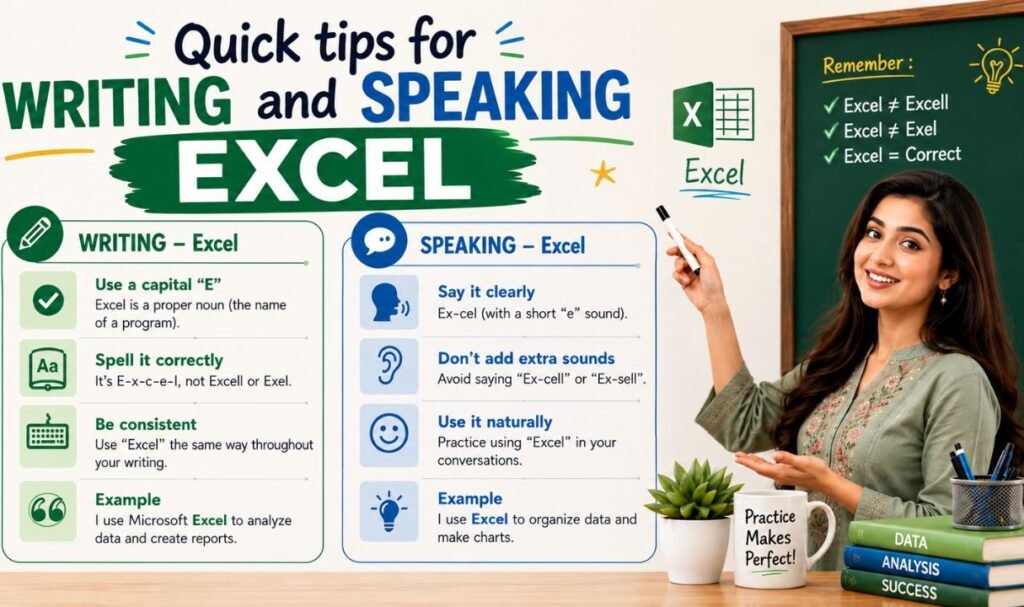
Read the sentence aloud before finalizing it. If you’re describing someone’s skill, picture the single-L spelling and resist the urge to double it. If you’re referring to the software, treat it like any other proper noun and capitalize the E.
When to Use Each One
Use “excel” whenever you’re talking about doing something exceptionally well, whether that’s a subject in school, a sport, a job skill, or any measurable performance. Use “Excel” (capitalized) whenever the sentence refers to Microsoft’s spreadsheet application, spreadsheets in general built with that tool, or formulas and functions specific to that software.
When NOT to Use Each One
Avoid “excell” entirely unless you’re citing a proper noun such as a business name or a person’s surname. Even then, double-check the exact spelling of that specific name rather than assuming. Never use “excell” as a substitute for the verb “excel,” and never lowercase “Excel” when referring directly to the Microsoft product in formal writing.
You May Like: Inter Vs Intra: The Complete Guide to Two Prefixes That Trip Up Even Careful Writers
Which One to Use (Decision Guide)
Ask yourself what the sentence is actually describing.
- Talking about a skill, achievement, or performance? Use excel, one L.
- Talking about spreadsheets, formulas, or the Microsoft application? Use Excel, capitalized.
- Referring to a business or a person’s last name? Confirm the exact spelling first; it might legitimately include the double L.
- Anything else? Stick with excel. It’s almost always the answer.
Real-World Practical Examples
Excell Examples
- “Excell Cleaning Services operates across three states.”
- “The plaque honors Thomas Excell, a local historian.”
- “Excell Motors specializes in vintage car restoration.”
Excel Examples
- “She excels at public speaking despite her nerves.”
- “Our team built the entire budget forecast in Excel.”
- “He’s determined to excel in his final year of law school.”
- “The company uses Excel dashboards to track weekly performance.”
Self-Assessment (Fill in the Blanks)
Test what you’ve learned. Choose the correct word for each sentence.
- She hopes to ______ in her new position.
- I track my expenses using Microsoft ______.
- The runner ______ed during the final lap of the race.
- ______ Industries is a manufacturer based in Ohio.
- They continue to ______ despite the tough competition.
Answers
- Excel
- Excel
- Excel (excelled)
- Excell (as a company name)
- Excel
Frequently Asked Questions
How do you spell to Excel at something?
It’s spelled “excel,” with a single L, whenever you’re describing performance or skill.
What does Excel mean?
It means to perform exceptionally well or surpass others, and it’s also the name of Microsoft’s spreadsheet software.
Does Excel mean excellent?
Not exactly. “Excel” is the verb form of achieving something outstanding, while “excellent” is the adjective describing something of very high quality. They share the same Latin root.
How do you spell Excel in something?
Write it as “in Excel” when referring to spreadsheet work, and always keep the E capitalized since it names the software.
Conclusion
The rule behind “excell” and “excel” is simpler than it first appears. Excel is the only correct spelling in standard English, whether you’re praising someone’s talent or opening a spreadsheet for work. Excell only earns a place in a sentence when it’s tied to a specific brand or surname, and even then, it’s worth confirming the exact spelling before using it.
Once you internalize the one-L rule for the base word and remember that doubling only happens with suffixes, this spelling mix-up becomes one you’ll never make again.