
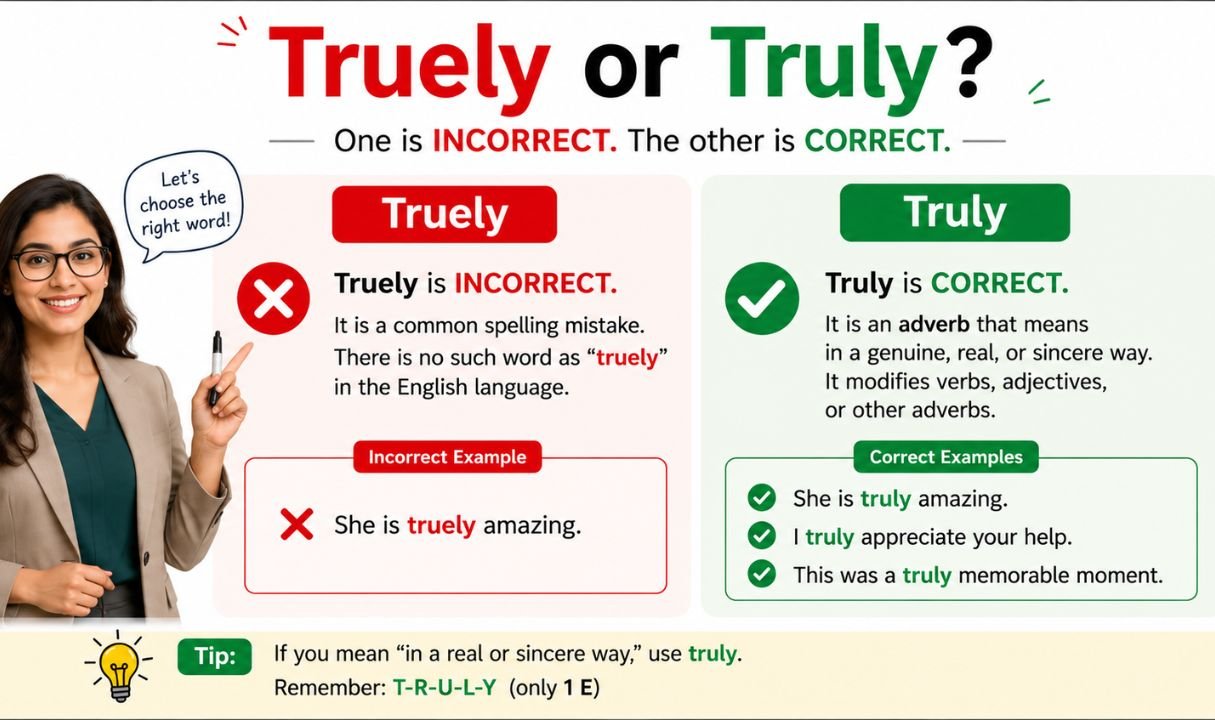
Open any group chat, comment section, or even a work email, and you’ll spot it sooner or later: someone signing off with “yours truely” instead of “yours truly.” It’s one of the most common spelling slips in English, and the reason is simple enough — the root word “true” has an “e” in it, so our brains expect the adverb to keep that letter too. It doesn’t.
This guide clears up the confusion for good. You’ll get the exact rule behind the spelling, real example sentences, a printable-style comparison table, and a short quiz to test yourself before you hit publish, send, or submit on your next piece of writing.
Comparison Overview
Before digging into grammar rules, here’s the short version for anyone in a hurry.
| Aspect | Truely | Truly |
|---|---|---|
| Correct spelling? | No | Yes |
| Found in dictionaries? | No | Yes |
| Part of speech | Not applicable | Adverb |
| Root word | true (misspelled form) | true |
| Common in | Typos, texting, casual writing | Formal and informal writing alike |
| Used in letter closings? | Never correctly | Yes (“Yours truly”) |
Only one of these two words has a place in standard English. “Truly” is the adverb form of “true,” and it appears in every major dictionary, from Merriam-Webster to the Oxford English Dictionary. “Truely” doesn’t exist as an accepted variant anywhere — not in American English, not in British English, not in any formal style guide.
Definition of Truely
“Truely” isn’t a word. It’s a spelling mistake that happens when someone adds “-ly” to “true” without dropping the final “e” first. You won’t find it listed as a valid entry in any recognized English dictionary, and no style guide — APA, MLA, Chicago, or otherwise — recognizes it as an alternate spelling.
People usually land on “truely” because the pattern feels intuitive. Plenty of adjectives keep their “e” when you turn them into adverbs: “nice” becomes “nicely,” “fine” becomes “finely,” “wide” becomes “widely.” Since “true” also ends in “e,” it seems logical to expect “truely.” English just doesn’t work that way here, and that mismatch between logic and actual usage is exactly why the mistake shows up so often.
Definition of Truly
“Truly” is an adverb built from the adjective “true.” It means something is done honestly, sincerely, or in a genuine way. It can also work as an intensifier, similar to “really” or “absolutely,” when you want to add weight to a statement.
A few core meanings:
- In a truthful or honest way — “She truly believes what she’s saying.”
- Genuinely or sincerely — “I’m truly sorry for the delay.”
- As an intensifier meaning “very” or “completely” — “That was truly the best meal I’ve had all year.”
“Truly” appears constantly in formal writing, everyday conversation, business correspondence, and creative work. It’s flexible enough to modify verbs, adjectives, other adverbs, or entire sentences, which is part of why it shows up so often.
You May Like: Hoodie or Hoody: Which Spelling Is Actually Correct?
Main Differences Between Truely and Truly
The gap between these two words isn’t about meaning — it’s purely about spelling. One is correct, the other is a typo that happens to look plausible.
- “Truly” is a recognized English word; “truely” is not.
- “Truly” drops the final “e” from “true” before adding “-ly”; “truely” keeps it, which is the error.
- Spell checkers, editors, and grammar tools will flag “truely” every time.
- “Truly” fits every register of writing — emails, essays, texts, novels; “truely” has no correct use case anywhere.
Comparison Table
| Feature | Truely | Truly |
|---|---|---|
| Grammatically correct | No | Yes |
| Appears in dictionaries | No | Yes |
| Spelling pattern | Keeps root “e” | Drops root “e” |
| Acceptable in formal writing | Never | Always |
| Acceptable in casual writing | Never | Always |
| Example use | “I truely appreciate it” ❌ | “I truly appreciate it” ✅ |
Grammar Guide
Truly meaning
At its core, “truly” means “in accordance with truth” or “genuinely.” Dictionaries also list it as an intensifier: saying something is “truly remarkable” pushes the emphasis further than just calling it “remarkable.”
Truely or truly meaning
Since “truely” carries no dictionary definition, there’s no separate meaning to compare. Whatever meaning a person intends when they type “truely,” they’re really reaching for “truly” — the spelling is the only thing that changes, not the sense of the word.
Yours truly or truely
This one trips up even careful writers because it’s a fixed phrase used to close formal letters and emails. The correct form is always “Yours truly.” Some people also use it casually to mean “me” — as in, “The trophy was won by yours truly” — but the spelling doesn’t change in either case. “Yours truely” is incorrect no matter the context.
Truely or truly synonym
Because “truely” isn’t a real word, it has no synonyms of its own. “Truly,” on the other hand, has plenty: really, genuinely, honestly, sincerely, undoubtedly, certainly, and indeed. Picking among these depends on tone — “genuinely” and “sincerely” lean warmer and more personal, while “certainly” and “indeed” feel more formal.
Truely or truly in a sentence
Correct: “I truly appreciate your patience during this process.” Incorrect: “I truely appreciate your patience during this process.”
The sentence structure never changes between the two — only the spelling of the adverb does, and only one version is acceptable.
Truely or truly grateful
A frequent phrase in thank-you notes and emails is “truly grateful.” It’s the only correct version. “Truely grateful” is a misspelling that a spell checker will catch immediately, so it’s worth a quick proofread pass before sending anything formal, like a thank-you letter or a professional message.
Truely or truly UK Oxford dictionary
British English follows the same rule as American English here. The Oxford English Dictionary lists “truly” as the sole correct spelling and does not include “truely” as a regional variant, historical spelling, or alternate form. This isn’t a US-versus-UK spelling difference, like “color” and “colour” — it’s simply an error on one side and a standard word on the other.
Is truely a word
No. “Truely” does not appear as a standalone entry in Merriam-Webster, Oxford, Cambridge, or Collins dictionaries. It exists only as a common misspelling of “truly,” similar to how “recieve” is a well-known misspelling of “receive.”
How each term is used in sentences
“Truly” slots into a sentence wherever an adverb of manner or an intensifier would fit:
- “He truly cares about his team.”
- “This is truly a difficult decision.”
- “We truly hope you enjoy the trip.”
“Truely” never has a correct sentence placement, since it isn’t a word to begin with. Any sentence using it needs the “e” removed to become grammatically sound.
Common mistakes learners make
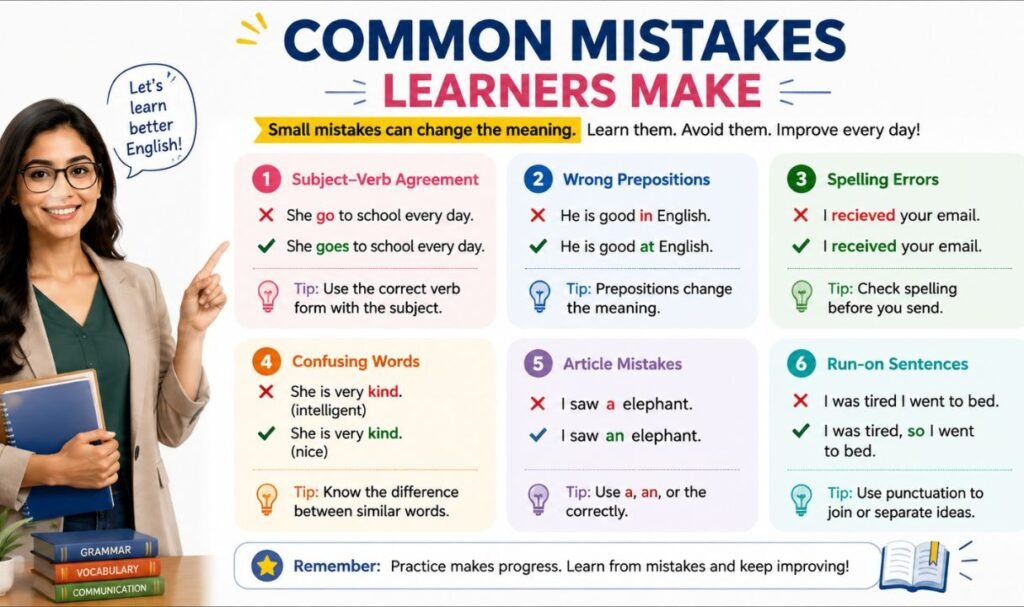
- Assuming “true” follows the same pattern as “nice” or “wide” when adding “-ly.”
- Typing quickly and letting muscle memory add the extra “e.”
- Trusting autocorrect blindly — some keyboards won’t flag it if the surrounding text looks natural.
- Using “truely” in formal documents like cover letters or academic essays, where the mistake stands out the most.
Simple rules to remember
One trick that sticks with a lot of writers: the word “error” also has an “e,” so pairing “truely” with “error” in your head is a quick way to remember that adding the extra letter is a mistake.
Another way to think about it: words ending in “-ue” typically drop the “e” before “-ly.” “True” becomes “truly,” and “due” becomes “duly” — same pattern, same rule.
You May Like: Inter Vs Intra: The Complete Guide to Two Prefixes That Trip Up Even Careful Writers
Quick tips for writing and speaking
- Read your sentence aloud — “truly” and “truely” sound identical, so this trick alone won’t catch the error, but pairing it with a visual check helps.
- Run a spell checker before submitting any formal document.
- If you’re ever unsure, swap in “genuinely” or “honestly” as a mental substitute, then switch back to “truly” once you’ve confirmed the sentence works.
- Keep a short list of commonly confused words (truly, definitely, separately) somewhere visible while drafting.
When to Use Each One
Use “truly” any time you want to express sincerity, honesty, or emphasis — in emails, essays, speeches, social captions, or casual texts. It works in every register of writing, from a quick thank-you message to a formal cover letter.
“Truely” should never be used. There’s no context, formal or informal, where it’s the correct choice.
When NOT to Use Each One
Avoid “truly” only in cases where a different word would communicate your meaning more precisely — for instance, using “certainly” instead of “truly” in a legal document where precision matters more than emotional tone. That’s a style choice, not a spelling issue.
“Truely” has no acceptable use case. Avoid it everywhere: resumes, essays, emails, text messages, and social media posts alike.
Which One to Use (Decision Guide)
Ask yourself these two quick questions:
- Am I trying to spell the adverb form of “true”? If yes, the answer is “truly,” every time.
- Does the word need to end in “-ly” after dropping the final “e” from the root? True → truly follows the same drop-the-e pattern as due → duly and whole → wholly.
If both answers point the same direction, you already have your spelling confirmed.
Real-World Practical Examples
Truely Examples
Since “truely” is always incorrect, these examples show the mistake so you can spot it in your own writing:
- “I truely hope you feel better soon.” ❌
- “She is truely one of a kind.” ❌
- “Thank you, yours truely.” ❌
- “This was truely the hardest exam I’ve taken.” ❌
Truly Examples
- “I truly hope you feel better soon.” ✅
- “She is truly one of a kind.” ✅
- “Thank you, yours truly.” ✅
- “This was truly the hardest exam I’ve taken.” ✅
- “He truly believes in second chances.” ✅
- “The sunset over the mountains was truly breathtaking.” ✅
Self-Assessment (Fill in the Blanks)
Test yourself before moving on. Fill in each blank with “truly” or “truely.”
- I _____ appreciate everything you’ve done for me.
- She signed the letter, “Yours _____, Sarah.”
- This restaurant serves _____ authentic Italian food.
- He _____ believed he could win the race.
- We were _____ grateful for the warm welcome.
- That performance was _____ unforgettable.
Answers
- truly
- truly
- truly
- truly
- truly
- truly
Every blank should be filled with “truly” — there’s no scenario here, or anywhere else, where “truely” is the right answer.
Frequently Asked Questions
Is it truely or truly correct?
“Truly” is the correct spelling. “Truely” is a common misspelling and isn’t recognized in any English dictionary.
What is the meaning of truely?
“Truely” has no meaning of its own since it isn’t a real word — it’s simply a misspelling of “truly.”
Is it correct to say “truly”?
Yes. “Truly” is a properly spelled adverb, correct in formal and informal English alike.
What does “truly” mean?
“Truly” means in a truthful, genuine, or sincere way, and it can also be used to add emphasis, similar to “really” or “absolutely.”
Conclusion
The rule behind “truly” versus “truely” comes down to one small spelling change: drop the “e” from “true” before adding “-ly.” It’s the same pattern you’ll find in “due” becoming “duly” and “whole” becoming “wholly.” Once that pattern clicks, the mistake tends to disappear from your writing for good.
Whether you’re closing a formal letter with “yours truly,” thanking someone sincerely, or just adding emphasis to a sentence, “truly” is the only spelling that belongs there. Keep the memory tricks from this guide handy — the “error has an e” trick works well — and you’ll never second-guess this one again.