
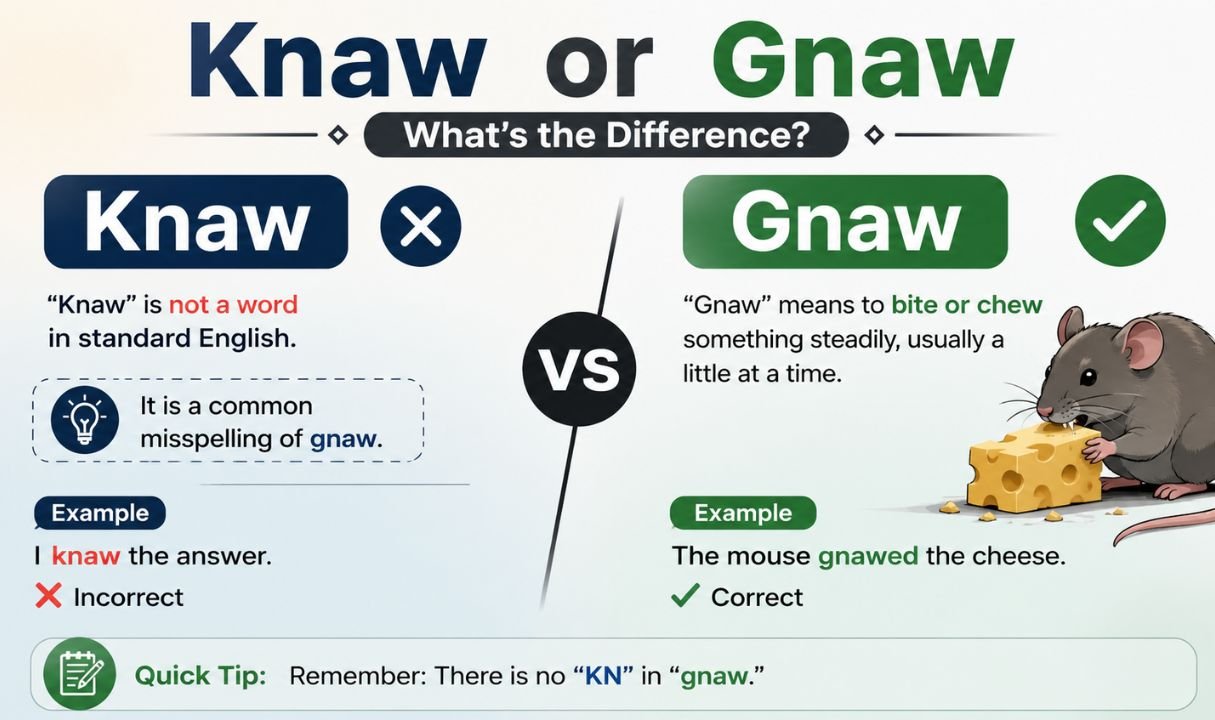
You’re texting a friend about your dog destroying another shoe, or maybe you’re finishing an essay at 11 p.m., and you stop. Is it “knaw” or “gnaw”? The word sounds like “naw,” so either spelling seems plausible until you actually see it written down. This guide settles the question for good, walks through where the confusion comes from, and shows you exactly how to use the word correctly in real writing.
Knaw or Gnaw – Quick Answer
Gnaw is correct. Knaw is not a standard English word.
Gnaw means to bite or chew something repeatedly, or to wear something down slowly over time. It also has a figurative sense — a worry, doubt, or fear that keeps bothering someone.
| Correct spelling | gnaw |
| Incorrect spelling | knaw |
| Pronunciation | /nɔː/ (“naw”) |
| Part of speech | verb (also used as a noun) |
| Example | The dog loves to gnaw on its bone. |
If you remember nothing else from this article, remember this: the “g” is silent, but it still belongs in the spelling. Drop it in speech, keep it on the page.
Knaw Meaning (Is It a Real Word?)
Short answer: no, not in modern English. “Knaw” doesn’t appear in Merriam-Webster, Cambridge, Oxford, or Collins as a standard entry for the chewing sense of the word. Some older dialect records list “knaw” as a regional variant tied to “know,” which is a completely unrelated word with a different meaning. That’s a historical curiosity, not a green light to use it today.
So when someone types “knaw,” what almost always happened is simple: they heard the word spoken, noticed the silent “g,” and guessed that the sound must come from a “kn-” pattern instead — the same pattern you see in words like knee, knife, and knock. It’s a reasonable guess. It’s just the wrong one for this particular word.
If a spell-checker or a teacher marks “knaw” as an error, that’s accurate. Treat it the same way you’d treat “recieve” instead of “receive” — a common typo, not an alternate spelling with its own legitimate use.
The Origin of Knaw or Gnaw
Gnaw traces back to Old English gnagan, which already meant to bite or chew. That root sits in the same family as other Germanic “gn-” words where the initial consonant cluster eventually stopped being pronounced but stuck around in the spelling — you’ll notice the same pattern in gnat, gnash, and gnome.
Knaw has no equivalent root tied to chewing or biting. Its only documented connection is as an old dialectal spelling of “know,” recorded in some regional English usage centuries ago. That thread has nothing to do with teeth, bones, or worry — it’s a linguistic coincidence created purely by how similar the two words sound once the “g” and “k” both go silent.
Knaw or gnaw meaning
There’s really only one meaning to learn here, and it belongs entirely to gnaw. To gnaw is to bite or chew on something persistently, often in small, repeated actions rather than one bite. Knaw carries no accepted meaning in current English.
Gnaw meaning
Gnaw has two main senses:
- Literal — to bite or chew repeatedly, usually wearing something down bit by bit. A beaver gnaws through a tree trunk. A puppy gnaws a chew toy.
- Figurative — to cause persistent discomfort, worry, or unease. Guilt can gnaw at someone. A nagging doubt can gnaw at your confidence for weeks.
Knaw or gnaw synonym
Since knaw isn’t a real word, it has no synonyms of its own. For gnaw, depending on context, you might reach for: chew, bite, nibble, erode, or wear away. For the figurative sense, words like nag, plague, or torment work well.
1. Gnaw in a sentence
- The rat managed to gnaw through the cardboard box overnight.
- A quiet fear had been gnawing at her since the diagnosis.
- Beavers gnaw on bark to keep their teeth from overgrowing.
- Regret gnawed at him long after the argument ended.
2. Gnaw off meaning
“Gnaw off” describes removing something by repeated biting or chewing until it separates. A fox caught in a trap might gnaw off part of a limb to escape. A dog might gnaw off a loose thread hanging from a blanket.
3. Gnaw synonym
Common alternatives include chew, bite at, erode, corrode, and wear down for the physical meaning; for the emotional meaning, torment, plague, and nag are close matches, though none of them carry the exact slow, persistent quality that “gnaw” implies.
You May Like: Hoodie or Hoody: Which Spelling Is Actually Correct?
British English vs American English Spelling
Here’s the part that surprises a lot of people: this isn’t one of those UK-versus-US spelling splits, like “colour” and “color” or “organise” and “organize.” Both British and American English use the identical spelling — gnaw. There’s no regional variant to choose between. Dictionaries on both sides of the Atlantic agree.
Comparison Table
| Feature | British English | American English |
|---|---|---|
| Correct spelling | gnaw | gnaw |
| Pronunciation | /nɔː/ | /nɔː/ |
| Past tense | gnawed | gnawed |
| Past participle | gnawed / gnawn (rare, literary) | gnawed |
| Accepted in formal writing | Yes | Yes |
| “Knaw” accepted | No | No |
The only minor wrinkle is the past participle. “Gnawn” shows up occasionally in older or poetic British writing, but “gnawed” is the standard past participle in everyday usage across both dialects, and it’s the safer choice in nearly all modern contexts.
Which Spelling Should You Use?
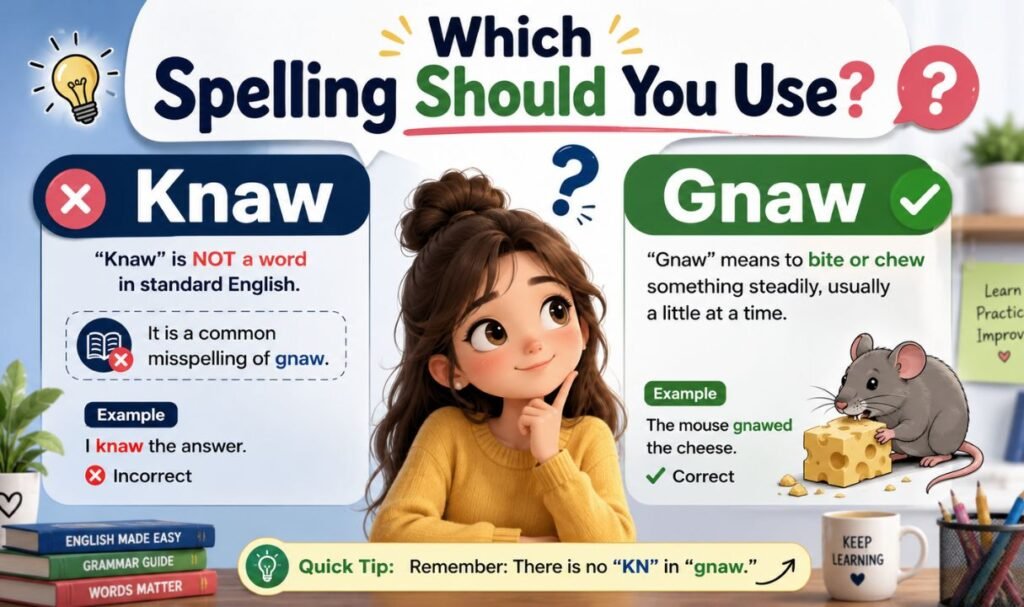
Use gnaw. Every time, in every context — text messages, school essays, business emails, novels, news copy. There isn’t a scenario where “knaw” is the recommended or accepted spelling in current English.
A simple way to lock it in: think of the phrase “say naw, write gnaw.” The pronunciation strips the “g,” but the spelling never does.
If you’re used to trusting patterns from words like “knee” or “knife,” it helps to remember that gnaw isn’t part of that family at all. It’s part of the “gn-” family, alongside gnat, gnash, and gnarl — words where the silent letter sits at the front but is a “g,” not a “k.”
Common Mistakes with Knaw or Gnaw
- Writing “knaw” because it sounds right. This is by far the most frequent error, and it happens even to strong writers when they’re typing quickly.
- Confusing gnaw with gnash. Gnash means to grind the teeth together, often out of anger or pain — “gnashing his teeth in frustration.” It’s related in spelling but different in meaning.
- Overusing the figurative sense in formal writing. “Gnawing doubt” and “guilt gnawed at him” are vivid, but sprinkling them into every paragraph of a report or academic paper can feel overwrought. Save it for moments that need the emphasis.
- Misspelling the past tense. It’s “gnawed,” not “gnawd” or “gnew.” There’s no irregular past tense here — treat it like a regular verb.
- Assuming “knaw” is a British spelling. As shown in the comparison table above, that’s not the case. Neither British nor American dictionaries list it as standard.
You May Like: Requester or Requestor: What is the Difference & Which is Correct?
Knaw or Gnaw in Everyday Examples
Emails
“Please review the attached report before Friday — a few open questions have been gnawing at the team all week, and we’d like your input before the deadline.”
News
“Wildlife officials confirmed that beavers had gnawed through several trees along the riverbank, prompting the park to install protective wire mesh.”
Social Media
“my dog just gnawed through my charger cable for the THIRD time this month 😭 sending help”
Formal Writing
“The committee noted that unresolved budget concerns continued to gnaw at staff morale throughout the fiscal quarter, ultimately prompting a formal review.”
Across all four contexts, the spelling stays exactly the same. Only the tone and sentence structure shift to match the setting.
Knaw or Gnaw – Google Trends & Usage Data
Search interest in “knaw or gnaw” tends to cluster around a specific type of user: someone who’s just heard or read the word and paused to double-check the spelling before sending an email, finishing homework, or posting online. Interest generally rises alongside searches for other silent-letter word pairs, such as “knight or nite” or “gnome pronunciation,” which suggests the confusion is tied to English’s broader pattern of silent consonants rather than anything unique to this one word.
A few patterns show up consistently across search behavior:
- Searches spike during the school year, especially among students working on writing assignments.
- English-language learners search this pairing more often than native speakers, since silent letters are one of the trickier parts of English spelling to internalize.
- Related searches often include “gnaw pronunciation,” “gnaw past tense,” and “words with silent g,” reinforcing that most people already suspect gnaw is correct and are simply confirming it.
None of this changes the answer. It just explains why so many people land on this exact question in the first place.
Comparison Table: Knaw vs Gnaw
| Category | Knaw | Gnaw |
|---|---|---|
| Standard English word | No | Yes |
| Found in major dictionaries (chewing sense) | No | Yes |
| Correct in American English | No | Yes |
| Correct in British English | No | Yes |
| Historical dialect use | Yes (as variant of “know”) | Yes (from Old English gnagan) |
| Acceptable in formal writing | No | Yes |
| Acceptable in casual writing | No | Yes |
| Scrabble-valid | No | Yes |
Frequently Asked Questions
What is meant by gnaw?
Gnaw means to bite or chew something repeatedly, or, figuratively, to cause someone ongoing worry or discomfort.
What does knaw actually mean?
Knaw has no accepted meaning in modern English; it’s a common misspelling of gnaw, with only an obscure historical link to the word “know.”
Is “knaw” a valid word in Scrabble?
No, “knaw” isn’t valid in standard Scrabble dictionaries, including both the TWL and SOWPODS word lists.
Is “gnaw” a word?
Yes, gnaw is a standard English verb recognized by all major dictionaries, in both American and British English.
Conclusion
The choice between knaw and gnaw really comes down to one silent letter causing an outsized amount of confusion. Gnaw is the only correct spelling, backed by every major dictionary, consistent across British and American English, and rooted in a word that’s been part of the language since Old English. Knaw, meanwhile, is little more than a phonetic guess that never became standard.