
You’ve typed the sentence, your cursor is hovering, and something feels off. Should a new policy “take effect” next month, or “take affect”? If you’ve paused on this before hitting send, you’re in good company. This mix-up shows up in work emails, school essays, news articles, and even government documents.
The short answer: only “take effect” is correct. “Take affect” is a grammatical error, not a valid alternative spelling or a regional variation. But knowing the rule and actually remembering it under pressure are two different things, so this guide walks through the reasoning, the real-world examples, and a memory trick that sticks.
What Is the Correct Phrase: Take Effect or Take Affect?
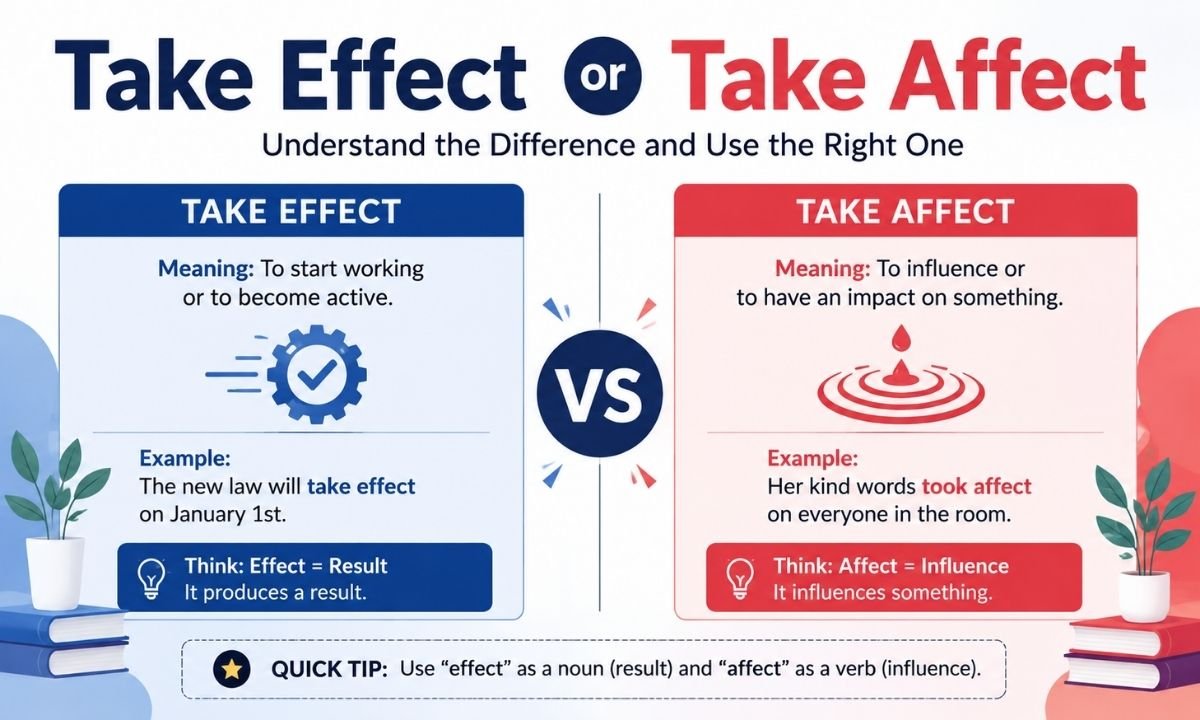
“Take effect” is the only grammatically valid version of this phrase. It means something has started to work, become active, or begin producing its intended outcome. A law, a medication, a policy, or a software update can all “take effect.”
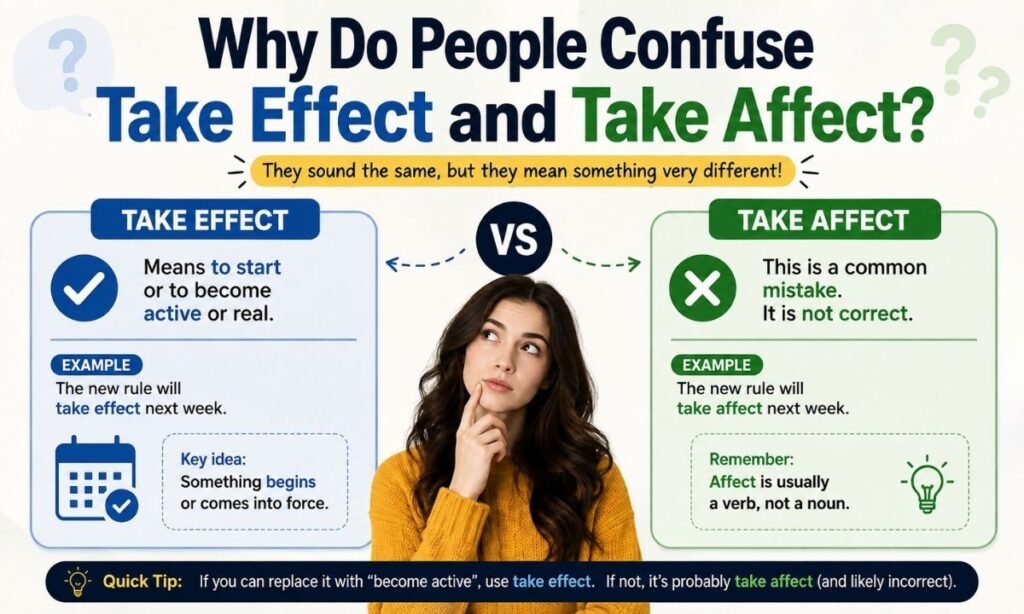
“Take affect,” on the other hand, isn’t a recognized phrase in English. It’s a common typo caused by the near-identical sound of “affect” and “effect,” not an accepted variant you’ll find in any dictionary or style guide.
Examples of “Take Effect”
- The new minimum wage law will take effect on January 1.
- Painkillers usually take effect within thirty to forty-five minutes.
- The updated privacy policy takes effect next Monday.
- Once you restart the app, the settings will take effect.
- The merger agreement takes effect once both boards sign off.
Notice the pattern: in every sentence, something transitions from inactive to active, or from proposed to enforced.
Is “Take Affect” Ever Correct?
No. There’s no context — formal, casual, legal, or scientific — where “take affect” is grammatically acceptable. The confusion usually stems from autocorrect not catching it, or from writers assuming “affect” and “effect” are interchangeable because they sound alike when spoken. They aren’t. One is (almost always) a verb, and the other is (almost always) a noun, and that distinction is exactly why “take effect” works and “take affect” doesn’t.
Understanding the Difference Between Affect and Effect
Before the phrase makes full sense, it helps to separate the two words it’s built from. They come from different Latin roots and settled into different grammatical jobs over time.
Affect Meaning
“Affect” is typically a verb. It means to influence, change, or have an impact on something.
- Lack of sleep can affect your concentration.
- The storm affected flight schedules across the region.
- Her feedback affected how the team approached the project.
There’s a smaller, more specialized use of “affect” as a noun in psychology, where it refers to an outward display of emotion (a patient with a “flat affect,” for instance). That usage is rare outside clinical writing, so for everyday purposes, treat “affect” as a verb.
Effect Meaning
“Effect” is typically a noun. It refers to a result, outcome, or consequence of an action.
- The medication had a strong effect on her energy levels.
- Climate change has a measurable effect on crop yields.
- The new manager’s arrival had a noticeable effect on morale.
“Effect” can also function as a verb in formal writing, meaning to bring something about or cause it to happen — as in “the committee effected several changes to the bylaws.” This use is far less common and shows up mostly in legal or academic contexts.
Why “Take Effect” Works
“Take” needs a noun to sit next to it — you take a break, take a seat, take a photo. Since “effect” is a noun in this context, it slots naturally after “take.” “Affect,” being a verb in nearly every everyday sentence, can’t follow “take” the same way. Two verbs stacked together like that simply don’t form a standard English phrase. That grammatical mismatch is the entire reason “take affect” fails and “take effect” holds up.
Take Effect Meaning in Everyday English
“Take effect” shows up constantly across very different fields, but the core meaning stays the same: something moves from planned to active.
Laws and Regulations
Legislation almost always “takes effect” on a specific date after it’s passed. News reports and government notices use this phrasing to mark exactly when compliance becomes mandatory.
- The new tax bracket takes effect at the start of the fiscal year.
- Updated traffic regulations take effect this Friday.
Medicine and Healthcare
Doctors, pharmacists, and patients use the phrase to describe when a drug starts working in the body.
- The anesthesia should take effect within a few minutes.
- If the antibiotics haven’t taken effect after 48 hours, contact your doctor.
Business and Workplace Policies
HR announcements, contract terms, and internal memos rely on this phrase to mark when new rules become binding.
- The revised remote work policy takes effect next quarter.
- Salary adjustments take effect from the first pay cycle of the new year.
Technology and Software
Updates, permission changes, and configuration settings frequently need a restart or refresh before they “take effect.”
- Your privacy settings will take effect once you save changes.
- The firmware update takes effect after the device reboots.
Take Effect vs Take Affect: Quick Comparison Table
| Feature | Take Effect | Take Affect |
|---|---|---|
| Grammatical status | Correct | Incorrect |
| Word type used | Noun (effect) | Verb (affect) |
| Meaning | To begin working or become active | No accepted meaning |
| Used in dictionaries | Yes | No |
| Common in formal writing | Yes | Never appropriate |
| Typical cause | Standard usage | Typo or sound confusion |
Simple Rule to Remember
If you can replace the word with “result” or “outcome,” use effect. If you can replace it with “influence” or “change,” use affect. Since “take effect” describes something starting to produce a result, effect wins every time.
Why Do People Confuse Take Effect and Take Affect?
This isn’t a rare slip. Search data and grammar-checker logs consistently show it as one of the more frequently corrected phrases in English writing, and there are a few clear reasons why.
Similar Pronunciation
“Affect” and “effect” differ by a single vowel sound at the start, and in fast, casual speech, that difference nearly disappears. If you learned the phrase by ear rather than by reading it, guessing the spelling becomes a coin flip.
Affect and Effect Are Commonly Mixed Up
Beyond this specific phrase, affect and effect are among the most frequently confused word pairs in the language, right up there with “your” and “you’re” or “its” and “it’s.” Once a writer is unsure about the base words, any phrase built from them becomes shaky too.
Autocorrect Doesn’t Always Help
Spell-checkers catch words that don’t exist, but “affect” is a real, correctly spelled word — it’s just the wrong one for this phrase. Most autocorrect tools won’t flag it, because they’re checking spelling, not word choice in context.
Lack of Grammar Awareness
Many writers never learned the noun-versus-verb distinction explicitly. Without that grammatical anchor, the two words feel like flexible synonyms rather than words with separate jobs, which makes the error easy to repeat for years without anyone pointing it out.
Real-Life Example: How One Small Grammar Mistake Changed a Professional Email
A project manager once sent a company-wide announcement stating that a new expense policy would “take affect” the following Monday. It was a minor typo, buried in an otherwise well-written message. But within an hour, several employees had replied — half asking what “take affect” meant, the other half gently correcting it in a reply-all thread that quickly became more about grammar than the policy itself.
The mistake didn’t change the policy, but it did shift how the message landed. Instead of focusing on the new expense rules, several employees spent the conversation debating spelling. It’s a small reminder that word choice shapes how seriously a message gets taken, especially in writing meant to sound authoritative.
Grammar Rule: When to Use Affect and Effect
Affect = Action
Use “affect” when describing an action that changes or influences something else. It’s almost always doing the work of a verb in the sentence.
- Noise levels affect sleep quality.
- The decision will affect thousands of employees.
Effect = End Result
Use “effect” when naming the outcome or consequence of that action. It’s almost always the noun sitting in the sentence, often paired with words like “an,” “the,” or “this.”
- The noise had a measurable effect on sleep quality.
- The decision’s effect will be felt for years.
Applying the Rule
Try substituting “influence” for the word in question. If the sentence still makes sense, you likely need “affect.” If it doesn’t, and “result” fits better, you need “effect.” Applied to the phrase in question: something can’t “influence” in this construction, but it can produce a “result,” which is exactly why “take effect” is the only version that holds together.
Statistics: Why Grammar Accuracy Matters in 2025–2026
Clear writing isn’t just a stylistic preference; it affects how readers judge credibility, especially online, where a single confused sentence can undercut an otherwise well-researched article.
Key Findings
- Confused word pairs like affect/effect remain among the most commonly flagged errors by grammar-checking tools, year after year, according to usage data from major writing platforms.
- Readers report lower trust in content — particularly business, legal, or medical writing — when it contains basic usage errors, even when the underlying information is accurate.
- Search interest in “take effect vs take affect” and similar comparisons has stayed consistently high, showing this remains a live point of confusion rather than a fading one.
- Professional style guides, including those referenced by Merriam-Webster and Purdue OWL, continue to list this pairing among commonly misused English phrases.
Common Examples of Take Effect
Government
New legislation, court rulings, and public health orders “take effect” on announced dates, often triggering compliance deadlines for citizens and businesses alike.
Healthcare
Treatment plans, prescriptions, and insurance changes “take effect” once approved or administered, marking the point where care actually begins.
Education
Grading policies, enrollment rules, and curriculum updates “take effect” at the start of a term or semester.
Workplace
Promotions, pay changes, and new company policies “take effect” from a specific date set by HR or management.
Technology
App permissions, software patches, and account settings “take effect” once saved, installed, or after a system restart.
Common Mistakes to Avoid
Mistake 1: Writing Take Affect
The single biggest error is simply writing “affect” instead of “effect” in this phrase. Slowing down for a two-second mental check — noun needed here, not verb — prevents most instances of this.
Mistake 2: Using Affect as a Noun
Outside of clinical or psychological writing, treating “affect” as a noun (as in “the affect of the new policy”) is incorrect. Stick with “effect” as the noun in general writing.
Mistake 3: Mixing Both Words Randomly
Some writers alternate between affect and effect within the same document without a consistent rule, which signals uncertainty to readers. Pick the correct word deliberately each time rather than guessing.
How to Remember the Difference Forever
The A-E Rule
A for Action, E for End result. Affect starts an action; effect is the result of that action. Since “take effect” is about reaching a result — a law becoming active, a drug starting to work — effect is the only word that fits.
Effect = End Result
If you’re ever unsure mid-sentence, ask what’s happening: is something influencing something else (affect), or is something becoming active or producing an outcome (effect)? “Take effect” is always about the second scenario.
Applying the Trick
Picture a light switch. Flipping it is the action (affecting the room). The room becoming lit is the result (the effect). The switch “takes effect” the moment it starts producing that result — never “takes affect.”
Mini Quiz: Take Effect or Take Affect
Test yourself with these short checks. Answers are noted after each one.
Quiz 1: Which Phrase Is Correct?
“The new rule will ___ next week.” — Answer: take effect.
Quiz 2: Spot the Right Word
“Stress can ___ your sleep.” — Answer: affect.
Quiz 3: Affect or Effect?
“The medicine had a strong ___ on her mood.” — Answer: effect.
Quiz 4: Fill in the Blank
“The policy changes ___ immediately.” — Answer: take effect.
Quiz 5: Quick Grammar Challenge
True or false: “affect” is usually a noun. — Answer: false, usually a verb.
Quiz 6: Real-Life Scenario
Your manager emails that new hours “take affect Monday.” Is this correct? — Answer: no, it should read “take effect.”
Quiz 7: True or False
“Take affect” appears in standard dictionaries. — Answer: false.
Quiz 8: Choose the Best Sentence
“The law takes effect in March” vs. “The law takes affect in March.” — Answer: the first.
Quiz 9: Meaning Check
Does “take effect” mean “to influence” or “to become active”? — Answer: to become active.
Quiz 10: Grammar Detective
Which word needs a noun after “take” — a noun or a verb? — Answer: a noun, which is why “effect” fits.
Quiz 11: Memory Trick Test
What does the “A” in the A-E rule stand for? — Answer: Action.
Final Bonus Quiz
Correct or incorrect: “The vaccine will take affect after two doses.” — Answer: incorrect; it should be “take effect.”
Frequently Asked Questions
Did it take effect or affect?
It took effect. “Affect” doesn’t fit after “take” in standard English.
What does it mean to take effect?
It means something has started working, become active, or begun producing its intended result.
How do I use effect vs affect?
Use “affect” as a verb meaning to influence, and “effect” as a noun meaning a result; “effect” can rarely act as a formal verb meaning to bring about.
Which is correct: “take effect” or “took effect”?
Both are correct — “take effect” is present tense, and “took effect” is the past tense form of the same phrase.
Conclusion
The rule behind “take effect or take affect” comes down to one grammatical fact: “take” needs a noun beside it, and “effect” is the noun that fits. “Affect” does its job elsewhere, as the verb that describes influence or change. Once that distinction clicks, the phrase stops being a guessing game.
Whether you’re drafting a company policy, writing a school paper, or just texting a friend about when your medication kicks in, “take effect” is the version that belongs in your writing. Keep the A-E rule in mind, double-check before hitting send, and this particular grammar trap won’t catch you again.