
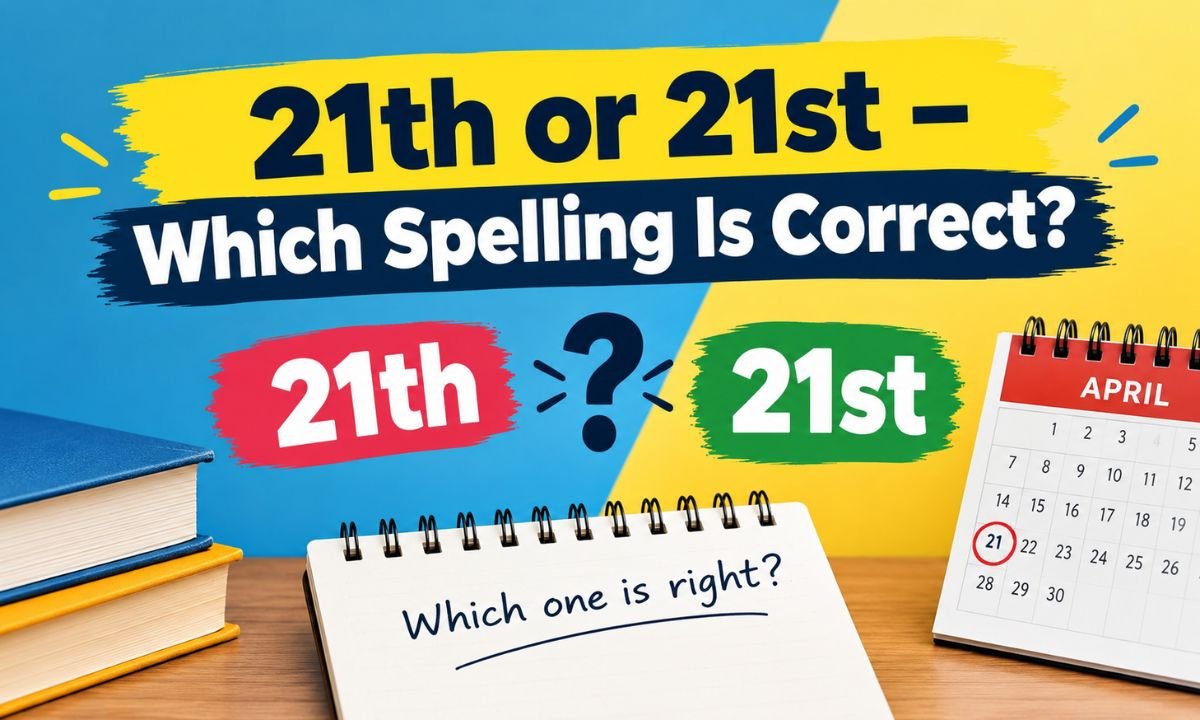
21st is the correct spelling. 21th is a mistake. An ordinal number that ends in 1 takes the suffix “st”, except 11, which takes “th.” So you write 1st, 21st, 31st, 41st and 101st, but 11th and 111th.
This guide explains the rule behind that answer and shows where “21th” goes wrong. It also gives clear examples of “21st” in dates, birthdays, centuries and rankings, plus style guide advice.
The advice reflects standard English usage and the editing and reference pages I reviewed while researching. Nothing here is a matter of taste. English has one accepted written form for this number.
21th or 21st – Which Spelling Is Correct?
The Short Answer
Use 21st. It is the standard written form of the ordinal number twenty-first, and no dictionary or style guide accepts 21th. No region, register or level of formality changes that.
Editing references agree that the “st” suffix belongs on ordinal numbers ending in 1, and one grammar resource calls 21th a grammatical error that is never correct.
Why the Last Digit Decides the Suffix
English builds written ordinals from the spoken word. You say “twenty-first,” so the written form keeps the last two letters of “first.” That gives 21st. The same logic produces 22nd from “second” and 23rd from “third.”
Every other ordinal ends in a “th” sound. Fourth, fifth, sixth, twentieth and twenty-fourth all share it. Since 21 ends in 1 and not in any of those sounds, “th” has no place in it.
Only the final word of the spoken number matters. Twenty-one is a compound, but the ordinal changes just its last part. “Twenty” stays as it is, and “one” becomes “first.”
Think of it as a two-step check. Look at the last digit first. Then see whether the last two digits fall between 11 and 13. If they do, use “th.” If not, follow the pattern in the table.
| Last digit | Suffix | Examples |
|---|---|---|
| 1 (but not 11) | st | 1st, 21st, 31st, 101st |
| 2 (but not 12) | nd | 2nd, 22nd, 32nd, 102nd |
| 3 (but not 13) | rd | 3rd, 23rd, 33rd, 103rd |
| 0, 4, 5, 6, 7, 8, 9 | th | 4th, 20th, 25th, 100th |
| 11, 12, 13 | th | 11th, 12th, 13th, 111th |
The Exception: Numbers 11 to 13
The range from 11 to 13 breaks the pattern. Those numbers take “th,” and so do 111 to 113 and any other number whose last two digits fall in that range.
That exception does not touch 21. Its last two digits are 2 and 1, which make 21, not a teen. The last digit is 1, so the normal “st” rule applies with no exception.
What Is an Ordinal Number?
An ordinal number shows position in a sequence: first, second, twenty-first. A cardinal number shows quantity: one, two, twenty-one. Ordinals answer “which one?” and cardinals answer “how many?”
So 21st describes the item that comes right after the 20th and right before the 22nd. If twenty runners cross the line before you, you placed 21st. If twenty-one runners entered, that is a count, and it stays 21.
| Cardinal | Ordinal (words) | Ordinal (numerals) |
|---|---|---|
| 20 | twentieth | 20th |
| 21 | twenty-first | 21st |
| 22 | twenty-second | 22nd |
| 23 | twenty-third | 23rd |
| 30 | thirtieth | 30th |
| 31 | thirty-first | 31st |
What the Letters After the Number Are Called
The letters after the numeral are called an ordinal indicator. They act as a shortcut for the ending of the spelled-out word. Twenty-first becomes 21 plus “st,” with no space and no period between them.
Some writers set the letters in superscript, as in 21ˢᵗ. Others keep them on the baseline. Both are accepted. Baseline text is more common online and holds up better in emails and plain-text fields.
Why English Uses st, nd, rd and th
The odd endings come from the history of the words themselves. “First” and “third” come from Old English. “Second” arrived later through French and Latin, replacing an older word. That mixed origin is why the first three ordinals look irregular.
From “fourth” onward, English settled on a “th” ending, which traces back to an old Germanic suffix. Numbers above twenty then inherit whichever ending their last word carries. That gives us twenty-first, twenty-second and twenty-third.
21th
What “21th” Actually Is
21th is not a variant, a regional spelling or an older form. It is an error. The word “twenty-onth” does not exist, so there is no spoken form the letters could stand for.
The number is written wrongly whenever “th” is attached to it. Editors correct it every time, and search engines treat “21st” as the intended term when people type the mistake.
Why People Write 21th
The slip is easy to understand. Most ordinals end in “th,” so the brain generalizes. After typing 14th, 15th, 16th and 20th, writing 21th feels like the next natural step.
Learners face an extra hurdle. Many languages use one marker for every ordinal, such as a full stop after the numeral. English looks inconsistent by comparison, so learners often apply “th” everywhere as a safe default.
Software adds to the problem. A template or script that attaches “th” to every number will output 21th, 22th and 23th. That is a coding shortcut, not a language rule.
Speed matters too. People who type quickly rarely double-check suffixes, and some spell checkers treat a number with letters attached as a single token and skip it.
Where You Still See It
Search the web and you will find 21th in product listings, translated pages, event announcements and forum posts. One editing site collects real examples such as “21th century” and “21th edition”, all of them flagged as incorrect.
Software bugs show it as well. A board game platform received a bug report because parts of its English interface displayed 21th, 22th and 23th instead of the correct forms.
Seeing a mistake often does not make it right. Frequency online reflects how many people make the same slip, not what standard English allows.
How to Fix It
Search your document for “21th” and replace every instance with “21st.” If a template or script adds suffixes automatically, test it with the numbers 1, 2, 3, 11, 12, 13, 21, 22 and 23. Those cases catch nearly every suffix bug.
| Incorrect | Correct |
|---|---|
| 21th birthday | 21st birthday |
| 21th century | 21st century |
| the 21th of May | the 21st of May |
| 21th place | 21st place |
| 21th floor | 21st floor |
| 21th edition | 21st edition |
21st
Meaning and Pronunciation
21st stands for twenty-first, the position right after twentieth. Dictionaries define it as an adjective meaning coming next after the twentieth in position.
It works as an adjective in “the 21st day” and as a noun in “the 21st of June.” Occasionally it acts as an adverb, as in “she finished 21st.” It can also name one of twenty-one equal parts of a whole.
Say it as “twen-tee-FURST.” The stress falls on the last syllable, and the ending sounds like the “st” in “first.”
Correct Examples of 21st
These sentences show the form in everyday use:
- She finished in 21st place at the regional meet.
- In 2026, the winter solstice falls on the 21st of December.
- Our office is on the 21st floor.
- Happy 21st birthday!
- This is the 21st edition of the festival.
- The 21st amendment ended national prohibition in the United States.
The 21st Century
The 21st century began on January 1, 2001, and runs through December 31, 2100. There was no year zero, so the first century covers years 1 to 100, and each later century follows the same count.
That is why the year 2000 belongs to the 20th century. Popular usage often treats 2000 as the start of the new era, but calendar purists follow the 2001 start.
As a modifier before a noun, hyphenate it: 21st-century skills, 21st-century architecture. After the noun, drop the hyphen: the skills of the 21st century.
Chicago style prefers the spelled-out form, “twenty-first century.” AP style and most web writing keep the numerals.
Here is a fresh angle for 2026. This year is the 26th year of the 21st century. Roughly a quarter of the century has already passed, which makes the phrase feel less futuristic than it once did.
The 21st Birthday
The 21st birthday is a milestone in many places. In the United States it marks the age at which a person can legally buy alcohol across the country, a standard set through the National Minimum Drinking Age Act of 1984.
Reference works note that the 21st birthday marks the age of majority in several countries. In others, that milestone arrives at 18.
On cards and invitations, write “21st,” never “21th.” Correct greetings include “Happy 21st birthday” and “Congratulations on turning 21.” The second uses the plain number because it states an age, not a position.
Anyone born in 2005 turns 21 in 2026, so this year’s birthday invitations will carry the “21st” spelling more than ever.
The same pattern holds for anniversaries. A couple married for twenty-one years is celebrating a 21st anniversary. The years are counted with a cardinal number, but the anniversary itself takes the ordinal.
Writing Dates With 21st
Dates are the most common home of ordinals. In American English, both “June 21” and “June 21st” are common. British English often uses “21 June” or “the 21st of June.”
Avoid mixing forms in one sentence. Write “from the 21st to the 25th,” not “from the 21 to the 25th,” unless a style guide asks for it.
When a date appears in numbers only, such as 21/06/2026, no suffix is used at all.
Common Phrases With 21st
| Context | Example |
|---|---|
| Calendar | the 21st of March |
| Sports | finished 21st overall |
| Buildings | the 21st floor |
| Addresses | 21st Street |
| Events | the 21st annual conference |
| Age milestones | a 21st birthday party |
| Time periods | the 21st century |
What the Style Guides Say
Style guides differ on numerals versus words, but none allows 21th. The table shows how major guides treat ordinals like 21st. Check the edition your publisher or professor requires, since details change between editions.
| Guide | General approach | Example |
|---|---|---|
| AP Stylebook | Spell out first through ninth, use figures from 10th onward | 21st century |
| Chicago Manual of Style | Spell out ordinals in running text | twenty-first century |
| MLA | Spell out numbers that take one or two words | twenty-first |
| APA | Use numerals for 10 and above | 21st |
Hyphens, Spacing and Capitals
There is no space between the numeral and the suffix. Write 21st, not 21 st. Do not add a period after it unless the sentence ends there.
Spelled out, twenty-first always takes a hyphen because it is a compound number between 21 and 99. Keep it lowercase unless it starts a sentence or sits in a title.
Street names follow the same rule: 21st Street and East 21st Street. Capitalize “Street” when it is part of the name.
Typing Ordinals in Word Processors
Microsoft Word can turn 21st into superscript automatically through its AutoFormat As You Type setting. You can switch it off if you prefer plain text.
Most web publishing tools, including CMS editors and email clients, leave the letters on the baseline. That is fine. Readers understand both, and plain text avoids formatting glitches.
The Neighbors: 20th to 25th
Once you know 21st, the next few numbers are simple. 20th takes “th,” 22nd takes “nd,” 23rd takes “rd,” and 24th and 25th go back to “th.” Then 31st repeats the “st” pattern.
Ten steps later the pattern repeats. Every number that ends in 1 and is not a teen behaves like 21: 41st, 51st, 61st, 71st, 81st, 91st and 101st.
Which Is Used the Most?
21st is used far more than 21th in edited English. Books, news outlets, government websites and dictionaries use 21st almost without exception. 21th appears mainly in translated pages, auto-generated text and informal posts by writers who have not checked the rule.
I cannot give an exact percentage. Any site that quotes a precise split without naming its data source deserves suspicion. What the pages I reviewed show is a clear pattern: correct usage in professional writing and mistakes in scattered low-quality sources.
Search behavior tells a similar story. People type “21th or 21st” into Google because they have seen both and feel unsure. That doubt shows that 21th circulates online, but not that anyone accepts it.
You can test the gap yourself. Open the Google Books Ngram Viewer and compare “21st” with “21th.” Expect the 21st line to sit far above the other, which is how edited published text behaves.
| Context | Usual form | Comment |
|---|---|---|
| Books and journals | 21st or twenty-first | Edited and consistent |
| Government and legal text | 21st | Follows style manuals |
| Social media | Mostly 21st, occasional 21th | Typos and habit |
| Translated or scraped pages | Mixed | Machine output varies |
| Software interfaces | Should be 21st | 21th counts as a bug |
Trusted Sources Agree
Reference pages, editing services and grammar sites all give the same answer. That consistency is one of the strongest signs that a spelling question has a settled answer.
When sources disagree, look at the date and the publisher. Here they do not disagree. The pages I reviewed, including one updated in September 2023 and another in April 2024, say the same thing.
Memory Tricks for 21st
- Match the last digit to the spoken word. Ends in 1 means “first,” so use “st.”
- Say it aloud. If you would say “twenty-first,” the letters must be “st.”
- Remember the order 1, 2, 3 and st, nd, rd, then “th” for the rest.
- Check for 11, 12 or 13 at the end. Those are the only exceptions.
- Test the pattern on 31st, 41st and 51st. It repeats every time.
Common Ordinal Mistakes
| Mistake | Why it is wrong | Correct form |
|---|---|---|
| 21th | Ends in 1, not a teen | 21st |
| 22th | Ends in 2, not a teen | 22nd |
| 23th | Ends in 3, not a teen | 23rd |
| 31th | Ends in 1, not a teen | 31st |
| 11st | Teen exception applies | 11th |
| 12nd | Teen exception applies | 12th |
| 21 st | Space before suffix | 21st |
| twenty first | Missing hyphen | twenty-first |
Frequently Asked Questions
Is it happy, 21st or 21th birthday?
“Happy 21st birthday” is correct. “21th” is never correct in any greeting.
Is it 21st or 22th?
21st is correct, but 22th is not. The right form for the next number is 22nd.
Is 21st correct grammar?
Yes. 21st is the standard ordinal for twenty-first and is correct in dates, rankings, floors and centuries.
Is 31st or 31th correct?
31st is correct. Like 21st, it ends in 1 and is not a teen, so it takes “st.”
Conclusion
21st is correct, and 21th is not. The rule fits in one sentence: ordinals ending in 1 take “st,” those ending in 2 take “nd,” those ending in 3 take “rd,” and the rest take “th,” including 11 to 13. Use 21st for birthdays, dates, floors, editions and the 21st century. Hyphenate it before a noun, skip the space before the suffix, and never write 21th.