
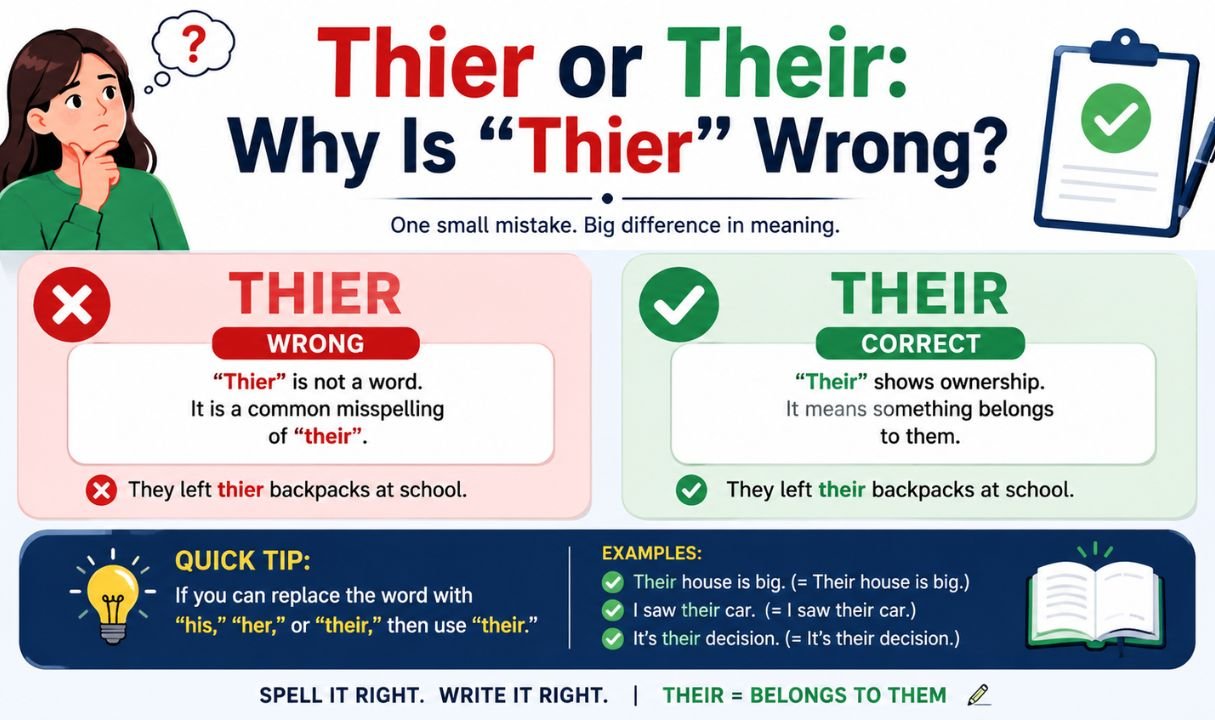
You typed it fast, glanced back at the screen, and something looked off. Was it “thier” or “their”? If you’ve ever paused mid-sentence over this word, you’re in good company. It’s one of the most misspelled words in the English language, and the mix-up shows up everywhere from text messages to job applications.
The short version: their is correct, and thier is not a word at all. But knowing that isn’t quite the same as understanding why your brain keeps swapping those two letters, or how to stop it from happening again. This guide breaks down the rule, the reasoning behind it, and the everyday situations where this error tends to creep in.
Thier or Their Quick Answer
Simple Explanation
Their is the only correct spelling. Thier is a misspelling with no place in standard English, no dictionary entry, and no grammatical function. Every major style guide and dictionary confirms the same thing: the letter order is E before I, not I before E.
Here’s the fastest way to lock it in. Take the word they, drop the Y, and add ir. That leaves you with t-h-e-i-r, which is exactly the spelling you want. Since “they” already has the E in it, the E naturally comes first in “their” too.
Examples
| Sentence | Correct? |
|---|---|
| Their house is at the end of the street. | ✅ Correct |
| Thier house is at the end of the street. | ❌ Incorrect |
| I borrowed their car for the weekend. | ✅ Correct |
| I borrowed thier car for the weekend. | ❌ Incorrect |
| The students packed their bags early. | ✅ Correct |
| The students packed thier bags early. | ❌ Incorrect |
Grammar Rules Explained
Their Meaning and Rule
Their is a possessive pronoun. It shows that something belongs to a group of people, animals, or things referred to as “they.” Grammatically, it functions the same way “his,” “her,” or “its” does, except it applies to the plural or gender-neutral case.
A few rules to keep in mind:
- Their always comes before a noun, since it’s showing ownership of that noun (their car, their opinion, their idea).
- It never stands alone as a subject or object in a sentence — that job belongs to “them” or “they.”
- In modern usage, their is also accepted as a singular, gender-neutral pronoun. “Someone left their umbrella at the office” is grammatically fine in contemporary English, even though “someone” is singular.
The word traces back to Old Norse þeirra, meaning “of them,” which entered English through Scandinavian contact during the medieval period. Over time, English spelling settled on “their” as the standard form, and it has stayed that way ever since.
Thier Meaning and Rule
Thier has no meaning. It carries no grammatical function, appears in no dictionary, and isn’t recognized as a variant spelling anywhere in English, British or American. If you see “thier” in a piece of writing, it’s simply a typo or a spelling error waiting to be corrected.
Most people who write “thier” are trying to write “their” and made a letter-order slip. The good news is that once you understand why the error happens, it becomes much easier to catch before you hit send.
You May Like: Drier vs Dryer: Which One Should You Use in Writing?
Why People Make Mistakes With Thier or Their
Letter Order Confusion
The classic culprit is the “I before E, except after C” rhyme taught in early schooling. It’s a useful memory trick for words like “receive” or “believe,” but it breaks down constantly, and “their” is one of its most famous exceptions. Since the rule gets repeated so often, some writers apply it automatically without checking whether the word actually follows the pattern.
Fast Typing
When you’re typing quickly, your fingers sometimes move faster than your brain can proofread. Letters get transposed, especially in short, frequently used words like “their.” Because the word appears so often in everyday writing, it’s also one of the easiest ones to mistype without noticing.
Weak Spelling Awareness
Not everyone was taught spelling rules the same way, and English spelling itself is notoriously inconsistent. Without a clear anchor for how “their” is built, it’s easy to guess wrong, especially since the misspelling looks so close to the real thing.
Autocorrect Misses Errors
Here’s something many people don’t expect: autocorrect doesn’t always catch “thier.” Some spell-checkers flag it instantly, but others, especially older systems or quick mobile keyboards, either miss it entirely or “correct” it to the wrong homophone, like “there.” This gives writers a false sense of security.
Informal Writing Habits
In texts, chats, and social media captions, most people write quickly and skip proofreading. Casual writing environments naturally invite more spelling slips because there’s less pressure to get every word exactly right before hitting send.
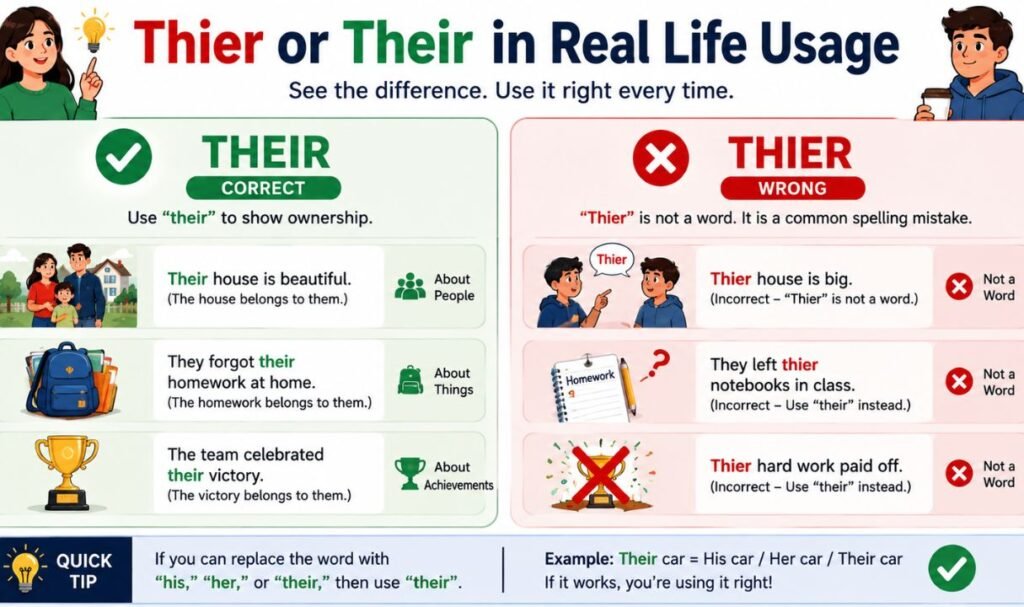
Thier or Their in Real Life Usage
Daily Conversation in Writing
In everyday messages, this mix-up is common but usually harmless. A quick text like “I’m meeting thier family tonight” will likely be understood, but it still reads as a small error. Since pronunciation doesn’t distinguish “their” from “thier” at all, the mistake tends to slip past writers who are relying on how the word sounds rather than how it’s spelled.
Related searches people run into around this topic include comparisons like thier or their or there, questions about thier or their meaning, and people looking for a thier or their quiz to test themselves. Others search for thier or their pronoun, thier or their grammar, or want to see thier or their in a sentence. Some search specifically for thier or their examples, and plenty still bring up thier or their I before E except after C, tracing the mistake straight back to that old classroom rhyme.
Emails
Professional emails carry more weight than a text message, and spelling errors stand out more in that context. A misspelled “thier” in a work email can come across as rushed or careless, even if the rest of the message is well-written. Running a quick reread, or using a grammar checker before sending, catches most of these slips.
Social Media
Social platforms move fast, and typos are common because posts are often written on the go. While a single misspelling in a casual caption rarely causes real harm, brands and public accounts benefit from double-checking their copy, since spelling errors in marketing content can affect how professional a page looks.
Formal Writing
In academic papers, official documents, and business reports, correct spelling is non-negotiable. “Thier” in a formal document is treated the same way any other spelling error would be: it undermines credibility and can distract readers from your actual point. Formal writing is where the E-before-I rule matters most, since these are the documents most likely to be scrutinized.
British and American English Usage
There’s genuinely nothing to debate here. Unlike words such as “colour” and “color,” or “centre” and “center,” where British and American English diverge, “their” is spelled identically on both sides of the Atlantic. There is no regional variant, no alternate accepted spelling, and no dialectal exception.
Examples
| Region | Correct Spelling | Notes |
|---|---|---|
| British English | their | Same spelling as American English |
| American English | their | Same spelling as British English |
| Australian English | their | Same spelling, no regional variation |
| Canadian English | their | Same spelling, no regional variation |
Because there’s no split between dialects, this is one of the easier spelling rules to remember once it clicks. You don’t need to think about your audience’s location or preferred style guide. Their is always the answer.
Which One Should You Use
Use their every single time you want to express possession by a group, whether that’s people, animals, or objects treated as a collective. Never use thier under any circumstance; it isn’t a recognized alternative, just an error.
Quick Check
Ask yourself these three questions before you commit to a spelling:
- Am I showing that something belongs to them? If yes, you need the possessive form.
- Does the word start with T-H, followed by E, then I? If your version has I before E, stop and fix it.
- Would “they” fit if I removed the Y and added “ir”? If so, you’ve built the word correctly.
If you answered yes to the first question and confirmed the letter order in the second, you’re using their correctly.
Common Mistakes and Corrections
| Common Mistake | Correction | Why |
|---|---|---|
| Thier dog is barking. | Their dog is barking. | E comes before I in this word. |
| I saw thier new house. | I saw their new house. | Same rule; letter order was reversed. |
| The team lost thier match. | The team lost their match. | “Thier” is never a valid spelling. |
| Is this their’s? | Is this theirs? | Theirs never takes an apostrophe. |
| Their going to the mall. | They’re going to the mall. | This needs the contraction “they are,” not the possessive. |
| I left my keys over their. | I left my keys over there. | This needs the location word “there,” not the possessive. |
Thier or Their in More Sentences
Simple Sentences
- Their bags are packed.
- I like their new car.
- The kids lost their toys.
Medium Sentences
- Their manager approved the vacation request without any hesitation.
- Neighbors often leave their bins out a day early during the holidays.
- The committee reviewed their proposal before the final vote.
Formal Sentences
- The board of directors submitted their quarterly report ahead of schedule.
- Applicants must include their full employment history in the attached form.
- The university confirmed that all students had met their academic requirements for graduation.
Related Confusing Words
“Their” isn’t the only word that trips people up. It belongs to a small group of commonly confused terms in English:
- There vs. their vs. they’re: “There” refers to a place or is used to introduce a sentence (“There is a problem”). “They’re” is a contraction of “they are.” “Their” shows possession.
- Its vs. it’s: “Its” is possessive, while “it’s” is short for “it is” or “it has.”
- Your vs. you’re: “Your” shows possession, while “you’re” is short for “you are.”
- Affect vs. effect: “Affect” is usually a verb meaning to influence, while “effect” is usually a noun meaning a result.
Understanding these together can help since they share a similar pattern: sound-alike words with completely different jobs in a sentence.
You May Like: Brake vs Break: What’s the Difference and How to Use Each Correctly
Practice Exercises
Fill in the Blanks
- The players celebrated after winning ______ championship game.
- I found ______ wallet on the kitchen table.
- ______ house is the blue one on the corner.
- The company updated ______ privacy policy last month.
- My friends brought ______ own snacks to the picnic.
(Answers: 1. their, 2. their, 3. Their, 4. their, 5. their)
Choose the Correct Word
- (Their / Thier) opinions matter during the meeting.
- Everyone should bring (their / thier) own laptop.
- The dog wagged (their / thier) tail happily. (Note: for animals, “its” is typically correct unless referring to a group.)
- The staff finished (their / thier) shift early.
- I respect (their / thier) decision completely.
(Answers: 1. Their, 2. their, 3. its, 4. their, 5. their)
Frequently Asked Questions
What is correct, their or thier?
Their is correct. Thier is a common misspelling and isn’t recognized in any English dictionary.
Why is “their” spelled that way?
It comes from Old Norse þeirra and has kept the E-before-I order through centuries of English spelling standardization.
When to use there or their?
Use “there” for location or to introduce a sentence, and “their” to show something belongs to a group of people or things.
What is the meaning of theirs?
Theirs is the possessive pronoun used without a following noun, as in “That car is theirs,” and it never takes an apostrophe.
Conclusion
The rule behind their versus thier is short and permanent: their is correct, thier is not, and no version of English recognizes it otherwise. The mix-up usually comes down to muscle memory, fast typing, or an old spelling rhyme that doesn’t apply here. Once you anchor the spelling to the word “they” plus “ir,” the letter order becomes second nature.