
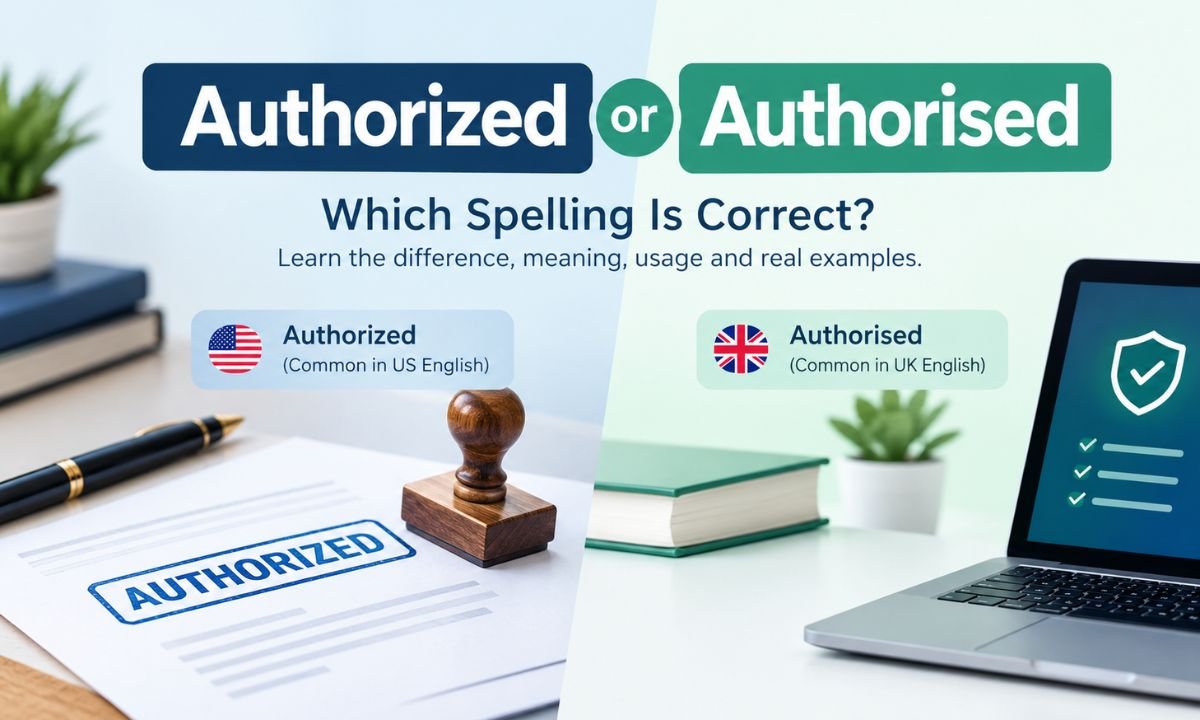
You are typing an email, a contract clause or a product page, and your cursor stops on one word. Is it authorized or authorised? The red squiggle appears under one of them, depending on your spellchecker, and now you doubt yourself.
Here is the short version: both spellings are correct. They are the same word. The only difference is the regional spelling convention behind them. American and Canadian writers use the z. Writers in the United Kingdom, Australia, New Zealand, India, Pakistan and South Africa mostly use the s.
Authorized
Authorized is the standard spelling in American English and Canadian English. It is the past tense and past participle of the verb authorize, and it also works as an adjective.
The word carries two closely related meanings:
- To give official permission for something to happen. The board authorized the purchase.
- Having official approval or legal power to act. Only authorized staff may enter the server room.
You will see authorized in:
- US legal documents and federal agency notices
- Banking and payment screens, such as “authorized transaction”
- Software permissions and login prompts
- Retail signs like “authorized dealer” or “authorized service center”
Related forms follow the same pattern: authorize, authorizes, authorizing, authorization, authorizer. Every one of them keeps the z.
Authorised
Authorised is the standard spelling in British English and in most other English-speaking countries outside North America. The meaning is identical to authorized. Only the ending changes.
The family looks like this: authorise, authorises, authorising, authorisation, authoriser.
Typical places you will meet it:
- UK government and local council documents
- Australian and New Zealand business writing
- Indian and Pakistani newspapers and official correspondence
- British banking, insurance and regulatory language, such as “authorised and regulated by the Financial Conduct Authority”
A well-known example is the phrase “authorised biography,” used in British publishing for a book written with the subject’s approval. The same phrase appears as “authorized biography” in American bookshops.
Authorized or Authorised – Quick Answer
Both spellings are correct. Use authorized for a US or Canadian audience. Use authorised for a UK, Australian, New Zealand, Indian, Pakistani or South African audience.
That is the whole rule. Pick one spelling and keep it the same across your entire document, website or brand style guide.
| Your audience | Correct spelling |
|---|---|
| United States | authorized |
| Canada | authorized |
| United Kingdom | authorised (authorized in Oxford style) |
| Australia | authorised |
| New Zealand | authorised |
| India | authorised |
| Pakistan | authorised |
| South Africa | authorised |
| Global or mixed readers | Choose one and stay consistent |
Notice the small asterisk next to the UK. Oxford University Press and a few academic publishers prefer the z there too. More on that in the history section below.
The Origin of Authorized or Authorised
To understand why two spellings exist, you have to go back to the word’s roots.
Authorize traces to the Latin word auctor, meaning a creator, originator or person with power. From there it passed into Medieval Latin as auctorizare and then into Old French as autoriser. English borrowed it in the Middle Ages, and the word arrived with the meaning “to give authority to.”
The Greek-style ending -izein shaped how many English verbs ended. Words such as organize, recognize and realize picked up the -ize ending because scholars wanted to show their Greek and Latin ancestry. Meanwhile, French spelled similar verbs with an s, as in autoriser. English had both influences available.
For centuries British writers used either ending. Then, during the twentieth century, the -ise form gained ground in Britain. Several reasons are usually given:
- French influence made -ise feel natural to British readers.
- A handful of verbs, like advertise and revise, must end in -ise, so some writers adopted -ise for everything to avoid mistakes.
- Newspapers and publishers standardized on -ise for simplicity.
American spelling, shaped in part by Noah Webster’s dictionaries in the early 1800s, settled on -ize for nearly every verb of this type. So authorize became the American default, while Britain drifted toward authorise.
Here is a fact that surprises many people. Authorize is actually the older form, and it was standard in British English until roughly the second half of the twentieth century. The Oxford English Dictionary still lists authorize as its primary entry. Some British publishers follow the same style, usually called “Oxford spelling.”
Even so, everyday British usage has moved on. Analysis of 21st-century British news publications shows authorise appearing about seven times for every one use of authorize. In Australia and New Zealand the -ise form dominates even more.
British English vs American English Spelling
The authorized/authorised split is one small case of a much larger pattern. If you learn the pattern, you can handle dozens of similar words without looking them up.
Main Rule
The rule is simple:
- American English uses -ize for verbs such as authorize, organize, realize and recognize.
- British English usually uses -ise for the same verbs, though -ize is also accepted in Oxford style.
- Canadian English follows the American -ize pattern for these verbs, even though it keeps British spellings elsewhere, such as colour.
- Australian and New Zealand English strongly prefer -ise.
The same switch carries over to related nouns and adjectives. Authorization becomes authorisation. Authorizing becomes authorising. Unauthorized becomes unauthorised.
One caution: a few words end in -ise in every variety of English. They do not follow the pattern at all. Do not change these to -ize:
- advertise
- compromise
- exercise
- revise
- supervise
- surprise
- improvise
- enterprise
Examples
Here is how the pattern plays out with common verbs.
| American English | British / Commonwealth English |
|---|---|
| authorize | authorise |
| organize | organise |
| recognize | recognise |
| realize | realise |
| apologize | apologise |
| criticize | criticise |
| summarize | summarise |
| finalize | finalise |
| customize | customise |
| prioritize | prioritise |
And here is the same idea inside full sentences:
- US: The manager authorized the refund after reviewing the receipt.
- UK: The manager authorised the refund after reviewing the receipt.
- US: Unauthorized access to this network is prohibited.
- UK: Unauthorised access to this network is prohibited.
- US: We need your authorization before we ship the order.
- UK: We need your authorisation before we ship the order.
Comparison Table
This table puts the two spellings side by side so you can scan the differences in a few seconds.
| Feature | Authorized | Authorised |
|---|---|---|
| Spelling ending | -ized | -ised |
| Main region | United States, Canada | UK, Australia, New Zealand, India, Pakistan, South Africa |
| Part of speech | Verb (past tense), adjective | Verb (past tense), adjective |
| Meaning | Given official permission or power | Given official permission or power |
| Noun form | authorization | authorisation |
| Present participle | authorizing | authorising |
| Negative form | unauthorized | unauthorised |
| Historical age | Older form in English | Became common in Britain in the 20th century |
| Used by Oxford style | Yes | Accepted, but not the Oxford default |
| Common in | US law, tech, finance | UK law, finance, public sector |
| Correct? | Yes | Yes |
How To Use “Authorised” In A Sentence
Because the word works as both a verb and an adjective, you can use it in several ways. Here are examples grouped by function.
As a verb (past tense):
- The council authorised the construction of a new footbridge.
- She authorised her bank to release the funds.
- Parliament authorised the use of emergency powers.
As a past participle in passive sentences:
- The repair was authorised by the head office.
- Payments must be authorised before they leave the account.
As an adjective:
- Only authorised personnel can enter the laboratory.
- You can buy the part from any authorised dealer.
- He wrote the authorised history of the football club.
In regulatory and business language:
- The firm is authorised and regulated by the relevant financial authority.
- An authorised signatory must sign the contract.
- Please contact an authorised service centre for repairs.
Swap the s for a z and every one of these sentences works equally well in American English.
A quick tip: if you can replace the word with “officially approved” or “given permission,” you are using it correctly.
Synonyms and Opposites
Choosing the right synonym keeps your writing from sounding repetitive. Not every synonym fits every context, so check the notes below.
Synonyms
| Synonym | Best used when |
|---|---|
| approved | The decision is formal but not necessarily legal |
| permitted | Someone is allowed to do something |
| sanctioned | An official body has given backing, often for a controversial act |
| licensed | A license or certificate has been issued |
| certified | A standard has been verified |
| empowered | Someone is given the authority to act |
| endorsed | Public support has been expressed |
| cleared | Permission has been given, especially for travel or access |
| validated | Something has been confirmed as acceptable |
| accredited | An institution has been officially recognized |
Opposites
| Antonym | Meaning |
|---|---|
| unauthorized / unauthorised | Done without permission |
| prohibited | Forbidden by rule or law |
| banned | Officially disallowed |
| forbidden | Not allowed at all |
| unapproved | Lacking formal approval |
| illegal | Against the law |
| unlicensed | Operating without the required license |
| barred | Blocked from entry or participation |
Remember that “unauthorized” keeps the same regional split. Americans write unauthorized, and British writers write unauthorised.
Which Spelling Should You Use?
The right choice depends on who will read your writing. Use this short decision guide.
- Writing for readers in the US or Canada? Use authorized.
- Writing for readers in the UK, Australia, New Zealand, India, Pakistan or South Africa? Use authorised.
- Following a style guide or brand guideline? Follow it. A company style sheet always wins over a general rule.
- Submitting to an academic journal? Check the author guidelines. Some British journals follow Oxford spelling and want the z.
- Writing for a global audience? Pick the variant that matches your largest group of readers, then apply it everywhere.
Think about your search audience
If you run a website, your spelling choice can affect who finds you. People in Karachi, London or Sydney tend to type authorised into Google. People in Chicago or Toronto tend to type authorized. Matching the spelling to your main market helps your page look familiar to the reader and to the search engine.
If your site serves both groups, you do not have to pick only one. A few approaches work well:
- Build separate regional pages with the local spelling.
- Use the main spelling in the headline and body, and mention the alternative once in a natural way, as this article does.
- Set the correct language tag in your page code, such as
en-USoren-GB, so search engines know which variety you are using.
Set your spellchecker
Most word processors let you choose a language variety. Set it to English (US), English (UK), English (Australia) or English (Canada) before you start writing. Your editor will then flag the wrong spelling for you.
Common Mistakes with Authorized or Authorised
Even careful writers slip on this word. These are the errors I see most often when editing business and web content.
1. Mixing both spellings in one document. A page that says “authorized users” in the first paragraph and “authorised users” in the fifth looks careless. Consistency matters more than which variety you choose.
2. Using the wrong spelling for the audience. A UK bank sending a customer letter with “authorized” feels slightly off, and so does a US software company writing “authorised.” It is not wrong, but it can look like a template error.
3. Spelling the noun incorrectly. Some writers change the verb but forget the noun. If you wrote authorised, the noun must be authorisation. Mixing authorised with authorization in the same text breaks the pattern.
4. Misspelling the word entirely. Common typos include autorized, authorized with a missing h, authorised written as authorized in a UK-targeted page, and athorized. Read the word slowly once before publishing.
5. Confusing it with “authoritative” or “authorized” as a synonym for “official.” Authorized means permission was given. Authoritative means reliable and trusted. A source can be authoritative without being authorized, and the other way round.
6. Treating one spelling as an error. Calling authorised “wrong” in a British text, or authorized “wrong” in an American text, is itself the mistake. Neither one is incorrect. The question is only whether it fits the audience.
7. Changing -ise to -ize in words that always take -ise. Writers who learn the American pattern sometimes over-apply it and produce advertize or supervize. Those forms are wrong in both American and British English.
8. Ignoring spellchecker language settings. A document set to the wrong language variety will mark correct spellings as errors, and people then “fix” them into the wrong form. Check your settings first.
Authorized or Authorised in Everyday Examples
Seeing the word in real situations makes the choice easier to remember. Here are examples from daily life, shown in both spellings.
At work
- US: Only authorized employees can approve purchase orders.
- UK: Only authorised employees can approve purchase orders.
In banking
- US: You have an authorized payment waiting for confirmation.
- UK: You have an authorised payment waiting for confirmation.
In shopping
- US: Buy from an authorized reseller to keep your warranty valid.
- UK: Buy from an authorised reseller to keep your warranty valid.
In technology
- US: The app asks you to authorize access to your contacts.
- UK: The app asks you to authorise access to your contacts.
In travel
- US: Authorized vehicles may park in this area.
- UK: Authorised vehicles may park in this area.
In publishing
- US: She released an authorized biography of the singer.
- UK: She released an authorised biography of the singer.
In law and government
- US: The statute authorizes the agency to issue fines.
- UK: The act authorises the agency to issue fines.
Each pair shows the same idea. Only the ending shifts.
Authorized or Authorised – Google Trends & Usage Data
A quick honest note first: search interest numbers move every week, so I am not going to invent exact percentages for you. You can check live data yourself by typing both spellings into Google Trends and setting the region to the country you care about. What I can tell you is the pattern that research and corpus studies consistently show.
What the usage evidence says:
- In the United States and Canada, authorized is by far the dominant spelling in books, news and web content.
- In the United Kingdom, authorised leads in newspapers and everyday web writing. One analysis of 21st-century British news found it roughly seven times more common than authorize.
- In Australia and New Zealand, the -ise spelling is even more dominant than in Britain.
- In the British National Corpus, the overall ratio of -ise to -ize across many verbs sits around three to two, which shows that the z is still very much alive in British writing.
- Globally, authorized gets more total search volume, mostly because the US has a very large English-speaking population and heavy online activity.
How to run your own check:
- Open Google Trends.
- Enter “authorized” and “authorised” as two comparison terms.
- Choose the country or region you want to study.
- Set the time range to the last five years.
- Compare the two lines and note which one leads.
Related searches people type alongside these words include authorized dealer, authorised signatory, authorization code, authorisation form, unauthorized access and authorised representative. Those phrases show that the word is mostly used in legal, banking, retail and technology settings.
Keyword Comparison Table
If you write for search, this table shows how the related keywords pair up across the two spellings. Use it to plan which version to target for each regional audience.
| US keyword | UK / Commonwealth keyword | Typical context |
|---|---|---|
| authorized | authorised | General use |
| authorize | authorise | Verb form |
| authorizing | authorising | Ongoing action |
| authorization | authorisation | Permission, access, payments |
| unauthorized | unauthorised | Security, law, warnings |
| authorized dealer | authorised dealer | Retail and warranty |
| authorized signatory | authorised signatory | Banking and contracts |
| authorized user | authorised user | Accounts and software |
| authorization code | authorisation code | Payments and login |
| authorized representative | authorised representative | Legal and business |
| authorized service center | authorised service centre | Repairs |
| authorized biography | authorised biography | Books |
Notice that other spelling differences sometimes sit inside the same phrase. Center and centre are a good example. If you target a UK audience, change both words, not just the verb.
Frequently Asked Questions
Is “authorized” or “authorised” correct?
Both are correct. Authorized is standard in American and Canadian English, and authorised is standard in British and most Commonwealth English.
Which spelling does the Oxford Dictionary prefer?
The Oxford English Dictionary lists authorize with a z as its primary spelling. It still accepts authorise as a common British variant.
Can I use “authorised” in the United States?
You can, and readers will understand it, but it will look like a British spelling. For US audiences, authorized is the safer choice.
Does the spelling affect the meaning?
No. Both spellings mean “to give official permission or power.” Only the regional convention changes.
What about “authorisation” vs “authorization”?
The same rule applies. Use authorization in the US and Canada, and authorisation in the UK, Australia and most other English-speaking countries.
Is “authorised” more formal than “authorized”?
No. Neither spelling is more formal. Formality comes from your wording and tone, not from the ending.
Which spelling should I use for global content?
Choose the spelling used by most of your readers and apply it consistently. If your audience is truly mixed, authorized is a practical default because of its higher worldwide search volume.
Conclusion
The debate over authorized or authorised has a calm answer. Both are correct, both mean the same thing, and the only real question is who you are writing for.