
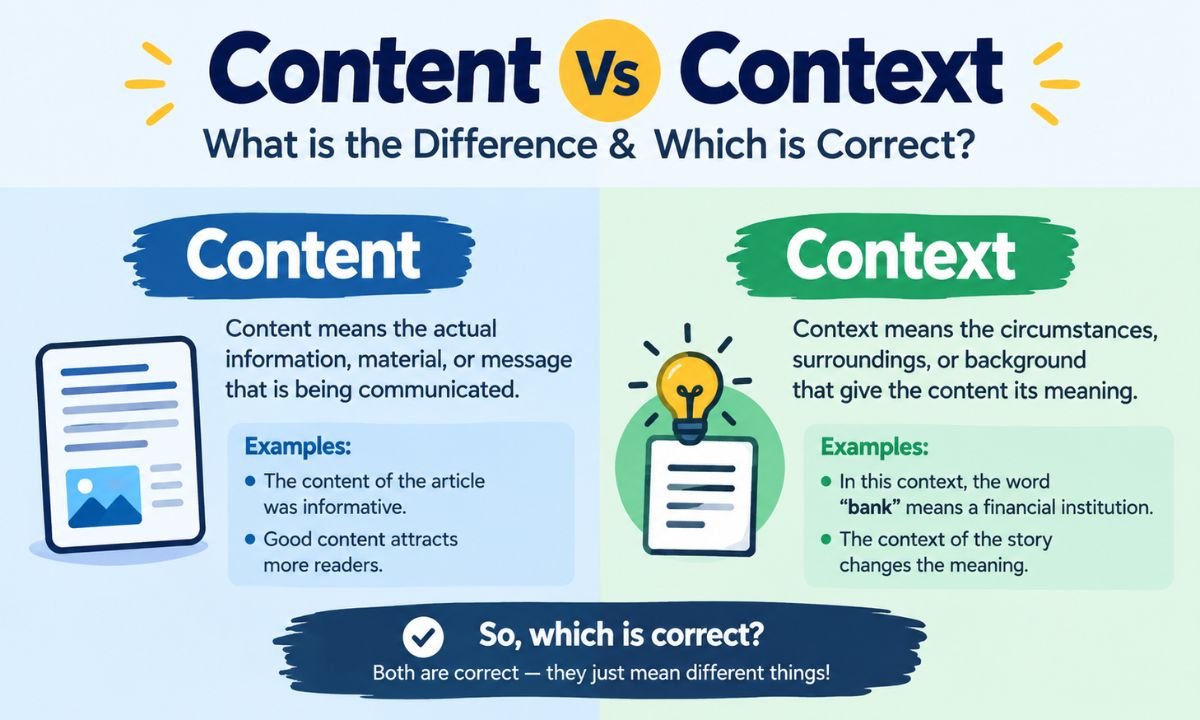
Two words, one shared prefix, and a lot of confusion. Content and context look alike on the page, they often appear in the same sentence, and writers swap them by accident more often than you would expect.
Short answer: Content is the material itself: the words, images, data, or message. Context is the situation around that material: who said it, when, where, and why. Neither word is “more correct.” They are different words that do different jobs, and the right choice depends on what you actually mean.
Comparison Overview
Before the details, here is a quick snapshot you can scan in ten seconds.
| Feature | Content | Context |
|---|---|---|
| Core meaning | The material, message, or substance | The setting or circumstances around the message |
| Answers the question | “What is being said or shown?” | “Why, when, where, and by whom?” |
| Part of speech | Noun (also an adjective, pronounced differently) | Noun |
| Plural form | Contents (for things inside something) | Contexts |
| Typical examples | An article, a video, a photo, a paragraph | A conversation, a historical period, a platform, a mood |
| Role in meaning | Carries the information | Shapes how the information is understood |
| Common phrase | Table of contents, content marketing | Out of context, context clues |
In short, content is what you see. Context is what helps you make sense of it.
Definition of Content
Content is the actual substance of something. It is whatever a container, a message, or a piece of media holds or delivers.
The word works in several ways, so it helps to separate them.
1. Content as information or media. This is the most common modern use. A blog post, a podcast episode, a product photo, and a tutorial video are all content. Marketers use the term broadly, and search engines evaluate it constantly.
2. Contents as the things inside something. Here the word is usually plural. You check the contents of a box, a bag, or a document. The “table of contents” in a book lists what the book holds.
3. Content as a feeling. As an adjective, content means satisfied or at ease. “She felt content after a long walk.” This version is stressed on the second syllable (kuhn-TENT), while the noun is stressed on the first (KON-tent).
Key traits of content
- It can be created, edited, copied, and published.
- It exists whether or not anyone is looking at it.
- It can inform, entertain, persuade, or teach.
- It can be measured by quality, accuracy, and relevance.
Think of content as the cargo on a ship. It matters a great deal, but cargo alone does not tell you where the ship is going or why.
Definition of Context
Context is the set of circumstances, background, or surroundings that give something its meaning. The word comes from the Latin contexere, which means “to weave together.” That origin is useful: context is what weaves a message into the world it belongs to.
Context can be several things at once.
- Situational context: What is happening when the message appears. A shout at a football match means something different from a shout in a library.
- Cultural context: The beliefs, customs, and norms of the people involved. A hand gesture that is friendly in one country can be rude in another.
- Historical context: The time period and events surrounding a statement, law, or book.
- Linguistic context: The words and sentences that sit before and after a particular phrase. This is why dictionaries give example sentences.
- Platform context: Where content is displayed, such as a news site, a private chat, or a social feed.
Key traits of context
- It is rarely visible on its own. You usually infer it.
- It changes how the same content is read.
- It includes timing, audience, tone, source, and location.
- It can be added, removed, or distorted, sometimes deliberately.
If content is the cargo, context is the sea, the weather, and the route. Strip those away and the cargo loses its meaning.
Main Differences Between Content and Context
The two ideas are partners, yet they are not interchangeable. This table shows where they split.
| Point of difference | Content | Context |
|---|---|---|
| Nature | Tangible and visible | Often invisible and inferred |
| Focus | The message itself | The surroundings of the message |
| Control | Creators can edit it directly | Creators can influence it but rarely own it fully |
| Question it answers | What? | Why, when, where, who? |
| Can it stand alone? | Yes, as raw material | Not really, because context needs something to surround |
| Effect on meaning | Supplies the information | Decides how the information is read |
| Marketing role | Articles, videos, emails, posts | Timing, audience mindset, device, location |
| Language use | “Original content,” “web content” | “In this context,” “taken out of context” |
| Risk when ignored | Message is weak or inaccurate | Message is misread or feels irrelevant |
A quick example that shows the gap
Take the sentence “That was brilliant.”
The content is those three words. The context decides what they mean. Said after a stunning goal, it is praise. Said after a spilled drink, it is sarcasm. The words never changed, but the meaning flipped.
That one example captures the whole difference. Content holds the message. Context steers it.
Grammar Guide
Getting the grammar right takes only a few minutes of practice. Start with how each word behaves inside a sentence.
How each term is used in sentences
Content as a noun (information or media):
- The website publishes new content every Monday.
- Her video content has grown a loyal audience.
- The content of the report surprised the committee.
Contents as a plural noun (things inside):
- The contents of the envelope were never revealed.
- Please list the contents of your suitcase.
- The table of contents shows twelve chapters.
Content as an adjective (satisfied):
- He seemed content with the offer.
- The cat looked content on the warm windowsill.
Context as a noun:
- You cannot judge that remark without the context.
- In this context, the word “bank” refers to a river’s edge.
- The historian explained the political context of the treaty.
Context in common phrases:
- Out of context: removed from the surrounding information, so the meaning changes.
- In context: viewed together with the surrounding information.
- Context clues: hints in nearby words that reveal a meaning.
- Contextual: an adjective meaning “related to context.”
Common mistakes learners make
Even confident writers slip here. These are the errors that show up most.
- Using content when you mean context. Wrong: “You need to understand the content of the situation.” Right: “You need to understand the context of the situation.”
- Using context when you mean content. Wrong: “The context of the email was two paragraphs long.” Right: “The content of the email was two paragraphs long.”
- Mixing up the adjective and the noun. Confusing: “I am content with the content.” Both words are spelled the same but mean different things. Rewrite it: “I am happy with the content.”
- Forgetting the plural. Wrong: “The content of the box were damaged.” Right: “The contents of the box were damaged.”
- Treating “contextual” and “content” as synonyms. They are not. Contextual describes something tied to its surroundings. Content names the thing itself.
- Writing “in the context of” when a simpler word works. “In the context of weather” can usually be shortened to “regarding weather” or “about weather.”
- Pronouncing the adjective like the noun. Spoken English separates them. KON-tent is the material, kuhn-TENT is the feeling.
Simple rules to remember
- If you can hold it, read it, watch it, or open it, it is content.
- If you need to ask “under what circumstances?”, you are talking about context.
- Use contents for things inside a container.
- Use content (singular) for media, information, or substance as a whole.
- Use context when meaning depends on surroundings.
- A handy memory trick: context contains clues; content contains cargo.
- Another trick: context has the word text inside it, and text is shaped by what comes around it.
Quick tips for writing and speaking
For writing:
- Read your sentence aloud and replace the word with “the material” or “the situation.” Whichever fits is your answer.
- Avoid stacking abstract nouns. “Contextual content considerations” says very little. Pick a plain verb instead.
- When you quote someone, add a line of background so readers get the context along with the content.
- In SEO writing, keep content focused on one topic and let surrounding headings and links supply the context.
For speaking:
- Stress the first syllable for the noun (KON-tent) and the second for the adjective (kuhn-TENT).
- Say “context” with a crisp “KON-text,” and do not let the two words blur together when you talk fast.
- If you are unsure in conversation, use a simpler phrase: “the background” for context, “what it says” for content.
When to Use Each One
Choosing the right word is easier when you match it to your intention.
Use content when you mean:
- A published piece of material. “Our content team produces two guides a week.”
- The substance of a message. “The content of her speech was thoughtful.”
- Things held inside something. “The contents of the drawer were sorted.”
- A strategy or industry. “Content marketing, content strategy, and content management systems.”
- Being satisfied. “He was content with a simple dinner.”
Use context when you mean:
- Background that explains something. “The context behind the decision matters.”
- The circumstances of a statement. “Her joke was fine in context, but harsh on its own.”
- Surroundings that guide interpretation. “The reader’s context shapes how the headline lands.”
- Word meaning from nearby words. “Use context clues to guess unfamiliar vocabulary.”
- Audience, timing, or device in marketing. “Mobile users in a commute are a different context from desktop users at work.”
A fast shortcut
Ask yourself two questions:
- Am I pointing at the thing itself? Choose content.
- Am I pointing at what surrounds the thing? Choose context.
When NOT to Use Each One
Knowing where a word does not belong prevents the most common slip-ups.
Do NOT use content when:
- You are describing the background or circumstances. Say context, background, or setting.
- You want the reason behind something. “The content behind the policy” should be “the context behind the policy” or “the reasoning behind the policy.”
- You mean a situation’s surroundings, such as a historical period or a cultural setting.
- You are using the singular form for physical items inside a container. Use contents.
Do NOT use context when:
- You are naming the message, data, or material itself. Say content, text, or material.
- You are talking about quality or quantity of writing. “The context of this article is excellent” should be “The content of this article is excellent.”
- You mean a feeling of satisfaction. That is content the adjective.
- You are adding a fancy word for no reason. “In this context” can often be deleted without losing any meaning.
Warning signs in your own draft
- You wrote “context” and the next words describe what something says. You probably need content.
- You wrote “content” and the next words describe when, where, or why. You probably need context.
Which One to Use (Decision Guide)
When you are stuck, walk through this simple flow. It works for essays, emails, captions, and spoken English.
Step 1. Can you replace the word with “the material” or “what is inside”?
- Yes: use content (or contents if it is a physical container).
- No: go to Step 2.
Step 2. Can you replace the word with “the background” or “the circumstances”?
- Yes: use context.
- No: go to Step 3.
Step 3. Does the sentence describe someone feeling satisfied?
- Yes: use content as an adjective.
- No: rewrite the sentence, because the word you want may be neither.
Quick-reference chart
| If your sentence is about… | Use |
|---|---|
| Words, images, videos, data | Content |
| Items inside a box, file, or bag | Contents |
| Why something happened | Context |
| Time, place, audience, or mood | Context |
| Meaning that changes by situation | Context |
| Feeling at ease | Content (adjective) |
| A publishing or marketing plan | Content |
| Explaining background to a reader | Context |
So, which is correct?
Both can be correct. The mistake is not picking the “wrong” one in general. The mistake is picking the one that does not match your meaning. Content answers what. Context answers under what conditions.
Real-World Practical Examples
Abstract definitions only go so far. These examples show both ideas at work in everyday settings.
Content Examples
- In marketing and websites
- A how-to blog post on repairing a bike tyre.
- A product demo video on a store’s landing page.
- An infographic that compares three phone plans.
- The newsletter a bakery sends each Friday.
2. In education
- A chapter on photosynthesis in a biology textbook.
- A recorded lecture on the French Revolution.
- Practice worksheets for fractions.
3. In daily life
- The contents of your wallet: cards, cash, a receipt.
- The text of a message from a friend.
- The playlist you share with a colleague.
4. In technology
- The data stored in a spreadsheet.
- Photos in a cloud folder.
- A page managed through a content management system.
In every case, the content is the thing you could point to or open.
Context Examples
Conversation
- A friend says, “I’m fine.” If she says it with a smile after good news, it is true. If she says it with a flat voice after a bad day, it likely is not. The words are the content. The tone and situation are the context.
History and law
- A quote from a 1940s speech reads very differently once you know the war that was underway. Courts also weigh the context of a statement, not only its wording.
Language learning
- A student meets the word “light” in a sentence about luggage. Nearby words like “carry-on” and “weight” signal that it means “not heavy,” not “bright.” That is the power of context clues.
Social media
- A screenshot of one angry reply looks harsh. The full thread, which shows what provoked it, is the context that changes the reading.
Marketing
- A coffee ad shown to someone at 7 a.m. on a commute lands well. The same ad shown at midnight may not. The ad is identical. The moment is not.
Workplace communication
- “We need to talk” from a manager can mean praise or concern. What happened earlier that week supplies the context.
The pattern is consistent: context never replaces content, but it decides how that content is received.
Self-Assessment (Fill in the Blanks)
Test yourself. Choose from content, contents, or context for each sentence. Some blanks may need a different form, so read carefully.
- A single line pulled out of ______ can mean the opposite of what the speaker intended.
- The blog’s ______ includes guides, videos, and a weekly podcast.
- I am perfectly ______ with a quiet evening at home.
- You can guess the meaning of a new word by using ______ clues.
- The email’s ______ was polite, but the timing made it feel rude.
- Before quoting the senator, check the historical ______ of the speech.
- The table of ______ appears on page two.
- Same joke, different room: the ______ changed, so the reaction did too.
- She uploads fresh video ______ every Friday.
- Without the right ______, even brilliant material can fall flat.
Answers
- context. The phrase “out of context” describes a line separated from its surroundings.
- content. It refers to published material, so the singular noun fits.
- content. This is the adjective meaning satisfied (stressed on the second syllable).
- context. “Context clues” is the standard phrase for hints in nearby words.
- content. The wording of the email is the content. The timing is the context.
- context. Historical background is context.
- contents. A table of contents lists what a book holds, so it takes the plural.
- context. The room and situation changed, not the joke itself.
- content. Video material is content.
- context. Surroundings and timing decide whether material works.
Score guide: 9 to 10 correct means you have a firm grip on both words. 6 to 8 means you are close, so review the “simple rules” section. Below 6, reread the definitions and try the quiz again tomorrow.
Frequently Asked Questions
What is Content Vs Context in simple words
Content is what is said or shown, and context is the situation around it that gives it meaning.
Why is context important in communication
Context tells the listener or reader how to interpret a message, which prevents misunderstandings, wrong assumptions, and misquotes.
Can content exist without context
Yes, content can exist on its own as raw material, but without context its meaning is often unclear or easy to misread.
What is an example of content and context
A quote from a speech is the content; the date, audience, and event where it was spoken are the context.
How do content and context work together
Content supplies the message and context shapes how it is understood, so the strongest communication needs both to match the audience and the moment.
Conclusion
Content and context share a prefix and a lot of letters, but they do very different work. Content is the substance: the article, the image, the data, the words you actually put out. Context is everything around that substance: timing, audience, tone, culture, and place.
If you remember only one thing, remember the cargo and the sea. A ship can carry the finest cargo in the world, yet without knowing the route and the weather, nobody can say whether the journey makes sense.