
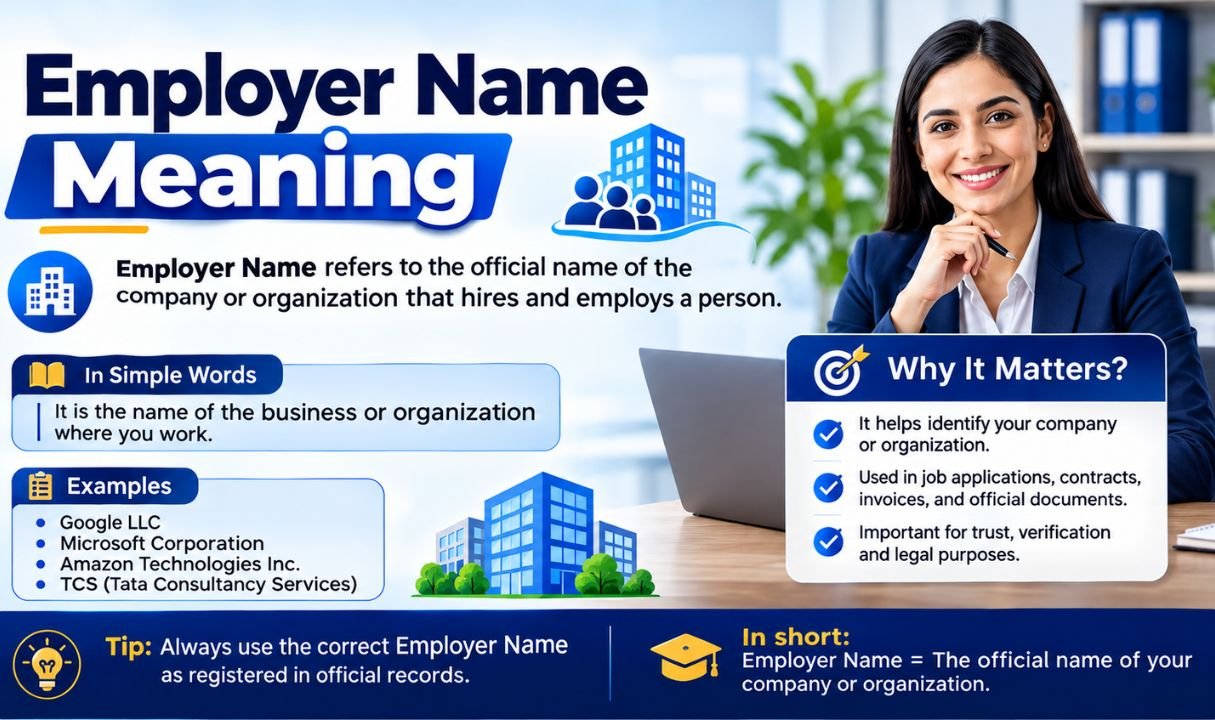
Employer name refers to the official, legal name of the company, organization, or individual that hires and pays you. On forms, resumes, and job applications, it identifies exactly who employed you, not your job title, your manager, or the department you sat in.
That one-line answer covers most searches. But the field trips people up more than it should, because “employer” and “employer name” get used loosely across CVs, loan forms, insurance paperwork, and government applications. Here’s the full picture, with every situation you’re likely to run into.
What Does “Employer Name” Mean? (Quick Answer)
Employer name is the entity, not the person you report to. If you worked at a retail chain, your employer name is the registered business, such as “Target Corporation,” not your store manager’s name or the mall it sits in.
You’ll see this field worded several ways, and they all mean the same thing:
- Employer name
- Employer’s name
- Name of employer
- Employers name (missing apostrophe, still identical meaning)
- Name of the employer
Whichever version a form uses, the answer expected is the same: the official name of the organization or person paying your wages.
Employer Name vs Name of Employer (Are They the Same?)
Yes, completely. “Name of employer” and “employer name” are just two orders of the same phrase. Government forms, tax documents, and older paper applications tend to favor “name of employer,” while modern online job portals usually shorten it to “employer name.”
| Phrase | Where you’ll see it | Meaning |
|---|---|---|
| Employer name | Job applications, resumes, HR software | Official company name |
| Name of employer | Tax forms, visa paperwork, bank forms | Same, official company name |
| Employer’s name | Insurance and legal documents | Same, with possessive grammar |
No form is asking something different by rewording the phrase. Treat all three as one and the same question.
Is Employer Name the Company or a Person?
Usually the company. But not always, and this is where people get stuck. If you work for a registered business, the employer name is that business’s legal name. If you’re employed directly by an individual, the employer name is that person.
| Work situation | What to write as employer name |
|---|---|
| Corporate job | Registered company name |
| Nanny, driver, or house help | Employer’s full personal name |
| Freelance or contract work | Your business name, or “Self-Employed” |
| Government position | The department or ministry name |
| Gig platform work | The platform name, unless the form asks for the end client |
If you’re unsure, check your pay stub or offer letter. The name printed there, not the brand you casually refer to the company by, is the one to use.
You May Also Like
Infact or In Fact? The Correct Way to Write It (With Examples)
Employer Name Meaning on a Job Application
On a job application, employer name asks for the exact company you currently work for or previously worked for, listed against each role in your work history section. Applications often split this into “current employer” and “previous employer” so hiring teams can trace your full timeline.
What Recruiters Expect
Recruiters use this field to run background checks, confirm dates of employment, and verify your reported salary or title. Because of that, accuracy matters more than style.
- Use the full legal or registered name, not a nickname
- Skip abbreviations unless they’re widely recognized, like IBM or UCLA
- Match the name exactly as it appears on your offer letter or payslip
- Add the city or branch if the company has multiple locations and the form allows it
When in doubt between a full name and its short form, lean toward the full version. Write “University of California, Los Angeles” instead of just “UCLA” on a formal application, even though most readers would understand either. The full name never counts against you, while an unfamiliar abbreviation occasionally does.
Common Mistakes to Avoid
Most errors on this field come from confusing employer name with something else on the org chart.
- Writing your manager’s or supervisor’s name instead of the company’s
- Using an internal nickname the public wouldn’t recognize
- Mixing the job title into the employer name field
- Leaving it blank when a “Self-Employed” or “N/A” entry would be more accurate
A clean, correctly formatted employer name signals professionalism before a recruiter reads a single line of your experience.
One detail people overlook: if you held more than one role at the same company, list the employer name separately for each position rather than merging them into one entry.
Most online application systems have a dedicated field for adding multiple roles under a single employer, so use it instead of cramming both titles into one line.
Employer Name Meaning in a Resume or CV
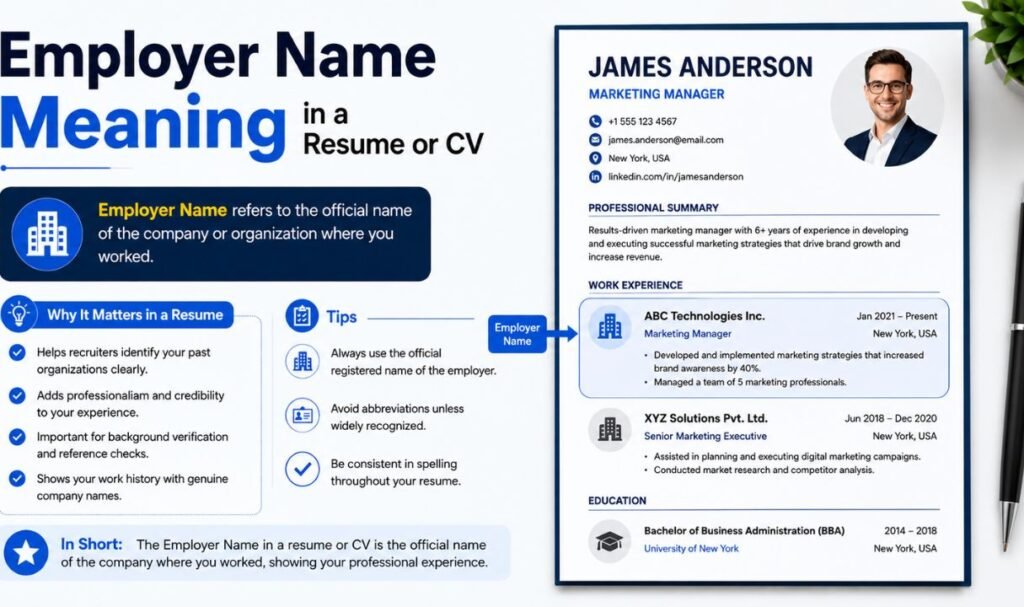
On a CV or resume, employer name is simply the company listed under each job entry in your work history. It answers one question for the reader: where did you work?
Example CV Entry
Job Title: Marketing Coordinator Employer Name: Horizon Retail Group Duration: 2023 to Present
Keep the format consistent across every entry. If you switch between full names and shortened versions from one job to the next, it reads as careless, even if the information itself is correct.
You May Also Like
Seeing or Seing: Which Spelling Is Correct?
Current Employer Name vs Employer Name
“Current employer name” narrows the question to the company you work for right now, as opposed to past employers listed elsewhere on the same form. You’ll see this distinction most often on loan applications, insurance forms, and background check paperwork, where lenders and insurers need to know who currently pays you.
Example: Current Employer Name: Meridian Software Ltd
If you’re between jobs, most forms accept “Unemployed” or “Not currently employed” rather than leaving the field blank, since blank fields can flag as incomplete during automated review.
What Does Employer’s Name Mean? (The Apostrophe Explained)
The apostrophe in “employer’s name” is just possessive grammar. It shows that the name belongs to the employer, the same way “the company’s address” means the address belonging to the company.
So functionally:
Employer’s name = Employer name = Name of employer
There’s no difference in what the form wants from you. The apostrophe is a grammar convention, not a separate question.
Employer Name vs Employer Business Name
“Employer business name” typically refers to the registered trade or business identity of the employer, which is almost always identical to the employer name. The two only diverge when a company operates under a different public-facing brand than its legal registration.
Example: Legal Business Name: Sunrise Holdings Pvt Ltd Employer Name (as commonly used): Sunrise Holdings
If your form specifically separates these two fields, use the legal registration for “business name” and the name on your payslip for “employer name.” In most everyday cases, they’re the same entry repeated twice.
Name and Address of Employer Meaning
“Name and address of employer” asks for two pieces of information together: the official company name plus its physical business address. Lenders and government agencies use this combination to verify both your workplace and its location for identity or income checks.
Example: Employer Name: Crestline Technologies Pvt Ltd Address: 45 Industrial Park Road, Lahore
Use the head office or the branch address listed on your employment documents, not a temporary work-from-home location.
What to Write If You’re Self-Employed or Freelance
If you run your own business, write your registered business name in the employer name field. If you don’t operate under a formal business name, it’s completely acceptable to write your own full name instead, since you are, functionally, your own employer.
For the job title field alongside it, use something accurate and specific, such as “Freelance Writer,” “Independent Contractor,” or “Founder.” Some forms also accept “Self-Employed” or “Multiple Clients” as the employer entry, particularly if you work across several projects rather than one steady arrangement.
What to Write If You Have No Work Experience Yet
First-time applicants often stall on this field simply because they’ve never had a job. If that’s your situation, it’s fine to leave the field blank or write “N/A,” and use any volunteer work, internships, or school-organized activities instead if the form allows a substitute entry.
Hiring teams reviewing entry-level applications rarely penalize an empty employer history. They’re generally more focused on your availability, communication, and willingness to learn than on a work timeline you haven’t had time to build yet.
What to Write If Your Former Employer Closed, Merged, or Changed Name
Businesses close, get acquired, or rebrand more often than people expect, and that doesn’t make your work history there invalid. Write the company name exactly as it was when you worked there, since that’s the name your employment records and references will match.
If the application gives you room for a note, a short line like “Company name changed following a merger in 2024” adds useful context without turning into a long explanation. If a recruiter needs proof beyond your entry, they can typically request a former supervisor’s contact, a pay record, or a tax document instead.
Employer Name Examples by Situation
| Situation | Employer Name to Write |
|---|---|
| Corporate job | Microsoft Corporation |
| Local small business | Bright Future Traders Pvt Ltd |
| Government job | Ministry of Health |
| Freelancer with no registered name | Your full legal name |
| Student internship | XYZ Marketing Agency |
| Household employment | Employer’s personal name |
| Company that has since closed | Original company name at time of employment |
Employer Name in Different Contexts
The core meaning of employer name stays fixed, but why it’s collected changes depending on the form.
- Banking: Used to verify income and employment status before approving loans or credit cards
- Insurance: Used to confirm policy eligibility and group coverage details
- Government forms: Used for identity verification and tax record matching
- Job applications: Used to confirm your employment history and check references
Across all four, the standard doesn’t change: write the official name, keep it consistent with your records, and avoid shorthand the reader might not recognize.
FAQs
What is an employer name?
It’s the official name of the company, organization, or individual that hires you and pays your wages.
What is an example of an employer?
A registered business like “Global Marketing Solutions Pvt Ltd,” a government department, or an individual who directly hires someone like a nanny or driver.
What should I put in the employer name?
Write the full legal or registered name of the organization you work for, matching your payslip or offer letter, not a nickname or abbreviation.
What is an example of an employee name?
That’s simply your own full legal name, the one listed on your employment contract or ID, distinct from the employer name field.
Is employer name the same as company name?
In most cases, yes. It only differs when your employer is an individual rather than a registered business.
What if I’m currently unemployed?
Write “Unemployed” or “Not currently employed” instead of leaving the field blank, since blank entries can read as incomplete on automated forms.
Conclusion
Employer name, name of employer, and employer’s name all ask the same question: who officially employs you? Use the legal or registered name, stay consistent across every document you submit, and adjust only for genuine edge cases like self-employment, household work, or a first job you haven’t started yet. Get that one detail right, and the rest of the form takes care of itself.