
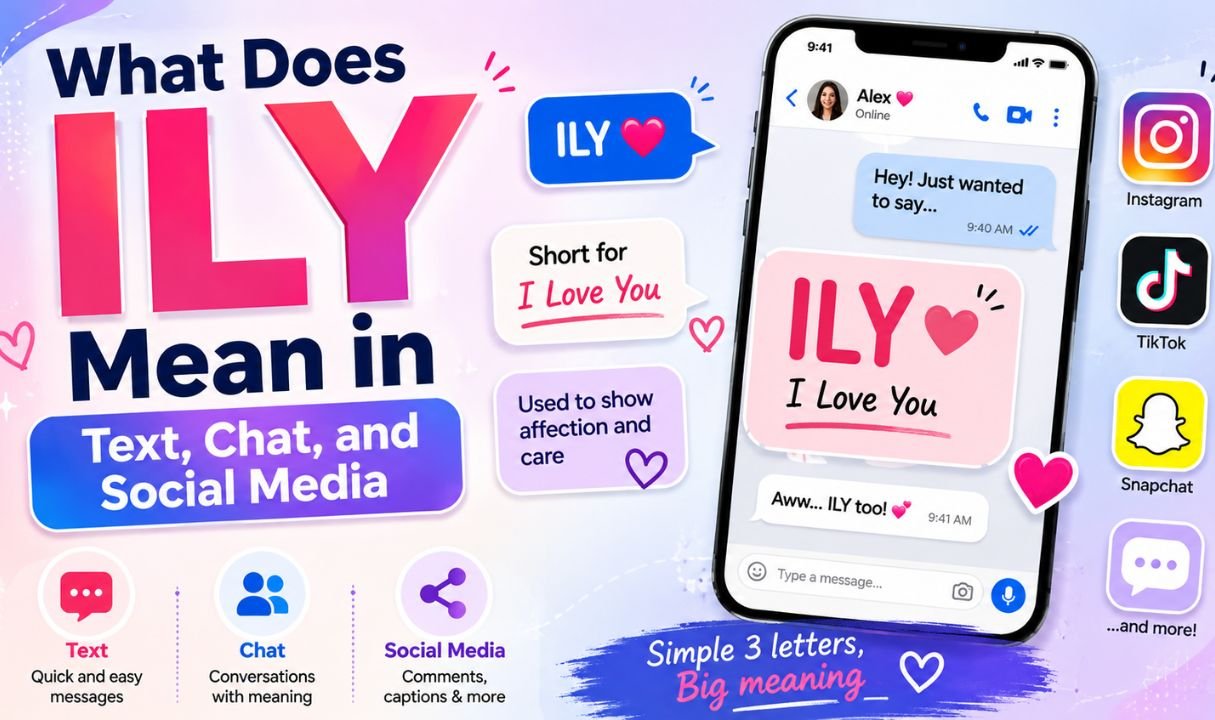
You get a text from someone you care about. It’s short — just three letters: ILY. No punctuation, no explanation, just those letters sitting on your screen. If you’ve ever paused and typed “what does that mean” into Google right after, you’re far from alone.
This guide breaks down exactly what ILY means, how people use it across texting apps and social platforms, and how to respond when someone sends it to you.
Quick Answer
ILY stands for “I Love You.” It’s a shorthand people use in texts, DMs, and social media captions when they want to express love, affection, or appreciation without typing the full phrase.
It’s casual, quick, and often used between romantic partners, close friends, and family members. While it almost always means “I love you,” the tone can shift depending on who sends it and the situation surrounding it.
Example:
Maya: heading to bed, long day tomorrow Josh: night, drive safe tmrw. ily Maya: ily2 💛
ILY Meaning in Text and Chat Explained
ILY is a texting abbreviation built from the first letters of “I Love You.” It belongs to the same family as other shorthand terms like BRB, TTYL, and OMW — phrases people shortened once typing on tiny phone keyboards became part of daily communication.
Unlike some slang terms that change meaning entirely, ILY has stayed fairly consistent. It’s almost never used sarcastically and rarely means anything other than affection, though a small number of niche or joking uses exist further down in this guide.
What ILY Usually Communicates
In most conversations, ILY sends one of these messages:
- Genuine romantic love toward a partner
- Platonic love or closeness toward a friend
- Warmth and gratitude toward a family member
- A quick way to end a conversation on a positive note
Why People Use ILY Instead of Typing “I Love You”
People reach for ILY because it fits the rhythm of modern texting. A few reasons stand out:
- Speed — three letters beat eleven.
- Casual tone — it feels lighter and less intense than the full phrase.
- Habitual affection — it works well for everyday, low-stakes moments, like signing off a text.
- Comfort with vulnerability — for some people, an abbreviation feels easier to send than spelling the words out.
Real Chat Examples
Seeing ILY in context makes the meaning clearer than any definition alone.
Texting Example
“omw, be there in 10, ily”
Family Example
“Made it home safe. Thanks for dinner tonight, ily mom”
Romantic Example
“Can’t stop thinking about this weekend. ily so much”
Friendship Example
“You seriously saved me today. ily, you’re the best”
Variations and Synonyms of ILY
ILY has spawned several close cousins, each adjusting the intensity or tone slightly.
Common Variations
| Variation | Meaning |
|---|---|
| ILY2 | I love you too |
| ILYSM | I love you so much |
| ILYSFM | I love you so freaking much |
| ILU | I love you (alternate spelling) |
| ILYB | I love you baby |
| ILYVM | I love you very much |
Popular Search Variations
People search for ILY in different contexts, and the meaning can shift slightly depending on who’s sending it:
- Ily mean in text from girl — usually signals affection toward a partner, close friend, or family member; context and the relationship decide how romantic it is.
- Ily mean in text from a guy — carries the same core meaning, though guys may use it more sparingly, which can make it feel more significant.
- Ily meaning from a girl — generally warm and sincere, whether platonic or romantic.
- Ily meaning from a guy — often used once trust or comfort has built up in the relationship.
- Ily meaning funny — occasionally used jokingly after a friend does something ridiculous or relatable, more as an exaggerated reaction than literal love.
- What does ily mean dirty — outside of niche slang communities, ILY doesn’t carry a sexual meaning; it stays tied to affection, not innuendo.
- ILY in text — simply the written shorthand for “I love you” across any messaging platform.
- Does ily mean I love you — yes, in the vast majority of everyday conversations, that’s exactly what it means.
You May Also Like: Seeing or Seing: Which Spelling Is Correct?
Background and History of ILY
Early Internet Usage
ILY dates back to the early days of instant messaging platforms like AIM and MSN Messenger, where character limits and slow typing speeds pushed users toward abbreviations. As texting on mobile phones took over in the 2000s, the same shorthand carried over naturally.
Why ILY Became Popular
Texting culture rewards brevity. As SMS plans charged by character count and phone keypads made typing tedious, abbreviations like ILY spread because they preserved meaning while cutting effort. Once smartphones and social apps arrived, the habit stuck — not out of necessity anymore, but out of familiarity and style.
How ILY Is Used in Texting and Social Media
ILY shows up almost everywhere people communicate digitally, though the tone shifts slightly by platform.
Platform Usage Examples
- Texting/iMessage: Common as a sign-off at the end of a conversation.
- Instagram: Frequently used in comments, captions, or as a hashtag (#ily) under photos of loved ones.
- Snapchat: Sent quickly between close friends, often paired with a heart emoji or streak update.
- TikTok: Appears in comment sections under emotional or wholesome videos.
- Twitter/X: Used in replies to show support or appreciation for a post or person.
Important Tip
Match the tone of the platform. A comment under a public post reads differently than a private DM — ILY in a public comment usually reads as friendly support, while the same three letters in a private chat can carry more personal weight.
ILY vs Love You vs ILYSM
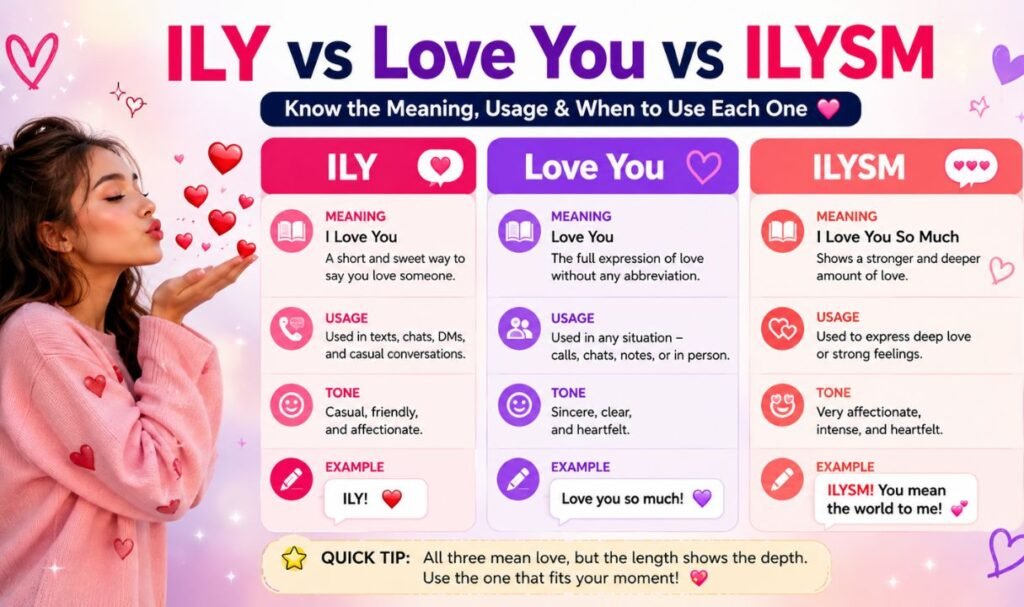
These phrases sit on a small scale of intensity, even though they all point back to the same core sentiment.
| Phrase | Formality | Typical Use Case |
|---|---|---|
| ILY | Very casual | Quick texts, sign-offs, everyday affection |
| Love You | Casual, but softer than “I love you” | Verbal or written goodbyes |
| ILYSM | Casual, but emphatic | Expressing stronger or heightened affection |
| I Love You | Formal/full expression | Serious, sincere, or significant moments |
Key Insight
The shorter the phrase, the more casual it usually feels — but shorter doesn’t mean less sincere. Many couples and families use ILY constantly precisely because it fits into daily, low-pressure communication.
Why People Use ILY
Common Reasons
People reach for ILY for practical and emotional reasons alike.
1. To Show Affection
It’s a fast way to let someone know they’re loved, even in the middle of a busy day.
2. To Strengthen Relationships
Small, frequent expressions of affection help maintain closeness between partners, friends, and family members over time.
3. To Show Appreciation
ILY often follows a favor, a kind gesture, or a moment of support — it works as a quick thank-you with warmth attached.
4. To Support Friends
Sent after a friend shares good or bad news, ILY reassures them they’re cared for.
5. To Create Positive Communication
Ending a conversation with ILY leaves things on a warm note, even after a mundane or logistical exchange.
Professional Suitability
Situations to Avoid
ILY doesn’t belong in:
- Work emails or Slack messages
- Client-facing communication
- Formal announcements
- Messages to acquaintances or coworkers you’re not personally close with
Appropriate Professional Alternatives
Instead of ILY, professional messages can close with:
- “Thanks so much, appreciate you”
- “Best” or “Best regards”
- “Really grateful for your help”
Important Note
Even close coworkers who are also personal friends should generally keep ILY out of work channels — it can read as unprofessional if seen out of context by others.
Other or Hidden Meanings of ILY
Less Common Meanings
While rare, ILY has occasionally been used to mean:
- “I’m Leaving You” — an uncommon, mostly joking usage tied to breakup contexts
- A username or handle abbreviation on some platforms
- Islay Airport’s IATA code (ILY), unrelated to texting entirely
Why Context Matters
These alternate meanings are rare enough that, in nearly every everyday text conversation, ILY should be read as “I love you.” Confusion mostly comes up in jokes or wordplay, not genuine usage.
Comparison Table
| Term | Full Meaning | Typical Sender-Receiver Relationship |
|---|---|---|
| ILY | I Love You | Partners, friends, family |
| ILY2 | I Love You Too | Reply to ILY |
| ILYSM | I Love You So Much | Close partners or best friends |
| ILU | I Love You | Same as ILY, alternate spelling |
| LY | Love You | Casual friends or family |
| ILYVM | I Love You Very Much | Romantic partners |
Best Practices
When to Use ILY
- With people you’re genuinely close to
- As a casual sign-off in texts or calls
- To respond warmly to good or supportive news
- In captions or comments celebrating people you love
When to Avoid ILY
- With someone you’ve just started talking to romantically
- In professional or formal settings
- When the relationship doesn’t yet support that level of familiarity
- As a substitute for a serious, in-person conversation about feelings
Helpful Tips
- Save ILY for people who’ll understand the tone behind it.
- Pair it with context when the moment calls for something more — sometimes a longer message says more than three letters can.
- Don’t overuse it to the point it loses meaning; reserve it for moments that matter, even small ones.
How to Respond to ILY
Someone sent you ILY — here’s how to reply depending on the tone you want to set.
Casual Response
“ily too” or “ily2”
Friendly Response
“aww love you too!”
Romantic Response
“I love you so much, you have no idea”
Grateful Response
“That means a lot, thank you, love you”
Playful Response
“ily but you still owe me $10 😂”
Regional and Cultural Differences
United States
ILY is extremely common in American texting culture, used freely across friendships, family, and romantic relationships.
United Kingdom
British texters tend to use ILY slightly more conservatively, often reserving it for closer relationships rather than casual friends.
Canada
Usage closely mirrors the US, appearing frequently in both texting and social media comments.
Australia
Common among younger texters, often paired with other casual shorthand like “ya” or “keen.”
Asia
In English-speaking digital spaces across Asia, ILY appears often among younger users on platforms like Instagram and TikTok, sometimes blended with local slang.
Europe
Usage varies by country and age group, but ILY has become widely recognized across most European English-speaking or bilingual chat communities.
You May Also Like: FWM Meaning in Text: What It Really Means and How to Use It
Why Understanding ILY Matters
Benefits
Knowing what ILY means — and how to use it well — helps you:
- Communicate affection clearly without overthinking it
- Avoid awkward misreads in texts or comments
- Match the tone of the person you’re talking to
- Respond appropriately instead of guessing
Frequently Asked Questions
What if a girl says “ILY”?
It usually means she feels genuine affection toward you, whether platonic or romantic — the relationship context tells you which.
Does ily mean in text?
Yes, ILY is texting shorthand for “I love you,” used across nearly every messaging app and platform.
Can Ily mean I like you?
Not typically. ILY specifically points to “love,” though some people use it loosely for strong platonic fondness.
How do you say ily in text?
Just type the letters “ily,” lowercase or uppercase, exactly as you would any other quick text.
Conclusion
ILY is one of the simplest, most enduring pieces of texting shorthand out there. At its core, it means exactly what it looks like — “I love you” — delivered in a form built for quick, everyday communication. Whether it shows up from a partner, a best friend, or a family member, the letters carry the same warmth as the full phrase, just wrapped in a faster package.