
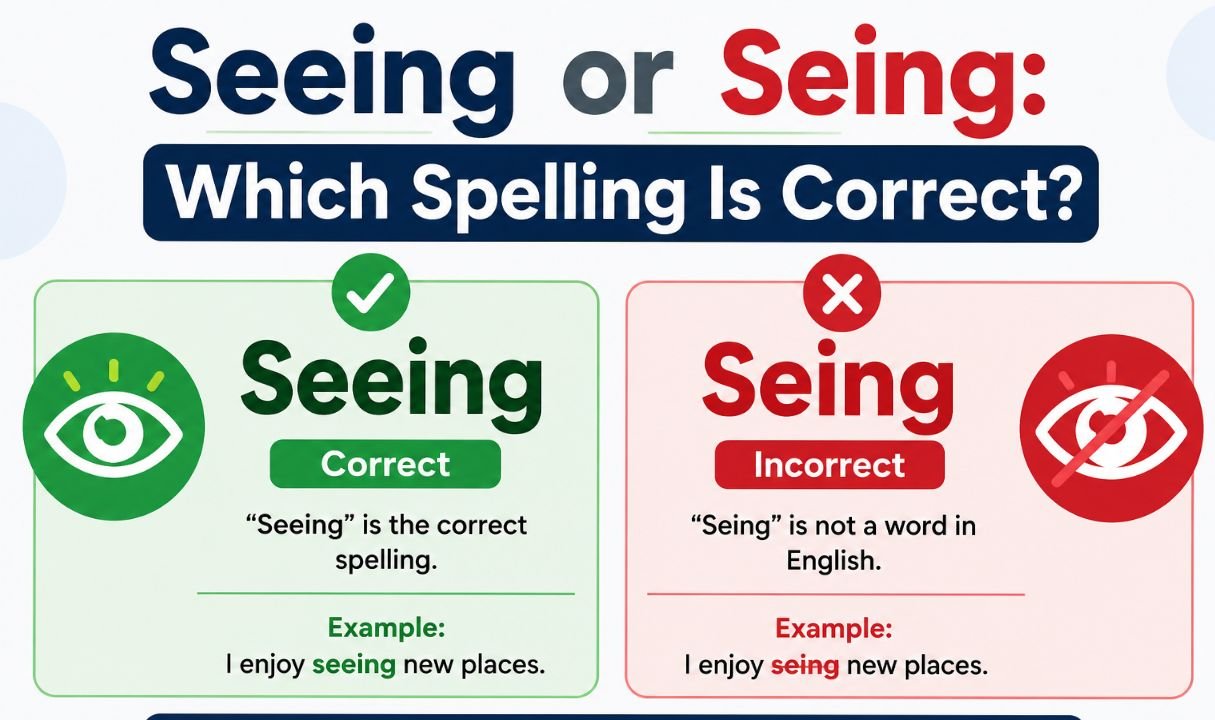
Seeing is the only correct spelling. Seing is a common typo, not a real word. The verb see already ends in a double e, so adding -ing keeps both vowels: see + ing = seeing.
I caught myself typing “seing” in a work email last month, mid-sentence, mid-deadline. Spell check flagged it before I hit send, and it made me realize how easy this one is to miss. The word sounds smooth when you say it, so your fingers skip a letter without your brain noticing.
That’s really the whole story behind this mix-up. Once you see the rule, you stop making the mistake. Here’s everything you need: the grammar reason, the meaning, real examples, and the answers to every version of this question people search for.
Seeing or Seing: Quick Answer
Seeing is correct in all forms of English, spoken and written, formal and casual. Seing is incorrect. It doesn’t appear in any dictionary and isn’t a variant spelling anywhere.
Correct Example
I am seeing real progress in my writing this year.
Incorrect Example
I am seing real progress in my writing this year.
Seeing or Seing Meaning
Seeing comes from the verb see, which carries a few distinct meanings depending on context:
- Noticing something with your eyes
- Understanding or realizing something
- Meeting or dating someone
- Experiencing or witnessing an event
Add -ing to any of those senses and you get seeing, the present participle (and sometimes gerund) form.
Examples
She is seeing a specialist about her shoulder. We’re seeing fewer errors since the update shipped. He’s been seeing someone new since spring.
Seeing or Seing Difference
| Word | Status | What it is |
|---|---|---|
| Seeing | Correct | Present participle/gerund of “see” |
| Seing | Incorrect | Misspelling, missing one “e” |
Key Point
English doesn’t strip a vowel from every verb before adding -ing. Verbs that already end in double e almost always keep both letters.
Why Seeing Is Correct
A lot of English learners assume the final letter of a verb always drops before -ing, because that’s true for words like write and make. But that rule only applies when a verb ends in a single silent e. See ends in two e’s, and neither one is silent, so nothing gets dropped.
You May Like
Ignitor vs Igniter: What’s the Real Difference and Which One Should You Use?
Grammar Rule Depth
Rule for Verbs Ending in Double E
When the base verb ends in ee, standard spelling keeps both vowels before adding the suffix. This isn’t a special exception for “see.” It’s a small, consistent pattern across a handful of English verbs.
Examples
see → seeing agree → agreeing free → freeing flee → fleeing
Compare that to verbs ending in a single silent e, where the e disappears: write → writing make → making hope → hoping
Why People Write Seing
Fast Typing
Most “seing” typos happen at speed. Your hands move faster than your spelling awareness, especially in texts, chats, and emails written under time pressure.
Confusion with Other Verbs
Learners who’ve memorized “drop the e before -ing” from words like write and hope sometimes apply that same rule to see, even though the rule doesn’t fit here.
Pronunciation Confusion
Said out loud, “seeing” blends into two smooth syllables. Nothing about how it sounds signals that there are two e’s in a row, so the ear gives no warning the eye would catch.
The Origin of the Word Seeing
See traces back to the Old English verb seon, meaning to perceive with the eyes. As Old English shifted toward Middle and then Modern English, spelling settled on the double-e form we use today, and the -ing form kept that pattern intact rather than simplifying it.
Seeing as a Verb
Present Continuous Tense
I am seeing a real improvement in my grades this semester.
Future Arrangements
We’re seeing the accountant on Thursday morning.
Experience or Understanding
After seeing the full report, she changed her recommendation entirely.
Seeing as a Gerund (Seeing as a Noun)
When seeing acts as a noun, grammarians call it a gerund, a verb form that functions like a noun in a sentence. It names the act itself rather than describing an ongoing action.
Example
Seeing is believing.
Here, “seeing” is the subject of the sentence. It behaves exactly like a noun would, even though it’s built from a verb.
Seeing in Everyday Conversation
| Setting | Example |
|---|---|
| At home | I’m seeing dust on that shelf again. |
| At work | We’re seeing strong numbers this quarter. |
| In school | Teachers are seeing better focus after the schedule change. |
| In relationships | She’s been seeing him for almost a year. |
Seeing in Professional Writing
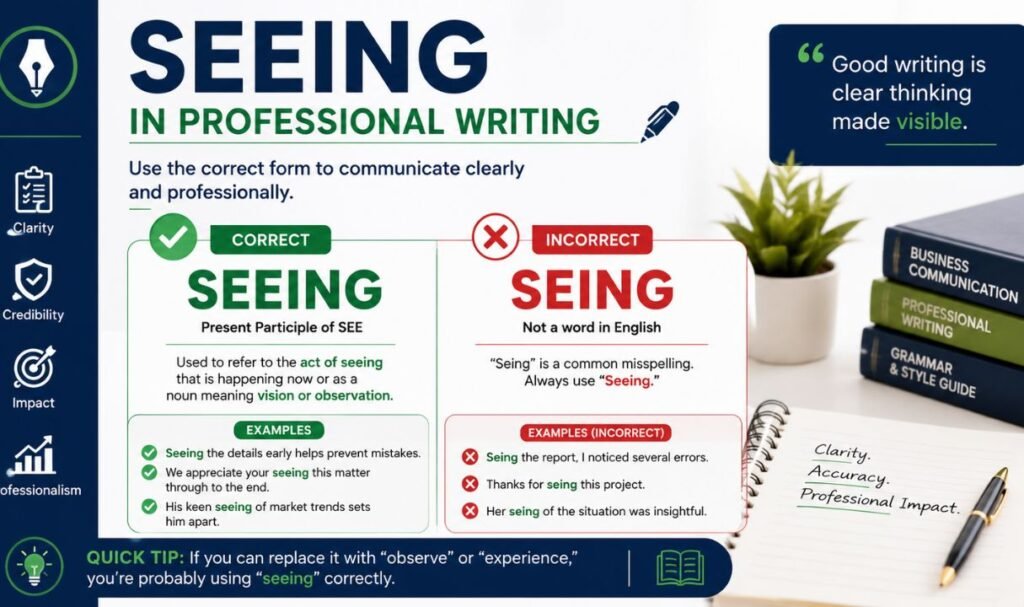
Business Example
The company is seeing steady growth in overseas markets.
Academic Example
Researchers are seeing consistent results across three separate trials.
Medical Example
The patient is seeing gradual improvement since starting physical therapy.
Seeing in Emails
Correct: I’m seeing a few issues with the attached file. Incorrect: I’m seing a few issues with the attached file.
A single dropped letter in a client email reads as careless, even when everything else about the message is accurate and well organized.
Seeing in Social Media
Correct: Seeing this trend blow up has been wild to watch. Incorrect: Seing this trend blow up has been wild to watch.
Fast typing on phones is the biggest driver of this typo online, more than any real confusion about spelling.
You May Like
Appendices vs Appendixes: Which Plural Is Actually Correct
Common Mistakes with Seeing or Seing
Mistake 1: Dropping One E
Incorrect: seing → Correct: seeing
Mistake 2: Treating It Like a Silent-E Verb
Writers sometimes apply the “drop the e” habit from words like write or hope, forgetting that rule only applies to verbs ending in one silent vowel, not two pronounced ones.
Mistake 3: Confusing It With Similar-Sounding Patterns
People occasionally second-guess “seeing” because “agreeing” and “freeing” look unusual too, and start wondering if all three should drop a letter. None of them should.
Seeing in Different Grammar Tenses
| Tense | Example |
|---|---|
| Present continuous | I am seeing improvement. |
| Past continuous | They were seeing changes by midyear. |
| Future continuous | We will be seeing updates next month. |
Idioms and Expressions
Seeing is believing — trusting something only once you’ve witnessed it firsthand. Seeing eye to eye — agreeing with someone on an issue. Not seeing the bigger picture — missing the full context of a situation.
Related Words and Synonyms for Seeing
| Word | Relationship to “seeing” |
|---|---|
| See | Base verb |
| Seen | Past participle |
| Sight | Related noun, the ability to see |
| Vision | Related noun, the power or scope of seeing |
| Witnessing | Close synonym in formal contexts |
| Observing | Close synonym, slightly more clinical tone |
| Noticing | Synonym when the meaning is about awareness, not eyesight |
| Dating | Synonym only in the romantic sense (“seeing someone”) |
The right synonym depends entirely on which meaning of “seeing” you’re using. Witnessing fits an event, observing fits data or behavior, and dating only fits the relationship sense.
Seeing vs Seen
| Word | Function | Example |
|---|---|---|
| Seeing | Present participle / gerund | I am seeing progress. |
| Seen | Past participle | I have seen this movie already. |
Seen always needs a helping verb like “have,” “has,” or “had” in front of it. On its own, “I seen it” is grammatically incorrect, even though it’s common in casual speech.
British English vs American English Spelling
| Region | Spelling |
|---|---|
| American English | Seeing |
| British English | Seeing |
Unlike words such as “color/colour” or “realize/realise,” seeing doesn’t split between dialects. It’s spelled identically everywhere English is written.
Why Correct Spelling Matters
Getting “seeing” right seems minor, but small slips like this add up in how a reader judges your writing. Clean spelling signals attention to detail in job applications, client emails, academic papers, and anything meant to be taken seriously.
Real World Examples of Seeing
News: Analysts are seeing early signs of a market slowdown. Workplace: Managers are seeing higher retention since the policy change. Education: Schools are seeing better attendance after moving to hybrid schedules. Technology: Users are seeing faster load times after the latest patch.
Memory Tricks for Seeing
- Start from the base verb. “See” already has two e’s, so nothing gets removed when you add “-ing.”
- Use the formula. see + ing = seeing, no letters lost in the process.
- Lean on the pattern. Agree becomes agreeing, free becomes freeing, see becomes seeing. Same rule, every time.
Practice Exercises
Exercise 1: Choose the Correct Word
- I am ______ better results now. (seeing)
- She is ______ a doctor tomorrow. (seeing)
- We are ______ progress every week. (seeing)
2 Exercise : Correct the Sentence
- “I am seing improvement in my writing.” → I am seeing improvement in my writing.
- “She is seing her cousin tomorrow.” → She is seeing her cousin tomorrow.
Exercise 3: Spot the Mistake
- “We are seing positive changes.” → seing → seeing
- “He keeps seing the same error.” → seing → seeing
Frequently Asked Questions
Which is correct, seing or seeing?
Seeing is correct. Seing is a spelling error and isn’t recognized in any standard dictionary.
Is it correct to say “seeing”?
Yes. “Seeing” is the standard present participle and gerund form of “see,” correct in every register of English.
Which is correct, sees or see’s?
Sees is correct as the third-person singular verb form (“she sees”). See’s is wrong; apostrophes aren’t used to form verb endings.
Is seen grammatically correct?
Yes, but only with a helping verb. “I have seen it” is correct. “I seen it” on its own is not standard grammar.
Is “seeing” a correct word?
Yes, fully correct and standard. It’s the -ing form of one of the most commonly used verbs in English.
What does “seeing you” mean?
It usually means meeting or spending time with someone, and in a relationship context, it can specifically mean dating them.
What’s a good synonym for seeing?
It depends on context: witnessing for events, observing for data or behavior, noticing for general awareness, or dating for the romantic sense.
Is “seeing” used the same way in Tagalog?
No. Tagalog has its own separate word, “nakikita” or related forms, for the concept of seeing. “Seeing” is strictly an English word and doesn’t carry over as a loanword.