
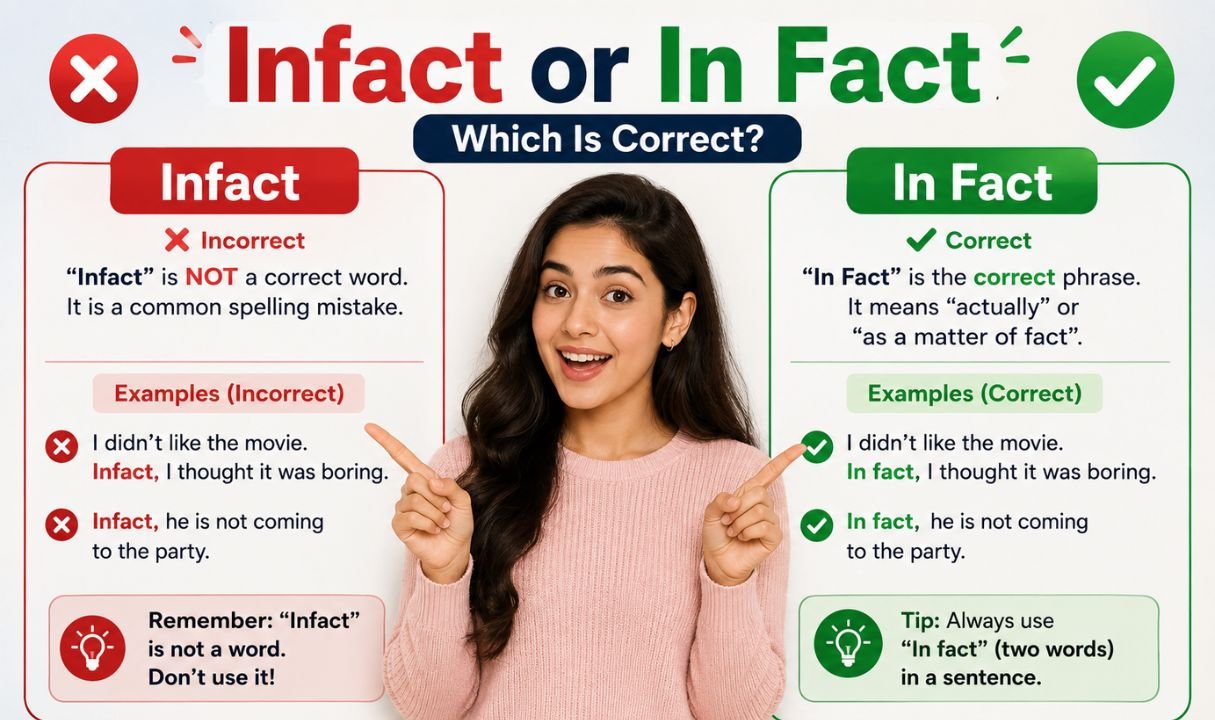
In fact is correct. It’s always written as two separate words. Infact is not a recognized English word, and no major dictionary lists it as a valid spelling.
The mix-up happens because the phrase gets said so fast in speech that the space between the words disappears. That habit then leaks into typing, especially in emails, texts, and quick social posts. Once you see why it happens, the fix takes about ten seconds to remember.
This guide covers the grammar rule, real usage examples, the phrase’s background, common mix-ups with similar words, and a short practice section so the correct spelling actually sticks.
Quick Answer
In fact = correct, two words, used to emphasize, clarify, or correct a statement. Infact = incorrect, not a standard English word, avoid it everywhere.
- Right: She looked calm. In fact, she was furious.
- Wrong: She looked calm. Infact, she was furious.
What Does “In Fact” Mean?
In fact is a transitional phrase that adds weight to a statement. Writers reach for it when a plain sentence needs more punch, or when the next sentence needs to correct or sharpen what came before it.
It shows up in three main jobs: emphasizing a point, correcting a wrong assumption, and clarifying something that sounded vague. Each job changes the tone slightly, even though the phrase itself stays the same.
For emphasis:
- He’s not just good at chess. In fact, he’s ranked nationally.
For correction:
- I assumed the flight was delayed. In fact, it landed early.
For clarification:
- She wasn’t ignoring the message. In fact, she replied within minutes.
You May Also Like
Training vs Trainning: Which Spelling Is Actually Correct
Is “In Fact” One Word or Two? (Grammar Explained)
In Fact Is a Fixed Phrase
In functions as a preposition, and fact is a noun. Together they form a set adverbial phrase, meaning the two words always travel together and never merge into one term. English has plenty of these fixed pairs, and none of them collapse into a single word just because they’re spoken quickly.
That’s the whole grammatical reason infact fails. It’s not a hyphenated compound, it’s not a portmanteau, and it never went through the gradual merging process that turned phrases like “into” or “nowadays” into single words over centuries.
Where It Sits in a Sentence
In fact moves freely through a sentence, and the position changes the emphasis slightly.
| Position | Example |
|---|---|
| Start | In fact, the numbers were worse than reported. |
| Middle | The numbers were, in fact, worse than reported. |
| End | The numbers were worse than reported, in fact. |
All three are grammatically sound. Starting a sentence with it hits hardest, which is why it’s common in persuasive and journalistic writing.
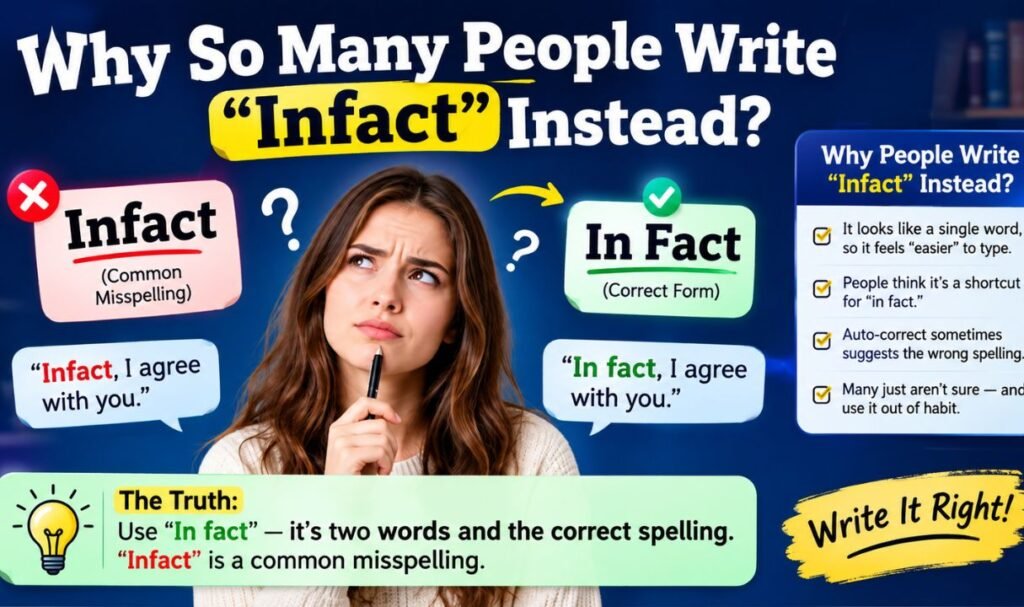
Why So Many People Write “Infact” Instead
Fast Pronunciation
Say “in fact” out loud at normal speed and the words blur together. Speech doesn’t mark spaces the way writing does, so the ear hears one sound where the page needs two words.
Typing Habits and Autocorrect
Fast typists often skip the space between short, frequently paired words. Autocorrect tools sometimes let the merged form slide through unflagged, especially on mobile keyboards that prioritize speed over accuracy.
Informal Messaging
Texting and chat apps train people to ignore small grammar details. That casual habit then follows writers into emails and documents where it doesn’t belong.
Visual Confusion With Other “In-” Words
English is full of words that start with “in” as a prefix rather than a preposition, like inside, indeed, and inside. Seeing so many single-word “in-” terms makes infact feel plausible even though it isn’t one.
Where “In Fact” Comes From
Fact traces back to the Latin word factum, meaning “a thing done.” Paired with the preposition in, the phrase originally meant something close to “in reality” or “in actual practice.” That core meaning hasn’t shifted much. Writers still use it to point at what’s actually true, as opposed to what was assumed or stated before.
In Fact vs Similar Phrases
Several transitional phrases overlap with in fact, but they don’t mean exactly the same thing.
| Phrase | Best used for | Example |
|---|---|---|
| In fact | Emphasizing or correcting | He seemed calm. In fact, he was panicking. |
| Actually | Correcting a misunderstanding | I thought it rained. Actually, it was sunny. |
| Indeed | Confirming something already suspected | She’s talented. Indeed, she won the award. |
| As a matter of fact | Casual emphasis, conversational tone | He didn’t complain. As a matter of fact, he thanked us. |
In Fact vs Actually
Actually leans toward correcting a false impression. In fact leans toward strengthening a point that’s already partly true, then pushing it further.
In Fact vs Indeed
Indeed confirms a suspicion. In fact often introduces new supporting detail rather than just agreeing with what was already implied.
In Fact vs As a Matter of Fact
As a matter of fact carries a more conversational, almost defensive tone. In fact works in both formal and casual writing without that same edge.
You May Also Like
Seeing or Seing: Which Spelling Is Correct?
How In Fact Is Used in Real Writing
Conversation and Texting
- I wasn’t mad. In fact, I barely noticed.
- He’s not new here. In fact, he trained half the team.
Emails
- The rollout is on schedule. In fact, we’re two days ahead.
- The bug report was minor. In fact, the fix is already deployed.
Academic Writing
- The data didn’t support the hypothesis. In fact, it pointed the opposite direction.
- The control group showed no change. In fact, results dropped slightly.
Professional Reports
- Client retention improved. In fact, churn dropped by double digits.
- The server had zero downtime. In fact, uptime beat last quarter’s record.
British vs American English
Both British and American English treat in fact the same way, as two separate words with the same meaning and the same grammar rules. There’s no regional spelling variant to worry about here, unlike words such as “colour” or “color.”
- Correct everywhere: In fact, the merger was announced early.
- Incorrect everywhere: Infact, the merger was announced early.
Common Mistakes and Corrections
| Mistake | Correction |
|---|---|
| Infact, I agree with you. | In fact, I agree with you. |
| He was tired, infact exhausted. | He was tired, in fact, exhausted. |
| Infact the results surprised everyone. | In fact, the results surprised everyone. |
| She wasnt infact upset. | She wasn’t in fact upset. |
Most of these errors trace back to one habit: writing at speaking speed and skipping the proofread pass. Reading a sentence back slowly, out loud if needed, catches this almost every time.
Advanced Usage of In Fact
Strengthening Arguments
Persuasive writers use in fact to escalate a claim right after making it, which keeps the reader engaged instead of letting the point sit flat.
- The strategy works. In fact, it outperformed every competitor last year.
Academic Tone
In essays and papers, in fact signals a shift from a general claim to specific supporting evidence.
- The theory seemed sound. In fact, later trials disproved it entirely.
Persuasive Writing
Marketing copy and opinion pieces lean on in fact to build credibility fast, especially right before a statistic or bold claim.
- This isn’t a small update. In fact, it’s the biggest release in company history.
Other Word Pairs With the Same Spacing Problem
In fact isn’t the only phrase people accidentally merge. These follow the same pattern:
- a lot, not “alot”
- at least, not “atleast”
- every day, not “everyday” (when used as an adverb)
- in to, not always “into,” depending on meaning
- may be, not always “maybe,” depending on function
Learning one of these rules makes the others easier to spot, since the underlying mistake is almost always the same: treating a two-word phrase like a single compound.
Quick Practice
Fill in the Blanks
- ______, the meeting ran twenty minutes over. (In fact)
- He wasn’t nervous. ______, he looked completely relaxed. (In fact)
- I assumed it was closed. ______, it was open until midnight. (In fact)
Correct the Sentence
- Infact, the project finished early. → In fact, the project finished early.
- She was quiet infact withdrawn. → She was quiet, in fact, withdrawn.
- Infact I disagree. → In fact, I disagree.
How to Never Make This Mistake Again
- Remember that fact is always a standalone noun, never a suffix.
- Read sentences back slowly before sending anything formal.
- Turn on a grammar checker for email and documents, not just word processors.
- If a sentence feels rushed, that’s usually where the merged spelling sneaks in.
Frequently Asked Questions
Is infact a single word?
No. Infact is not recognized as a word in any standard English dictionary. The correct form is always in fact, written as two words.
What is the meaning of infact?
Infact has no accepted meaning of its own. It’s simply a misspelling of in fact, which means “in reality” or “to emphasize a point.”
What is the meaning of fakt?
Fakt isn’t standard English either. It resembles the German or Scandinavian word for “fact” and sometimes appears as a typo or non-native spelling of the English word fact.
How to use infact in a sentence?
You shouldn’t. Replace it with in fact instead: “In fact, the results were better than expected.”
Can in fact start a sentence?
Yes. In fact can open a sentence, sit in the middle, or close it, and all three placements are grammatically correct.
Does in fact need commas?
Use commas with in fact to improve readability when it appears in the middle or at the end of a sentence. When in fact starts a sentence, place a comma after it before continuing with the rest of the statement.
Conclusion
The correct form is in fact—written as two separate words. Writers use this common phrase to add emphasis, introduce additional information, or correct a previous statement.
Avoid writing infact because it is simply a spelling mistake. Whether you are writing an academic paper, a business email, or an everyday message, always use in fact as two separate words.