
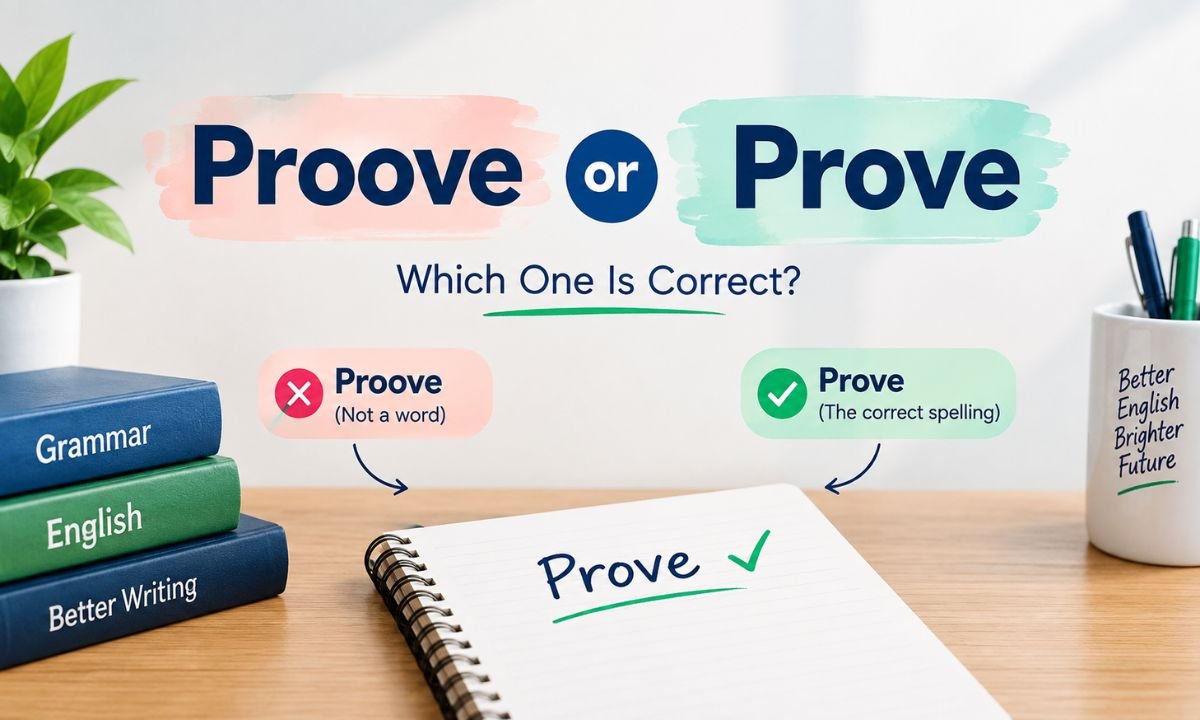
Typing fast can play tricks on anyone. You write a sentence, glance at the word “prove,” and suddenly wonder if it needs an extra “o.” Is it proove or prove? This mix-up shows up in emails, school essays, court transcripts, and social media comments every single day, and the answer is shorter than you’d expect.
If you’ve landed here after typing “proove” into a search bar and staring at the red squiggly underline, you’re in good company. This guide walks through the correct spelling, why the mistake happens so often, where the word comes from, and how to use it correctly in real writing — from a quick text message to a formal legal brief.
Proove or Prove – Quick Answer
Here’s the short version before we go any further: only one of these is a real word.
Proove
“Proove” is not standard English. It’s a misspelling that pops up because of how the word sounds when spoken aloud, and because so many other English words with the same vowel sound do use a double “o.” You won’t find “proove” listed as a valid entry in Merriam-Webster, Oxford, or Cambridge dictionaries. Autocorrect tools flag it, spell-checkers reject it, and editors will send it straight back to you.
Prove
“Prove” is the correct and only accepted spelling. It’s a verb meaning to show that something is true through evidence, facts, logic, or demonstration. It has three main forms:
- Prove (base form)
- Proved (past tense)
- Proven or proved (past participle)
Both “proven” and “proved” are acceptable as past participles, though “proven” is more common as an adjective (a “proven method”), while “proved” is often preferred in formal past-tense writing (“She has proved her theory”).
Examples:
- Can you prove that the invoice was sent on time?
- The lawyer worked for months to prove her client’s innocence.
- Scientists have proved the theory through repeated testing.
- His track record has proven his skills beyond doubt.
The Origin of Prove
Word history often explains why a spelling looks the way it does, and “prove” is no exception.
The word traces back to the Latin verb probare, meaning “to test,” “to examine,” or “to demonstrate the quality of something.” From there, it passed into Old French as prover, and Middle English speakers adapted it into “proven” or “preven” before it settled into the modern spelling we use today: prove.
Interestingly, the related noun “proof” followed a slightly different path through Old French preuve, which is part of why the noun and the verb don’t share identical spelling patterns. English kept the single “o” in the verb form even though the pronunciation stretches the vowel sound the way “food” or “moon” would. That single historical detail is the root of nearly every modern misspelling of this word.
British English vs American English Spelling
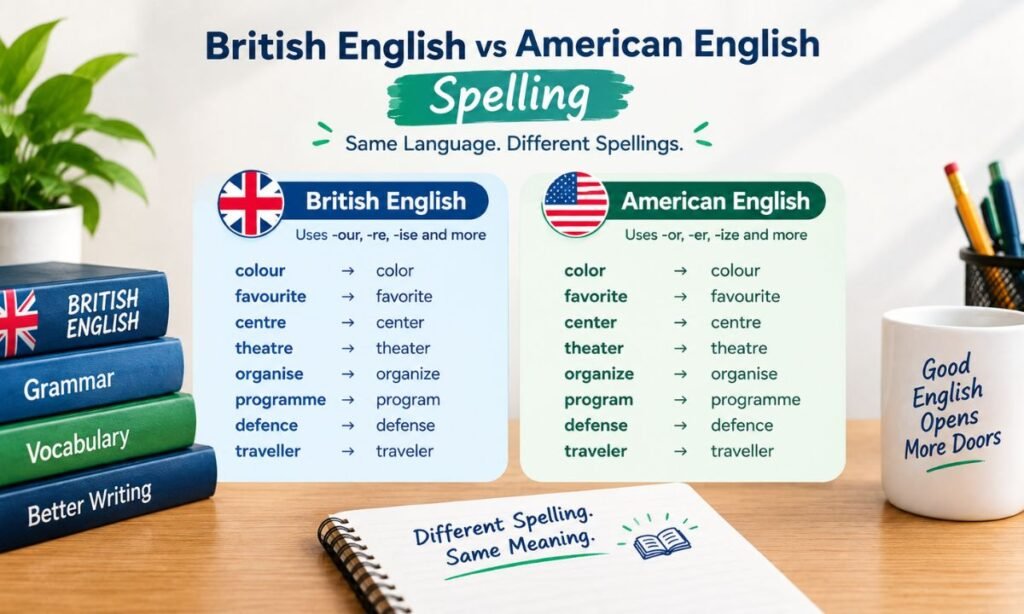
Plenty of English words shift depending on which side of the Atlantic you’re writing for — think “colour” versus “color” or “organise” versus “organize.” Prove is refreshingly simple by comparison: it doesn’t change.
Both British and American English use the identical spelling, “prove,” for the base verb. The only minor variation shows up in the past participle. British writers lean toward “proven” almost as often as Americans do now, though traditionally “proved” was the more formal British choice in legal and academic writing.
Comparison Table
| Form | British English | American English | Notes |
|---|---|---|---|
| Base verb | prove | prove | Identical spelling worldwide |
| Past tense | proved | proved | No regional difference |
| Past participle | proved / proven | proven / proved | Both accepted; “proven” common as adjective |
| Misspelling | proove | proove | Incorrect in both dialects |
So if you were hoping for a regional loophole that makes “proove” acceptable somewhere in the English-speaking world, there isn’t one. This is one of the rare cases where the entire English-speaking internet agrees.
Which Spelling Should You Use?
Always use “prove.” There is no context — casual texting, academic writing, business communication, legal documents, or creative writing — where “proove” is the accepted form. It doesn’t matter if you’re writing for a British audience, an American audience, or anyone else who reads English.
A simple way to remember it: prove rhymes with move and love, and none of those words double the “o.” If you can recall that one comparison, you’ll never second-guess the spelling again.
Common Mistakes with Prove
Understanding why people slip up helps the correct spelling stick. Here are the four most frequent reasons “proove” keeps appearing in searches, emails, and comment sections.
1. Doubling the Vowel
English is full of words where the long “oo” sound is spelled with two o’s — groove, choose, moon, smooth, balloon. Because “prove” carries that same stretched vowel sound when spoken, writers often apply the same pattern by habit, even though the rule doesn’t hold here. This is technically called a spelling analogy error, where your brain borrows a pattern from a similar-sounding word.
2. Confusing with “Approve”
“Approve” sits right next to “prove” in both meaning and appearance, and it’s easy to blend the two when typing quickly. Since “approve” already contains a doubled letter pattern feel to some writers (even though it’s actually a double “p,” not a double “o”), the confusion carries over into how people spell “prove” itself.
3. Auto-Correct Mistakes
Not every spell-checker catches every error, especially on mobile keyboards with custom dictionaries or predictive text that’s learned bad habits from previous typos. Some users have even trained their own devices to accept “proove” after typing it enough times, which only reinforces the mistake.
4. Mishearing Pronunciation
Prove is pronounced /pruːv/, with a long vowel sound that can trick the ear into assuming it needs extra letters to represent that length in writing. Non-native English speakers, in particular, sometimes learn the word by sound first and guess at the spelling based on similar-sounding vocabulary they already know.
Prove in Everyday Examples
Seeing a word used naturally across different settings makes the correct spelling easier to remember. Here’s how “prove” shows up across different types of writing.
Emails:
- Please prove your identity by attaching a copy of your ID.
- I’ve attached the receipts to prove the expense report is accurate.
Education:
- Students are asked to prove their answer using a step-by-step method.
- The essay question required students to prove their argument with three supporting sources.
Social Media:
- She posted the screenshots to prove she wasn’t lying.
- “Prove it” has become a common comeback in online arguments.
News Reports:
- Investigators say the new evidence could prove the suspect’s involvement.
- The company released data to prove its product meets safety standards.
Legal Writing:
- The prosecution must prove guilt beyond a reasonable doubt.
- The plaintiff has the burden to prove damages occurred as a direct result of the incident.
Prove – Google Trends & Usage Data
Search behavior tells its own story about this spelling confusion. Thousands of people type “proove” into search engines every month, usually followed immediately by a correction click toward “prove” once the search results show the right spelling. This pattern is common across many English words that involve a long vowel sound, and it places “proove” among the more frequently searched misspellings related to everyday verbs.
Search interest for “prove” itself stays fairly steady year-round, with small spikes during exam seasons, tax season, and periods of major news events involving court cases or investigations — all situations where the idea of proving something becomes part of daily conversation. Meanwhile, “proove” shows up mostly as a spelling-check query rather than something people intend to publish, which suggests most writers catch the mistake before it reaches a final draft.
Which One Should Stick in Your Memory?
If you take away one thing from this guide, let it be this: prove has one “o,” always. Whether you’re writing a school assignment, a legal filing, a text to a friend, or a company memo, that spelling doesn’t change based on tone, audience, or country. The doubled-vowel version, “proove,” is a spelling slip worth catching before it goes out the door, especially in professional or academic writing where credibility matters.
A quick mental trick that works for most people: pair “prove” with “love” and “move.” None of those words carry a double “o,” and neither does this one. Once that connection sticks, the confusion tends to disappear for good.
Frequently Asked Questions
What does proove mean?
“Proove” has no meaning of its own — it’s simply an incorrect spelling of “prove,” which means to show something is true through evidence or facts.
Which is correct, prove or proof?
Both are correct, but they serve different roles: “prove” is a verb (to demonstrate something is true), while “proof” is a noun (the evidence itself).
Is proove a common misspelling?
Yes, it’s one of the more frequently searched misspellings in English, largely because of how the long vowel sound in “prove” is pronounced.
What is meant by prove?
To prove something means to demonstrate its truth or existence using facts, evidence, logic, or a clear argument.