
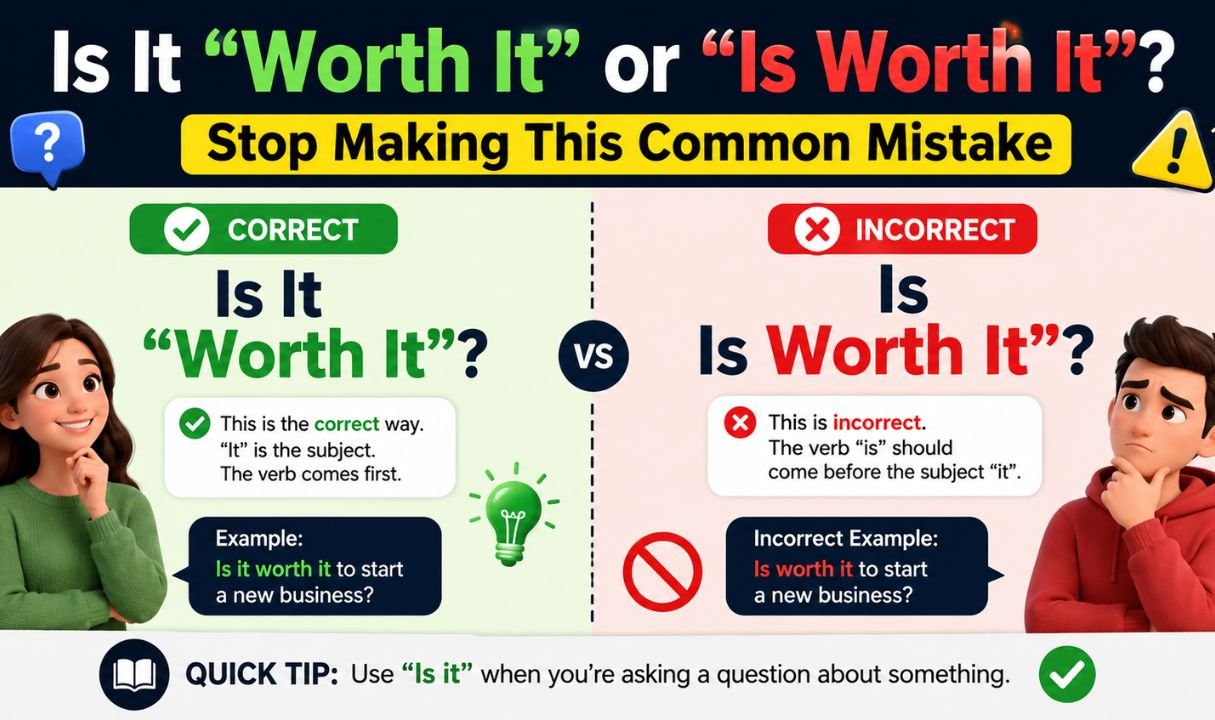
If you’ve ever typed “it worth it” into a text message and then paused, unsure if something felt off, you’re not alone. This tiny phrase trips up native speakers and English learners alike. The good news is that the rule behind it is short, logical, and easy to remember once you see it laid out clearly.
By the end of this guide, you’ll know exactly which form to use, why the other one fails grammatically, and how to apply “worth it” naturally in writing, conversation, and even professional communication.
Definition
“Worth” is an adjective, not a verb. Adjectives in English cannot stand alone next to a subject without a linking verb connecting them. That single fact explains this entire topic.
- Correct: It is worth it.
- Incorrect: It worth it.
The linking verb “is” bridges the subject “it” and the adjective phrase “worth it.” Remove that bridge, and the sentence structure collapses, even though the meaning might still be guessable from context.
Understanding the Confusion: “It Worth It” vs. “It Is Worth It”
The mix-up usually starts with speech patterns. In fast, casual conversation, people often drop small linking words without even noticing. Someone might say “worth it” as a quick reply, and that habit bleeds into full sentences where the verb is actually required.
There’s also an influence from other languages. Many languages don’t require a separate linking verb the way English does, so speakers translating directly from their native tongue sometimes skip “is” without realizing English demands it here.
Text messaging and social media captions add another layer. Informal writing rewards brevity, and “worth it” alone reads fine as a caption or a one-word reply. The problem shows up when that shortcut gets carried into essays, emails, or formal writing where a complete sentence is expected.
You May Like: Drier vs Dryer: Which One Should You Use in Writing?
The Meaning of “It Is Worth It”
At its core, “it is worth it” means that something’s value, benefit, or outcome justifies the cost, time, or effort involved. The cost doesn’t have to be financial. It can be emotional, physical, or measured in hours spent.
Two Main Uses
- Statement form — used to declare that something has value: “The trip is worth it.”
- Question form — used to ask whether something has value: “Is it worth it to switch jobs?”
Both forms rely on the same linking verb principle. The verb simply moves position depending on whether you’re making a statement or asking a question.
Examples in Everyday Life
- The late nights studying were worth it once she saw her exam results.
- Paying extra for a direct flight is worth it when you value your time.
- He said the surgery recovery was painful, but it was worth it in the end.
- Waking up at 5 a.m. to train is worth it if the goal actually matters to you.
Notice how the verb changes tense (is, was, were) but never disappears. That consistency is the whole rule in action.
Why “It Worth It” Is Incorrect
English sentences built around adjectives need a linking verb to connect the subject to that adjective. Compare these:
- She happy. ❌
- She is happy. ✅
- It worth it. ❌
- It is worth it. ✅
Both examples fail for the same reason. “Happy” and “worth” are adjectives, and neither can attach directly to a subject without help. Once you see “it worth it” next to “she happy,” the error becomes obvious.
Why People Make This Mistake
- Speech habits: Spoken English often compresses words, and listeners fill in the missing verb automatically, so the error goes unnoticed in conversation.
- Translation from other languages: Some languages don’t use a separate “to be” verb in similar constructions, so the omission feels natural to bilingual speakers.
- Copying casual online writing: Repeated exposure to shortened phrases like “worth it” as standalone replies can make the full sentence version feel unnecessary.
- Autocorrect and typing speed: Fast typing on phones sometimes drops small function words without the writer noticing.
Common Variations and Related Forms
“Is It Worth It?”
This is the standard question form and is grammatically correct. The auxiliary verb “is” moves to the front of the sentence, following normal English question structure (verb before subject).
Example: “Is it worth it to renovate an old house before selling?”
“Worth It” (Informal)
Used alone, “worth it” works fine as a short, informal reply when the subject and verb are already understood from context.
Example:
- “Should I buy the premium version?”
- “Worth it.”
This shortcut is acceptable in texting and casual speech but should be avoided in formal writing, where the complete sentence is expected.
“Is It Worth”
This phrase is incomplete on its own. “Worth” typically needs an object or the word “it” to complete the thought, such as “Is it worth the money?” or “Is it worth it?” Leaving “worth” dangling without a following noun or pronoun sounds unfinished.
“Does It Worth It?”
This form is always incorrect. “Worth” is an adjective, so it cannot follow the auxiliary verb “does” the way action verbs do (compare: “Does it work?” versus “Does it worth?”). “Worth” never pairs with “does,” “did,” or “do.”
Quick Summary Table
| Phrase | Correct? | Why |
|---|---|---|
| It is worth it | Yes | Complete sentence with linking verb |
| Is it worth it? | Yes | Correct question structure |
| Worth it | Yes (informal) | Fine as a short reply, not formal writing |
| It worth it | No | Missing linking verb |
| Is it worth | No | Incomplete, needs an object |
| Does it worth it? | No | “Worth” cannot follow “does” |
If you search for it worth it or it is worth it grammar, this table sums up the entire rule. Related searches like it worth it or it is worth it examples, is it worth it meaning, is it worth it correct grammar, it was totally worth it meaning, and it will be worth it meaning all trace back to the same linking-verb principle, just applied to different tenses and contexts.
“Worth” vs. “Worthy” – Spotting the Difference
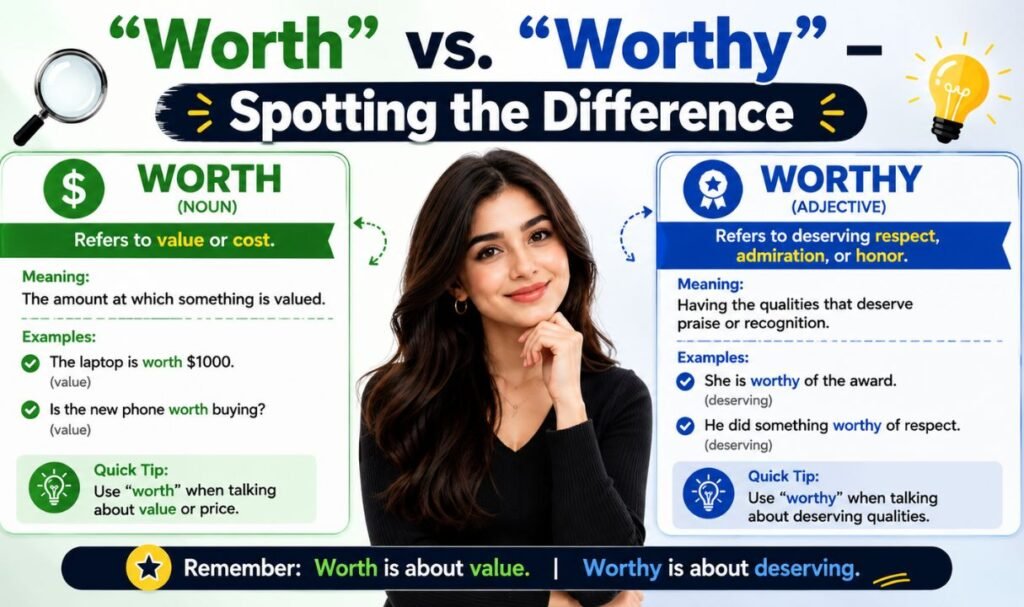
These two words look related but serve different purposes.
- Worth describes value, cost, or benefit gained: “The ring is worth a lot of money.”
- Worthy describes merit or deserving quality: “She is worthy of the award.”
A simple test: if you’re talking about price, benefit, or return on effort, use “worth.” If you’re talking about someone or something deserving recognition or respect, use “worthy.”
You May Like: Tying vs Tieing: Learn the Correct Spelling in Minutes
Common Mistake: “Worthed”
“Worth” never takes the “-ed” ending. There’s no such word as “worthed” in standard English. Past tense is shown by changing the linking verb instead:
- Wrong: It worthed the wait.
- Right: It was worth the wait.
Since “worth” functions as an adjective, it doesn’t conjugate like a regular verb. Only the linking verb changes form across tenses.
Synonyms & Professional Alternatives to “Worth It”
Repeating “worth it” throughout a piece of writing can feel flat. Here are alternatives grouped by tone.
Casual Alternatives
- Totally worth it
- Paid off
- No regrets
- So worth it
Professional or Academic Alternatives
- Justified the investment
- Offered good value
- Warranted the effort
- Produced a favorable return
- Was a worthwhile use of resources
Phrase Tips
Match the alternative to your audience. A fitness blog can stay casual with “no regrets,” while a business report reads better with “produced a favorable return.” Swapping in the right synonym also helps writing sound more natural and less repetitive, which matters both for readers and for search engines scanning for varied language.
Case Studies: Using “Worth It” in Real Life
Case Study 1: Education
A student spends three years and a significant amount of money earning a degree. Whether “it is worth it” depends on factors like career outcomes, salary growth, and personal satisfaction. Someone who lands a stable job in their field afterward would likely say the degree was worth it. Someone who struggles to find related work might disagree.
Case Study 2: Fitness
Someone commits to a six-month training program with early mornings and sore muscles. If they reach their goal weight or strength target, most people describe the process as worth it, framing short-term discomfort against long-term gain.
Case Study 3: Business Investment
A small business owner spends money upgrading equipment. If the upgrade increases output and lowers long-term costs, the investment is worth it. If it barely changes efficiency, the owner may conclude the spending wasn’t justified.
Case Study 4: Relationships
People sometimes describe difficult conversations or compromises in relationships as worth it when the outcome strengthens trust or resolves conflict. The phrase captures emotional cost-benefit thinking just as easily as financial decisions.
Quick Reference Table: Correct vs. Incorrect Usage
| Incorrect | Correct |
|---|---|
| It worth it. | It is worth it. |
| It worth the price. | It is worth the price. |
| Does it worth it? | Is it worth it? |
| It worthed the trouble. | It was worth the trouble. |
| It worth trying. | It is worth trying. |
Common Mistakes & How to Avoid Them
1. Missing the Linking Verb
The most frequent error. Always check that a form of “to be” (is, was, were, will be) sits between the subject and “worth.”
2. Using “Does” Instead of “Is”
“Does” pairs with action verbs, not adjectives. Replace “does it worth” with “is it worth” every time.
3. Confusing “Worth” and “Worthy”
Ask whether you’re discussing value (worth) or deserving quality (worthy) before choosing the word.
4. Overusing “Worth It”
Relying on the same phrase repeatedly in an essay or article weakens the writing. Rotate in synonyms like “justified the effort” or “paid off.”
5. Forgetting Context
“Worth it” alone only works when the reader or listener already knows what “it” refers to. In writing, spell out the subject clearly before shortening the phrase.
Mini Grammar Diagram
Subject  +  Linking Verb  +  Adjective Phrase
  It     +      is        +     worth it
  It     +     was        +     worth the wait
  It     +   will be      +     worth trying
This simple pattern applies across nearly every tense. Once the structure clicks, building correct sentences with “worth” becomes automatic.
Linguistic Insight & Expert Opinion
Grammar teachers often describe “worth” as a word that behaves partly like an adjective and partly like a preposition, since it can be followed by a noun, a gerund, or the pronoun “it.” What stays consistent across every use is the requirement for a linking verb before it.
Language researchers who study spoken versus written English note that dropped linking verbs are common in relaxed speech across many dialects, which is part of why “it worth it” sounds familiar even to people who know it’s technically wrong.
Written English, especially in academic or professional settings, still holds to the complete structure, so it’s worth building the habit of including “is” every time you write the phrase.
Table of Comparison
| Feature | “It Is Worth It” | “It Worth It” |
|---|---|---|
| Grammatically correct | Yes | No |
| Contains linking verb | Yes | No |
| Acceptable in formal writing | Yes | No |
| Common in casual speech | Yes | Sometimes heard, still incorrect |
| Recommended for essays/emails | Yes | No |
Self Assessment Section
Test yourself with these quick questions before moving on:
- Fill in the blank: The concert tickets ______ worth it despite the price.
- True or false: “Does it worth it?” is a correct question.
- Choose the correct word: She is worth / worthy of your trust.
- Rewrite correctly: “It worth the risk.”
- Which tense is used here: “It will be worth it”?
Answer key: 1. were 2. False 3. worthy 4. “It is worth the risk.” 5. Future tense (will be).
Frequently Asked Questions
Is it correct to say it is worth it?
Yes. “It is worth it” is the grammatically correct form because it includes the linking verb “is” connecting the subject to the adjective phrase.
Is it its worth or it’s worth?
“It’s worth” (with the apostrophe) is correct when you mean “it is worth,” as in “it’s worth trying.” “Its worth” without an apostrophe refers to a possessive noun phrase, as in “the coin’s value, or its worth, increased.”
What does “is it worth it” mean?
It’s a question asking whether the benefit, outcome, or value of something justifies its cost, effort, or risk.
How do you say something is worth it?
Use the pattern subject plus a form of “to be” plus “worth it,” such as “It is worth it,” “It was worth it,” or “It will be worth it,” depending on the tense you need.
Conclusion
“It is worth it” is the only grammatically complete version of this phrase, and the reason comes down to one simple rule: adjectives need a linking verb to connect them to a subject. “It worth it” skips that verb and breaks the sentence, even though it’s common to hear in casual speech.