
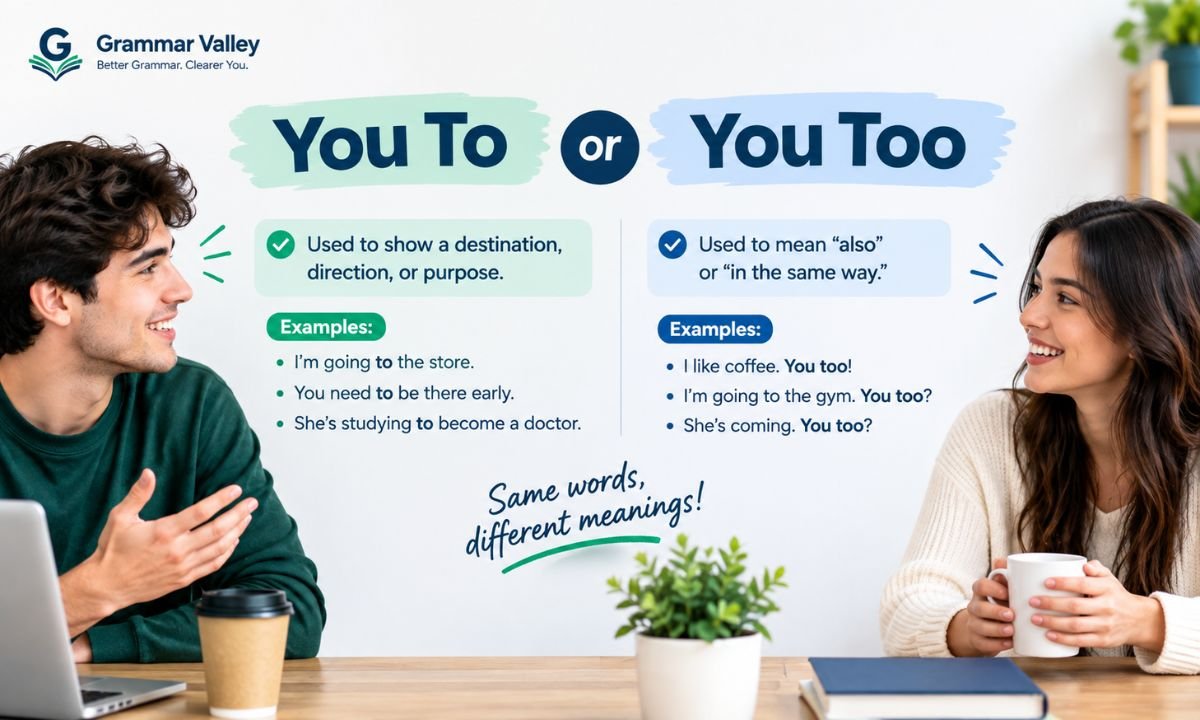
If you’ve ever typed a quick reply and then stared at it, wondering whether you just wrote “you too” or “you to,” you’re far from alone. This tiny mix-up shows up in text messages, work emails, and social media comments every single day, and most people never stop to ask why it keeps happening.
This guide breaks down the difference in plain language. You’ll learn what each word actually means, when to use “you too,” when “you to” is genuinely correct, and how to stop second-guessing yourself the next time someone wishes you a good day.
Why “You To” vs “You Too” Confuses So Many People
English has a habit of taking two completely different words and making them sound identical. “To” and “too” are a textbook example, and that single detail explains almost every mistake people make with them.
Why This Error Happens So Often
Spoken English doesn’t give you any clues here. When you say either word out loud, your mouth does the exact same thing. The confusion only becomes visible once you write the words down, and by then, autocorrect, muscle memory, and typing speed have often already made the decision for you.
Most people learned to speak these words years before they learned to spell them. That means the sound got wired into memory first, and the spelling got tacked on later, almost as an afterthought. When you’re typing fast, replying to a friend, or dashing off a work message between meetings, your brain reaches for the version it’s used most, and for many people, that’s “to.”
Real-World Example
Picture this exchange in a group chat: “Have a safe flight!” followed by a quick reply, “You to!” The sender meant something warm and simple, wishing the same safe travels back. But what they typed technically doesn’t mean anything on its own, because “to” needs another word after it to make sense.
Nobody in that group chat is likely to notice or care. But the same slip in a client email or a cover letter reads differently, and that’s where the stakes quietly go up.
Why It Actually Matters
Grammar mistakes rarely change the actual message you’re trying to send. People usually understand what you meant regardless of which spelling you used. The real issue is perception.
Readers form quick impressions based on small details, and spelling is one of them. A single mixed-up word won’t ruin your credibility, but a pattern of them can make careful writing look careless. That’s especially true in professional settings, where a hiring manager or client might be reading dozens of messages a day and forming judgments almost automatically.
The Quick Answer: “You To” or “You Too”?
Here’s the short version, if you only have ten seconds: “you too” is almost always what you want when replying to someone. “You to” only works when it’s followed by more words that complete a thought, such as a verb.
If someone says “Good luck today!” and you want to respond in kind, you write “You too!” If you’re forming a longer sentence like “I need you to send that file,” then “to” is doing a different job entirely, connecting to the verb “send.”
Quick Comparison Table
| Phrase | Meaning | Example | Correct Standalone Reply? |
|---|---|---|---|
| You too | Also you, or the same to you | “Have a great trip!” — “You too!” | Yes |
| You to | Part of a longer sentence, usually before a verb | “I want you to succeed.” | No |
Understanding “To”: Meaning and Real Usage
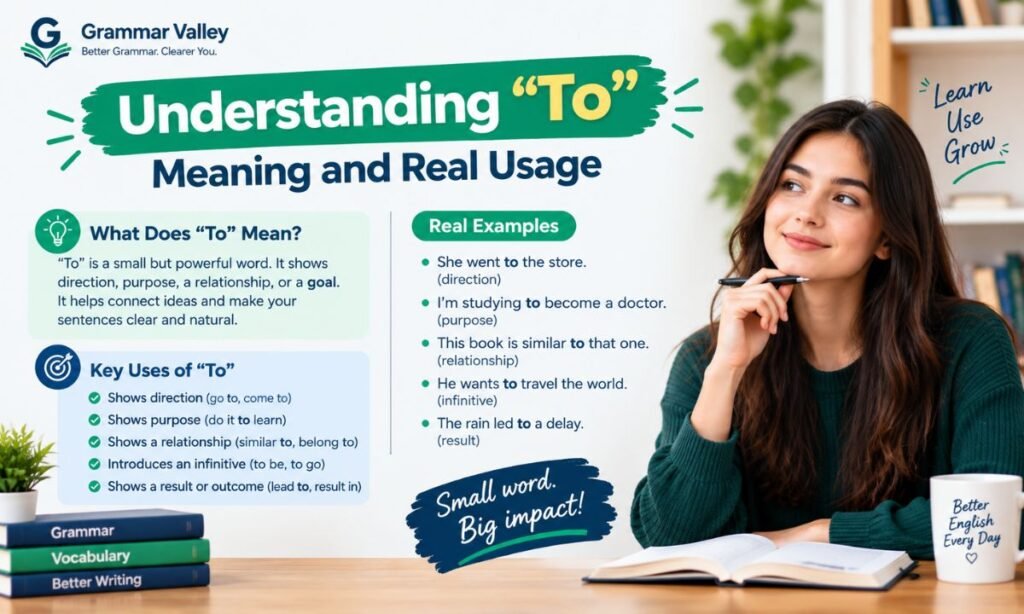
“To” is one of the most common words in English, and it rarely appears alone. It almost always connects one part of a sentence to another.
What “To” Actually Does
At its core, “to” is a connector. It links an action to its target, a verb to its purpose, or one idea to the next. It shows up constantly in directions (“go to the store”), goals (“hoping to finish early”), and simple verb pairings (“want to leave”).
Because it’s so flexible, “to” can feel almost invisible in a sentence. You rarely notice it doing work, which is part of why people forget it needs a partner word to actually mean something.
How “To” Works in Sentences
“To” plays a few distinct roles depending on where it sits in a sentence. Recognizing these patterns makes it much easier to tell when “to” belongs and when “too” should be there instead.
Direction or Destination
This is the most familiar use. “To” points toward a place, person, or goal.
- She drove to the airport.
- Send this email to the client.
- He walked to the park with his dog.
Infinitive Verb Form
“To” also pairs with a base verb to form what’s called an infinitive, such as “to run,” “to learn,” or “to help.” This pattern shows up constantly in everyday speech.
- I want you to succeed this year.
- She asked him to wait outside.
- We need you to finish the report by Friday.
Time and Range
“To” can also describe a range, especially with time or numbers.
- The store is open from nine to five.
- We expect ten to fifteen guests.
Key Insight About “To”
Notice that in every single example above, “to” is followed by something else, a noun, a verb, or a number. It never stands alone as a full thought. If you ever find “to” sitting at the end of a sentence with nothing after it, that’s usually your first clue something has gone wrong.
Understanding “Too”: Meaning and When to Use It
“Too” behaves very differently. Unlike “to,” it can sit comfortably at the end of a sentence and still make complete sense.
What “Too” Means
“Too” is an adverb, and it carries one of two meanings depending on context: “also” or “excessively.” Both meanings are common, but they show up in slightly different situations.
How “Too” Works in Real Life
Understanding these two meanings side by side makes it much easier to spot which one applies in any given sentence.
Meaning “Also”
This is the meaning behind nearly every “you too” reply.
- I’m going to the party too.
- She likes coffee, and I do too.
- Nice to meet you too.
Meaning “Excessively”
The second meaning shows up when something has gone past a comfortable limit.
- This soup is too hot to eat right now.
- He arrived too late for the meeting.
- The room felt too crowded to relax in.
Key Insight About “Too”
Both meanings share something important: “too” can end a sentence on its own. “I like it too” is complete. “This is too much” is complete. That single trait sets “too” apart from “to” and is one of the fastest ways to tell them apart while proofreading.
Why “You To” vs “You Too” Gets Confused
Three separate habits combine to create this mistake, and understanding each one helps explain why even careful writers slip up occasionally.
Homophones: Same Sound, Different Meaning
“To” and “too” are homophones, meaning they sound identical despite having different spellings and meanings. Your ears simply can’t help you here. The distinction lives entirely on the page, which is exactly why it trips people up in writing far more often than in conversation.
Speed and Habit
Fast typing rewards the shortest, most automatic response. “To” often gets typed first because it’s slightly more common overall in English, appearing in countless everyday phrases. When your fingers are moving faster than your attention, that extra “o” is easy to drop.
Default Bias Toward “To”
Many keyboards and autocorrect systems lean toward “to” as well, since it’s statistically more frequent across written English. That quiet bias means the mistake can slip past you even when you do proofread, especially on a phone screen.
“You Too” Explained Clearly
Once you understand what “too” means, “you too” becomes simple to use correctly every time.
What “You Too” Means
“You too” means “also you” or “the same to you.” It’s a short, natural way to return a sentiment someone just expressed toward you, without repeating their entire sentence back.
Common Situations
This phrase shows up constantly in daily conversation, including:
- Responding to a greeting: “Nice to meet you!” — “You too!”
- Returning a wish: “Have a wonderful weekend!” — “You too!”
- Reciprocating encouragement: “Good luck on the exam!” — “You too!”
- Matching a compliment: “You look great today.” — “You too!”
Why It Works
“You too” works because it borrows meaning from the sentence that came before it. It’s shorthand for saying the exact same wish back, without sounding repetitive. That’s part of why it feels so natural in casual conversation, and it remains just as correct in more formal writing.
When “You To” Is Actually Correct
“You to” isn’t always wrong. It has a legitimate place in English, just not as a standalone reply.
It Must Be Part of a Larger Sentence
“To” only makes sense when something follows it, usually a verb. Once that structure is in place, “you to” is completely correct.
- I need you to call me back tonight.
- She wants you to join the meeting early.
- The coach asked you to arrive by six.
- It’s up to you to decide.
Why “You To” Alone Doesn’t Work
Compare that to a bare reply of “You to.” There’s nothing after it, no verb, no destination, no completed thought. The sentence simply stops before it says anything. That incomplete feeling is the clearest sign something is off, and it’s the exact reason this version almost never works as a standalone response.
Side-by-Side Examples: Spot the Difference Fast
Seeing both forms next to each other often makes the rule click faster than any explanation.
| Situation | Correct Version | Why |
|---|---|---|
| “Take care!” | You too! | Reciprocating a wish, meaning “also you” |
| “I want ___ finish this project.” | I want you to finish this project. | “To” connects to the verb “finish” |
| “Congrats on the promotion!” | You too! (if applicable) | Returning a sentiment |
| “The manager told ___ wait outside.” | The manager told you to wait outside. | Infinitive structure |
| “Enjoy the concert!” | You too! | Simple reciprocal reply |
Memory Tricks That Actually Work
A handful of small tricks can make this decision almost automatic once you’ve practiced them a few times.
Trick 1: The Extra “O”
Think of the second “o” in “too” as representing something extra, an additional wish, an additional amount, an additional meaning. If your sentence involves something “in addition,” reach for the extra letter.
Trick 2: Replace With “Also”
Try swapping the word for “also” in your sentence. If it still makes sense, “too” is correct. If it sounds broken, you likely need “to” instead.
- “I’m coming also” works, so “I’m coming too” is correct.
- “I want you also finish this” doesn’t work, so “to” belongs there instead.
Trick 3: Look Ahead
Before finishing a sentence with “to” or “too,” glance at what comes next. If nothing follows, “too” almost certainly belongs there. If a verb or destination is coming, “to” is doing its job as a connector.
Common Mistakes and How to Fix Them
Most errors with these two words fall into a small handful of predictable patterns.
Mistake: Ending Replies With “You To”
This is the most frequent error, usually appearing in quick text replies or casual comments. The fix is simple: if you’re reciprocating a wish or statement and nothing follows, add the second “o.”
Mistake: Using “Too” Before a Verb
The reverse mistake happens too, typically in sentences like “I need you too call me,” where “too” incorrectly takes the place of the infinitive marker. Whenever a verb follows directly, drop the extra “o” and use “to.”
Mistake: Overthinking It
Some writers become so worried about getting this wrong that they hesitate over every sentence containing either word. The fix here isn’t more anxiety, it’s practicing the “also” substitution trick until it becomes second nature.
Real-Life Use Cases: Where This Actually Matters
Context changes how much a mistake like this actually costs you.
Text Messages
In casual texting, a slip between “to” and “too” rarely causes real confusion. Friends and family understand your meaning instantly, and most people won’t even notice. Still, getting it right takes no extra effort once the habit sets in.
Professional Emails
Work communication is a different story. A misspelled reply in a client email or a message to a supervisor can quietly signal carelessness, even if the reader never says anything about it. Small details add up when someone is deciding whether to trust your attention to detail on bigger tasks.
Social Media
Public posts and comments sit somewhere in between. They’re casual in tone but permanent and visible to a wide audience. A recurring pattern of mixed-up homophones in your public writing can shape how strangers perceive your credibility, particularly if you’re posting in a professional or business capacity.
Case Study: How One Small Mistake Changes Perception
Consider two versions of a short reply sent during a job application process, both responding to the same encouraging line from a recruiter: “Looking forward to speaking with you!”
Version 1
“Thank you! Looking forward to it you to!”
Version 2
“Thank you! Looking forward to it too!”
Result
The message content is nearly identical, and both applicants clearly meant the same thing. But the second version reads as polished and intentional, while the first introduces a small stumble right before an important conversation. A recruiter reading dozens of applications a week may not consciously dock points for it, but first impressions form quickly, and clean, careful writing rarely hurts your chances.
Quick Grammar Cheat Sheet
- Use “you too” when reciprocating a greeting, wish, or compliment.
- Use “you to” only when a verb, destination, or number follows it.
- “Too” can end a sentence on its own. “To” cannot.
- Try the “also” substitution test whenever you’re unsure.
- Proofread short replies before sending them in professional settings, since these are the messages most likely to slip past quickly.
Subtle Nuances Most People Miss
Beyond the basic rule, a few smaller details shape how these words land in real conversation.
Tone Matters
“You too” can carry warmth, humor, sarcasm, or sincerity depending on how it’s used. “Have a wonderful day!” — “You too, truly” reads very differently from a flat, one-word “you too” typed without punctuation. The words are identical, but tone shifts meaning constantly in written conversation, especially without facial expressions or vocal cues to guide the reader.
Context Is Everything
The same two words can serve entirely different functions depending on what surrounds them. “I like her too” and “I need you to like her” both contain a form of “to” or “too,” yet they’re doing completely different grammatical jobs. Reading the full sentence, rather than reacting to a single word, is the surest way to choose correctly.
Simplicity Wins
Despite all the rules and exceptions above, this distinction really comes down to one habit: pause for half a second before finishing a sentence with either word, and ask whether something else needs to follow it. That one small check prevents the vast majority of mistakes people make with “to” and “too.”
Frequently Asked Questions
How do you use to or too?
Use “to” before a verb, destination, or number, since it connects one part of a sentence to another. Use “too” when you mean “also” or “excessively,” and it can stand at the end of a sentence on its own.
Is it love you too or to?
It’s “love you too,” since it means “I also love you.” Try substituting “also” to confirm: “I also love you” makes sense, so “too” is correct here.
What does “you, too” mean?
“You too” means “also you” or “the same to you.” It’s a short way of returning a wish, greeting, or compliment someone just gave you.
When should I say you too?
Say “you too” whenever you’re reciprocating something someone said to you, such as a greeting, a wish for a good day, or a piece of encouragement, and nothing else follows in your reply.
Conclusion
“You too” and “you to” look almost identical, but they serve completely different purposes. “You too” reciprocates a wish, greeting, or compliment, and it works perfectly well standing on its own. “You to” only makes sense as part of a longer sentence, usually right before a verb.
Once you internalize that single distinction, the confusion mostly disappears.