
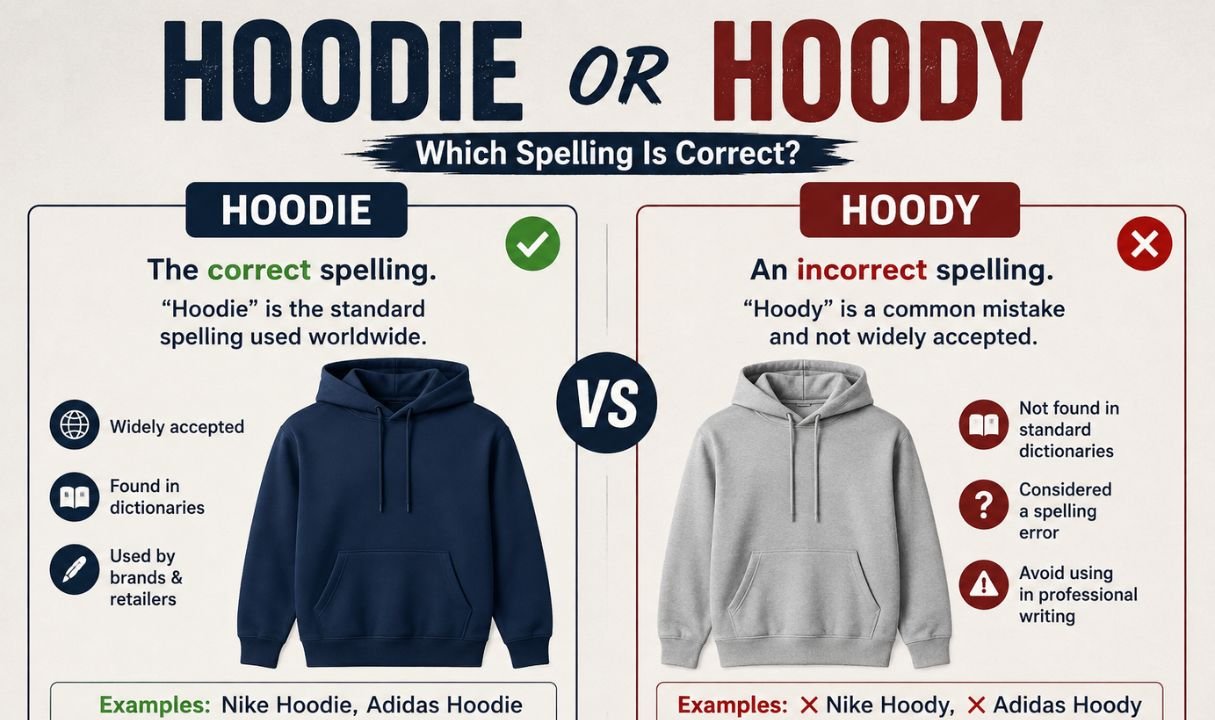
You’ve typed it both ways. Maybe you’ve even second-guessed yourself mid-sentence, deleted one version, and retyped the other. “Hoodie or hoody” is one of those small spelling puzzles that trips up shoppers, writers, and English learners alike, and the honest answer is that both forms exist for a reason.
This guide breaks down where each spelling comes from, how native speakers actually use them, and which one you should reach for depending on what you’re writing.
Comparison Overview
| Feature | Hoodie | Hoody |
|---|---|---|
| Popularity | Dominant spelling worldwide | Rare, mostly historical or regional |
| Formal writing | Preferred | Generally avoided |
| Dictionaries | Primary entry | Listed as a variant |
| Retail and marketing | Standard term | Almost never used |
| Region | US, UK, Australia, global | Older British usage |
| Word type | Noun | Noun |
| Plural form | Hoodies | Hoodys or hoodies (inconsistent) |
The table tells most of the story already: hoodie has won the spelling contest. Hoody hasn’t disappeared, but it now reads as dated or unusual to most readers.
Definition of Hoodie
A hoodie is a pullover or zip-up sweatshirt with an attached hood, usually made from cotton, fleece, or a cotton-polyester blend. Most hoodies include a kangaroo pocket on the front and ribbed cuffs at the wrists and hem. People wear them for warmth, comfort, athletic activity, or simply as a casual style statement. The word functions as a shortened, informal version of “hooded sweatshirt,” and it has been fully absorbed into everyday vocabulary — you’ll find it in dictionaries, on clothing tags, and across every major online retailer.
Definition of Hoody
Hoody carries the exact same meaning as hoodie: a hooded sweatshirt. The two words are not different garments: they’re different spellings of one item. Hoody shows up occasionally in older British texts, in some brand names, and in casual writing where someone simply picked the alternate form. Merriam-Webster and Oxford both recognize hoody as a valid variant, but they list hoodie as the main entry, which tells you which one carries more everyday weight.
You May Like: Rational vs Rationale: Difference, Meaning, and How to Use Each
History and Evolution of the Word
The garment itself is older than the slang. Hooded sweatshirts trace back to the 1930s, when Champion produced them for workers in cold New York warehouses. Athletes adopted the style through the following decades, and hip-hop culture in the 1990s pushed the hooded sweatshirt into mainstream fashion, where it picked up a nickname.
Language trackers point to the early 1990s as the moment “hoodie” entered common slang, shortened from “hooded sweatshirt” the way “sweats” replaced “sweatpants.” Hoody appeared around a similar period, likely as a straightforward alternate spelling rather than a separate coinage. Over the following thirty years, hoodie pulled ahead in print, in retail copy, and eventually in search behavior, while hoody settled into the role of an occasional stand-in.
Popular Usage in Modern English
Open any clothing website today and you’ll see hoodie everywhere product titles, size charts, marketing emails, influencer captions. News articles, fashion blogs, and style guides follow the same pattern. Hoody still turns up here and there, mostly in casual conversation, older UK publications, or as a stylistic choice by a specific writer or brand.
A quick mental test: picture a search bar. Type “hoodie” and you’ll get results instantly recognized by autocomplete, product filters, and SEO tools. Type “hoody” and search engines will often nudge you back toward the more common spelling. That’s a reliable signal of which term the broader English-speaking world has settled on.
Main Differences Between Hoodie and Hoody
| Aspect | Hoodie | Hoody |
|---|---|---|
| Meaning | Hooded sweatshirt | Same garment, alternate spelling |
| Frequency of use | Very high | Low |
| Tone | Neutral, works in casual and semi-formal writing | Feels informal or old-fashioned |
| SEO value | Strong — matches search volume | Weak — fewer searches |
| Brand usage | Nearly universal | Occasional |
Nothing about the actual clothing changes between the two spellings. The differences sit entirely in frequency, tone, and audience expectation.
Hoodie vs Hoody in Fashion Writing
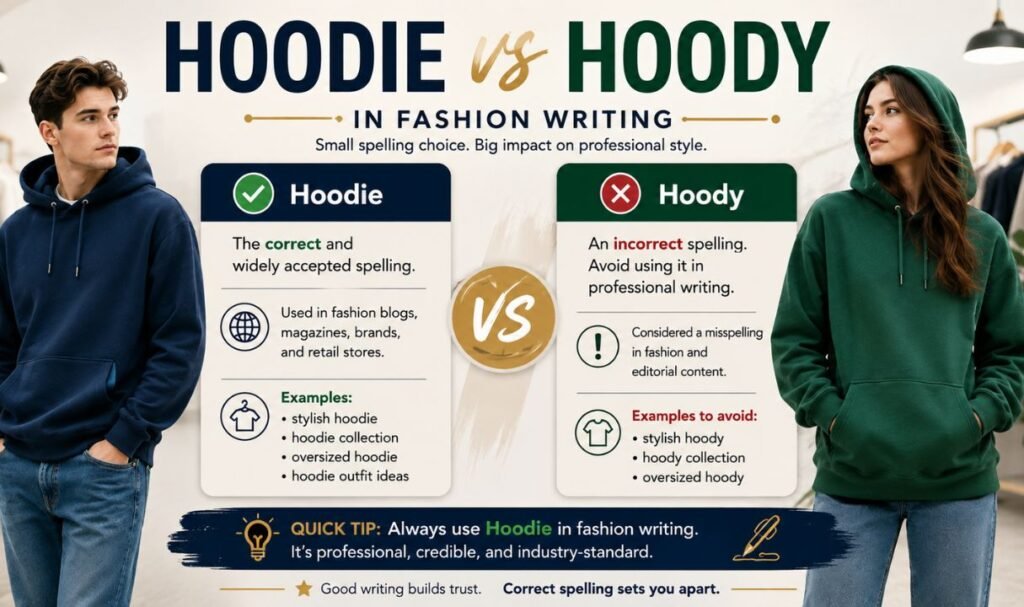
Fashion copywriters lean on hoodie almost exclusively, and there’s a practical reason beyond habit. Product descriptions need to match how customers actually search and speak, and shoppers type “hoodie” far more often than “hoody.” A brand that labels its listings “hoody” risks losing visibility in search results and looking slightly out of step with current style vocabulary.
That said, you’ll occasionally spot “hoody” used deliberately — in a brand name, a nostalgic streetwear campaign, or a British publication aiming for a retro tone. It’s not wrong; it’s just a smaller, more specific lane.
Hoodie for Girls
Hoodies for girls span cropped fits, oversized silhouettes, graphic prints, and pastel or neutral colorways. Retailers almost always use “hoodie” in these product names, since it’s the spelling shoppers search for.
What Is a Hoodie on a Guy
On a guy, a hoodie usually means a relaxed pullover or zip-front sweatshirt worn over a tee, layered under a jacket, or paired with joggers for an athleisure look. The term describes fit and style rather than gender-specific design.
Hoody or Hoodie Creepypasta
Online horror fiction communities often use “hoodie” (occasionally “hoody”) to describe an anonymous, hood-obscured figure — a visual shorthand for mystery or menace in internet folklore. Spelling varies by author, but “hoodie” appears more frequently even in these informal fan communities.
When Were Hoodies Popular
Hoodies gained traction in the 1930s as workwear, spread through college and pro sports in the mid-1900s, and became a cultural fixture through 1990s hip-hop fashion. They remain popular today across streetwear, athleisure, and everyday casual wardrobes.
Hoody or Hoodie Price
Prices vary by material and brand rather than by spelling — a basic fleece hoodie might run $20 to $40, while premium or designer versions climb well past $100. Searching either spelling online will pull similar product ranges.
Hoodie vs Jacket
A hoodie is typically soft, unlined, and made from sweatshirt fabric, while a jacket often uses heavier or weatherproof material and may include a full lining. Hoodies prioritize comfort and casual style; jackets often prioritize protection from wind, rain, or cold.
Hoody or Hoodie Men’s
Men’s hoodies range from lightweight zip-ups to heavyweight pullovers built for cold weather. Retailers list these almost exclusively under “hoodie,” with “hoody” appearing only in rare cases.
How Each Term Is Used in Sentences
- Hoodie: “She pulled on a gray hoodie before heading out for her run.”
- Hoodie: “The store restocked their best-selling zip-up hoodie.”
- Hoody: “He wore an old hoody from his college days.”
- Hoody: “That brand still calls its pullover a hoody on the tag.”
Common Mistakes Learners Make
- Assuming hoody is incorrect rather than simply less common
- Mixing both spellings within a single piece of writing
- Using hoody in formal or business writing where hoodie reads more polished
- Forgetting that the plural of hoodie is hoodies, not hoodys
Simple Rules to Remember
- Default to hoodie unless you have a specific reason to use hoody.
- Stay consistent — pick one spelling per document and stick with it.
- Match your audience: American readers expect hoodie almost every time.
- Check style guides for your publication or brand before publishing.
Quick Tips for Writing and Speaking
- Say “hoodie” out loud in casual conversation; it sounds natural to nearly every English speaker.
- Use hoodie in product listings, resumes, articles, and anything meant for a wide audience.
- Reserve hoody for direct quotes, older references, or a deliberate stylistic choice.
You May Like: Hustle vs Hussle: Why People Confuse These Two Words
When to Use Each One
Use Hoodie When:
- Writing for a general or international audience
- Creating product listings, blog posts, or marketing copy
- Optimizing content for search engines
- Speaking casually with friends or family
- Writing professionally or academically about clothing
Use Hoody When:
- Quoting someone who used that spelling
- Referencing a specific older British text or brand name
- Writing dialogue for a character with a particular regional voice
- Matching an existing house style that already uses “hoody”
When NOT to Use Each One
Do Not Use Hoodie When:
- You’re directly quoting a source that spells it “hoody”
- A brand’s official product name uses “hoody” specifically
Do Not Use Hoody When:
- Writing for SEO, since search volume favors hoodie
- Producing formal, professional, or academic content
- Addressing a primarily American audience
- Consistency with the rest of your document requires hoodie
Which One to Use (Decision Guide)
- Are you writing for search engines or a broad audience? Choose hoodie.
- Are you quoting someone or referencing an existing brand name? Match their spelling exactly.
- Are you writing casually, just for yourself or friends? Either works, but hoodie will read more naturally to most people.
- Still unsure? Default to hoodie — it’s the safer, more widely accepted choice in nearly every situation.
Real-World Practical Examples
Hoodie Examples
- “I grabbed my hoodie on the way out because the evening turned chilly.”
- “The gym sells branded hoodies at the front counter.”
- “This oversized hoodie has become my go-to travel layer.”
Hoody Examples
- “My dad still calls every hooded sweatshirt a hoody.”
- “The vintage shop had a faded hoody from the early 2000s.”
- “She grew up hearing hoody used more than hoodie.”
Self-Assessment (Fill in the Blanks)
- She wore a bright red ______ to the football match.
- The old sweatshirt in the attic is a faded, thirty-year-old ______.
- Most online stores list this item as a ______, not a ______.
- He zipped up his ______ before stepping into the cold.
- Grandpa still calls it a ______ out of habit.
Answers
- Hoodie
- Hoody (works with either, though hoodie is more common today)
- Hoodie, hoody
- Hoodie
- Hoody
Frequently Asked Questions
Is it hoody or hoodie?
Hoodie is the standard, widely accepted spelling today, though hoody remains a recognized variant.
What does “hoody” mean?
It means the same thing as hoodie: a sweatshirt with an attached hood.
What do Brits call a hoodie?
Modern British English mostly uses “hoodie” as well, though “hoody” was more common in older UK usage.
Is it a hoodie or a hoodie?
Both spellings, hoodie and hoody, refer to the same garment; hoodie is simply the more common and preferred form.
Conclusion
Hoodie and hoody describe the exact same piece of clothing, and neither spelling is technically wrong. What separates them is usage: hoodie has become the standard across dictionaries, retail, fashion writing, and everyday conversation, while hoody survives as an older or more regional variant.