
Mixing up “rational” and “rationale” is one of the most common slip-ups in English writing, and it happens even to careful writers. The two words share a root, a similar spelling, and a general connection to logic — but they play completely different roles in a sentence. One describes a person’s thinking. The other names a document, explanation, or set of reasons.
This guide breaks down exactly what separates them, shows you how to use each one correctly, and gives you a memory trick so you never second-guess yourself again.
Quick Answer
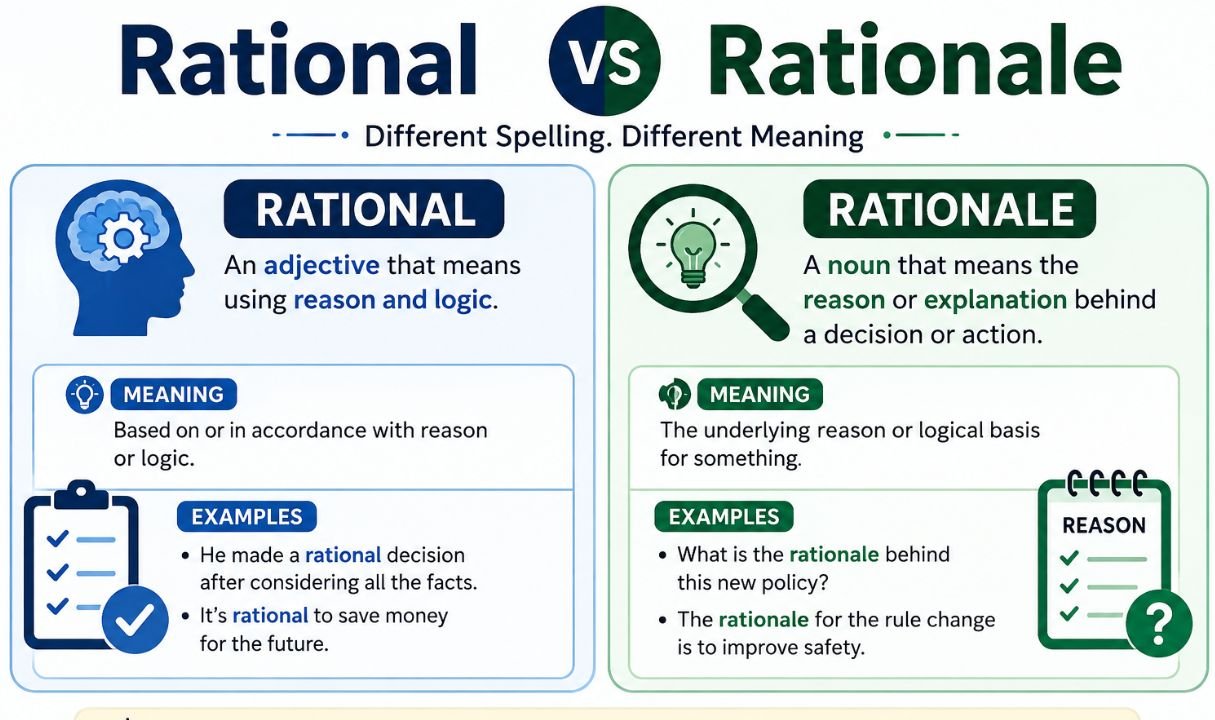
Rational is an adjective. It describes a person, decision, or thought process that is logical, sensible, or grounded in reason.
Rationale is a noun. It refers to the explanation or set of reasons behind a decision, belief, or action.
If you’re describing how someone thinks, use rational. If you’re naming the reason behind something, use rationale.
Simple Examples
- She made a rational choice by comparing all her options before deciding.
- Please explain the rationale behind your choice.
Easy Tip
Rationale ends in “-ale,” which rhymes with “tale.” Think of a rationale as the tale or story you tell to justify a decision. Rational, on the other hand, describes a trait — the way a person or idea behaves.
Understanding the Meaning of Rational
Definition of Rational
Rational means based on reason, logic, or sound judgment. A rational person weighs facts before acting. A rational decision follows a clear line of thinking rather than emotion or impulse. The word traces back to the Latin rationalis, meaning “of reason,” and it has been part of English since roughly the 1300s.
In mathematics, rational carries a second, technical meaning: a rational number is one that can be written as a fraction of two integers, such as 1/2 or 3/4.
Rational Is an Adjective
Because rational is an adjective, it modifies a noun. It cannot stand alone as the subject or object of a sentence. You’ll typically see it paired directly with a person, thought, decision, or explanation:
- a rational person
- a rational argument
- a rational explanation
- rational thinking
Example Sentences
- He stayed calm and gave a rational response even under pressure.
- It wasn’t a rational decision — it was driven purely by fear.
- Scientists rely on rational analysis rather than guesswork.
- A rational buyer compares prices before making a purchase.
Opposite of Rational
The most common antonym is irrational, which describes thinking or behavior that ignores logic or evidence. Other opposites include unreasonable, illogical, and emotional (when used in contrast to logical thought).
| Rational | Irrational |
|---|---|
| Logical, evidence-based | Illogical, emotion-driven |
| Calm and measured | Impulsive or erratic |
| A rational fear (based on real risk) | An irrational fear (no real basis) |
Understanding the Meaning of Rationale
Definition of Rationale
A rationale is the underlying reasoning or justification behind a decision, policy, or belief. It answers the question “why?” A rationale can be a single sentence explaining a choice, or it can be a formal, multi-page document — such as a project rationale submitted to a funding committee.
The word entered English later than rational, around the 1650s, borrowed from Late Latin.
Rationale Is a Noun
Rationale names a thing — specifically, an explanation. As a noun, it needs an article (a, the) or possessive pronoun before it, and it’s often followed by “for” or “behind”:
- the rationale for the merger
- her rationale behind the new policy
- a clear rationale
Example Sentences
- The manager shared her rationale for cutting the marketing budget.
- I still don’t understand the rationale behind this rule.
- The report opens with a short rationale explaining the study’s purpose.
- Their rationale made sense once we saw the full data.
Rational vs rationale pronunciation
They sound different once you know the pattern. Rational is pronounced RASH-uh-nl (three syllables, stress on the first). Rationale is pronounced rash-uh-NAL (three syllables, stress on the last, and it rhymes with “sale” or “pale”).
1. Rational vs rationale examples
- Rational: “It’s the rational choice given the risks involved.”
- Rationale: “What’s the rationale behind that choice?”
2. Rational vs rationale meaning
Rational describes a quality — logical, sensible thinking. Rationale names a specific set of reasons offered to support an action or belief.
Rational vs rationale grammar
Rational functions as an adjective and sits before a noun (a rational decision). Rationale functions as a noun and typically follows an article or possessive (the rationale, my rationale).
Rational vs irrational numbers
In math, this is a separate but related distinction. A rational number can be expressed as a fraction of two integers (like 4/5 or 7). An irrational number cannot be written as a simple fraction and has a decimal that never repeats or ends, such as pi or the square root of 2.
Rational vs logical
The two overlap heavily but aren’t identical. Logical usually refers to strict, step-by-step reasoning following formal rules. Rational is broader — it describes overall soundness of judgment, which can include practical or emotional context alongside pure logic.
Rational vs reasonable
Reasonable often carries a social or fairness angle — a reasonable request is one that’s fair or moderate given the circumstances. Rational is more about the process of thought itself, focused on logic rather than fairness.
Rationale in research
In academic and scientific writing, a rationale is a required section that explains why a study matters, what gap it fills, and why the chosen methods are appropriate. A strong rationale connects existing research to the new questions the study aims to answer.
Common Word Pairings
| Word | Common Pairings |
|---|---|
| Rational | rational thinking, rational decision, rational person, rational argument, rational choice |
| Rationale | business rationale, clear rationale, provide a rationale, rationale for the decision, project rationale |
Grammar Rules Explained Clearly
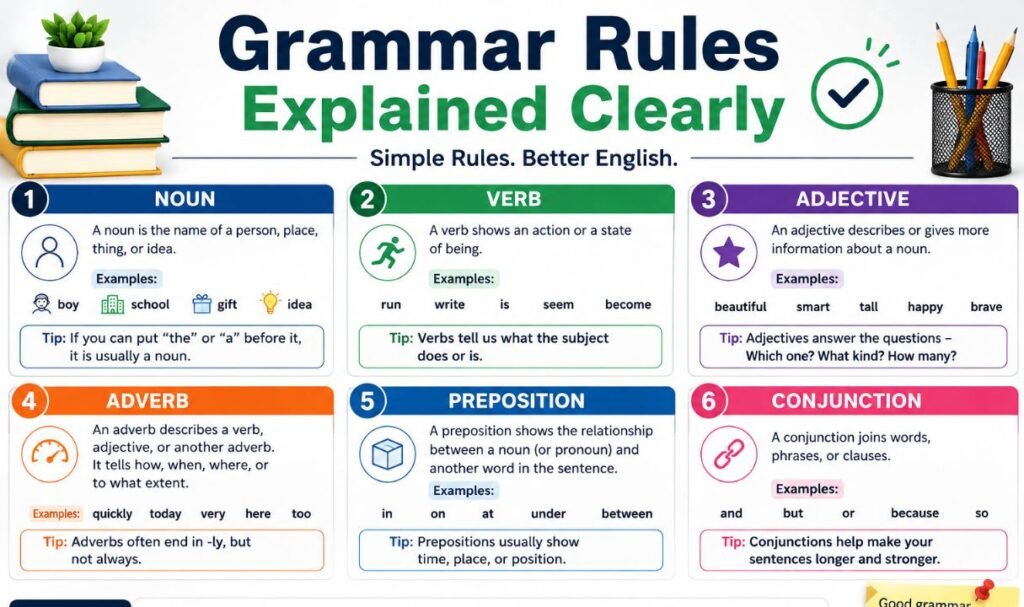
Rational Is an Adjective
An adjective describes or modifies a noun. Rational always sits next to (usually before) the noun it describes, and it can also follow linking verbs like “is” or “seems”:
- His approach is rational.
- She seemed perfectly rational during the interview.
Rationale Is a Noun
A noun names a person, place, thing, or idea. Rationale names the “thing” — the explanation itself — and can take a plural form (rationales) when referring to more than one set of reasons:
- The committee reviewed several rationales before choosing a winner.
Pronunciation Differences
| Word | Pronunciation | Syllable Stress |
|---|---|---|
| Rational | RASH-uh-nl | First syllable |
| Rationale | rash-uh-NAL | Last syllable |
A quick way to remember it: rationale rhymes with “corral” and “locale,” both of which also end in that same “-ale” sound.
You May Like: Appendices vs Appendixes: Which Plural Is Actually Correct
Why People Confuse Rational vs Rationale
Similar Spelling
The two words differ by only a few letters, and rationale is essentially “rational” with an “e” added on. At a glance, especially when skimming or typing quickly, it’s easy to drop or add that final letter without noticing.
Same Root Origin
Both words descend from the Latin ratio, meaning reason or calculation. Because they share a family tree and a general theme — logic and reasoning — writers sometimes assume they’re interchangeable. They aren’t.
Lack of Grammar Awareness
Many people don’t consciously check whether a sentence needs an adjective or a noun. Since both words “feel” academic and serious, it’s tempting to use whichever one comes to mind first, regardless of the sentence’s grammatical needs.
Academic Usage
Both words appear constantly in essays, research papers, and business reports, often in the same paragraph. That repeated exposure in similar contexts blurs the line between them, especially for non-native speakers or students under deadline pressure.
Rational vs Rationale in Real-Life Usage
In Academic Writing
Students are frequently asked to submit a “rationale” for their research topic, explaining why it’s worth studying. Meanwhile, professors evaluate whether a student’s argument is “rational” — logically constructed and supported by evidence.
Business Communication
Executives ask for a rationale before approving a budget, a merger, or a new hire. Teams are expected to make rational decisions grounded in data rather than gut feeling, even though gut feeling often sneaks in anyway.
In Daily Conversation
In everyday speech, rational shows up more often than rationale. People describe friends, decisions, or fears as rational or irrational. Rationale tends to surface in more formal or explanatory conversations, such as justifying a big purchase.
In Professional Reports
Formal reports often include a dedicated “Rationale” section near the introduction, laying out why the project, policy, or recommendation exists. The rest of the report is expected to read as rational — coherent, evidence-based, and free of contradictions.
Which One Should You Use
Ask yourself what role the word plays in your sentence.
- Need to describe a person, decision, or way of thinking? Use rational.
- Need to name the reasons or justification behind something? Use rationale.
Quick Test
Try substituting “logical” for the word in question. If “logical” fits naturally, you need rational. If it doesn’t fit but “reasoning” or “justification” does, you need rationale.
- “That was a logical decision” ✔ → use rational.
- “What’s the logical for this?” ✘ → doesn’t work, so use rationale.
Common Mistakes and Corrections
| Incorrect | Correct |
|---|---|
| What’s your rational for quitting? | What’s your rationale for quitting? |
| She gave a very rationale explanation. | She gave a very rational explanation. |
| His rational behind the plan was solid. | His rationale behind the plan was solid. |
| It’s not a rationale approach to the problem. | It’s not a rational approach to the problem. |
Rational vs Rationale in Extended Examples
Simple Sentences
- He is a rational thinker.
- She explained her rationale.
Medium Sentences
- The board wanted a rational explanation for the sudden drop in sales.
- Before approving the plan, the investors asked for a written rationale.
Advanced Sentences
- Even under intense scrutiny, the CEO maintained a rational, evidence-driven stance while defending the company’s long-term rationale for entering an unfamiliar market.
- Critics questioned whether the policy’s rationale actually held up once rational cost-benefit analysis was applied.
Synonyms of Rational
- Logical
- Sensible
- Reasonable
- Sound
- Coherent
- Level-headed
- Clear-headed
Synonyms of Rationale
- Justification
- Reasoning
- Basis
- Explanation
- Grounds
- Logic
- Premise
You May Like: Seeing or Seing: Which Spelling Is Correct?
Practice Exercises
Fill in the Blanks
- The teacher asked for a clear _______ behind the new grading policy.
- His argument seemed _______ once he laid out the evidence.
- I need a _______ explanation before I approve this budget.
- Their _______ for moving offices was purely financial.
(Answers: 1. rationale, 2. rational, 3. rational, 4. rationale)
Choose the Correct Word
- It was a (rational / rationale) fear, given the circumstances.
- Please share the (rational / rationale) for this proposal.
- She thinks (rational / rationale)ly under pressure.
- The committee couldn’t agree on a single (rational / rationale).
(Answers: 1. rational, 2. rationale, 3. rational, 4. rationale)
Advanced Usage in Academic Writing
Academic papers often separate the “rationale” from the “hypothesis” and “methodology.” The rationale explains why the research question matters and what prior studies left unresolved. It typically appears early in the introduction, before the literature review narrows into specific objectives.
A well-written rationale connects existing knowledge gaps to the study’s purpose, making the paper’s contribution obvious to reviewers and readers alike. Meanwhile, the paper’s overall argument should hold up as rational — each claim supported by data, each conclusion following logically from the evidence presented.
Rational vs Rationale in Business Strategy
Companies build a rationale before major decisions: entering a new market, launching a product, or cutting costs. This rationale usually includes market research, financial projections, and risk assessments, all packaged into a document leadership can review.
Once that rationale exists, teams are expected to execute it in a rational way — sticking to the plan, tracking results against forecasts, and adjusting only when the data supports a change. A business that skips the rationale stage often ends up making decisions that look rational on the surface but lack real justification underneath.
Memory Trick to Remember the Difference
Picture rationale as a tale — a story someone tells to explain their reasoning. The “-ale” ending is your cue: rationale is a noun, a thing you can hold, hand over, or write down.
Rational, without the extra letters, describes a trait someone has. If you can replace the word with “logical” and the sentence still makes sense, you’re looking at rational, not rationale.
Frequently Asked Questions
What does rationale mean?
Rationale is a noun meaning the set of reasons or the logical basis behind a decision, belief, or action.
Does rational have an e on the end?
No. Rational ends in “-al.” Only rationale ends in “-e.”
Should it be rational or rationale?
Use rational to describe logical thinking or behavior (an adjective). Use rationale to name the reasoning behind a decision (a noun).
What is the difference between reasoning and rationality?
Reasoning is the active process of thinking through a problem to reach a conclusion. Rationality is the broader quality of being logical and sound in judgment, which good reasoning helps produce.
Conclusion
Rational and rationale look almost identical, but they belong to different parts of speech and serve different jobs in a sentence. Rational describes logical, sensible thinking — it’s the adjective. Rationale names the explanation or reasoning behind a decision — it’s the noun. Once you remember that a rationale is the “tale” you tell to justify something, and rational is a trait a person or idea has, the confusion disappears for good. Keep this guide handy, run your sentences through the quick test above, and you’ll never mix these two up again.