
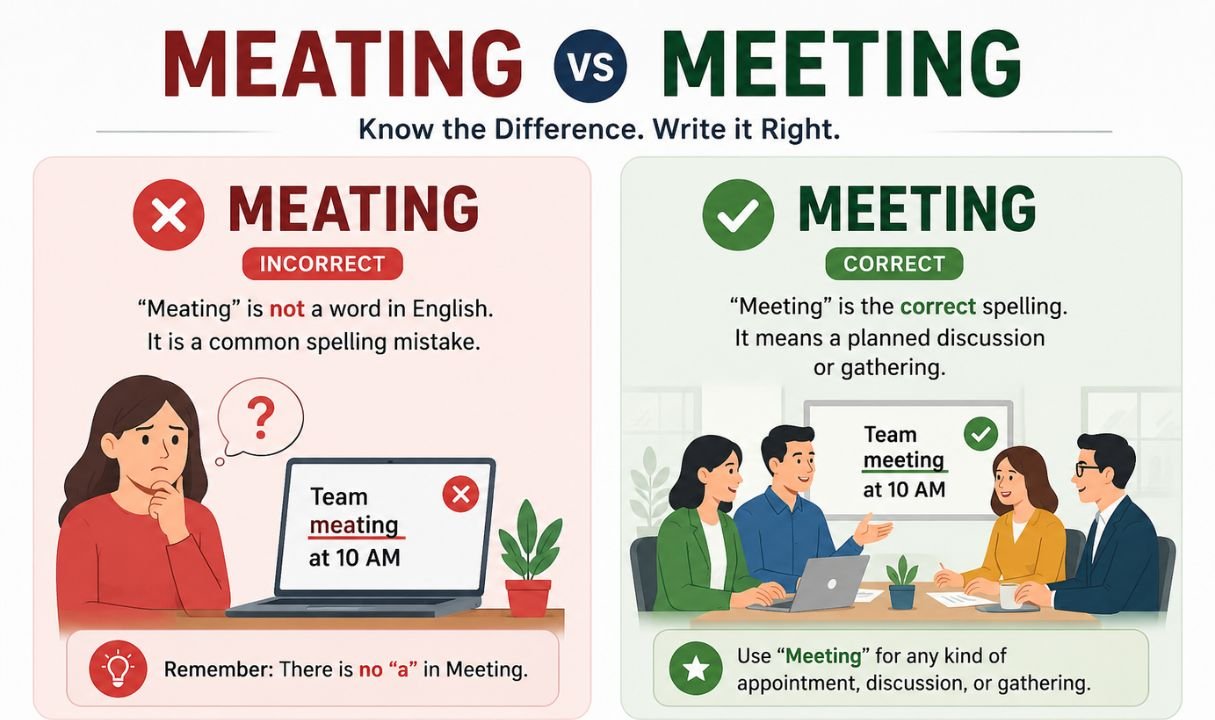
Typing fast has a way of exposing small cracks in our spelling. One of the most common slips happens between two words that look almost identical on a keyboard: meeting and meating. A single misplaced letter can turn a routine calendar invite into something that looks like a typo sent in a hurry — because, honestly, it usually is.
If you’ve ever paused mid-email wondering whether it’s “team meating” or “team meeting,” you’re in good company. This confusion shows up in student assignments, Slack messages, Google Meet invites, and even printed reports. The good news is that once you understand where each word comes from and what it actually means, you won’t second-guess yourself again.
This guide breaks down the origin, meaning, correct spelling, and real-world usage of both words, along with the related term “meting,” so you can write with confidence every time.
Origins and Meanings of Meeting and Meating
Both words trace back to older English roots, but only one of them belongs in your everyday vocabulary. Here’s how each one developed and what it means today.
Meeting Meaning in English
Meeting comes from the verb “meet,” which has meant “to come together” since Old English. As a noun, meeting refers to an occasion when two or more people gather for a purpose — to talk, plan, negotiate, or make a decision. As a verb, it’s the present participle of “meet,” describing an ongoing or planned action.
You’ll see meeting used in:
- Business settings — board meetings, client meetings, status meetings
- Education — parent-teacher meetings, faculty meetings
- Casual contexts — meeting a friend for coffee
- Virtual platforms — a Google Meet meeting or a Zoom meeting
It’s one of the most frequently typed words in modern work communication, largely because so much of professional life now runs through calendars and video calls.
Meating Meaning
Is meating a word? Technically, yes, in a very narrow sense. “Meating” can appear as a rare, almost archaic term connected to supplying, processing, or dealing in meat — think of phrases from old hunting or butchery contexts, where someone might describe “meating” an area, meaning providing it with meat. You won’t find this usage in everyday conversation, and most dictionaries either omit it or flag it as obsolete.
If you search meating on Urban Dictionary, you’ll mostly find joke entries poking fun at the typo, since the internet has turned this spelling mistake into something of a running gag. Outside of that niche or humorous context, meating is not a word people should reach for. In practically every sentence where you’re tempted to type it, meeting is what you actually mean.
Meting Meaning
This one trips people up in a different way. Meting is a real, standard English word — the present participle of “mete.” Meting out something means distributing or dispensing it, most often used with punishment, justice, or portions.
Example: “The judge is meting out a harsher sentence than expected.”
Meting has nothing to do with gatherings or food. It’s a distribution word, and the confusion arises purely because it looks and sounds close to both meeting and meating.
Correct Spelling and Pronunciation
Here’s a fast side-by-side comparison to settle the spelling question for good.
| Word | Correct Spelling | Pronunciation | Common Meaning | Standard Word? |
|---|---|---|---|---|
| Meeting | M-E-E-T-I-N-G | MEE-ting | A gathering of people for discussion | Yes |
| Meating | M-E-A-T-I-N-G | MEE-ting | Rare term related to supplying meat; usually a typo | Rarely, mostly obsolete |
| Meting | M-E-T-I-N-G | MEE-ting | Distributing or handing out (often punishment) | Yes |
Notice that all three sound almost the same when spoken aloud, which is exactly why the spelling gets muddled in writing. Meeting has a double “e,” meating swaps in “ea” (borrowed from the word “meat”), and meting drops a letter entirely compared to meeting.
A quick memory trick: meeting comes from “meet,” so it keeps that double “e.” If you’re describing people getting together, that double “e” is your anchor.
How to Use ‘Meeting’ in Sentences
Meeting works as both a noun and a verb, and understanding the difference helps you use it correctly in any context.
As a noun (a gathering):
- The quarterly meeting starts at 10 a.m.
- We rescheduled the client meeting to Thursday.
- Her calendar shows five meetings today.
- The full meeting covered budget, staffing, and next quarter’s targets.
As a verb (present participle of “meet”):
- She is meeting the new vendor tomorrow.
- We’re meeting at the downtown office this week.
- I’ll be meeting with the design team after lunch.
It also fits naturally with modern tools:
- Join the Google Meet meeting using the link in your invite.
- Our Zoom meeting got pushed back by fifteen minutes.
Whether you’re scheduling, describing, or referencing an event that already happened, meeting is the word that fits.
Why ‘Meating’ is Usually Incorrect
In nearly every modern context, meating is simply the wrong word choice. Here’s why it keeps showing up anyway, and why it rarely belongs in your writing:
- Auto-pilot typing. Your fingers know the rhythm of “meeting,” but under speed, the brain sometimes substitutes a more familiar letter pattern from words like “meat” or “eating.”
- Phonetic overlap. Spoken quickly, meeting and meating sound close to identical, so people who spell by ear are more prone to the slip.
- Autocorrect gaps. Some spell-checkers don’t flag meating as an error because it technically exists in dictionaries as an obscure term, so the red squiggly line doesn’t always appear.
- Lack of awareness. Many writers have simply never seen the word broken down this way and assume it’s an accepted variant spelling of meeting. It isn’t.
Using meating in a professional email or document can quietly damage credibility. A recruiter, client, or manager may not say anything, but a spelling slip like this is the kind of thing that gets noticed and remembered.
Common Confusions and Mistakes
Meeting and meating aren’t the only pair that trips writers up. Related words pile onto the confusion, so it helps to separate them clearly.
Meet vs Meat vs Meeting
| Word | Part of Speech | Meaning | Example |
|---|---|---|---|
| Meet | Verb | To come together with someone | Let’s meet at the cafe. |
| Meat | Noun | Animal flesh used as food | She doesn’t eat red meat. |
| Meeting | Noun/Verb | A gathering, or the act of coming together | The meeting ran long. |
Meeting vs Meting
Meeting refers to people gathering. Meting refers to distributing something, almost always in formal or legal contexts like justice, punishment, or resources. They share no real connection beyond similar spelling.
- Correct: “The committee is meeting to review the case.”
- Correct: “The committee is meting out consequences for the violation.”
- Incorrect: “The committee is meting to review the case.”
Spelling Mistakes in English
Meeting, meating, and meting belong to a larger family of near-identical word pairs that cause everyday spelling mistakes — pairs like “affect/effect,” “accept/except,” and “than/then.” What they have in common is that spellcheck tools sometimes miss them because the words themselves are valid; only the context is wrong. That’s exactly why proofreading by eye still matters, even with modern writing tools.
Scenarios
Picture a hiring manager scanning through dozens of applications. One candidate writes, “I’m available for a meating anytime this week.” It’s a small thing, but it stands out, and not in a good way. Or imagine a student submitting an assignment that says, “The class meating discussed historical events.” A teacher marking that paper will likely dock points for something that has nothing to do with the actual content.
These small slips rarely change what the reader understands, but they do change how the writing is perceived.
Examples for Clarity
Here’s a batch of sentences showing correct versus incorrect usage side by side.
| Incorrect | Correct |
|---|---|
| Let’s schedule a meating for Monday. | Let’s schedule a meeting for Monday. |
| Join the meating link at 3 p.m. | Join the meeting link at 3 p.m. |
| The parent-teacher meating is next week. | The parent-teacher meeting is next week. |
| We had a productive meating yesterday. | We had a productive meeting yesterday. |
| Her calendar is full of meatings. | Her calendar is full of meetings. |
Reading these side by side makes the pattern obvious — meating almost never belongs where meeting should be.
Practice Session: Meating vs Meeting
Ready to test what you’ve learned? Work through these quickly, then check your answers below.
Fill in the Blank
- We are ______ at 2 p.m. today. (meeting/meating)
- The board ______ covered next year’s budget. (meeting/meating)
- She’s ______ the client tomorrow morning. (meeting/meating)
- Our weekly ______ moved to Friday. (meeting/meating)
- The judge began ______ out the sentence. (meting/meeting)
Correct the Sentences
- “The team has a meating scheduled for noon.”
- “I can’t attend the meating due to a conflict.”
- “Please join the Zoom meating using this link.”
Scenarios
- You’re drafting a calendar invite for a client call. Which word do you use?
- You’re writing a sentence about a judge deciding punishments. Which word fits?
- You’re describing an old hunting text that references supplying meat to a village. Which word could technically apply?
Answer
Fill in the blank: 1. meeting 2. meeting 3. meeting 4. meeting 5. meting
Correct the sentences: 1. “The team has a meeting scheduled for noon.” 2. “I can’t attend the meeting due to a conflict.” 3. “Please join the Zoom meeting using this link.”
Scenarios: Calendar invite → meeting. Judge and punishments → meting. Old hunting text about meat supply → meating (rare, archaic usage).
Tips to Avoid Mistakes
- Say the word slowly and connect it to “meet,” not “meat.”
- Remember the double “e” — meeting mirrors meet.
- Proofread calendar invites and emails before sending; spellcheck won’t always catch this one.
- If you’re unsure, replace the word mentally with “gathering.” If that fits, you need meeting.
- Keep a personal note of tricky word pairs you tend to mix up, and review them occasionally.
Frequently Asked Questions
What is the difference between “meeting” and “meating”?
Meeting refers to a gathering of people for discussion, while meating is a rare, largely outdated term connected to meat and is almost always a spelling mistake in modern writing.
What’s the difference between meet and meat?
Meet is a verb meaning to come together with someone, while meat is a noun referring to animal flesh eaten as food.
What does the word “meatings” mean?
“Meatings” isn’t a standard English word; it’s a common misspelling of “meetings,” which refers to multiple gatherings of people.
What does “meting” mean?
Meting is the present participle of “mete” and means distributing or dispensing something, most often used in phrases like “meting out punishment.”
Conclusion
The mix-up between meeting and meating comes down to a single swapped letter, but the impact on how your writing reads can be bigger than it seems. Meeting is the word you want almost every time you’re talking about people coming together, whether that’s a Google Meet call, a Zoom meeting, or an in-person huddle.