
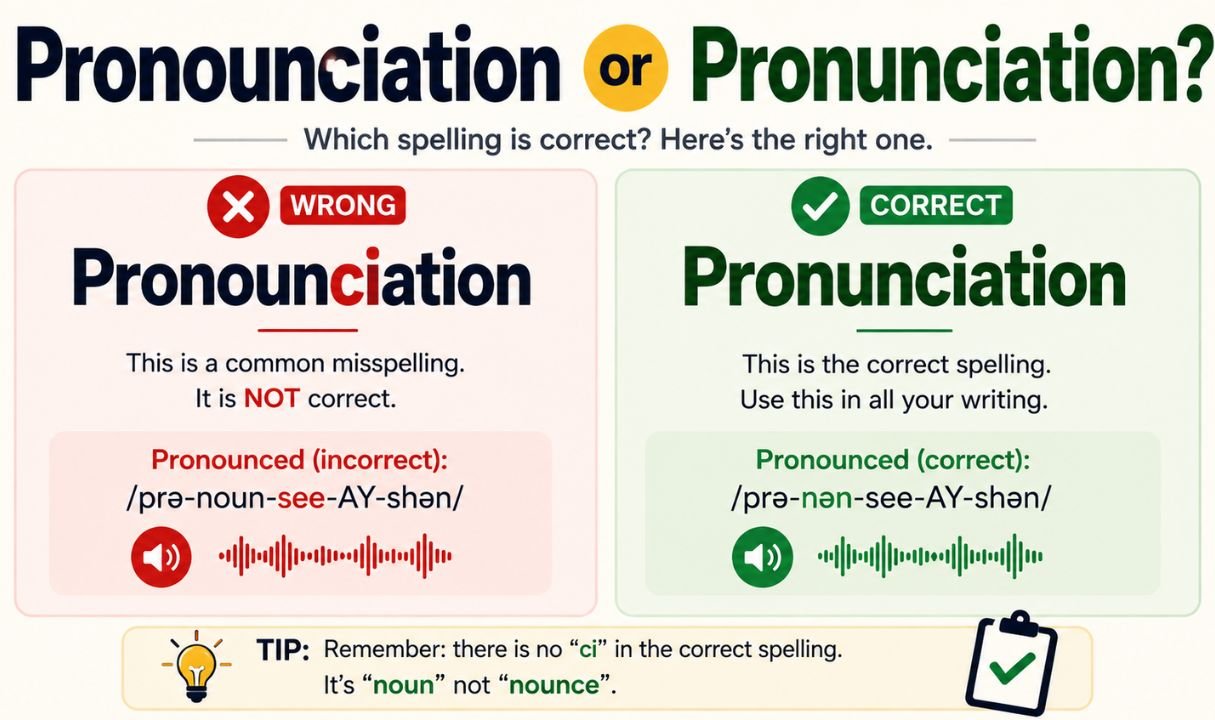
Type the word into any search bar and autocorrect starts arguing with you. One version has an extra “o,” the other doesn’t, and both somehow look right the longer you stare at them. That single letter has tripped up students, job applicants, and even confident native speakers for centuries.
Here’s the short answer before we go further: pronunciation is correct. Pronounciation is a misspelling, no matter how natural it feels to write. The rest of this guide explains why the mistake happens, how the word is used correctly, and how to make sure you never lose points — or credibility — over it again.
Comparison Overview
| Feature | Pronounciation | Pronunciation |
|---|---|---|
| Correct spelling | ❌ No | ✅ Yes |
| Found in dictionaries | Not listed | Merriam-Webster, Oxford, Cambridge |
| Word origin | Misspelling of the noun | Latin pronuntiatio |
| Common cause | Influence of the verb “pronounce” | Standard noun form |
| Used in formal writing | Never acceptable | Always acceptable |
| Grammar type | N/A (not a real word) | Noun |
Definition of Pronounciation
Pronounciation isn’t a word you’ll find in any recognized dictionary. It shows up constantly in emails, essays, and social media posts, but that popularity doesn’t make it real. It’s a spelling error that happens because the related verb, “pronounce,” carries an “ou” in its spelling, and writers assume the noun form should match.
Key Points
- Pronounciation has no dictionary entry in any major English dictionary.
- It’s classified as a common misspelling, not an alternate spelling.
- Spell-checkers and grammar tools flag it automatically.
- Using it in formal documents can undermine your credibility.
- It likely persists because it “sounds right” when spoken quickly.
Definition of Pronunciation
Pronunciation is a noun that describes the way a word, phrase, or language is spoken aloud. It covers stress patterns, vowel sounds, syllable breaks, and accent — essentially everything that shapes how speech is understood by a listener.
Key Points
- Pronunciation is a standard English noun, recognized worldwide.
- It traces back to the Latin word pronuntiatio, meaning “to announce” or “proclaim.”
- It appears in both American and British dictionaries with the same spelling.
- The word is spelled with just one “u” between the two n’s, unlike the verb “pronounce.”
- It’s used across linguistics, education, and everyday conversation.
You May Like: Disregulated vs Dysregulated: Definition, Usage & Common Mistakes
Main Differences Between Pronounciation and Pronunciation
The two words look almost identical, but only one belongs in the English language. Here’s a side-by-side breakdown that makes the distinction easy to remember.
| Category | Pronounciation | Pronunciation |
|---|---|---|
| Status | Misspelling | Correct word |
| Letter pattern | Has “oun” | Has “un” |
| Root connection | Confused with “pronounce” | Derived from Latin pronuntiatio |
| Acceptable in writing | No | Yes |
| Pronunciation of the word itself | Often mispronounced too | pruh-nun-see-AY-shun |
The core issue comes down to one missing letter. Speakers hear the “oun” sound in “pronounce” and carry it over when writing the noun, but English doesn’t work that predictably here. The noun dropped the “o” long before modern spelling rules were formalized, and it never came back.
Why Do People Confuse These Words?
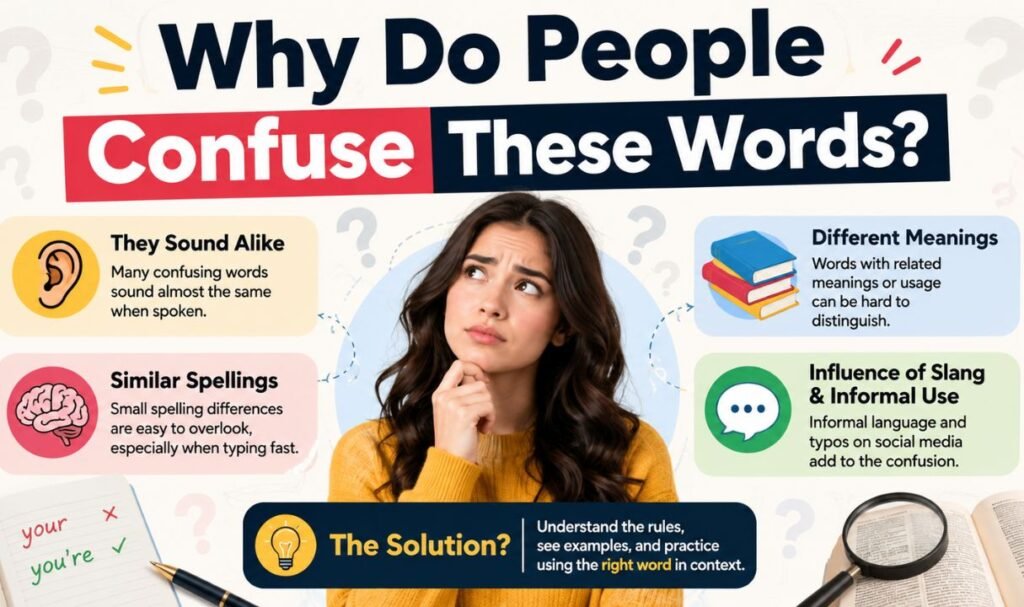
This mix-up isn’t a sign of poor grammar skills. It happens to careful writers and native speakers just as often as it happens to English learners, and there’s a clear reason why.
- Verb influence – “Pronounce” is spelled with “ou,” so the brain assumes the noun should match.
- Sound-based spelling – English speech doesn’t always mirror English spelling, and this word is a classic example.
- Repetition in casual writing – The more people see “pronounciation” online, the more normal it starts to look.
- Lack of dictionary checking – Many writers trust their memory instead of confirming the word before submitting an essay, resume, or article.
- Similar-sounding words – Terms like “announce” and “denounce” reinforce the instinct to keep the “ou” pattern everywhere.
Even language teachers report the same pattern in student essays year after year, which shows this is a spelling habit built on logic — just the wrong logic for this particular word.
Historical Background of Pronunciation
Pronunciation entered English from the Latin pronuntiatio, built from pro- (forth) and nuntiare (to announce). The word made its way into English usage by the 15th century and has kept the same core spelling ever since dictionaries began standardizing English in the 1700s.
Before spelling conventions were locked in, English writing was far less consistent than it is today. Some historical texts show irregular spellings across many words, not just this one, since printers and authors often spelled by ear. Once dictionary makers like Samuel Johnson began documenting standard forms, “pronunciation” was set as the accepted noun, and “pronounciation” was never adopted as a legitimate variant, in American English, British English, or any other recognized dialect.
That history explains something useful for learners today: the spelling isn’t arbitrary, and it isn’t new. It’s been “pronunciation” for centuries, so the correct version has far more consistency behind it than the mistake does.
You May Like: Hustle vs Hussle: Why People Confuse These Two Words
Grammar Guide
How Each Term Is Used in Sentences
Pronounciation
Because it isn’t a real word, “pronounciation” shouldn’t appear in any sentence, formal or casual. If you’re drafting an email, essay, or report and this spelling shows up, it needs to be corrected before you hit send.
Pronunciation
Pronunciation functions as a standard countable or uncountable noun, depending on context.
- Her pronunciation improved after months of daily practice.
- The teacher explained the pronunciation of each new vocabulary word.
- This app offers pronunciation guides for over 40 languages.
Common Mistakes Learners Make
Mistake 1
Writing “pronounciation” because it visually matches the verb “pronounce.”
Mistake 2
Mispronouncing the correct word itself by saying “pro-NOUN-ciation” instead of “pro-NUN-ciation.”
Mistake 3
Assuming British and American English spell the noun differently. They don’t — both use “pronunciation.”
Simple Rules to Remember
- The verb keeps “ou”: pronounce.
- The noun drops it: pronunciation.
- If you’re unsure, say the word slowly — you’ll hear “nun,” not “noun.”
- Spell-check exists for a reason; let it catch this one.
Quick Tips for Writing and Speaking
Try linking the word to a quick memory trick: “The noun has no ‘oun.'” Reading it aloud a few times, and writing it out longhand instead of relying on autocorrect, helps the correct spelling stick faster than simply memorizing a rule.
When to Use Each One
Use Pronunciation When
- You’re describing how a word or phrase sounds when spoken.
- You’re writing about accents, dialects, or phonetics.
- You’re referring to language learning, teaching, or coaching.
- You’re writing any formal document — resumes, essays, articles, or reports.
Use Pronounciation When
There isn’t a valid context for this spelling. It should be avoided in every situation, since it’s not recognized as correct in any dictionary, style guide, or professional standard.
When NOT to Use Each One
Do Not Use Pronounciation
Never use this spelling in academic papers, business communication, resumes, or published content. It signals a spelling error to readers, teachers, and hiring managers alike.
Do Not Misuse Pronunciation
While “pronunciation” is correct, it’s still misused when people confuse it with related terms like “diction” (clarity of speech) or “enunciation” (clear articulation of sounds). Pronunciation specifically refers to how a word is meant to sound, not how clearly someone speaks overall.
Which One to Use (Decision Guide)
Ask yourself one question: are you talking about how a word sounds? If yes, the answer is always “pronunciation.” There’s no scenario — formal, informal, academic, or casual — where “pronounciation” is the right choice. When in doubt, say the word out loud slowly. If you hear “nun” in the middle, spell it that way too.
Real-World Practical Examples
Pronounciation Examples
Since this isn’t a valid word, there are no correct example sentences to provide. Any sentence using it would need to be corrected, such as changing “Her pronounciation is great” to “Her pronunciation is great.”
Pronunciation Examples
- The dictionary app includes an audio pronunciation for every entry.
- His pronunciation of French vowels took years of practice to master.
- Good pronunciation makes a big difference in job interviews conducted in a second language.
- The linguist studied regional pronunciation differences across the UK.
- Online courses often pair vocabulary lessons with pronunciation drills.
Self-Assessment (Fill in the Blanks)
Test what you’ve learned. Choose the correct spelling for each sentence.
- Her ______ of Spanish has improved dramatically this year.
- The app offers audio guides for word ______.
- I struggled with the ______ of the word “colonel” for years.
- Teachers often correct ______ before grammar in beginner classes.
- Clear ______ matters more than a large vocabulary in daily conversation.
Answers
- Pronunciation
- Pronunciation
- Pronunciation
- Pronunciation
- Pronunciation
Frequently Asked Questions
Why do people say pronounciation instead of pronunciation?
It happens because the verb “pronounce” contains “ou,” and writers assume the noun form should follow the same pattern, even though it doesn’t.
What is the real spelling of pronunciation?
The correct spelling is “pronunciation,” with a single “u” between the two n’s and no “o” after the first n.
Is pronounciate a word?
No, “pronounciate” is not a real word. The correct verb is “pronounce,” and the related noun is “pronunciation.”
What does pronunciation mean?
Pronunciation refers to the way a word, phrase, or language is spoken, including its sounds, stress, and accent.
Conclusion
The rule here is simpler than it feels. “Pronunciation” is the only correct spelling — no exceptions for American English, British English, or informal writing.The confusion comes from the verb “pronounce,” but the noun form has dropped that extra “o” since the word entered English centuries ago.