
Most people type “onsite” and “on site” without ever pausing to check which one actually fits the sentence. That’s understandable — the two forms look almost the same, sound identical when spoken, and refer to the same basic idea: something happening at a physical location rather than remotely. But grammatically, they don’t play the same role, and mixing them up in a resume, a work email, or a company policy document can make your writing look inconsistent.
This guide breaks down exactly what separates “onsite” from “on site,” when each one belongs in a sentence, and how native English style guides treat the hyphenated middle option, “on-site.” By the end, you’ll be able to pick the right form without second-guessing yourself.
Comparison Overview
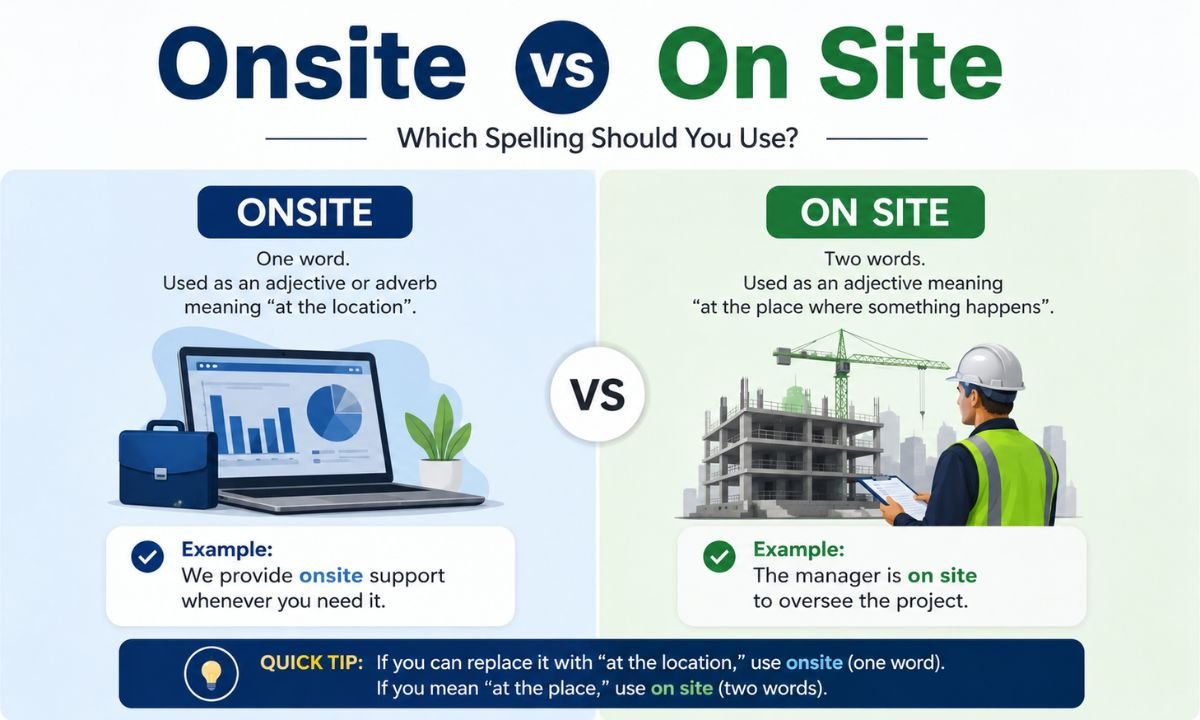
Both words describe presence at a specific place — a job site, an office, a construction zone, a client’s building. The difference comes down to grammar, not meaning.
- Onsite is a single word, usually functioning as an adjective before a noun (“onsite training”) or, in casual American usage, as an adverb (“she works onsite”).
- On site is a two-word phrase that typically answers the question “where?” and follows a verb (“the technician is on site”).
- On-site, the hyphenated version, sits in between. Many style guides recommend it as the adjective form, reserving the unhyphenated “on site” strictly for location.
None of these forms is “wrong” in every context. What matters is choosing the version that matches the grammatical job the phrase is doing in your specific sentence.
Definition of Onsite
Onsite is a compact adjective (and, increasingly, an adverb) meaning “located at, or taking place at, the actual site of a business, project, or event,” rather than somewhere else or online. It’s the form you’ll see constantly in job postings, HR documents, tech companies, and marketing copy.
Typical uses include:
- Onsite support
- Onsite training
- Onsite parking
- Onsite interview
- Onsite team
In each example, “onsite” sits directly in front of a noun and tells you what kind of support, training, or parking is being offered — specifically, the kind available at the physical location. This is why dictionaries and modern usage guides increasingly list “onsite” as an accepted, single-word adjective, particularly in American English and in digital, business-facing writing.
Definition of On Site
On site, written as two separate words, functions as a prepositional phrase. It usually comes after a verb and answers “where,” describing the physical location of a person, activity, or object.
Examples:
- The crew is on site.
- Materials were delivered on site.
- Please check in with security when you arrive on site.
Here, “on site” isn’t describing a category of service — it’s telling you that someone or something is physically present at a particular place. Because it works as an adverbial phrase rather than a noun modifier, it doesn’t usually sit directly before a noun the way “onsite” does. You’d say “the manager is on site,” not “we offer on site training” (that spot calls for “onsite” or “on-site” instead).
Main Differences Between Onsite and On Site
The clearest way to separate these two forms is to look at their grammatical function rather than their meaning, since the underlying idea — physical presence at a location — stays the same either way.
- Word count: Onsite is one word; on site is two.
- Grammatical role: Onsite typically modifies a noun (adjective); on site typically follows a verb (adverbial phrase).
- Position in a sentence: Onsite usually comes before the noun it describes; on site usually comes after the verb.
- Formality: On site (and its hyphenated cousin, on-site) tends to appear in traditional, formal, or academic writing. Onsite is more common in modern business, HR, and tech contexts.
- Regional preference: American English has been quicker to adopt “onsite” as a single word than British English, which still leans toward “on site” or “on-site.”
Comparison Table
| Feature | Onsite | On Site |
|---|---|---|
| Form | One word | Two words |
| Part of speech | Adjective / adverb | Adverbial phrase |
| Typical position | Before a noun | After a verb |
| Example | Onsite training program | The team is on site |
| Style guide preference | Common in HR, tech, business writing | Common in AP style, academic and formal writing |
| Regional lean | More accepted in US English | Common in UK English |
| Hyphenated version | Rarely hyphenated | Becomes “on-site” before a noun |
Grammar Guide
Onsite vs on site examples
- Onsite: “The company provides onsite childcare for employees.”
- On site: “Employees can drop off their kids on site before their shift.”
- Onsite: “Our onsite technician can fix the printer today.”
- On site: “A technician is on site right now.”
Notice the pattern: whenever the phrase sits directly in front of a noun, “onsite” fits naturally. Whenever it follows a verb and describes location, “on site” is the safer, more traditional choice.
Onsite vs on site grammar
Grammatically, this pair behaves the same way as many compound modifiers in English. Compare it to “everyday” versus “every day.” “Everyday” is an adjective (“an everyday routine”), while “every day” is an adverbial phrase (“I exercise every day”). Onsite and on site follow that identical logic — one word describes a noun, two words describe when or where something happens.
Working onsite or on-site
When you’re describing the arrangement of a job — as opposed to naming a location someone is standing in — most style guides recommend the hyphenated adjective “on-site” or the single word “onsite,” not the two-word phrase. So you’d write:
- “This is an on-site position” or “This is an onsite position.”
- Not: “This is an on site position.”
But if you’re describing where a person physically is right now, “on site” (two words, no hyphen) is correct:
- “She’s working on site this week,” meaning she’s physically present at the location, is grammatically sound as an adverbial phrase after the verb “working.”
Both patterns are common in real job postings, so consistency within a single document matters more than picking one “universal” rule.
On site vs off site
This pair is a straightforward opposite. “On site” means physically present at the relevant location; “off site” (or “offsite,” following the same one-word/two-word pattern) means somewhere else entirely — a different building, a remote location, or working from home.
- “The backup files are stored off site for security reasons.”
- “We’re holding the workshop offsite this year, away from the main office.”
The same grammar logic that applies to onsite versus on site carries over here: offsite functions as an adjective, off site functions as an adverbial phrase.
Onsite or on site UK English
British English publications, including many UK newspapers and government style guides, tend to favor “on site” as two words in most contexts, and “on-site” with a hyphen when it directly modifies a noun. The single-word “onsite” is used in the UK too, especially in tech and startup writing, but it’s considered less traditional than in American business English. If you’re writing for a UK audience or following British style conventions, leaning toward “on site” or “on-site” rather than “onsite” is generally the safer call.
I will be onsite or on site
This is one of the most searched versions of this question, and it has a simple answer: “I will be on site” is the grammatically traditional choice, because the phrase follows the verb “be” and describes location. “I will be onsite” is increasingly accepted in casual and business English, especially in the US, where “onsite” has picked up adverbial use. Both will be understood, but “on site” holds up better if you’re writing something formal, like a status report or an official announcement.
How each term is used in sentences
To make the pattern easier to internalize, here’s a side-by-side look at real sentence structures:
- Onsite as an adjective before a noun: “The onsite manager will greet visitors at the front desk.”
- On site as a phrase after a verb: “Visitors should sign in when they arrive on site.”
- Onsite in a job title or description: “This role requires onsite attendance three days a week.”
- On site describing a delivery or event: “The equipment arrived on site ahead of schedule.”
Common mistakes learners make
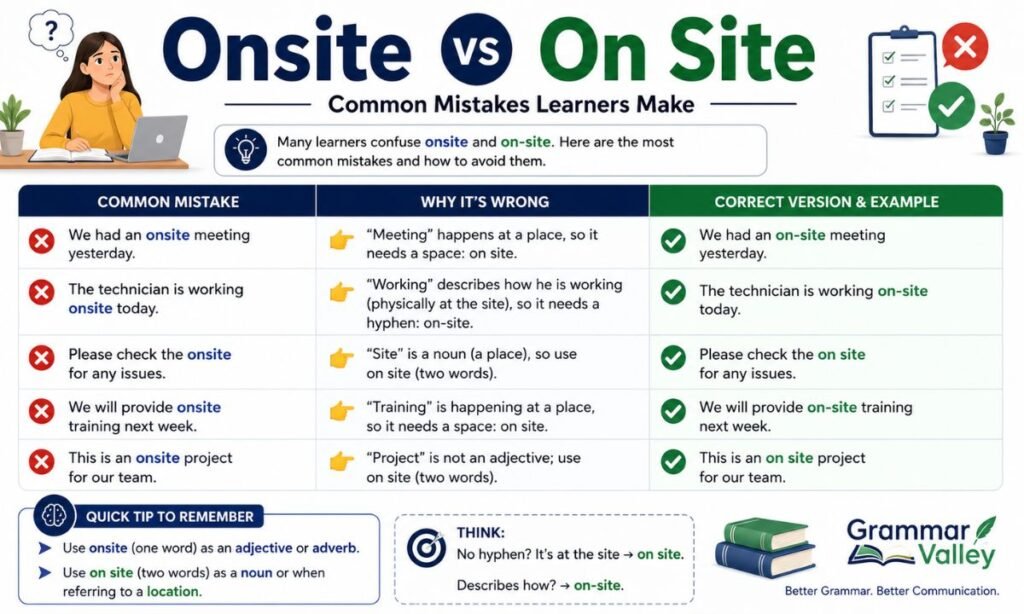
- Writing “onsite” directly after a verb where “on site” is expected: “The inspector is onsite today” is often flagged in formal writing, even though it’s widely understood.
- Hyphenating “on-site” when it’s functioning as an adverbial phrase: “The team is working on-site” should typically drop the hyphen and read “on site.”
- Inconsistent spelling within the same document — switching between “onsite,” “on-site,” and “on site” on different pages of a report or website.
- Assuming the two forms are always interchangeable, which can weaken clarity in technical or legal writing where precision matters.
Simple rules to remember
- If the word sits right before a noun, reach for “onsite” or “on-site.”
- If the word follows a verb and answers “where,” reach for “on site.”
- Pick one spelling convention for your document or company style guide, and apply it consistently.
- When writing for an academic, legal, or government audience, “on site” and “on-site” are generally the more conservative, widely accepted choices.
Quick tips for writing and speaking
- Read the sentence aloud and ask whether the word is describing a noun or describing a location. That single test resolves most confusion.
- Keep a note in your personal style sheet or company brand guide so every writer on your team uses the same form.
- When in doubt, spell-check tools and major style guides (AP, Chicago) still favor the two-word or hyphenated versions over the single word “onsite,” so match your choice to your audience’s expectations.
When to Use Each One
Use onsite (or its hyphenated form, on-site) when:
- The word functions as an adjective directly modifying a noun.
- You’re writing a job posting, product description, or marketing copy where a compact, modern tone fits.
- You’re describing a category of service, staff, or facility tied to a location — onsite gym, onsite kitchen, onsite parking.
Use on site when:
- The phrase follows a verb and answers “where.”
- You’re writing formal, academic, legal, or government content.
- You want to emphasize physical presence rather than describe a type of service.
When NOT to Use Each One
Avoid onsite when the sentence needs a phrase describing location after a verb in formal writing — “the auditor is onsite” reads less polished in a compliance report than “the auditor is on site.”
Avoid on site directly in front of a noun in casual, modern business writing, since it can look unfinished. “On site training” without a hyphen tends to look like a typo next to “onsite training” or “on-site training.”
Avoid switching spellings mid-document. Even if both forms are technically defensible, jumping between “onsite,” “on-site,” and “on site” within the same page signals inconsistent editing and can hurt the professionalism of a resume, proposal, or website.
Which One to Use (Decision Guide)
Ask yourself these three questions in order:
- Does the word come right before a noun? If yes, use “onsite” or “on-site.”
- Does the word come after a verb, describing where something or someone is? If yes, use “on site.”
- What audience and style guide are you writing for? Academic, legal, and UK-leaning contexts favor “on site” or “on-site.” Modern, digital, US-based business writing accepts “onsite” freely.
If you’re still unsure, “on-site” with a hyphen is the safest all-purpose adjective form, and “on site” without a hyphen is the safest all-purpose location phrase.
Real-World Practical Examples
Onsite Examples
- The hospital added an onsite pharmacy to reduce wait times for patients.
- Our onsite IT team resolves most hardware issues within the hour.
- The university offers onsite housing for first-year students.
- This apartment complex includes onsite laundry facilities.
- The conference will feature onsite registration starting at 8 a.m.
On Site Examples
- The safety inspector arrived on site before construction began.
- All visitors must wear a badge while on site.
- The catering company set up on site two hours before the event.
- Employees are expected to be on site by 9 a.m.
- The engineer confirmed the equipment was tested on site.
Self-Assessment (Fill in the Blanks)
Try filling in each blank with either “onsite” or “on site.”
- The new hire will work _______ three days a week and remotely the rest.
- Security asked everyone to check in as soon as they were _______.
- The company provides _______ meals for night-shift workers.
- The technician said the router was fixed _______ within thirty minutes.
- We’re hosting an _______ workshop for new managers next month.
Answers
- Onsite (or on-site) — describes the work arrangement, functioning as an adjective.
- On site — follows the verb “were” and describes location.
- Onsite (or on-site) — modifies “meals,” describing a type of benefit.
- On site — describes where the router was fixed, following the verb “fixed.”
- Onsite (or on-site) — modifies “workshop,” describing the type of event.
Frequently Asked Questions
Is onsite all one word?
Yes, “onsite” is written as a single word and typically functions as an adjective, though it’s also used informally as an adverb in American English.
Are you onsite or on site?
Both are used to ask about physical presence, but “on site” (two words) is the more grammatically traditional form when following a verb like “are.”
Is it working onsite or on site?
“Working on site” is the more formally correct phrase, since it follows a verb and describes location; “working onsite” is common in casual and business speech.
Is it “on site” or “onsite” for a meeting?
If it’s describing the meeting itself, “onsite meeting” or “on-site meeting” (as an adjective) is standard; if you’re saying attendees will be “on site” for the meeting, keep it as two words.
Conclusion
Onsite and on site aren’t competing spellings of the same word — they’re different grammatical tools that happen to share a meaning. Onsite (and its hyphenated sibling, on-site) works as an adjective, sitting in front of nouns like training, support, or parking. On site works as a location phrase, following verbs to describe where someone or something physically is.