
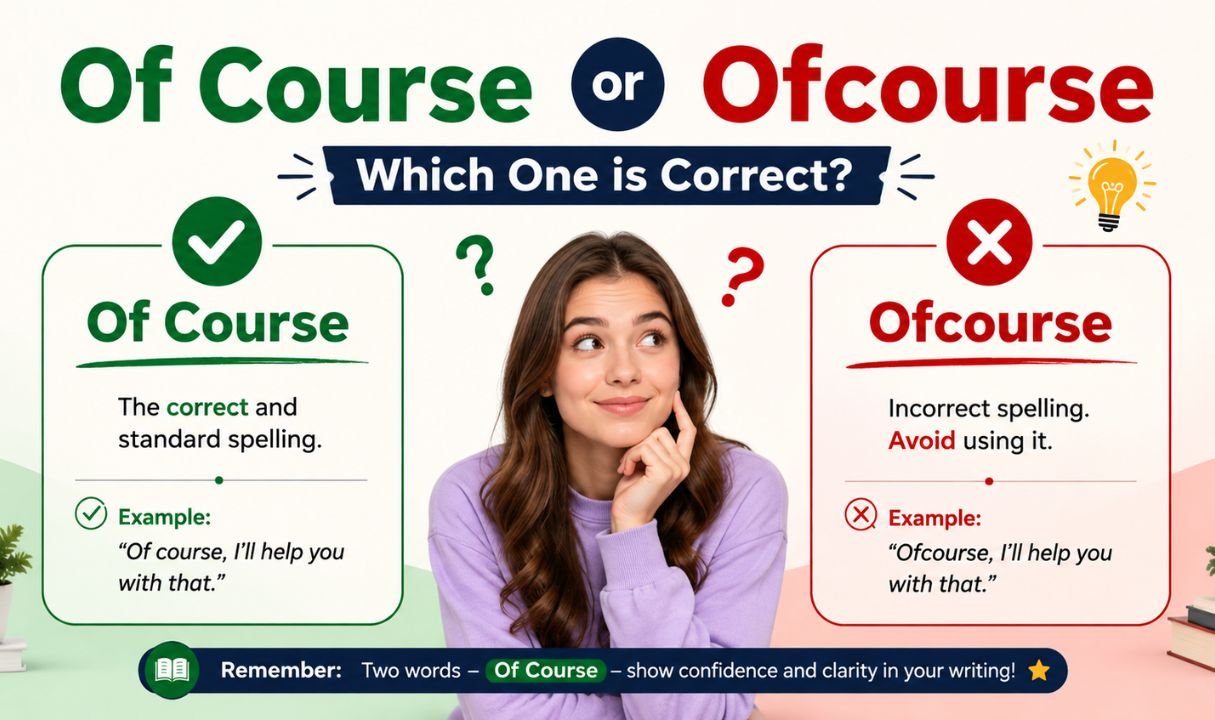
You’ve typed it a thousand times without thinking twice. Someone asks a favor, and your fingers fly across the keyboard: “yeah ofcourse!” It looks fine. It sounds fine when you read it back. But is it actually correct English?
Short answer: no. “Of course” is the only accepted spelling in standard English, while “ofcourse” is a widespread misspelling that sneaks into texts, emails, and even resumes. This guide breaks down exactly why that happens, how each version behaves in real sentences, and how to make sure you never second-guess yourself again.
Comparison Overview
| Feature | Of Course | Ofcourse |
|---|---|---|
| Spelling | Two separate words | One merged word |
| Grammatical status | Standard English phrase | Nonstandard spelling error |
| Accepted in dictionaries | Yes | No |
| Use in formal writing | Appropriate | Never appropriate |
| Use in texting/casual chat | Fine | Common but still wrong |
| Grammar checkers | Passes | Flagged as an error |
| Meaning | Certainly, obviously, naturally | No independent meaning |
The table tells most of the story already, but the reasoning behind it matters just as much as the verdict.
Definition of Of Course
“Of course” is an adverbial phrase that signals certainty, agreement, or something so obvious it barely needs stating. It combines the preposition “of” with the noun “course,” and together they form what linguists call a fixed expression — a set of words that functions as a single unit of meaning while keeping its own internal grammar intact.
You’ll hear it doing several jobs in conversation:
- Confirming a request: “Can you send that file today?” “Of course.”
- Softening a statement of the obvious: “Of course it’s raining — I forgot my umbrella.”
- Adding emphasis mid-sentence: “She is, of course, the best person for the job.”
Its roots trace back to the idea of something happening “in the course of” events — a natural, expected progression. Over centuries the phrase shortened in speech, but the spelling never collapsed into one word.
You May Like: Hoodie or Hoody: Which Spelling Is Actually Correct?
Definition of Ofcourse
“Ofcourse” isn’t a word. There’s no dictionary entry, no grammatical function, no meaning attached to it beyond being a merged version of “of course.” It shows up because people say the phrase quickly, and speed in speech gets mistaken for a single unit in writing. English does form compound words this way sometimes — think of “notebook” or “handshake” — but “of course” never made that transition.
Every major style guide and grammar checker treats “ofcourse” the same way: as an error to correct, not a variant to accept.
Main Differences Between Of Course and Ofcourse
| Aspect | Of Course | Ofcourse |
|---|---|---|
| Word count | Two words | Falsely written as one |
| Origin | Established phrase, centuries old | Modern typing shortcut / error |
| Professional writing | Required form | Reduces credibility |
| Search engines & spellcheckers | Recognized | Underlined in red |
| Regional variation | Same across US, UK, Australia, Canada | Never correct anywhere |
Of course or ofcourse meaning
The meaning lives entirely in “of course.” It expresses that something is expected, agreed upon, or obviously true. “Ofcourse” carries no meaning of its own — it borrows all its sense from the correct phrase it’s trying to imitate.
Of course or ofcourse grammar
Grammatically, “of” functions as a preposition and “course” as a noun. Put together, they form an adverbial phrase that modifies a statement or stands alone as a reply. Merging them into “ofcourse” breaks that structure. There’s no rule in English that allows a preposition and noun to fuse this way without a hyphen or established compound status, and this pair never earned that status.
Of course or ofcourse examples
- Correct: Of course I’ll come to your party.
- Incorrect: Ofcourse I’ll come to your party.
- Correct: She agreed, of course, without hesitation.
- Incorrect: She agreed, ofcourse, without hesitation.
Yes of course meaning
“Yes, of course” doubles down on agreement. The “yes” confirms the answer, and “of course” adds that the answer was never in doubt. It’s warmer and more affirming than a plain “yes,” often used to reassure someone that their request wasn’t an imposition.
Of course series
Some writers use “of course” as a recurring rhetorical device across a paragraph or article — starting several sentences with it to build a pattern of obviousness or irony (“Of course the printer jammed. Of course it happened during the deadline.”). This repetition works in casual or narrative writing but should be used sparingly in formal content, since it can start to feel like a crutch.
Of course synonyms
- Certainly
- Naturally
- Undoubtedly
- Obviously
- Definitely
- Absolutely
- Without question
Swapping in one of these can help you check your sentence. If “naturally” or “certainly” fits, then “of course” is the phrase you need — never “ofcourse.”
Of course why not
“Of course, why not?” is a casual way to accept an invitation or suggestion enthusiastically, layering agreement (“of course”) with a rhetorical shrug (“why not”) that signals there’s no reason to hesitate. It’s common in spoken English and informal messaging.
Of course origin
The phrase grew out of older usage where “course” referred to a natural path or sequence of events — as in “the course of nature” or “in due course.” Something happening “of course” meant it followed naturally from what came before. That sense of natural progression is why the phrase still implies obviousness today.
You May Like: Requester or Requestor: What is the Difference & Which is Correct?
How each term is used in sentences
“Of course” slots into a sentence in three main positions: at the start, in the middle set off by commas, or at the end. “Ofcourse” doesn’t have a legitimate sentence position because it isn’t a real word — any sentence containing it needs a correction, not a placement rule.
Common mistakes learners make
- Typing the phrase as one word because it’s pronounced quickly.
- Assuming autocorrect will catch it (many tools miss it if it’s not flagged in their dictionary).
- Confusing “of course” with “off course,” which means deviating from a planned route.
- Overusing “of course” at the start of nearly every reply, which can sound dismissive.
Simple rules to remember
- Two words, always: “of” plus “course.”
- If a single-word synonym like “certainly” fits, you need “of course,” not “ofcourse.”
- “Off course” (with two Fs) is a different phrase entirely, referring to navigation or a plan going astray.
- No dictionary lists “ofcourse” — if you’re ever unsure, that absence is your answer.
Quick tips for writing and speaking
- Read your sentence aloud slowly. Slowing down usually reveals the two-word structure.
- Run your text through a grammar checker before sending important emails.
- When texting quickly, it helps to build the habit of typing “of” and “course” as separate taps rather than one continuous word.
- Keep a mental list of synonyms (naturally, certainly, undoubtedly) as a backup check.
When to Use Each One
Use “of course” whenever you want to:
- Confirm something is true or expected
- Grant a request or permission
- Add emphasis to a statement
- Respond politely and reassuringly
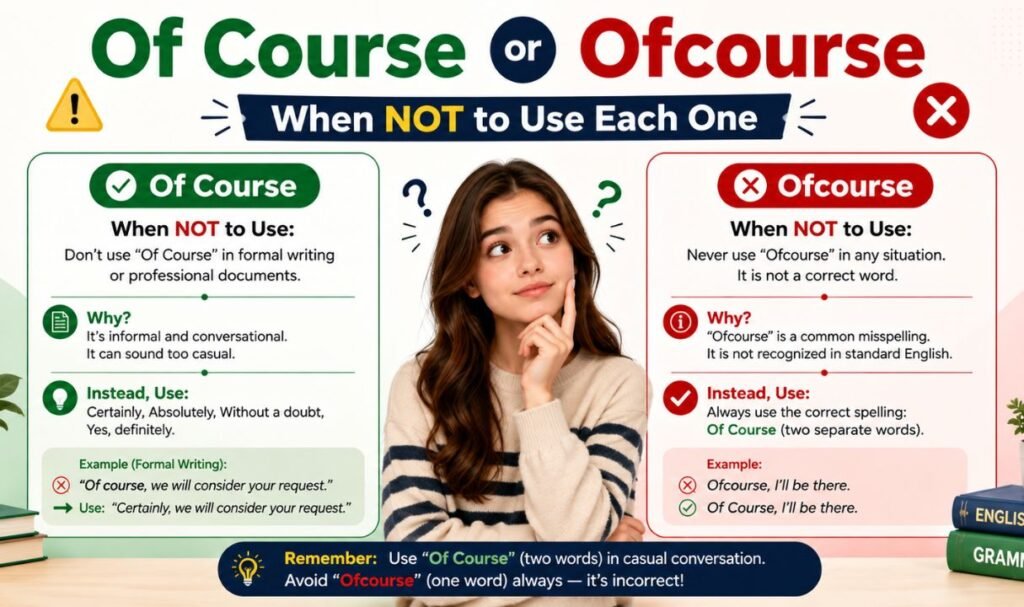
“Ofcourse” should never be used. There’s no context — casual, formal, academic, or professional — where the merged spelling is the right choice.
When NOT to Use Each One
Avoid “of course” when:
- It might sound condescending, implying the other person should have already known the answer
- You’re writing a very formal document where a more precise word like “certainly” or “indeed” fits the tone better
- You’ve already used it several times in the same paragraph and it’s starting to feel repetitive
Avoid “ofcourse”:
- Always. In texts, emails, essays, captions, or professional documents, this spelling has no place.
Which One to Use (Decision Guide)
Ask yourself these three questions:
- Am I trying to express certainty or agreement? If yes, you need the phrase, not a substitute.
- Does a single word like “naturally” or “certainly” fit in its place? If yes, write “of course” as two words.
- Have I accidentally merged the two words while typing fast? Slow down and check before sending.
If you follow that sequence, you’ll land on “of course” every single time — because “ofcourse” was never a real option to begin with.
Real-World Practical Examples
Of Course Examples
- “Of course, I remember your birthday.”
- “You can borrow my car, of course.”
- “Of course she passed the exam; she studied for weeks.”
- “Will you help me move this weekend?” “Of course, no problem.”
- “He was, of course, running late again.”
Ofcourse Examples
There aren’t any correct examples to show here, because “ofcourse” doesn’t function as valid English in any sentence. The only “examples” you’ll find online are mistakes pulled from casual texts and social posts — worth noting as what to avoid, not what to copy.
Self-Assessment (Fill in the Blanks)
Test yourself with these five sentences. Choose “of course” or “ofcourse” for each blank.
- “___ I’ll be there on time.”
- She agreed, ___, without any hesitation.
- “Can I ask you something?” “___.”
- He forgot his keys, ___, because he always does.
- “___, that makes complete sense.”
Answers
- Of course
- of course
- Of course
- of course
- Of course
Every blank takes the same answer, and that’s the point. There’s only one correct spelling, no matter where the phrase sits in the sentence.
Frequently Asked Questions
Is it correct to say “of course yes”?
It’s understood but redundant — “of course” already implies “yes,” so pairing them is more casual repetition than a grammar rule.
How do Brits say “of course”?
British English uses the exact same phrase and spelling as American English; the only difference is occasional pronunciation and intonation.
What can I say instead of “ofcourse”?
Use “of course” (correct spelling) or synonyms like certainly, naturally, undoubtedly, or absolutely.
Why is “of course” a saying?
It developed from the idea of something following the natural “course” of events, meaning it was expected or obvious.
Conclusion
The choice between “of course” and “ofcourse” isn’t really a choice at all it’s a spelling rule with one right answer. “Of course” has stood as two words for centuries, carrying meaning as a fixed phrase that signals certainty, agreement, and obviousness. “Ofcourse” is simply what happens when fast typing and fast speech blur into a spelling mistake that spreads through habit rather than accuracy.