
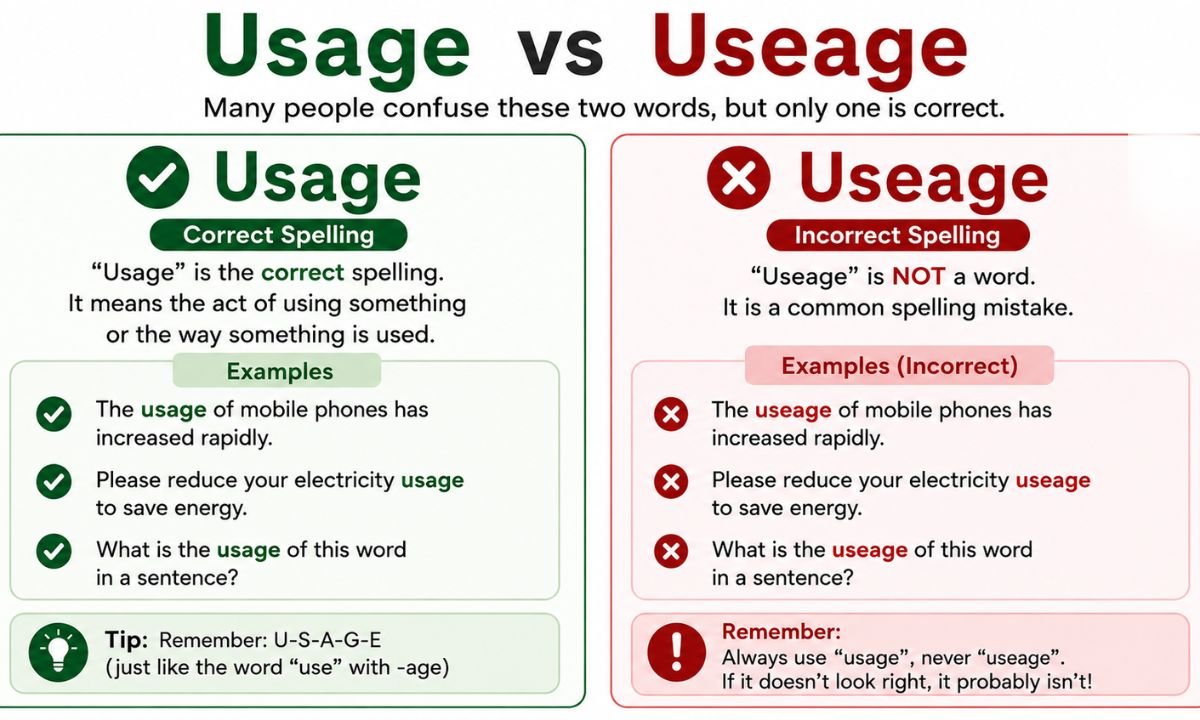
If you’ve ever typed “useage” and paused, wondering whether spell-check is wrong, you’re not alone. This is one of the most common spelling mixups in English writing, and it trips up students, professionals, and even experienced writers. The short answer: only one of these words is real. This guide breaks down exactly why, how the confusion started, and how to make sure you never type the wrong one again.
Comparison Overview
| Feature | Usage | Useage |
|---|---|---|
| Correct spelling | Yes | No |
| Found in dictionaries | Yes (Oxford, Merriam-Webster, Cambridge) | No |
| Word type | Noun | Not a word |
| Common in | Formal writing, tech, grammar, everyday speech | Typos and informal online text |
| Origin | Latin usus via Old French | Misspelling of “usage” |
The table above tells most of the story. “Usage” is the standard, dictionary-approved noun. “Useage” is a spelling slip that people make because the base word, “use,” already ends in an “e,” so adding “-age” on top of it feels natural. It isn’t.
You May Like: Hoodie or Hoody: Which Spelling Is Actually Correct?
Definition of Usage
“Usage” is a noun that describes the way something is used, the amount of something used, or an established custom or practice. It shows up constantly in conversations about language, technology, and daily habits.
A few core meanings:
- The manner of using something — how a tool, word, or resource is applied. Example: “Proper usage of commas can change the meaning of a sentence.”
- The amount consumed — often tied to data, electricity, or water. Example: “Our electricity usage dropped after we switched to LED bulbs.”
- An accepted custom or convention — especially in language. Example: “Modern usage no longer treats that phrase as offensive.”
The word traces back to the Latin usus, meaning “the act of using.” It moved through Old French as usage before settling into Middle English in roughly the form we use today. That long history is part of why it’s so firmly entrenched in dictionaries and style guides.
Definition of Useage
There isn’t one. “Useage” has no entry in Merriam-Webster, Oxford, or Cambridge, and it carries no separate meaning of its own. Whenever someone writes “useage,” they mean “usage” — they’ve simply added an extra letter by mistake.
This isn’t a case of a rare or archaic spelling that fell out of favor, the way “colour” and “color” split between British and American English. “Useage” was never a recognized variant in either dialect. It’s purely a typo that has spread widely enough to make people question themselves.
Main Differences Between Usage and Useage
| Aspect | Usage | Useage |
|---|---|---|
| Grammatical status | Standard English noun | Nonstandard misspelling |
| Acceptable in formal writing | Yes | Never |
| Passes spell-check | Yes | Flagged as an error |
| Regional variation (US/UK) | Same spelling in both | Not applicable |
| Etymology | Latin usus → Old French usage | None; typo of “usage” |
The gap between the two isn’t a matter of style or region — it’s the difference between a real word and an error. There’s no context, formal or casual, academic or conversational, where “useage” is the right choice.
Grammar Guide
How each term is used in sentences
“Usage” fits naturally into a wide range of sentences, from technical to everyday:
- “The manual explains the correct usage of the equipment.”
- “Water usage tends to spike during summer months.”
- “Her usage of technical jargon confused the new hires.”
- “This phrase is no longer in common usage.”
“Useage” doesn’t belong in any sentence, because it isn’t a word. If you find it in a draft, the fix is always the same: remove the extra “e” and replace it with “usage.”
Common mistakes learners make
- Keeping the silent “e” from “use” before adding “-age” (writing “useage” instead of “usage”)
- Assuming British and American English spell it differently (they don’t — both use “usage”)
- Confusing “usage” with “use,” treating them as interchangeable in every context
- Trusting autocorrect to catch it, when some tools and casual writing environments let it slip through
Simple rules to remember
- Think of the pattern in words like “message,” “package,” and “village” — the base word drops its trailing “e” before “-age” is added.
- “Use” becomes “usage,” not “useage.” The “e” disappears.
- If you’re ever unsure, say it out loud. “Usage” sounds like “YOO-sij,” not “yoo-SEE-ij.”
Quick tips for writing and speaking
- Run a quick spell-check pass before submitting any formal document.
- When proofreading, search your document for “useage” specifically — it’s an easy fix once spotted.
- Read sentences aloud during editing; your ear will often catch what your eyes miss.
- Keep a short list of commonly confused words (like “usage/useage,” “definitely/definately”) somewhere you’ll actually see it while writing.
When to Use Each One
Use “usage” whenever you’re describing:
- How something is used or applied (word usage, software usage)
- The quantity of a resource consumed (data usage, fuel usage)
- A language convention or custom (formal usage, regional usage)
There is no scenario for using “useage.” It should never appear in an email, essay, report, or casual message.
You May Like: Inter Vs Intra: The Complete Guide to Two Prefixes That Trip Up Even Careful Writers
When NOT to Use Each One
Avoid “useage” in every context — academic papers, business communication, resumes, social media captions, and casual texts alike. Even in informal writing where grammar rules loosen up, a nonstandard spelling like this can make a message look careless.
As for “usage,” there’s really only one caution: don’t substitute it for “use” when you actually mean the simple act of using something. “I use my laptop every day” reads more naturally than “I usage my laptop every day,” because “usage” typically describes a pattern, method, or amount rather than a single action.
Which One to Use (Decision Guide)
Ask yourself these quick questions:
- Are you talking about how, how much, or in what way something is used? → Use “usage.”
- Are you describing a single, direct action of using something? → Use “use” instead.
- Did you just type “useage”? → Delete the extra “e.” It’s always “usage.”
There’s no decision tree needed for choosing between “usage” and “useage,” because “useage” is never the answer. The only real choice writers face is between “use” and “usage,” depending on whether they mean an action or a pattern.
Real-World Practical Examples
Usage Examples
- “Smartphone usage among teenagers continues to rise every year.”
- “Please monitor your data usage to avoid extra charges.”
- “The dictionary includes notes on formal versus informal usage.”
- “Energy usage in the building dropped after the renovation.”
- “Correct grammar and usage matter in professional emails.”
Useage Examples
There are none. Every instance of “useage” in the wild is simply “usage” spelled incorrectly. If a sentence contains “useage,” the fix is to replace it with “usage” — there’s no alternate meaning or acceptable use case to demonstrate.
Self-Assessment (Fill in the Blanks)
Test yourself with these five sentences. Fill in the blank with either “usage” or “use.”
- Our monthly electricity ______ has gone up since we started working from home.
- Please ______ this door only in case of emergency.
- Modern ______ allows this word to describe both objects and actions.
- I try to ______ my phone less before bedtime.
- The report tracks water ______ across all city departments.
Answers
- usage
- use
- usage
- use
- usage
Frequently Asked Asked Questions
Is it spelled useage or usage?
It’s spelled “usage.” “Useage” is a common misspelling and doesn’t appear in any standard dictionary.
Is useage an accepted word?
No. “Useage” is not recognized by Oxford, Merriam-Webster, Cambridge, or any other major dictionary.
Is usage a proper word?
Yes. “Usage” is a standard English noun describing how something is used, the amount used, or an accepted custom.
Is “usage” spelled correctly?
Yes, “usage” is the correct spelling in both American and British English, with no regional variation.
Conclusion
The confusion between “usage” and “useage” comes down to one small, understandable slip: adding an extra “e” that feels logical but isn’t. “Usage” is the only correct spelling, backed by every major dictionary and centuries of etymological history.
“Useage” is nothing more than a typo, no matter how often it shows up online. Once you remember the simple pattern — “use” drops its “e” before “-age” — you’ll never have to second-guess this word again.