
Anyone who has typed the plural of “wife” into a text message and then paused before hitting send knows the feeling. The word looks slightly off. Is it “wifes”? Is it “wives”? Autocorrect sometimes fixes it, sometimes doesn’t, and that inconsistency is exactly why so many people search for an answer.
This confusion isn’t a sign of poor English skills. It happens because English plurals don’t always follow the simple “add an s” pattern. Words like wife belong to a small but common group that changes shape in the plural form, and once you understand the pattern, you’ll never second-guess it again.
This guide walks through the correct spelling, the reasoning behind it, and how to avoid the small slip-ups that trip up even confident writers.
Quick Answer
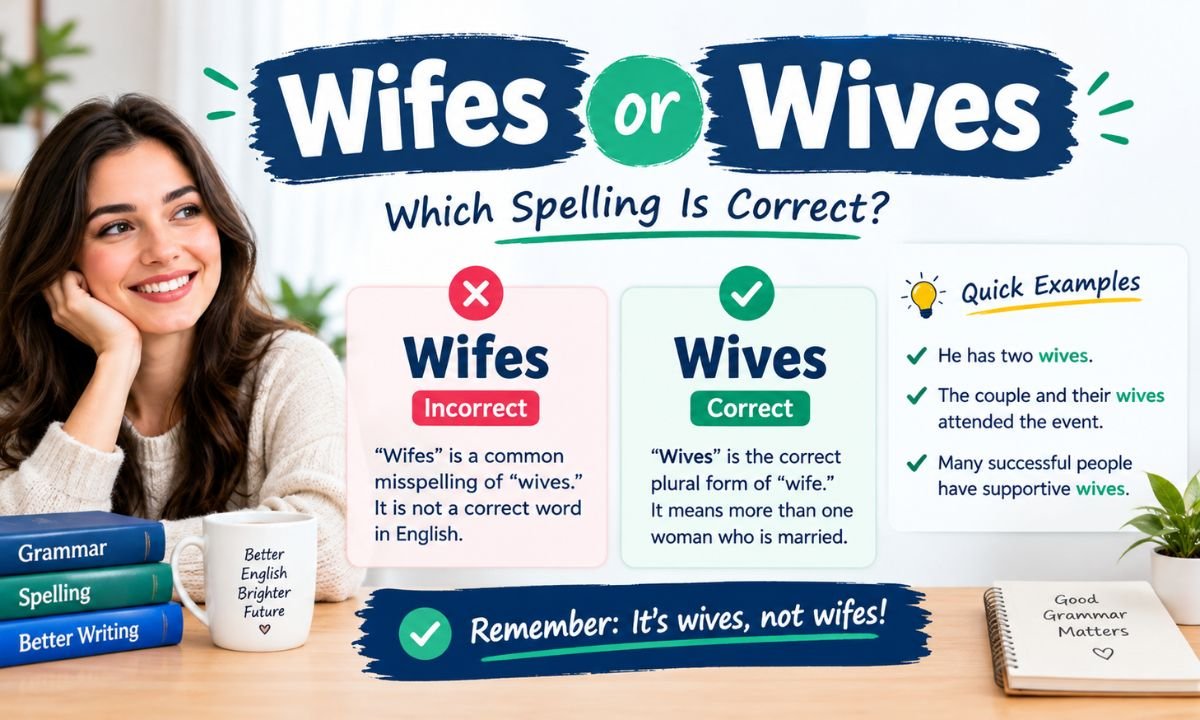
Wives is the correct plural of wife. Wifes is not a real word in standard English and should be avoided in every context, from text messages to formal reports.
| Word | Status | Use It? |
|---|---|---|
| Wife | Correct (singular) | Yes |
| Wives | Correct (plural) | Yes |
| Wifes | Incorrect spelling | No |
If you remember one thing from this article, remember this: the “f” in wife turns into a “v” before you add the ending. That single shift is the entire rule.
Simple Origin and Background
The word wife traces back to Old English “wīf,” which simply meant “woman.” It didn’t always refer specifically to a married woman the way it does now; over centuries the meaning narrowed while the spelling and pronunciation shifted along with the rest of the language.
Old English and Middle English handled plurals differently than modern English does. Many nouns that ended in a voiceless “f” sound picked up a voiced “v” sound once a vowel followed it in the plural ending. Speakers found “wives” easier to say than “wifes,” and spoken language usually wins out over strict spelling logic. Written English eventually caught up and locked in the spelling we use today.
This isn’t a random quirk. Other everyday words followed the same path:
- Knife → knives
- Life → lives
- Leaf → leaves
- Calf → calves
- Shelf → shelves
- Half → halves
Notice the pattern? Each of these words ends in “f” or “fe,” and each one swaps that letter for a “v” before adding “es.” Wife fits neatly into this family, which is why the plural has stayed fixed as wives for hundreds of years, in both British and American English.
Clear Explanation of the Difference
Understanding wife, wives, and wifes side by side makes the rule click faster than memorizing it in isolation.
Wife
Wife is a singular noun describing one married woman, used in relation to her spouse. It’s grammatically simple: one person, one word.
- My wife works in finance.
- He introduced his wife to the neighbors.
- She has been a supportive wife for over a decade.
There’s no trick here. If you’re talking about a single married woman, wife is always the word you want.
Wives
Wives is the plural form, used whenever you’re referring to two or more married women. It follows the same spelling change seen in knife/knives and leaf/leaves — the final “f” becomes “v,” and “es” is added instead of a plain “s.”
- The soldiers wrote letters to their wives.
- Both wives attended the fundraiser together.
- The novel follows three wives navigating the same small town.
Say the word out loud and you’ll notice the “v” sound comes naturally. That’s the pronunciation clue baked right into the spelling.
Wifes
Wifes doesn’t exist as a standard English word. It shows up online because people apply the regular plural rule — just add an “s” — without realizing wife belongs to an irregular group. It’s an easy mistake to make, especially for new English learners who haven’t yet encountered the f-to-v pattern, but it isn’t accepted in any style guide, dictionary, or formal writing standard.
- ❌ Our wifes are coming to the reunion.
- ✅ Our wives are coming to the reunion.
There is one narrow exception worth mentioning for completeness. In archaic or informal usage, “to wife” has occasionally appeared as a verb meaning “to marry,” where “wifes” would technically be a third-person singular verb form (as in “he wifes her”). This usage is obsolete, virtually never seen in modern writing, and shouldn’t influence how you handle the plural noun.
Comparison Table
Here’s a side-by-side breakdown you can bookmark and return to whenever doubt creeps in.
| Feature | Wife | Wives | Wifes |
|---|---|---|---|
| Word type | Singular noun | Plural noun | Not a standard word |
| Number | One | Two or more | N/A |
| Spelling rule | Base form | f → v, then add -es | Incorrect application of regular plural rule |
| Pronunciation | Ends in “f” sound | Ends in “v” sound | Would sound unnatural |
| Correct usage | My wife | Their wives | Never correct |
| Common in | All formal and casual writing | All formal and casual writing | Internet typos, informal texting errors |
Which One Should You Use and When?
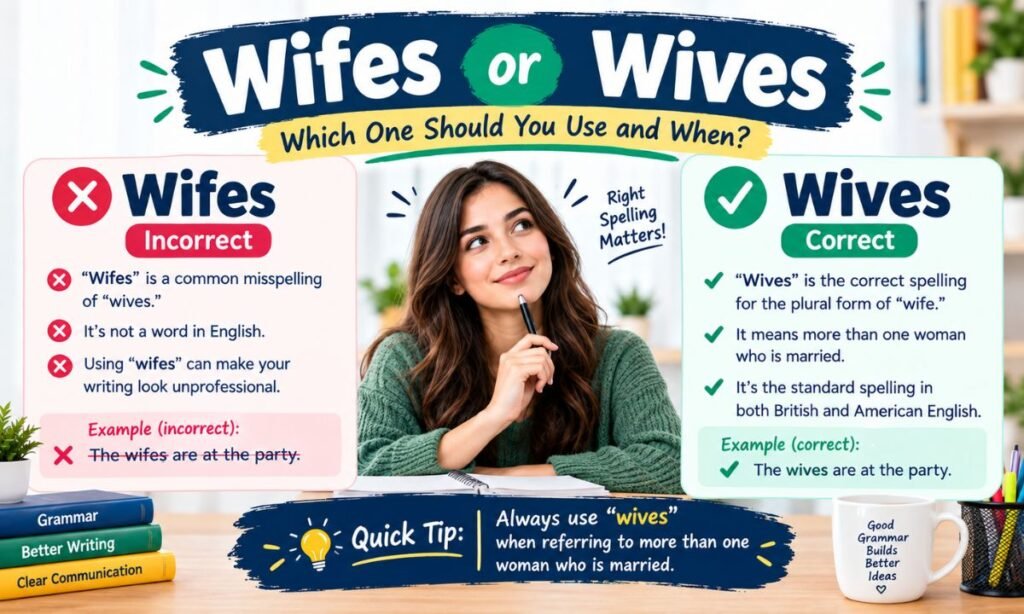
The choice between wife and wives comes down to a single question: how many married women are you talking about?
- Talking about one person → use wife.
- Talking about more than one person → use wives.
- Talking about none of the above → don’t use wifes at all, in any situation.
This holds true across every writing context — emails, resumes, academic papers, news articles, novels, and casual chats. There’s no formal-versus-informal distinction that changes the spelling. Unlike some words that loosen up in casual speech, “wives” stays fixed no matter how relaxed the setting is.
A quick mental test that helps: swap in a word you already know follows the same pattern, like “knife.” Would you write “two knifes” or “two knives”? Since “knives” feels obviously correct, “wives” should follow the exact same logic.
Common Mistakes People Make
Even careful writers slip on this word from time to time. Here are the four most frequent errors and why they happen.
1. Adding “s” instead of “ves”
This is the most common mistake by far. Writers default to the standard plural rule — add an “s” to the end — because it works for the overwhelming majority of English nouns. Wife just happens to belong to the smaller group of exceptions.
- ❌ The two wifes talked for hours.
- ✅ The two wives talked for hours.
2. Forgetting the spelling rule
Some people know that wife has an irregular plural but forget the specific mechanics of the change. They might write “wivs” or “wifves,” neither of which is correct. The full transformation is f → v, then add “es” — nothing more, nothing less.
- ❌ wivs
- ❌ wifves
- ✅ wives
3. Mixing singular and plural
This mistake shows up in longer sentences where the subject and the related noun don’t match in number. A sentence might start talking about multiple men and then accidentally use the singular “wife” instead of “wives,” or vice versa.
- ❌ The men brought their wife to the event.
- ✅ The men brought their wives to the event.
4. Copying common internet mistakes
Search engines and social media are full of typos, and repeated exposure to an incorrect spelling can make it feel normal. Seeing “wifes” often enough in comment sections or forum posts can trick the brain into thinking it’s an accepted variant. It isn’t. Frequency online doesn’t equal correctness.
Everyday Real Life Examples
Seeing the correct word in familiar settings makes it stick better than any rule alone.
Emails
- “Please extend the invitation to employees and their wives.”
- “My wife will be joining the call at 3 PM.”
- “Thank you both — you and your wife are welcome anytime.”
News
- “Local firefighters and their wives organized the charity dinner.”
- “The senator thanked his wife during his acceptance speech.”
- “Historians studied letters written by soldiers’ wives during the war.”
Social Media
- “Shoutout to all the wives holding things together this week 🙌”
- “My wife just ran her first marathon, so proud of her!”
- “Group photo with the wives at the reunion 📸”
Daily Conversations
- “Are your wives coming to the barbecue?”
- “His wife just started a new job.”
- “The two wives have been best friends since college.”
In every one of these examples, swapping “wives” for “wifes” would instantly look like an error to a native reader, even if they couldn’t explain the grammar rule behind it.
Learning Section for Students and Beginners
If English isn’t your first language, or if grammar rules like this one still feel shaky, these four tips make the wife/wives distinction easier to lock in permanently.
Tip 1: Remember the pattern
Wife isn’t alone in this behavior. Group it mentally with knife, life, leaf, and shelf. Once you memorize that these words swap “f” for “v” before adding “es,” you’ve essentially memorized the rule for wife too, along with several other useful words at the same time.
Tip 2: Listen to pronunciation
Say “wife” and “wives” out loud, back to back. Notice how the ending sound changes from a soft “f” to a “v.” Written English often mirrors spoken English, and this word is a clear example. Trusting your ear can back up what you know about the spelling.
Tip 3: Practice simple sentences
Write five short sentences using “wife” and five using “wives.” Repetition builds muscle memory faster than reading a rule once and moving on. Try:
- My wife cooks dinner every Friday.
- The wives organized a surprise party.
- His wife teaches at the local school.
- Their wives traveled together last summer.
- Her wife runs a small bakery downtown.
Tip 4: Think about number
Before writing the word, pause for half a second and ask: one woman or more than one? That tiny mental checkpoint prevents almost every mistake covered in this article. It takes less time than typing the word itself, and after enough repetition it becomes automatic.
Frequently Asked Questions
Which is correct, wives or wifes?
Wives is correct. Wifes is a common misspelling and isn’t accepted in standard English.
What is the plural of wife?
The plural of wife is wives, formed by changing the “f” to “v” and adding “es.”
What is the difference between wifes and wives?
Wives is the correct, standard plural of wife. Wifes is simply an incorrect spelling with no accepted use.
Is it correct to say “wife’s” or “wives”?
It depends on meaning: “wife’s” shows possession (his wife’s car), while “wives” refers to more than one married woman.
Conclusion
The rule behind wife and wives isn’t complicated once it’s broken down: one married woman is a wife, two or more are wives, and wifes simply isn’t part of standard English. The spelling shift traces back centuries to how English speakers naturally pronounced these words, and it lines up with a whole family of similar nouns like knife, leaf, and shelf.