
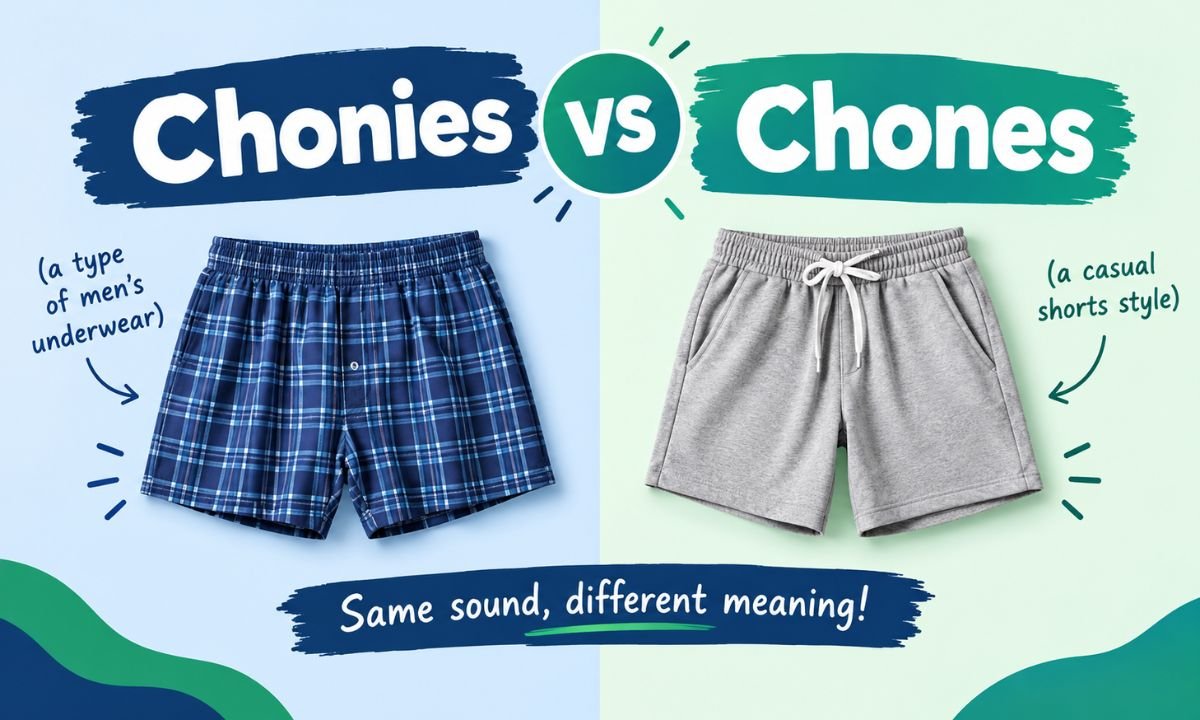
If you have ever scrolled through social media or listened to a Mexican-American family chat about laundry, you have probably heard someone say “chones” or “chonies.” Both words pop up constantly online, and both refer to the same everyday item: underwear. But which spelling is actually right, and does it even matter?
This guide breaks down the meaning, origin, and everyday use of chonies and chones so you never have to guess again. We will look at how the word traveled from Spanish into English, why two spellings exist at all, and how native speakers actually use each version in real conversation.
✔ Chones
“Chones” is the original slang term, borrowed directly from Mexican Spanish. It is short for calzones, the Spanish word for underpants or shorts. Spanish speakers clipped the word down over generations, the same way English speakers turned “refrigerator” into “fridge.” You will hear this spelling most often from Spanish speakers or bilingual households, and it appears frequently in casual Spanish sentences such as “¿Dónde están mis chones?”
⚠️ Chonies
“Chonies” is the Anglicized version. English speakers who grew up hearing “chones” spoken aloud added an “-ies” ending, following the same pattern English uses for informal plural nouns like “undies” or “panties.” This spelling shows up constantly in English-language slang dictionaries, memes, and casual writing across the United States, particularly in California and the Southwest.
✅ Quick Difference
| Feature | Chones | Chonies |
|---|---|---|
| Language root | Mexican Spanish | English adaptation of Spanish slang |
| Common users | Spanish speakers, bilingual families | English speakers, especially in the U.S. |
| Typical setting | Spoken Spanish, Spanglish conversation | English slang, social media, casual texts |
| Formality | Informal | Informal |
| Google search volume | Lower | Higher |
Chonies or Chones
So which one should you actually type when you’re texting a friend or writing a caption? Honestly, either spelling gets the point across, and most native speakers won’t blink at either one. The real difference comes down to audience and context rather than correctness.
If you’re writing in Spanish or talking to someone who grew up speaking Spanish at home, “chones” will feel natural and familiar. If your audience is primarily English-speaking, especially younger people who picked up the word from social media rather than from a Spanish-speaking household, “chonies” tends to read more naturally.
Neither spelling is standardized by any dictionary in the way that, say, “color” and “colour” are standardized across American and British English. This is slang, and slang spelling shifts depending on who’s typing it and where they grew up.
The Origin of Chones
The story behind this word starts with calzones, a Spanish term for underpants, shorts, or drawers. Over time, casual speech trimmed the word down. Spanish, like most spoken languages, tends to shorten frequently used words, especially ones tied to everyday household items. Kids pick up shortened forms from their parents, and those shortened forms stick.
Linguists who track slang formation point to a common pattern here: informal speech drops middle syllables and softens harsh consonant sounds. “Calzones” lost its front half and became “chones,” a word that’s quicker to say and easier for young children to pronounce.
Mexican Spanish carried this word across the border with immigrant families throughout the twentieth century. Once “chones” reached English-speaking households, especially in states like California, Texas, and Arizona, it began evolving again. Bilingual kids who spoke both languages started applying English pluralization habits to Spanish loanwords, and that’s roughly how “chonies” entered the picture.
A few points worth remembering about the word’s background:
- The root word, calzones, is still used in formal Spanish today.
- “Chones” is considered informal even within Spanish-speaking communities.
- The word carries a playful, almost childlike tone rather than a crude one.
- Regional dialects across Mexico and Central America may use slightly different slang for underwear, so “chones” isn’t universal even in Spanish.
Why Spelling Differences Exist
Spelling variation like this isn’t unusual, and it isn’t a sign that anyone is using the word “wrong.” Slang terms rarely pass through a formal spelling committee. They spread by ear, not by textbook, which means the way a word gets written down often depends on how it sounded to the person writing it for the first time.
A few forces drive this kind of split:
- Oral transmission. Slang is heard before it’s read. Someone who first encountered the word by listening to a grandparent will spell it differently than someone who first saw it in a meme.
- Bilingual blending. Spanglish speakers borrow grammar rules from both languages at once, so a Spanish root word can end up wearing an English plural ending.
- Regional habits. Communities along the U.S.-Mexico border developed their own hybrid vocabulary, and that vocabulary doesn’t always match how the same word is used further from the border.
- Internet spread. Once a word goes viral online, whichever spelling gets used in the most-shared post tends to become the “default” version for a whole new audience, regardless of the word’s original form.
None of this makes one spelling more “correct” than the other. It just means the word has two live branches instead of one settled form.
British English vs American English Spelling
It’s tempting to compare “chones” and “chonies” to classic British-versus-American spelling pairs like “colour” and “color,” but the comparison only goes so far. Those word pairs came from formalized spelling reforms centuries ago, and both versions are recognized by dictionaries on their respective sides of the Atlantic.
“Chones” and “chonies,” by contrast, aren’t tied to national dialects of English at all. Both spellings are American in the sense that they developed in the United States, largely within Mexican-American communities. The split isn’t geographic in the British-versus-American sense; it’s generational and linguistic, tied to whether the speaker leans more toward Spanish or English phonetics.
That said, there’s a loose parallel worth noting:
| Comparison | British/American Example | Chones/Chonies Example |
|---|---|---|
| Origin of split | Formal spelling reform (Noah Webster) | Informal oral transmission |
| Dictionary status | Both spellings standardized | Neither spelling formally standardized |
| Geographic basis | UK vs. US | Spanish-dominant vs. English-dominant speakers |
| Everyday usage | Both widely accepted in writing | Both accepted, but “chonies” leans more common in English text |
Which Spelling Should You Use?
The honest answer: use whichever spelling matches the sentence you’re writing.
- Writing in Spanish or texting a Spanish-speaking relative? Go with “chones.”
- Writing in English, especially for a wider audience? “Chonies” usually reads more naturally.
- Writing a bilingual caption or joke? Either spelling works, and mixing them intentionally can even land as a fun code-switch.
- Writing something formal, like a school paper or professional document? Skip the slang entirely and use “underwear” or “ropa interior.”
Since this is slang rather than standardized vocabulary, there’s no grammar authority handing down a ruling. Context, audience, and personal habit decide the answer far more than any rulebook does.
Common Mistakes with Chonies or Chones
Even native speakers occasionally trip over this word. Here are the mistakes that show up most often:
- Assuming it’s formal Spanish. “Chones” will get you strange looks in a business meeting or classroom setting. Formal Spanish uses “calzoncillos” (for men) or “ropa interior” as a general term.
- Using it in professional English writing. Both spellings are casual slang, so they don’t belong in resumes, reports, or formal emails.
- Mixing up singular and plural forms. Both “chones” and “chonies” are already plural in everyday use, much like “pants” in English. You wouldn’t typically say “a chone” the way you’d say “a sock.”
- Assuming the word is offensive. It isn’t. It’s playful and informal, similar to “undies,” not a vulgar term.
- Overcorrecting spelling. Because neither version is in a standard dictionary, autocorrect tools often flag both. That doesn’t mean either spelling is wrong; it just means your phone doesn’t recognize slang.
- Treating it as universally understood. Outside of Mexican-American communities and certain U.S. regions, plenty of English and Spanish speakers alike have never heard either word.
Chonies or Chones in Everyday Examples
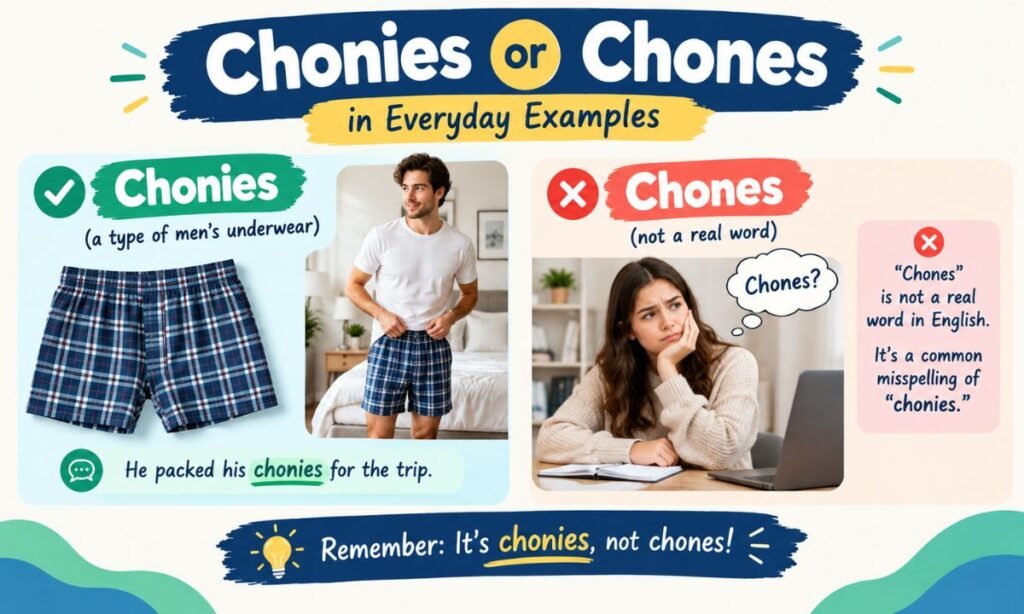
Seeing the word in context makes the difference between the two spellings much easier to grasp. Here are some natural, everyday sentences:
Using “chones” (more Spanish-leaning):
- “Mis chones están en la secadora.”
- “Apúrate, ponte los chones y vámonos.”
- “No encuentro mis chones limpios.”
Using “chonies” (more English-leaning):
- “I need to grab clean chonies before we leave.”
- “Her little brother ran outside in his chonies again.”
- “Pack an extra pair of chonies for the trip, just in case.”
Mixed or Spanglish use:
- “Ya lavé tus chonies, they’re in the dryer.”
- “Grandma always folds our chonies so neatly.”
Notice how the tone stays light and casual across every example. This word almost never shows up in a serious or formal sentence, which is part of why it has stayed so popular in memes, jokes, and family conversations for decades.
Fun Facts About Chonies or Chones
A few details make this little slang word more interesting than it first appears:
- The word has appeared in slang dictionaries since at least the early 2000s, though its spoken use goes back much further.
- Some etymologists connect it loosely to “long johns,” though the Spanish “calzones” root is far better documented and more widely accepted.
- Mothers and grandmothers in Mexican-American households are often credited as the ones who keep the word alive across generations, since it’s frequently used in the context of laundry, dressing children, or scolding kids for running around half-dressed.
- The word carries an affectionate, homey feel rather than a crude one, closer in tone to “undies” than to any clinical or vulgar term for underwear.
- It rarely appears in dubbed Spanish media or formal subtitling, since translators typically default to “calzoncillos” or “ropa interior” for broader audiences.
- Regional slang across Latin America varies quite a bit. Some countries use “calzones,” others use “trusa,” and still others use entirely different informal terms, so “chones” isn’t a pan-Latin American word.
Chonies or Chones – Google Trends & Usage Data
Search interest for both spellings has grown steadily over the past decade, largely driven by social media, bilingual content creators, and nostalgia posts about growing up in Spanish-speaking households.
General patterns worth knowing:
- “Chonies” tends to show higher overall search volume in English-speaking regions of the United States, particularly California, Texas, and Arizona.
- “Chones” search interest concentrates more heavily in Spanish-language search results and among users searching in Spanish.
- Both terms spike periodically alongside viral memes, TikTok trends, or nostalgic “growing up Mexican-American” content.
- Neither term shows meaningful search volume outside North America, reinforcing that this is a regional, culturally specific slang word rather than a globally recognized one.
- Search interest for both spellings tends to be higher among younger users, roughly ages 15 to 34, which lines up with where the word gets the most social media exposure.
This pattern reflects exactly what you’d expect from a bilingual slang term: strong regional roots, generational spread through informal speech, and periodic bursts of renewed interest whenever it resurfaces online.
Frequently Asked Questions
What is chonies in Spanish slang?
In Spanish slang, “chonies” (more commonly spelled “chones”) refers to underwear, shortened from the word “calzones.”
What does “chones” mean?
“Chones” is informal Mexican Spanish slang for underwear or underpants, derived from “calzones.”
How do you pronounce “chonies”?
It’s pronounced “CHO-nees,” rhyming with “phony” plus an “s” sound at the end.
Where did chonies originate?
It originated from Mexican Spanish slang, evolving from “calzones” and later adapted into English by bilingual Mexican-American communities in the United States.
Conclusion
“Chones” and “chonies” are two branches of the same word, both meaning underwear, both traced back to the Spanish “calzones,” and both perfectly acceptable in casual conversation. Neither spelling is right or wrong in any strict grammatical sense; the choice mostly comes down to whether you’re leaning toward Spanish or English phonetics in the moment.