
If you’ve typed “habbit” into a search bar and paused, wondering whether you got the spelling right, you’re not alone. This word trips up more writers than almost any other everyday term in English. The good news is that the answer is short and settled — but understanding why one spelling wins, and how the word actually behaves in real writing, takes a bit more explaining.
This guide covers the correct spelling, the meaning behind it, where the word came from, how to pronounce it, how it’s used across psychology and daily life, and the small grammar details that trip people up. By the end, you’ll never second-guess this word again.
Habbit or Habit: Quick Answer Explained Clearly
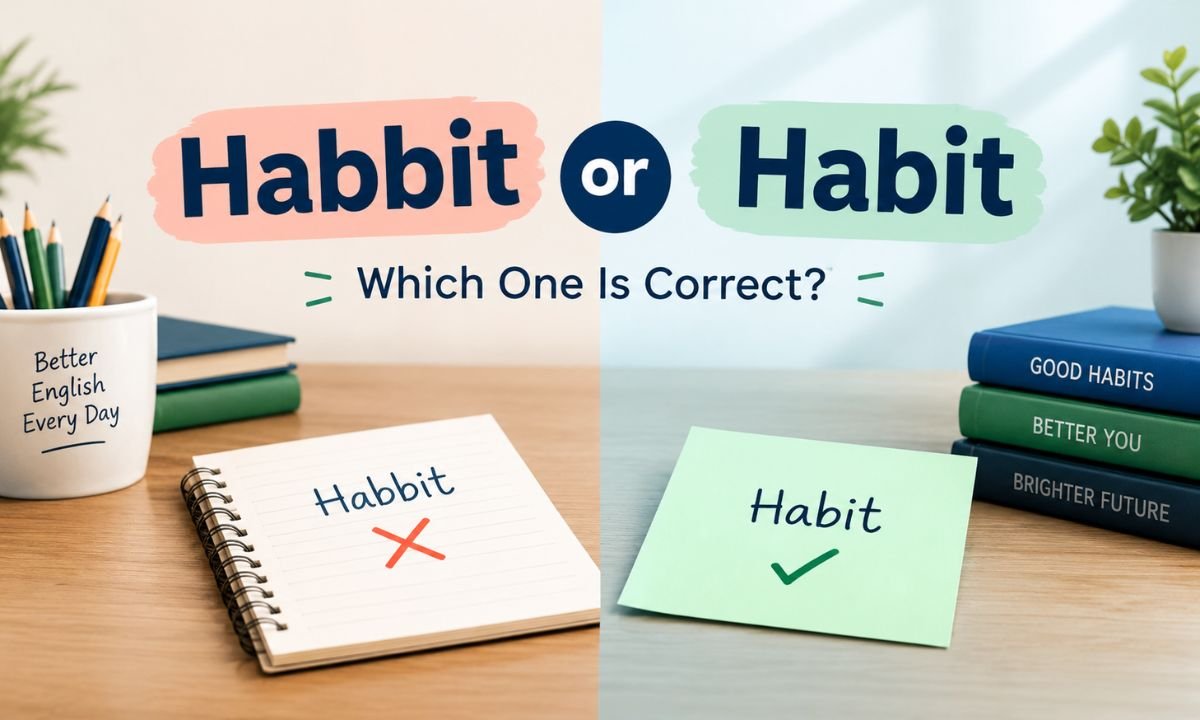
“Habit” is correct. “Habbit” is a misspelling.
There is no dictionary — American, British, or otherwise — that lists “habbit” as an accepted spelling. The word has one b, not two, and it comes directly from the Latin habitus, meaning a condition or state of being.
Here’s the distinction laid out plainly:
| Spelling | Status | Notes |
|---|---|---|
| Habit | Correct | Standard English noun; used in speech, writing, and academic contexts |
| Habbit | Incorrect | Common misspelling; not found in any standard dictionary |
If you remember nothing else from this article, remember this: one b, and you’re done.
What Does Habit Mean? (Simple but Deep Explanation)
Simple definition
A habit is something you do regularly, often without consciously thinking about it. It’s a behavior that’s been repeated so many times that it becomes close to automatic — brushing your teeth, checking your phone first thing in the morning, saying “bless you” after a sneeze.
Merriam-Webster and Oxford both frame it the same way at heart: a settled or regular tendency or practice, especially one that’s hard to give up.
Real-life examples of habits
Habits show up everywhere, and most people carry dozens of them without noticing:
- Drinking coffee at the same time every morning
- Biting your nails when you’re nervous
- Reading before bed
- Taking the same route to work
- Saying “um” while thinking mid-sentence
Some of these are harmless routines. Others, left unchecked, can turn into patterns people actively want to break.
Interesting fact about habits
Researchers at Duke University found that roughly 40 percent of the actions people perform each day aren’t the result of active decision-making — they’re habits running on autopilot. That’s a staggering share of daily life shaped by behaviors we barely notice ourselves doing.
Why “Habbit” Is Incorrect (And Why People Still Use It)
Why people write “habbit”
Despite being wrong, “habbit” shows up constantly in casual writing, text messages, and even some published content. There’s a reason for that.
English has a habit (no pun intended) of doubling consonants in short words — think “rabbit,” “hobbit,” “habitat” almost doubling but not quite. When a word rhymes with something that does have a double consonant, the brain sometimes borrows that pattern by mistake. “Rabbit” is the most obvious culprit here — it looks and sounds close enough to “habit” that the spelling bleeds over.
Important truth
No major dictionary — not Merriam-Webster, not Cambridge, not Oxford — lists “habbit” as a valid variant, informal or otherwise. It isn’t regional slang, and it isn’t an accepted alternate spelling the way “color” and “colour” both work depending on region. It’s simply an error.
Simple memory trick
Here’s an easy way to lock in the correct spelling for good: think of the phrase “a bit of a habit.” Notice that “habit” contains “a bit” hidden inside it — one b, just like “a bit.” If you can remember that small phrase, you’ll never double the b again.
Origin and Etymology of Habit
Word journey
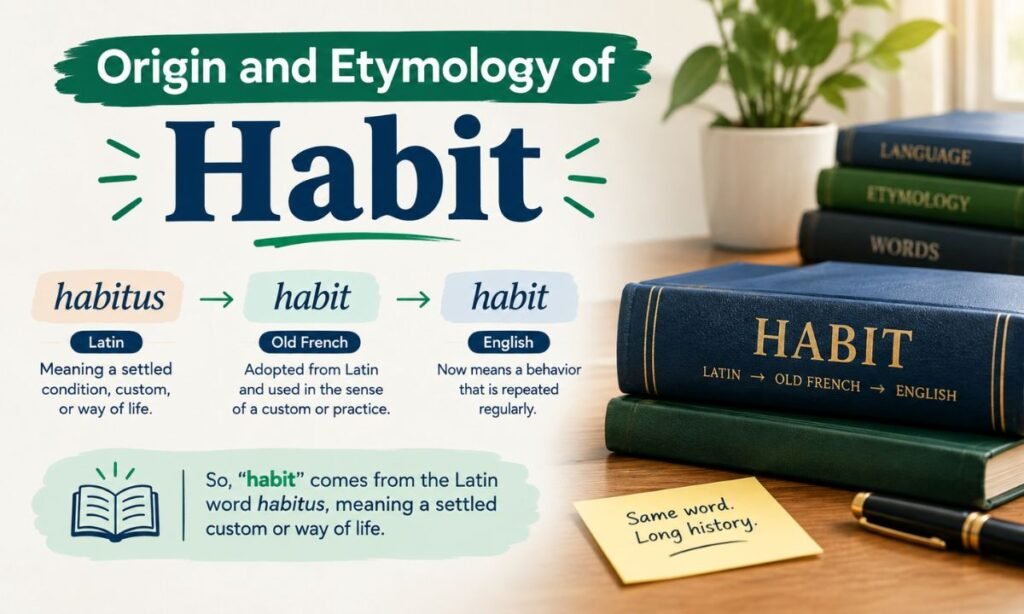
The word “habit” has a long history that stretches back through French and into Latin. It entered Middle English in the 13th century from the Old French habit (also spelled abit), which itself came from the Latin habitus — a past participle of habere, meaning “to have, hold, or possess.”
How meaning changed over time
Interestingly, “habit” didn’t originally refer to behavior at all. Its earliest English use described the distinctive clothing worn by monks and nuns — you still see traces of this in the phrase “a monk’s habit” today. The sense of “a habitual practice or way of acting” developed separately, also in the 13th and 14th centuries, from the same Latin root, since habitus could describe both a person’s outward “condition” (including dress) and their inward disposition or bearing.
Modern meaning evolution
By the 19th century, the word had also picked up a narrower, more clinical use — “habit” as a euphemism for addiction, particularly around drug use, a sense first recorded in the late 1800s. Today, the dominant meaning in everyday English is the behavioral one: a repeated action or pattern, whether neutral, positive, or difficult to shake.
Pronunciation of Habit (Simple Breakdown)
How to pronounce it correctly
“Habit” is pronounced HAB-it, with the stress on the first syllable. In phonetic spelling, that’s /ˈhæb.ɪt/.
- First syllable: “hab” — rhymes with “cab” or “tab”
- Second syllable: “it” — a soft, quick “it” sound
Common mistakes
Non-native speakers sometimes stretch the first vowel too long, making it sound like “HAYB-it.” Others soften the t at the end so much that it disappears entirely. Neither error changes meaning, but both make the word sound less natural in fluent speech.
Easy trick
Say the phrase “habit a habit” quickly — it should sound rhythmic and clipped, almost like two quick taps. If it comes out smooth and drawn-out, you’re likely over-lengthening the vowel.
How “Habit” Works in Modern English
As a noun
In everyday use, “habit” functions almost exclusively as a noun. It describes an action, tendency, or pattern: “She has a habit of arriving early.” It can be countable (“I have three bad habits”) or uncountable when referring to the general concept (“Change is a matter of habit”).
In psychology
Psychologists treat habit as a specific, well-defined concept — not just casual repetition. A habit, in the behavioral science sense, is an action triggered automatically by a cue in the environment, requiring little or no conscious decision-making once it’s formed. This is different from a goal-directed behavior, which involves active thought about outcomes each time.
In lifestyle and productivity
Outside the lab, “habit” has become something of a cultural buzzword, thanks in large part to books like Atomic Habits and The Power of Habit. In this context, the word usually refers to small, repeatable actions people deliberately build into their routines — morning journaling, daily exercise, or a consistent sleep schedule — with the goal of long-term self-improvement.
Common Collocations with Habit
Most common combinations
Certain word pairings with “habit” show up again and again in natural English. Knowing them helps both writing and reading comprehension.
| Collocation | Typical Meaning |
|---|---|
| Bad habit | A negative or unwanted repeated behavior |
| Good habit | A positive or beneficial repeated behavior |
| Break a habit | To stop doing something habitual |
| Form a habit | To develop a new repeated behavior |
| Out of habit | Doing something automatically, without thinking |
| Kick the habit | To quit, often used for addiction (smoking, etc.) |
| Habit of mind | A mental tendency or way of thinking |
| Creature of habit | Someone who strongly prefers routine |
Real usage examples
- “He’s trying to break the habit of checking his phone during meetings.”
- “Reading every night has become a good habit for her.”
- “I locked the door out of habit, even though no one else was home.”
- “Quitting smoking meant kicking a fifteen-year habit.”
Habit vs Similar Words (Important Differences)
Habit vs Routine
These two words get used interchangeably, but there’s a real distinction. A habit is automatic and often unconscious — you don’t have to think about it to do it. A routine is a set of actions performed deliberately in a specific sequence, usually requiring intention and planning. Brushing your teeth is a habit; a full 20-minute morning skincare routine is, well, a routine — even if parts of it eventually become habitual too.
Habit vs Addiction
A habit is not inherently harmful. Addiction, on the other hand, involves a compulsive physical or psychological dependency, often with serious consequences if the behavior stops. Every addiction involves habitual behavior, but not every habit is an addiction. Biting your nails is a habit; needing a substance to function normally is addiction.
Habit vs Habitat
This one is a common source of confusion simply because the words look alike. Habit refers to a behavior. Habitat refers to the natural environment where a plant or animal lives — “the polar bear’s Arctic habitat.” They share a Latin root (habitare, “to dwell”), but their modern meanings point in completely different directions.
Plural Form and Grammar Rules of Habit
Grammar rules
“Habit” is a regular countable noun. Its plural is formed simply by adding an -s: habits. There are no irregular forms to memorize.
- Singular: habit
- Plural: habits
The word can also function in an uncountable sense when discussing the general concept of habitual behavior rather than a specific instance — “Change comes from habit, not willpower” — but this is a matter of usage, not a separate grammatical form.
Examples
- Singular: “That’s a strange habit.”
- Plural: “He has several strange habits.”
- Uncountable/general: “Habit shapes more of our lives than we realize.”
Real Examples of Habit in Sentences
Daily life examples
- “She checks her email out of habit before she’s even had coffee.”
- “Walking the dog every evening became a habit within weeks.”
Academic usage
- “The study examined how habit formation differs between adolescents and adults.”
- “Researchers measured habit strength using a validated behavioral scale.”
Professional usage
- “Good communication habits improve team trust over time.”
- “He built a habit of reviewing his calendar every Sunday night.”
Negative habits
- “Procrastination is a habit that’s surprisingly difficult to unlearn.”
- “Interrupting others in meetings is a habit worth breaking.”
Common Spelling Mistakes: Habbit or Habit Confusion
Top reasons for confusion
- Visual similarity to “rabbit” — the double b pattern transfers by accident.
- Auto-correct gaps — some keyboards and apps don’t flag “habbit” as clearly wrong.
- Phonetic guessing — the short “a” sound in the first syllable doesn’t obviously signal a single consonant.
- Non-native speaker patterns — many languages double consonants differently than English does.
Memory techniques
- Recall the phrase “a bit of a habit” — one b, just like “a bit.”
- Picture the word split as hab + it, two clean syllables, no doubling.
- Compare it directly to “rabbit” and consciously note the difference: rabbit has two b‘s, habit has one.
Why People Search “Habbit or Habit” (Search Intent Explained)
Main reasons
People type this exact phrase into search engines for a handful of overlapping reasons — spelling uncertainty, homework help, content writing, and general curiosity about English usage.
Search intent types
| Intent Type | What the Searcher Wants |
|---|---|
| Informational | A direct answer: which spelling is correct |
| Educational | Understanding of grammar, etymology, or usage rules |
| Practical | Confirmation before submitting an essay, email, or article |
| Comparative | Clarifying “habit” against similar-looking or similar-sounding words |
What users really want
Most searchers want a fast, confident answer followed by just enough explanation to trust it. They’re not looking for a linguistics lecture — they want to know the correct spelling, why the wrong one is so tempting, and how to remember the difference going forward.
Case Study: How Spelling Affects Writing Credibility
Scenario
A small marketing agency published a blog post about productivity, including the line: “Building good habbits takes consistency.” The article was otherwise well-researched, with solid advice and a clear structure.
Result
Several readers left comments pointing out the misspelling. One reader noted, only half-jokingly, that they’d stopped trusting the rest of the article’s advice after spotting the error early on.
Impact
The agency’s editor later reviewed site analytics and found that pages with basic spelling errors had a measurably higher bounce rate than error-free posts covering similar topics. Readers didn’t always comment, but many quietly left.
Key takeaway
A single misspelled word rarely ruins an entire piece of writing on its own. But it chips away at credibility, especially in professional or educational content where accuracy signals competence. Getting “habit” right is a small thing — and small things add up to trust.
Expert Insight: Why Habit Formation Matters More Than Spelling
Quote from behavioral psychology
Charles Duhigg, author of The Power of Habit, has written that habits emerge because the brain is constantly looking for ways to save effort — once a behavior becomes automatic, the mind can shift its attention elsewhere. That’s the real reason habits are so powerful and so hard to break: they’re not really decisions anymore, they’re default settings.
Spelling the word correctly matters for clear communication. But understanding how habits form — through cue, routine, and reward — matters far more for anyone trying to actually change their behavior. Getting the word right is step one. Understanding what it describes is the part that changes lives.
Frequently Asked Questions
What does habbit mean?
“Habbit” has no meaning of its own — it’s simply a common misspelling of “habit,” which refers to a regular, often automatic behavior or practice.
What is this habit?
“This habit” refers to whatever specific repeated behavior is being discussed in context, such as a routine, tendency, or pattern someone has developed over time.
Which is correct, a habit or an habit?
“A habit” is correct. Since “habit” starts with a pronounced “h” sound (not a silent one), it takes “a,” not “an.”
What is an example of habit?
Common examples include brushing your teeth every morning, checking your phone out of routine, or always taking the same route to work.
Conclusion
“Habit” — one b, two syllables, rooted in Latin habitus — is the only correct spelling, and “habbit” is a misspelling worth retiring for good. But the word itself deserves more attention than its spelling alone.
Habits quietly shape a huge share of daily behavior, from the harmless to the deeply ingrained, and understanding how they form is far more useful than simply knowing how to spell the word.