
I’ve typed “unphased” into more emails than I’d like to admit. It looked right. It felt right. Then an editor circled it in red and asked me to check a dictionary. That one correction sent me down a rabbit hole of etymology pages, style guides, and old newspaper archives, and I came out the other side with a much clearer picture of what’s actually going on with these two words.
What surprised me most was how many other people run into this exact same wall. A quick scroll through writing forums, social media threads, and grammar comment sections shows the same pattern over and over: someone writes “unphased,” a reader points out the error, and a small debate breaks out about which spelling is actually correct. So I decided to settle it properly, checking dictionaries, style guides, and even old newspaper clippings rather than trusting my gut.
Here’s everything I found, laid out the way I wish someone had explained it to me the first time.
My Quick Answer
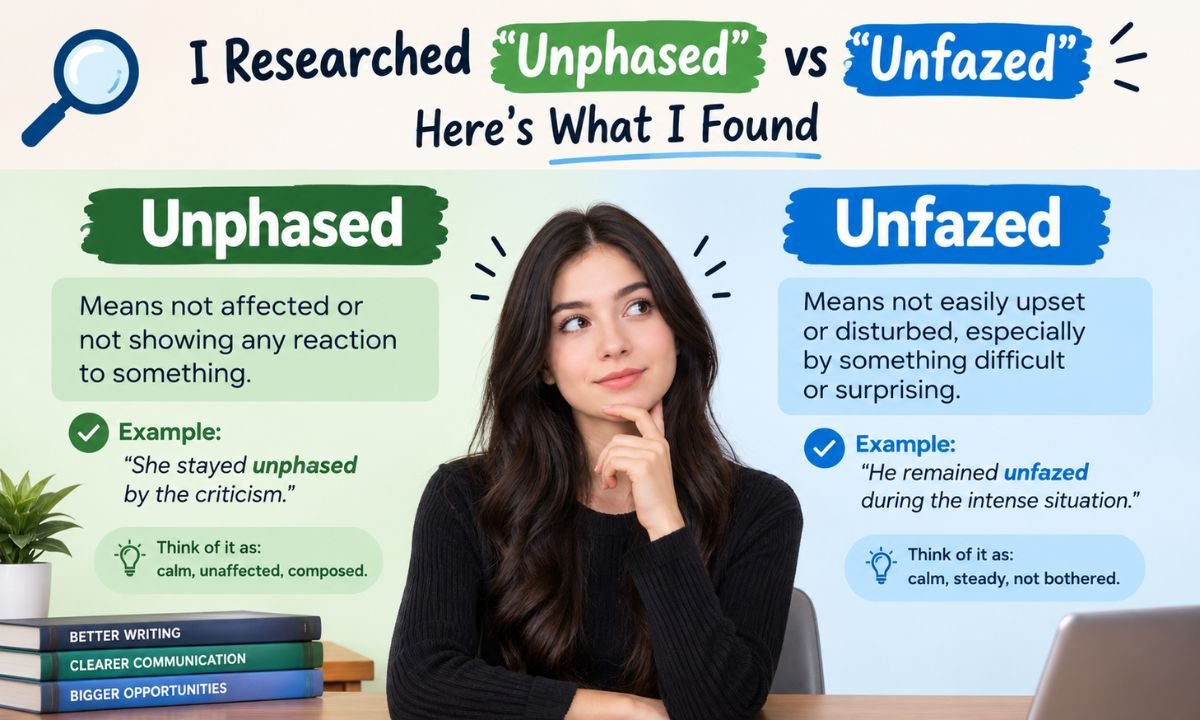
“Unfazed” is the correct spelling. It means calm, unbothered, or undisturbed by something that would normally shake a person up. “Unphased” is a common misspelling that most major dictionaries don’t even list as a word. If you remember nothing else from this article, remember that: fazed has a Z, and so does unfazed.
Why I Found That “Unfazed” Is Correct
The confusion makes sense once you understand where these words come from. “Unfazed” is built from the verb “faze,” which means to disturb, unsettle, or throw someone off their game. Add the prefix “un-” and you get a word that describes someone who refuses to be shaken.
“Unphased” borrows its spelling from a completely different word: “phase,” a noun referring to a stage or period in a process. The moon has phases. Projects have phases. Teenagers go through phases. None of that has anything to do with staying calm under pressure, yet the words sound identical when spoken aloud, and that’s exactly why writers keep swapping one for the other.
I checked several dictionary sites during my research, and the pattern was consistent. Vocabulary.com notes directly that “unphased” is simply a frequent misspelling and not a recognized word at all. That single line settled the debate for me faster than anything else I found.
The Core Difference I Found
Here’s the distinction in the simplest terms I could manage:
- Faze is a verb meaning to disturb or unsettle someone emotionally.
- Phase is usually a noun (sometimes a verb) describing a stage in a timeline or process.
- Unfazed describes a person who isn’t disturbed by something.
- Unphased has no accepted meaning of its own. It’s simply a misheard version of “unfazed.”
Once that clicked for me, I stopped second-guessing the spelling every time I sat down to write.
My Definition and Usage Analysis
To really understand “unfazed,” I looked at how it shows up across different situations. The word carries a similar emotional core wherever it’s used, but the flavor shifts slightly depending on context.
1. Remaining Calm Under Pressure
This is the classic use. Someone faces a stressful, chaotic, or high-stakes moment and simply doesn’t crack. A surgeon working through a complication, a pilot handling turbulence, a parent managing a toddler’s meltdown in a grocery store — all of them can be described as unfazed if they keep their composure.
2. Unaffected by Criticism
I noticed this usage constantly in interviews and profiles. A public figure gets slammed on social media or in a review, and the write-up notes they seemed unfazed by the backlash. It signals thick skin and emotional steadiness rather than defensiveness.
3. Steady in a Crisis
News coverage leans on this one heavily. Reporters describe first responders, business leaders, or entire communities as unfazed during emergencies, floods, market crashes, or security scares. It communicates resilience without over-dramatizing the reaction.
4. Unimpressed or Undeterred
Sometimes “unfazed” carries a slightly different shade — not fear-based calm, but sheer indifference. A veteran negotiator unfazed by a low opening offer isn’t scared; they’re simply not moved by the tactic. This usage leans more toward “unimpressed” than “unafraid.”
My Complete Comparison Table: Unfazed vs Unphased
I put together this table after cross-checking several dictionaries and grammar references, since a side-by-side view made the differences click faster than paragraphs ever did.
| Feature | Unfazed | Unphased |
|---|---|---|
| Standard spelling | Yes, accepted in all major dictionaries | No, not recognized as a standard word |
| Root word | Faze (to disturb or unsettle) | Phase (a stage in a process) |
| Part of speech | Adjective | Not applicable — informal misspelling |
| Meaning | Calm, undisturbed, unbothered | No official meaning |
| Correct spelling letter | Z | Mistakenly uses PH |
| Used in professional writing | Yes | Should be avoided |
| Dictionary status | Listed in Merriam-Webster, Oxford, Vocabulary.com | Flagged as a common error |
| Example sentence | She remained unfazed by the tough questions. | Incorrect: She remained unphased by the tough questions. |
Real Examples I Found in Daily Life
Reading through news articles, interview transcripts, and everyday writing gave me a good sense of how “unfazed” actually gets used — and how “unphased” keeps sneaking in anyway.
✓ Correct Examples I Use:
- The goalkeeper stayed unfazed after missing the first penalty and saved the next three shots.
- Investors seemed unfazed by the market dip, and stock prices recovered within days.
- My neighbor is completely unfazed by thunderstorms, even when the power goes out.
- The candidate remained unfazed during the debate, answering every hostile question with a steady voice.
- Despite the harsh reviews, the author was unfazed and kept writing in the same style.
✗ Incorrect Examples I Avoid:
- She looked unphased by the news. (should be unfazed)
- He stayed unphased through the entire negotiation. (should be unfazed)
- The team seemed unphased after the loss. (should be unfazed)
- Nothing seems to leave him unphased. (should be unfazed)
Seeing these side by side made the pattern obvious. Anywhere “unphased” appears, you can swap in “unfazed” and the sentence instantly becomes correct.
My Memory Tricks to Remember
I needed more than a definition to stop making this mistake. These are the tricks that finally made the spelling stick for me.
Trick #1: The “Z” for “Zero Disturbance”
I picture the letter Z as a jagged little lightning bolt of disturbance that got cancelled out. “Fazed” has a Z because something jolted a person. “Unfazed” has that same Z because the jolt never landed. If there’s no Z, the word isn’t about being disturbed at all.
Trick #2: The “Phase” Connection
Whenever I see “phase,” I force myself to picture the moon. Full moon, new moon, crescent — phases are stages, not feelings. If a sentence isn’t about a stage in a process, “phase” doesn’t belong in it, and neither does “unphased.”
Trick #3: The Meaning Test
Before typing either word, I ask myself: am I describing a stage of something, or a person’s emotional reaction? If it’s a reaction, it’s “faze” every time. This quick mental check catches the mistake before it ever hits the page.
Trick #4: The “Faze” Word Family
I started grouping related words together: faze, fazed, unfazed, fazing. All spelled with a Z, all connected to disturbance. Keeping this little word family in mind makes the spelling feel automatic rather than something I have to look up.
The “Faze” vs “Phase” Confusion: My Deep Dive
Once I understood “unfazed,” I wanted to know exactly why “faze” and “phase” cause so much trouble in the first place. A few things stood out.
Why These Two Words Get Mixed Up
1. Identical Pronunciation
Both words are pronounced exactly the same way, which linguists call a homophone pair. Your ear can’t tell them apart, so your fingers have to know the difference instead.
2. “Phase” Is More Common
“Phase” shows up constantly in business, science, and everyday conversation — project phases, moon phases, phases of grief. That frequency trains people to reach for “phase” by default, even in sentences where it doesn’t belong.
3. “Faze” Is Less Familiar
“Faze” almost never appears outside the specific context of being disturbed or unsettled. Because people encounter it less often, their brains default to the spelling they already know.
4. Sound-Alike Pattern
English is full of these traps: their/there/they’re, your/you’re, affect/effect. “Faze” and “phase” fit right into that pattern, and spellcheck tools don’t always catch the error since “phase” is a real, correctly spelled word — just the wrong one for the sentence.
My Research on “Faze” – The Root Word
Digging into etymology, I found that “faze” is an American English term believed to descend from the 15th-century Kentish word “feeze,” which meant to frighten or drive away. Over time it settled into the modern verb we use today: to disturb someone’s composure. Several usage guides describe the verb the same way — as something that shakes a person’s confidence or throws their emotional balance off, rather than a physical or a scheduling concept.
That single verb spawned the adjective “unfazed” simply by adding the negating prefix “un-.” No hidden complexity, no irregular spelling rule. Just a straightforward word that got tangled up with its more famous homophone.
Similar Sound-Alike Confusions I Found
While researching, I kept bumping into other word pairs that trip people up for the exact same reason: identical sound, different spelling, different meaning.
- Affect vs Effect — one’s usually a verb, the other’s usually a noun.
- Its vs It’s — possessive versus contraction.
- Compliment vs Complement — praise versus something that completes another thing.
- Discreet vs Discrete — careful and subtle versus separate and distinct.
- Stationary vs Stationery — not moving versus paper and envelopes.
Seeing “faze vs phase” sitting comfortably alongside these classic mix-ups made me feel a lot less embarrassed about getting it wrong for years. What all of these pairs share is a reliance on sound rather than sight.
Most of us learn language by ear long before we learn it by page, so when two words share a pronunciation, the spelling that gets reinforced first in our memory tends to win out, even when it’s the wrong one for a given sentence.
That’s precisely why “phase” so often muscles its way into places where “faze” belongs; it’s simply the version we encounter more often in daily life.
Expert Opinions and Dictionary Evidence I Found
I didn’t want to rely on my own conclusions alone, so I checked what the recognized authorities on English usage actually say.
Merriam-Webster Dictionary
Merriam-Webster lists “faze” as a standard verb meaning to disturb the composure of, and it recognizes “unfazed” as the correct related adjective. “Unphased” doesn’t appear as an entry.
Oxford English Dictionary
Oxford’s references treat “faze” and its derivatives the same way, tracing the word’s American origins and confirming the Z spelling across every related form, including “unfazed.”
Grammar Experts & Style Guides
Editorial resources I reviewed were consistent on this point. Several usage guides drew the same line: unsettling someone emotionally calls for “faze,” while describing a stage in a process or a stretch of time calls for “phase.” Style guides across the board flag “unphased” as an error to catch during proofreading, not a regional variant or acceptable alternative spelling.
NPR Analysis
Even professional newsrooms aren’t immune to this slip. NPR’s own standards team once corrected a published story after a writer used “unphased” to describe a radar technician’s calm attitude toward isolated work, with an editor stepping in afterward to confirm that “unfazed” was the word the writer actually needed. If trained journalists can make this mistake in a published piece, the rest of us can certainly forgive ourselves for the occasional slip, as long as we fix it going forward.
Common Contexts Where I Use “Unfazed”
Once I had the spelling locked in, I started noticing just how often the word fits naturally into everyday writing and speech.
Professional Settings
Performance reviews, client meetings, and workplace feedback sessions are full of moments where staying unfazed matters. A manager unfazed by a tense negotiation projects confidence to the entire room.
Emergency Situations
First responders, ER staff, and crisis teams get described as unfazed constantly, since composure under pressure is often the entire job.
Sports & Performance
Athletes who miss a shot, lose an early point, or face a hostile crowd and still perform well are almost always called unfazed in post-game coverage.
Personal Resilience
Friends and family members who handle bad news, setbacks, or disappointments with steady nerves earn this label in everyday conversation.
Criticism & Feedback
Writers, artists, and public figures who take harsh reviews in stride without changing course are frequently described as unfazed by critics.
Unexpected Challenges
Sudden schedule changes, travel delays, or last-minute problems test composure fast, and staying unfazed through them tends to stand out to everyone watching.
My Personal Tips for Avoiding This Mistake
After all this digging, here’s what actually keeps me from typing “unphased” out of habit:
- I say the sentence out loud and picture the letter Z before I finish typing the word.
- I run a quick find-and-replace check on longer pieces just to catch any stray instances.
- I remind myself that “phase” belongs to time and stages, never to emotions.
- I keep a short list of commonly confused words, including this one, pinned near my writing setup.
- I read the sentence back and ask whether I’m describing a stage or a state of calm — that one question rarely fails me.
None of these tricks are complicated, but together they’ve kept “unphased” out of my writing for good.
Frequently Asked Questions
What does “unphased” really mean?
“Unphased” has no official meaning. It’s a common misspelling of “unfazed,” which describes someone who stays calm and undisturbed.
Is it fazed or phased?
When describing someone being disturbed or unsettled, the correct word is “fazed,” spelled with a Z.
What is the opposite of unphased?
Since “unphased” isn’t a standard word, its intended opposite would be “fazed,” meaning disturbed, rattled, or thrown off balance.
Is unfaze a word?
“Unfaze” itself isn’t standard; the recognized form is the adjective “unfazed,” used to describe someone who remains calm and unbothered.
Conclusion
Small spelling mix-ups like this one rarely change the meaning of a sentence enough to confuse a reader, but they do chip away at how polished and credible your writing looks. A resume, a news article, or a business email that includes “unphased” instead of “unfazed” signals a small lack of attention, even if the rest of the writing is sharp. Now that the difference is clear, going with “unfazed” should feel automatic.