
I’ve seen “spicey” typed in recipe comments, Instagram captions, and even a few restaurant menus. I’ve also typed it myself once or twice before catching the mistake. So I sat down, checked dictionaries, style guides, and a stack of grammar references, and worked out exactly why one spelling survives and the other doesn’t.
Here’s everything I found, laid out the way I wish someone had explained it to me the first time I second-guessed this word.
My Quick Answer
“Spicy” is correct. “Spicey” is a misspelling.
Every major dictionary — Merriam-Webster, Cambridge, Oxford — lists only “spicy.” There’s no British-versus-American split here, and no context where “spicey” becomes acceptable in standard writing. If you remember nothing else from this article, remember that.
Why I Found It’s Spelled “Spicy”
The short version: English has a spelling habit that shows up constantly, and “spicy” is just one more word following it.
The noun is “spice.” To turn it into an adjective, English adds “-y.” But when a word ends in a silent “e,” that “e” usually gets dropped before “-y” joins the party. So:
- spice → spic + y → spicy
Not spice + y = spicey. The silent “e” has already done its job in the noun form (it affects how the “c” sounds), and it becomes redundant once “-y” takes over that role.
I found this explained the same way across grammar sites, style guides, and even old-school English textbooks. It’s not a modern rule invented for the internet age — it’s a pattern baked into the language for centuries.
The “Drop the E and Add Y” Rule I Follow
Here’s the mental checklist I now run through whenever I’m unsure about a word like this:
- Does the base word end in a silent “e”? (spice, ice, price, grace)
- Am I adding a suffix that starts with a vowel, like “-y” or “-ing”?
- If yes to both, drop the “e” first.
A few quick checks:
- ice → icy (not icey)
- price → pricy or pricey (this one’s a genuine exception — more on that later)
- grace → gracy? No — this one doesn’t apply the same way, which shows the rule has limits, not that it’s wrong.
For spice, though, there’s no ambiguity. Spicy is the only form recognized by dictionaries and style guides.
My Definition and Meaning Analysis
“Spicy” carries more range than most people assume. I broke down the meanings I found used most often across dictionaries and real writing samples.
1. Food with Heat
This is the meaning most people reach for first. It describes food that contains chili, black pepper, cayenne, hot sauce, or similar ingredients that produce a burning or tingling sensation on the tongue.
Example: The green curry at that place is genuinely spicy, not just warm.
2. Flavorful and Seasoned
Spicy doesn’t always mean “hot.” It can simply mean rich in spices — cumin, cinnamon, cloves, nutmeg — without any burn at all. A mulled wine can be spicy in this sense, full of warm, layered flavor with zero heat.
3. Exciting or Lively
Outside the kitchen, “spicy” describes something with energy or unpredictability. A spicy debate, a spicy plot twist, a spicy rivalry. It signals that something has more edge than the ordinary version.
4. Slightly Scandalous
This is the meaning that shows up in gossip columns and casual conversation. A “spicy” story, comment, or bit of drama suggests something a little risqué or provocative — not explicit, just enough to raise an eyebrow.
The Pattern: Similar Word Transformations
Once I noticed the drop-the-e rule in “spicy,” I started spotting it everywhere. Here’s a short list I put together while checking other common words:
| Base Word | Correct Adjective | Common Mistake |
|---|---|---|
| Spice | Spicy | Spicey |
| Ice | Icy | Icey |
| Juice | Juicy | Juicey |
| Lace | Lacy | Lacey |
| Face | Facy? (rare — usually “facial”) | — |
| Race | Racy | Racey |
| Mace | Macy? (proper noun instead) | — |
Words like “ice,” “juice,” “lace,” and “race” all follow the same path. The silent “e” disappears the moment “-y” arrives.
Why This Pattern Makes Sense
English tends to avoid stacking a silent letter next to a suffix when it serves no purpose. Keeping the “e” in “spicey” wouldn’t change pronunciation — it would just add clutter. Dropping it keeps the word shorter and consistent with dozens of similar transformations.
There’s also a practical reason this matters for writers today: search engines and spell-checkers are trained on the correct form. Consistently using “spicy” keeps your writing aligned with what readers, editors, and algorithms all expect.
Spicy vs Spicey: My Visual Comparison
| Feature | Spicy ✅ | Spicey ❌ |
|---|---|---|
| Dictionary status | Listed in all major dictionaries | Not listed as standard |
| British English | Correct | Incorrect |
| American English | Correct | Incorrect |
| Formal writing | Acceptable | Never acceptable |
| Casual writing | Acceptable | Sometimes seen, still wrong |
| Search engine recognition | Standard, ranks correctly | Flagged as a misspelling |
| Origin logic | Drops silent “e” before “-y” | Keeps “e” unnecessarily |
Real-World Examples I Use
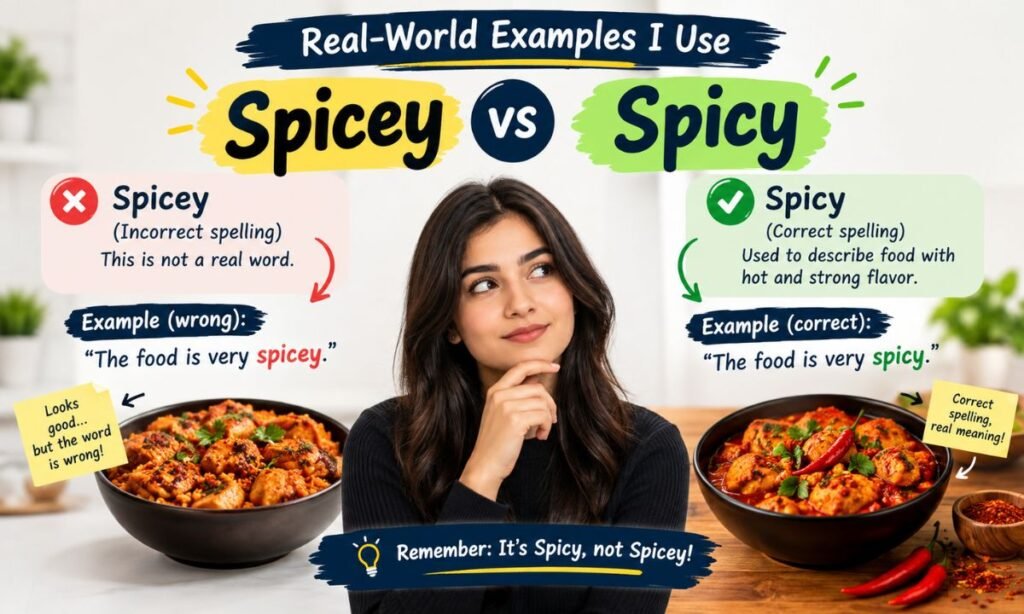
I keep a running mental list of example sentences for each context. Here’s how I sort them.
Culinary and Food Examples:
- The ramen broth was rich, spicy, and full of garlic.
- She asked the waiter to make the tacos less spicy.
- Sichuan cuisine is known for its bold, spicy peppercorn flavor.
- This spicy mango salsa pairs well with grilled fish.
Informal and Creative Examples:
- That group chat got spicy after the game ended.
- Her reply to the review was a little spicy, honestly.
- The plot took a spicy turn in the second act.
- He’s got a spicy sense of humor once you know him.
Professional and Descriptive Examples:
- The quarterly report included some spicy commentary on competitor pricing.
- Our marketing brief called for a spicy tagline, something bold and memorable.
- The panel discussion turned spicy when the two experts disagreed publicly.
Examples of What NOT to Write:
- ❌ “The wings were too spicey for me.”
- ❌ “I love spicey food.”
- ❌ “That comment was a bit spicey.”
Swap every “spicey” above for “spicy” and the sentence becomes correct.
Pronunciation Guide I Use
Both “spicy” and the misspelled “spicey” are pronounced identically, which is exactly why the mistake happens so often. The spelling error doesn’t come from mishearing the word — it comes from over-applying the base noun’s spelling.
Phonetic Pronunciation
/ˈspaɪ.si/
Broken down: SPY-see
- “Spi” rhymes with “sky”
- “cy” rhymes with “see”
Say it out loud and you’ll notice there’s no reason to add an extra “e” — the sound doesn’t call for it.
Spicy vs Spicey: My Summary Table
| Question | Answer |
|---|---|
| Which spelling is correct? | Spicy |
| Is “spicey” ever standard? | No |
| Does British English allow “spicey”? | No |
| Does American English allow “spicey”? | No |
| Rule behind the spelling | Drop silent “e,” add “-y” |
| Common cause of the mistake | Base word “spice” ends in “e” |
| Pronunciation | Identical for both spellings |
Did You Know?
“Spice” traces back to Old French “espice” and, further back, Latin “species,” originally meaning a particular kind or sort of goods. Merchants once used the term for valuable trade goods before it narrowed down to the seasonings we know today.
Common Mistakes I’ve Learned to Avoid
After digging through forums, comment sections, and my own old drafts, three mistakes kept showing up again and again.
Mistake #1: Adding Unnecessary Letters
This is the classic “spicey” error — carrying the “e” over from “spice” without realizing the adjective form drops it. It’s an easy fix once you know the rule, but it’s the single most common typo tied to this word.
Mistake #2: Confusing with Similar Words
Some writers blend “spicy” with unrelated words like “spiced” (a past-tense or adjective form used differently, as in “spiced rum”) or “spice” itself used incorrectly as an adjective (“this dish is very spice”). Keep the forms distinct:
- Spice = noun (“add more spice”)
- Spiced = adjective describing something flavored with spice (“spiced cider”)
- Spicy = adjective describing heat or boldness (“spicy cider” would imply heat, not just flavoring)
Mistake #3: Inconsistent Spelling
I’ve seen the same blog post use “spicy” in one paragraph and “spicey” three paragraphs later. Inconsistency hurts readability and looks careless, especially in professional or published content. Pick “spicy” and stick with it throughout.
When to Use “Spicy” in Different Contexts
Food Writing
Recipe blogs, restaurant menus, and food reviews should always use “spicy” when describing heat or seasoning level. Readers searching for recipes expect the standard spelling, and using it correctly also helps your content rank for food-related searches.
Casual Conversation
Texting, social captions, and informal chats are the most common places “spicey” sneaks in. It’s harmless between friends, but if you’re building a personal brand or writing publicly, correcting the habit early saves you from repeating it in more visible writing later.
Professional Writing
Business reports, marketing copy, and client-facing documents should never contain “spicey.” A single misspelling in professional material can chip away at credibility, even if the rest of the writing is strong.
Creative Writing
Fiction and poetry sometimes bend spelling rules for stylistic effect, but “spicey” isn’t a recognized stylistic variant — it just reads as an error. If you want a playful or nonstandard word, invent one intentionally rather than misspelling an existing word.
Synonyms and Related Terms I Found
Depending on which meaning of “spicy” you’re using, different synonyms fit better:
- For heat: hot, fiery, peppery, zesty, piquant
- For seasoning: flavorful, aromatic, well-seasoned, fragrant
- For excitement: lively, bold, provocative, edgy, racy
- For scandal: juicy, salacious, risqué, gossip-worthy
Choosing the right synonym depends on context — “piquant” fits a restaurant review, while “racy” suits a description of a controversial headline.
Cultural Context and Spiciness Levels
Understanding Spiciness Levels:
Heat in food is measured using the Scoville scale, developed in 1912 by pharmacist Wilbur Scoville. It ranks peppers and sauces by their capsaicin concentration, from bell peppers (0 Scoville units) up through ghost peppers and Carolina Reapers, which reach into the millions.
Common spiciness tiers people reference casually:
- Mild — barely noticeable warmth
- Medium — a clear kick but still comfortable
- Hot — noticeable burn, may need a drink nearby
- Extra hot — intense, often used as a challenge or dare
Cultural Differences:
What counts as “spicy” shifts drastically by region. A dish considered mild in parts of Thailand or Sichuan province might register as intensely hot to someone raised on milder Western cuisine. Mexican, Indian, Korean, and Ethiopian cuisines each build heat differently — using different chilies, spice blends, and cooking methods — so “spicy” from one culinary tradition doesn’t always translate directly to another.
Pro Tip I Learned
When ordering food in an unfamiliar cuisine, ask for a spice level “one notch below what locals consider medium” if you’re unsure of your tolerance. It’s a simple way to enjoy the flavor without overestimating your heat threshold.
What are some common synonyms for spicy?
Hot, peppery, fiery, zesty, piquant for heat; flavorful and aromatic for seasoning; bold or racy for excitement.
How do I use spicy in a sentence?
Use it after a linking verb or before a noun: “The soup is spicy” or “a spicy soup.” Both patterns work in food, personality, and content descriptions.
Are there any exceptions to this spelling rule?
Yes — “pricey” is a well-known exception where the “e” is often kept, though “pricy” also appears in some dictionaries. “Spicy,” however, has no accepted exception; it’s always spelled without the “e.”
Frequently Asked Questions
Is the word “spicy” spelled spicy or spicey?
It’s spelled “spicy.” “Spicey” is a common misspelling with no standard recognition.
What does “spicey” mean?
Nothing on its own — it’s simply an incorrect spelling of “spicy” and carries the same intended meaning as the correct word.
Is there an E in spicy?
Yes, one — at the end: s-p-i-c-y. There’s no second “e” before the “y.”
What is the difference between “spicy” and “spice”?
“Spice” is a noun referring to a seasoning ingredient, while “spicy” is the adjective describing something flavored with spice or containing heat.
Conclusion
“Spicy” wins, no exceptions, no regional variations, no situational passes. It follows a spelling pattern English uses again and again — drop the silent “e,” add “-y” — the same pattern that gives us icy, juicy, and racy. “Spicey” might look reasonable at a glance because “spice” ends in “e,” but dictionaries, style guides, and search engines all agree on one form only.