
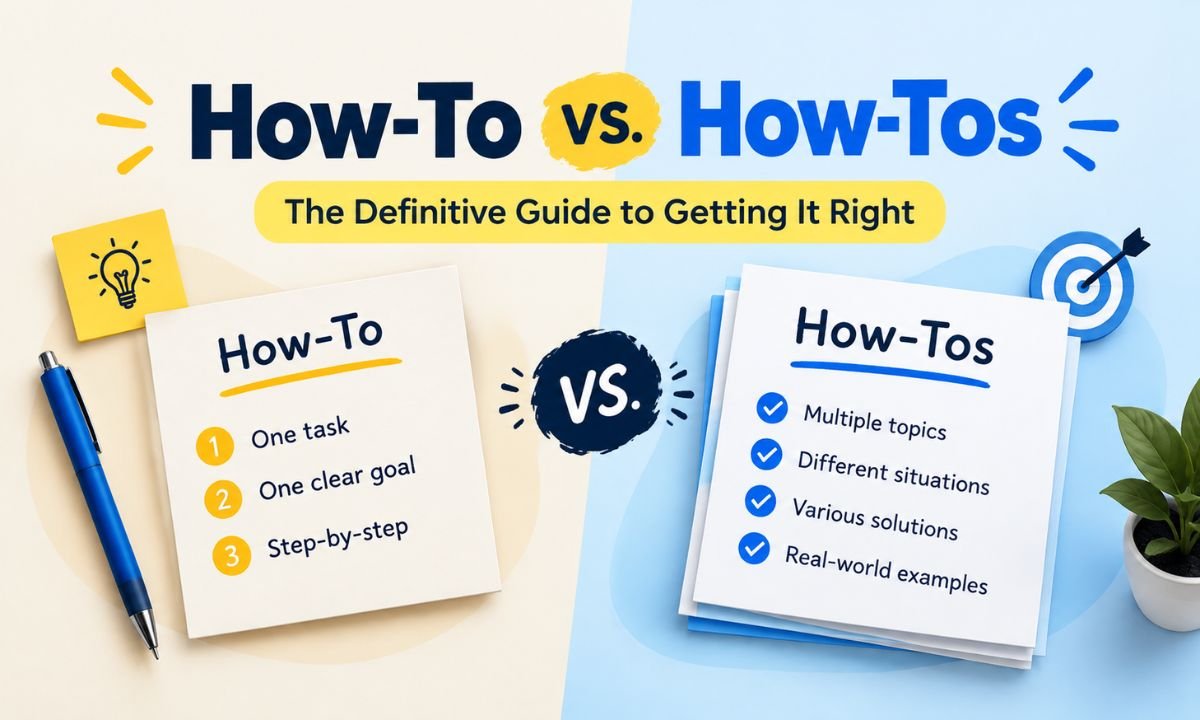
Few small phrases cause as much quiet doubt as “how-to.” You type it, stare at it, and wonder whether the hyphen belongs there. Then you try to make it plural, and the doubt doubles. Is it how-tos? How to’s? How-to’s? Something else entirely?
The confusion is understandable. “How to” began as a plain question phrase, then picked up a second life as an adjective, and later as a noun. Each role follows slightly different punctuation habits, and the plural has to squeeze a suffix onto a word that was never built to carry one.
This guide sorts it out. You’ll see what “how-to” means in each grammatical role, exactly when the hyphen is required, and why “how-tos” is the plural most dictionaries and editors prefer. You’ll also get comparison tables, common mistakes, and a few clean workarounds for the moments when the plural still looks clumsy. If you write blog posts, help-center articles, product manuals, or video titles, you’ll use this often.
Understanding What “How-To” Really Means
Start with the basic split. “How to” without a hyphen is an adverb followed by an infinitive verb. It sits inside a sentence and asks or explains a method: “She showed me how to tie a bowline.” Nothing there is a noun or an adjective. It is simply two words doing their normal jobs.
The hyphenated “how-to” is a different creature. It is a compound word, and it has two recognized roles. Dictionary.com, for example, lists “how-to” as both an adjective and a noun, with “how-tos” as the plural noun. The same entry dates the word to the late 1920s or 1930s, so this is not a modern internet invention. People have been buying how-to books for close to a century.
As a noun
As a noun, “how-to” names a piece of content or a set of instructions. It stands on its own, usually with an article in front of it.
According to Dictionary.com, the noun covers a set of step-by-step instructions for reaching a goal, and also the basic principles behind doing something. Both meanings show up in everyday writing.
Here are some noun examples:
- I found a how-to for replacing a bike chain.
- The magazine ran a short how-to on pruning roses.
- Her channel is mostly how-tos aimed at first-time home cooks.
- He never learned the how-to of budgeting, only the theory.
Notice that in every case you could swap in a normal noun such as “guide,” “tutorial,” or “lesson” and the sentence would still work. That swap test is a handy way to confirm you’re dealing with a noun.
As an adjective (noun modifier)
The adjective use is far more common. Here “how-to” sits before another noun and describes it. A “how-to video” is a video that teaches a process. A “how-to article” is an article that walks you through steps.
Grammar folks call this a noun modifier or compound modifier. The hyphen is what glues “how” and “to” together so the reader sees one descriptive unit instead of two loose words.
Examples of the adjective role:
- a how-to guide on sourdough
- a how-to column in the weekend paper
- how-to videos for beginners
- a how-to manual for the new printer
One practical point: this adjective almost always appears directly before the noun it describes. It sounds odd to say “This book is how-to.” Writers usually reword that as “This book is a how-to” (noun) or “This is a how-to book” (adjective).
When You Should Hyphenate “How-To”
The rule of thumb is simple. If the phrase works as a single label, either naming a thing or describing a thing, it takes a hyphen. If it works as a normal adverb plus verb inside a sentence, it doesn’t.
Microsoft’s older style manual for technical writers puts it in the same terms. According to a forum post quoting that manual, the hyphen is used when the phrase acts as an adjective, as in “how-to books,” while two separate words are used when it acts as an adverb plus infinitive, as in “This is how to format your disk”. That guidance comes from a 1998 edition, so treat it as a historical reference, but the logic still matches what current dictionaries show.
You hyphenate “how-to” when:
- It modifies a noun. “A how-to video,” “how-to tips,” “a how-to blog.”
- It names a piece of instructional content. “This week’s how-to is about repotting orchids.”
- It appears as a plural noun. “The site hosts hundreds of free how-tos.”
- It is part of a longer compound modifier. “A step-by-step how-to guide.”
The test for number one is quick. Remove “how-to” and see whether the remaining noun still makes sense alone. “A video” works. That tells you the phrase was describing the video, so it needs its hyphen.
You don’t hyphenate when:
- It introduces a method inside a sentence. “Please show me how to reset the router.”
- It starts a question or explanation. “How to bake bread without a mixer.”
- It follows a verb like know, learn, explain, or ask. “She wants to learn how to swim.”
- You can replace it with “the way to.” “I’ll explain how to do it” becomes “I’ll explain the way to do it,” and the sentence still works.
That last check is a favorite among editors. If “the way to” fits, you are looking at the adverb-plus-infinitive pattern, and no hyphen is needed.
Quick Reference Chart
| Sentence | Correct form | Why |
|---|---|---|
| Watch this ___ video. | how-to | Adjective before a noun |
| I’m learning ___ code. | how to | Adverb plus infinitive |
| She wrote a ___ for beginners. | how-to | Noun meaning a guide |
| Nobody told me ___ do it. | how to | Adverb plus infinitive |
| We publish weekly ___. | how-tos | Plural noun |
| Here is ___ fix a flat tire. | how to | Adverb plus infinitive |
| A ___ manual for the stove | how-to | Compound modifier |
Print that table or bookmark it. Nearly every real-world case fits one of those rows.
The Plural Problem: “How-Tos” vs. “How To’s”
Now for the part that starts arguments in editorial meetings. Once “how-to” becomes a noun, you need a way to talk about more than one. Writers land on at least four versions:
- how-tos
- how-to’s
- how to’s
- how tos
Only one of these has strong, consistent support. The others show up in the wild constantly, which is exactly why they feel acceptable. Frequency is not correctness, though. Plenty of common spellings are still nonstandard.
The confusion has a clear source. “How-to” ends in the word “to,” and “to” is a tiny function word. Adding “s” directly to it looks strange on the page: “tos.” Many writers reach for an apostrophe to make it look friendlier. That instinct is understandable, but it works against a well-established rule of English punctuation.
The debate is not new, either. In a 2007 developer mailing-list thread, one contributor argued that “how-to” is not a normal word and might therefore need an apostrophe before the “s”, while another countered that most native speakers simply mix up the plural “s” with the possessive “‘s”. The second person had it right.
Why “How-Tos” Is the Correct Plural Form
The plural of a noun that ends in a normal letter gets an “s.” That is the default, and “how-to” follows it. The hyphenated compound is treated as a single noun, so the “s” attaches at the very end: how-to + s = how-tos.
Dictionary.com, drawing on Collins, lists “how-tos” as the plural noun. Style guides and copy desks generally agree, and it also matches how we pluralize similar compounds such as “go-tos,” “to-dos,” and “no-nos.”
Why “how-tos” is the preferred form
Four reasons keep coming up among editors:
- It follows the standard plural rule. Regular nouns add “s,” not “‘s.”
- It avoids a false possessive. “How-to’s” can look like something belongs to a how-to.
- It reads cleanly in headlines. “Home Repair How-Tos” is quick to scan.
- It has dictionary backing. Reference works record it as the plural.
There is a real counterpoint. Some usage guides tolerate the apostrophe here because “tos” looks odd. A Django documentation ticket on exactly this question ended with a maintainer saying both forms are acceptable in their docs and that “how-to guides” was a clearer option. So you will see “how-to’s” in respected places. It is a tolerated variant in some house styles rather than the recommended default.
Simple rule to memorize
Add “s” to the end of the whole compound: how-to → how-tos.
If you remember nothing else from this guide, remember that line. It works in a blog post, an email, a book title, and a support article.
Why “How To’s” Creates Confusion
Writing “how to’s” with a space is the trickiest version because it breaks two things at once. It drops the hyphen, and it adds an apostrophe. The result looks like “how to” with a possessive tacked on, which makes no grammatical sense.
Here is what goes wrong in the reader’s mind. “How to” is normally followed by a verb. When they see “how to’s,” they expect a verb that never arrives, or they wonder what the apostrophe is claiming. The phrase stalls the eye for a fraction of a second, and small stalls add up across a long article.
Search engines and style-conscious readers also notice inconsistency. A page that uses “how-tos” in the title, “how to’s” in the intro, and “how-to’s” in a subheading can come across as careless, even if the advice itself is excellent.
Grammarbook’s apostrophe guidance, which the Django ticket linked to, states that apostrophes should not be used to make regular nouns plural. That is the core objection to every apostrophe version of this word.
Incorrect vs. Correct Examples
| Incorrect | Correct | What went wrong |
|---|---|---|
| Check out our latest how to’s. | Check out our latest how-tos. | Missing hyphen and stray apostrophe |
| Ten how-to’s for new gardeners | Ten how-tos for new gardeners | Apostrophe used for a plain plural |
| Read the how tos below. | Read the how-tos below. | Missing hyphen |
| We share tips and how to’s daily. | We share tips and how-tos daily. | Two errors in one phrase |
| Her how-to’s are popular. | Her how-tos are popular. | Apostrophe suggests possession |
| The how-to’s title was long. | The how-to’s title was long. (possessive, correct) | Here the apostrophe is legitimate |
That last row matters. Sometimes “how-to’s” really is correct, because you mean possession: the title that belongs to one how-to. The punctuation itself is fine there. The mistake only happens when you use it for a plain plural.
Using “How-To” as a Noun Modifier (Adjective Position)
When “how-to” describes another noun, the plural question mostly disappears. English adjectives don’t take plural endings. You say “how-to videos,” never “how-tos videos.” The plural lives on the noun that follows.
This is worth stressing because writers sometimes over-correct. After learning that “how-tos” is a valid plural, they start sprinkling the “s” everywhere, including places where the word is acting as an adjective.
Compare these:
- Correct: how-to articles
- Incorrect: how-tos articles
- Correct: a collection of how-tos
- Incorrect: a collection of how-to
In the first pair, “how-to” modifies “articles,” so it stays singular in form. In the second pair, “how-tos” is the noun being counted, so it takes the plural ending.
A second habit to watch is headline styling. Many editors capitalize both parts in title case (“How-To Guide”), while others lowercase the second element (“How-to Guide”). Style guides differ, so choose one and apply it across your site. Microsoft’s older manual, as quoted in the forum thread, avoided capitalizing the “t” in headings, giving examples like “How-tos, Tips, and Tricks”. Consistency matters more than which option you pick.
Table: Correct vs. Incorrect Usage
| Correct | Incorrect | Note |
|---|---|---|
| a how-to guide | a how to guide | Adjective needs its hyphen |
| how-to videos | how-tos videos | Adjectives stay singular in form |
| a how-to on knitting | a how to on knitting | Noun use still takes a hyphen |
| several how-tos on knitting | several how to’s on knitting | Plural noun, no apostrophe |
| a step-by-step how-to guide | a step by step how to guide | Both compounds need hyphens |
| I know how to knit. | I know how-to knit. | Verb phrase, no hyphen |
| this how-to manual | this how-tos manual | Modifier, not a plural noun |
Common Misunderstandings About “How-To” and Its Plural
Most mistakes trace back to three mental shortcuts. Once you can spot them, they are easy to stop making.
Misunderstanding #1: Treating “how to” as a noun
Writers sometimes use the two-word form as if it were a noun: “This is my favorite how to.” The sentence feels natural when spoken, because speech has no hyphens. On the page, though, the reader needs the hyphen to know the phrase is a single thing.
A useful habit is to reread any sentence where “how to” follows an article such as “a,” “an,” or “the.” If the phrase behaves like a thing you could hold, or a thing that can be counted, it’s a noun and needs its hyphen. “A how-to” is correct. “A how to” is not.
Misunderstanding #2: Putting the plural “s” in the wrong place
Some writers try to pluralize the first word: “hows-to.” It sounds odd, and it is not used. Others split the compound the way “attorneys general” or “mothers-in-law” do, where the plural goes on the main noun inside the phrase.
The trouble is that “how-to” has no main noun inside it. Neither “how” nor “to” is the head of the phrase. Because the compound acts as a single unit, the plural goes on the end. That is why “how-tos” is right and “hows-to” is not.
Misunderstanding #3: Thinking apostrophes make things look ‘cleaner’
This one is about looks rather than logic. “Tos” seems strange because we rarely see that letter combination. An apostrophe softens the appearance, so the writer adds one.
But visual comfort is a weak reason to bend a rule. English has plenty of plurals that look odd at first, such as “dos and don’ts,” “ifs and buts,” and “yeses.” We get used to them. The same is true of “how-tos.” After a few uses, it stops looking strange, and the apostrophe version starts to look like the odd one.
There is also the honest reader-experience point. A slightly unfamiliar spelling is a small cost. A punctuation mark that suggests possession, when none exists, changes what the reader thinks the sentence means. That cost is bigger.
How Punctuation Changes the Whole Meaning
Hyphens and apostrophes are not decoration. A single mark can turn a sentence into something else, and the “how-to” family shows it clearly.
A hyphen tells the reader that two words belong together. An apostrophe tells them that something is possessed or that letters are missing. Mixing those signals confuses the message.
Examples
Look at how meaning shifts:
- “The how-to’s cover was torn.” The apostrophe signals possession. One how-to has a cover, and it’s torn.
- “The how-tos cover was torn.” This is unclear. Readers can’t tell whether it’s a plural, a typo, or a strange compound.
- “The how-tos’ covers were torn.” Here several how-tos each have a torn cover. The apostrophe comes after the “s” because the plural noun is doing the possessing.
- “She wrote a how-to guide.” The hyphen makes “how-to” modify “guide.”
- “She wrote a how to guide.” Readers might briefly wonder what a “how to guide” is, or whether a word is missing.
- “Explain how to guide the group.” Two separate words, because “guide” is now a verb and “how to” belongs to the sentence structure.
That last pair is a nice reminder that the same three words can mean different things depending on where the hyphen sits. Without punctuation cues, the eye has to work harder.
The same principle appears in ordinary compound modifiers. A “man-eating shark” is a different creature than a “man eating shark.” A “small-business owner” runs a small business, while a “small business owner” could be a short person who owns a business. Hyphens do real work.
Quote to remember
A hyphen joins words together. An apostrophe claims something for one of them.
Keep that in mind and the “how-to” puzzle mostly solves itself. Use the hyphen to build the compound, then add a plain “s” to make it plural. Save the apostrophe for true possession or a missing letter.
Workarounds: Avoiding the Need to Pluralize “How-To”
Sometimes “how-tos” is correct and still reads awkwardly. It might land in a headline that already has a lot going on, or in a formal report where you’d rather avoid a casual-sounding word. In those cases, the easiest fix is to reword the sentence so the problem never appears.
Rewording is not cheating. Professional editors do it all the time. If one phrasing feels stiff, another usually reads better.
Useful Alternatives
These substitutes carry the same meaning and skip the plural puzzle entirely:
- how-to guides
- tutorials
- step-by-step instructions
- walkthroughs
- explainers
- practical guides
- instructional articles
- tip sheets
Each has a slightly different flavor. “Tutorials” suggests a learning sequence. “Walkthroughs” fits software or games. “Explainers” work well for concept-focused pieces, while “tip sheets” suggest shorter reference material. Choose the one that matches your content.
You can also rely on the adjective form. Instead of “our latest how-tos,” write “our latest how-to articles.” The noun modifier stays singular, and the plural moves to “articles.”
Examples
| Awkward or risky | Cleaner alternative |
|---|---|
| Browse our how to’s. | Browse our how-to guides. |
| Fifty home-repair how-tos | Fifty home-repair tutorials |
| The best how-tos of the year | The year’s best step-by-step guides |
| Subscribe for weekly how-tos. | Subscribe for weekly how-to videos. |
| Her how-to’s are famous. | Her instructional posts are famous. |
| We collect how-tos from experts. | We collect expert walkthroughs. |
Pick one approach for your site and stay with it. If your brand voice is casual, “how-tos” is perfectly natural. If it’s more formal, “how-to guides” reads more smoothly. Either choice is fine as long as your pages agree with each other.
For content teams, a short style-sheet entry helps. Something like this works: “Use how-to as an adjective and noun. Plural: how-tos. Use how to (no hyphen) after verbs.” Once it’s written down, nobody has to relitigate it on every article.
Frequently Asked Questions
Is it correct to say “go to’s” or “go tos”?
Neither is standard. The noun and adjective take a hyphen, so the plural is “go-tos,” as in “these are my go-tos.” “Go to” without a hyphen is only a verb phrase.
Is it “how to” or “how-to”?
Use “how to” (two words) when it’s followed by a verb, as in “I know how to cook.” Use “how-to” (hyphenated) when it’s a noun or an adjective, as in “a how-to guide.”
What are the three rules for apostrophes?
Use them to show possession (Maria’s book), to mark missing letters in contractions (don’t), and, in a few cases, to pluralize single letters or numerals for clarity (mind your p’s and q’s). They aren’t used for ordinary plurals.
How tos meaning?
How-tos” is the plural of the noun “how-to,” meaning step-by-step instructions or guides that explain how to do something. It’s usually written with a hyphen.
Conclusion
The “how-to” question feels bigger than it is. Break it into roles and each answer becomes clear. Use how to with no hyphen when it works as a normal adverb and infinitive, as in “learn how to paint.
Use how-to with a hyphen when it acts as a noun or as an adjective before another noun, as in “a how-to guide.” For the plural, write how-tos, adding a plain “s” at the end of the compound. Avoid “how to’s” and “how-to’s” unless you truly mean possession.