
Type the word fast enough and your fingers might betray you. You mean to write “submission,” but “submittion” slips out instead. It looks close enough to correct that spell-check sometimes lets it pass unnoticed, and by the time someone flags it, the email or assignment is already sent.
This mix-up is common, and it happens for a simple reason: English has a lot of “-tion” words, and the brain likes patterns. Once you see why “submittion” breaks that pattern, you won’t second-guess yourself again.
Which One Is Correct? Submission vs Submittion
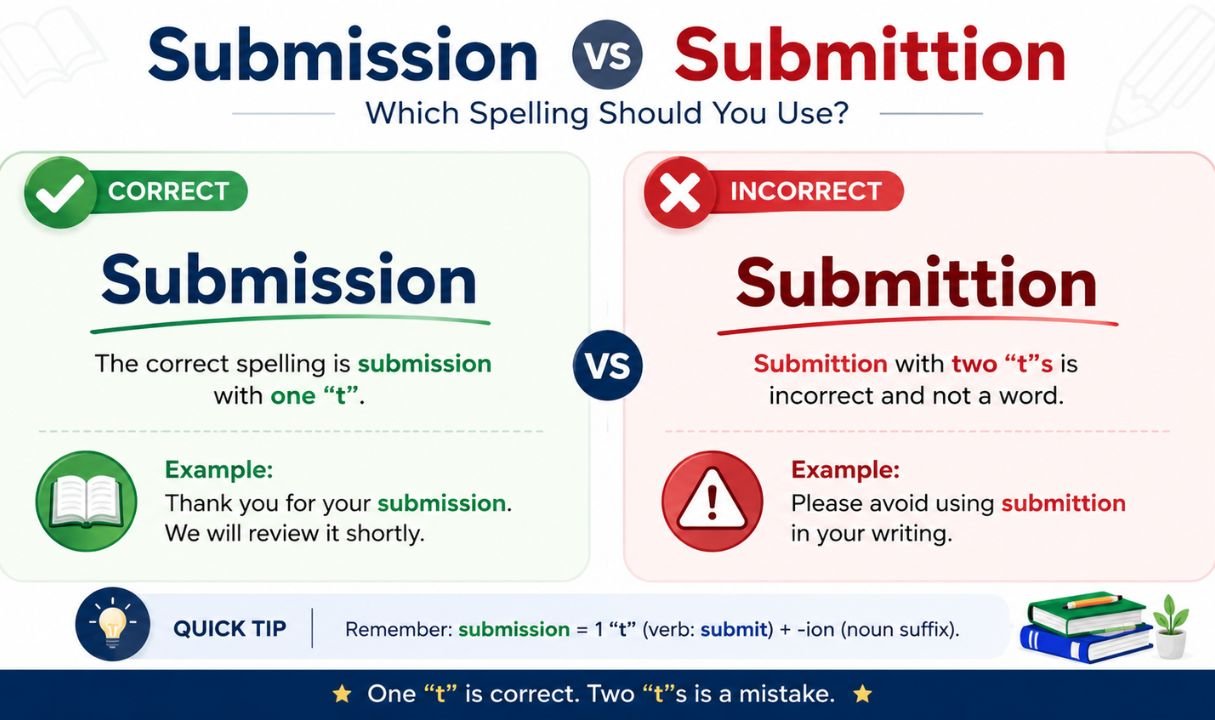
There’s no gray area here. Submission is the only correct spelling. Submittion is not a word — it doesn’t appear in Merriam-Webster, Oxford, Cambridge, or any other recognized English dictionary.
| Word | Status | Notes |
|---|---|---|
| Submission | Correct | Standard English noun, derived from “submit” + “-ion” |
| Submittion | Incorrect | Common misspelling; not recognized by any dictionary |
If you’re staring at a document right now trying to decide which one to use, the answer is always submission. There’s no context — formal, casual, academic, or legal — where “submittion” is the right choice.
Meaning of Submission
At its core, submission means the act of presenting or handing something over for review, approval, or judgment. A student submits a paper. A writer submits a manuscript. A contractor submits a bid.
The word carries a second meaning too: yielding to authority or giving in to someone else’s control. A wrestler forces a submission. A defeated army offers its submission to the victor. Both meanings trace back to the same Latin root, submittere, which means “to place under” or “to yield.”
So when you see the word “submission,” context tells you which sense applies:
- Presenting something for review — “Her submission for the writing contest arrived a day early.”
- Yielding or surrender — “The negotiations ended with the rebels’ submission.”
Most everyday and professional writing uses the first meaning far more often than the second.
Why “Submittion” Is Incorrect
The mistake usually comes from a reasonable, if flawed, guess. English is full of verbs that turn into nouns by adding “-tion”: inform becomes information, create becomes creation, direct becomes direction. Somewhere along the way, people apply that same pattern to “submit” and land on “submittion.”
The problem is that “submit” doesn’t follow the simple add-a-suffix rule. It belongs to a small group of Latin-derived verbs ending in “-mit” — commit, permit, admit, transmit — and every one of them forms its noun with “-mission,” not “-mittion”:
- Commit → Commission
- Permit → Permission
- Admit → Admission
- Transmit → Transmission
- Submit → Submission
Notice the pattern: the “t” at the end of the verb doesn’t double. Instead, it merges with the suffix to form “-ssion.” Adding an extra “t” and writing “submittion” breaks that rule and produces a word English never adopted.
Autocorrect tools sometimes fail to catch this because “submittion” is close enough phonetically to slip past a quick glance, and some browser spell-checkers don’t flag it as aggressively as they should. That’s part of why the mistake spreads — it looks almost right, and it sounds almost right when spoken aloud.
How to Spell Submission Correctly
The safest way to lock this in is to remember the family of words submission belongs to. If you can spell “permission” or “admission” without hesitation, apply the same ending to “submit” and you’ll never write it wrong again.
Breaking it down: sub- + mission. Not “sub- + mittion.” Reading it as two familiar chunks — “sub” and “mission” — makes the correct spelling stick.
Submission vs Submittion Synonym
Depending on which meaning you intend, submission has several close synonyms:
- For “presenting something”: entry, application, proposal, filing
- For “yielding”: surrender, compliance, capitulation, deference
“Submittion” has no synonyms, because it isn’t a real word with a real definition to substitute.
Submission vs Submittion in a Sentence
- ✅ Correct: “Please double-check your submission before the deadline.”
- ❌ Incorrect: “Please double-check your submittion before the deadline.”
Reading both versions side by side usually makes the error obvious once you know what to look for.
1. Submission vs Submittion Examples
| Correct Sentence | Incorrect Sentence |
|---|---|
| The journal accepted her submission for publication. | The journal accepted her submittion for publication. |
| Late submissions will not be graded. | Late submittions will not be graded. |
| He reviewed each submission carefully. | He reviewed each submittion carefully. |
| The grant submission process takes two weeks. | The grant submittion process takes two weeks. |
2. Submission of a Document
“Submission of a document” describes the formal act of sending or delivering paperwork — a report, an application, a manuscript — to whoever needs to receive and review it. This phrase shows up constantly in academic, business, and legal writing, and it always uses “submission,” never the misspelled variant.
3. Submission Date
The submission date is simply the deadline by which something must be turned in. Missing it can mean a rejected application, a late penalty on an assignment, or a disqualified contest entry, so this term matters as much as the spelling of the word itself.
Common Spelling Mistakes of Submission
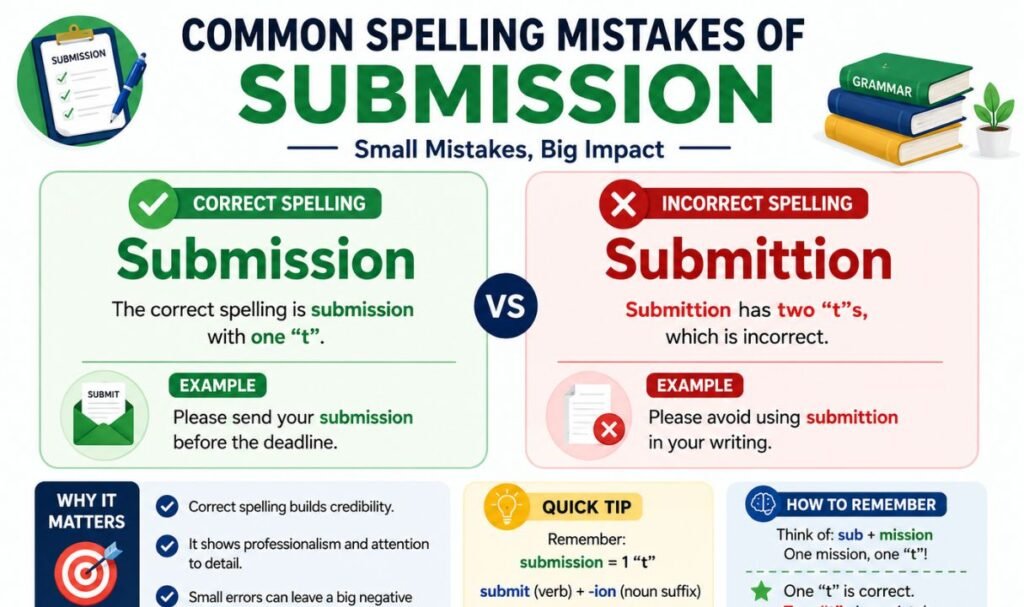
People don’t only write “submittion.” A few other variants show up in search bars and rough drafts:
- Submition
- Submision
- Sumission
- Submissoin (a simple letter-swap typo)
Submission vs Submittion
Among all these variants, “submittion” remains the most frequent mistake, likely because the double “t” mirrors verbs like “commit” and “admit” in their base form, even though the noun form drops that pattern. Once you’ve memorized the “-mission” ending, the other typos become easy to catch too, since they all deviate from that same fixed spelling.
Submission Grammar Usage and Word Forms
This is a noun, and it has related word forms worth knowing so your sentence structure stays accurate:
| Word Form | Part of Speech | Example |
|---|---|---|
| Submit | Verb | “You must submit your report by Friday.” |
| Submitted | Verb (past tense) | “She submitted the application yesterday.” |
| Submitting | Verb (gerund/present participle) | “He is submitting his thesis today.” |
| Submission | Noun | “The submission was well-organized.” |
| Submissive | Adjective | “The dog had a submissive posture.” |
Submission vs Submittion
Since “submittion” doesn’t exist, it also has no valid verb, adjective, or gerund forms. Every version of this word family — submit, submitted, submitting, submission, submissive — keeps the double “s” spelling and drops the doubled “t.” Learning this table once removes the guesswork from every tense and form you’ll ever need.
Submission vs Submittal
Unlike “submittion,” the word “submittal” is a real English word, though it’s far less common and mostly appears in construction, engineering, and contract documents. A “submittal” refers to a document or set of materials formally handed over for approval, often as part of a technical or regulatory process.
| Term | Common Field | Example Use |
|---|---|---|
| Submission | General, academic, business | “Your submission was received on time.” |
| Submittal | Construction, engineering | “The contractor filed the submittal for the materials list.” |
In everyday writing, “submission” is almost always the right choice. “Submittal” only belongs in specialized technical contexts, and mixing the two up in a general document can sound out of place.
Submission of a Document in Real Life
Consider a graduate student finishing a thesis. Weeks before the deadline, they format the file, check citations, and prepare a cover page. Then comes the actual submission — uploading the document to the university’s portal, confirming receipt, and saving the confirmation email as proof.
The same pattern plays out across industries. A freelance writer submits a pitch to an editor. A job seeker submits a resume through an online portal. A tax filer submits forms before the government deadline. In every case, “submission” describes both the action of sending the document and the document itself once it’s been sent.
Submission Date Meaning and Importance
A submission date isn’t just a calendar reminder — it often determines whether your work gets considered at all. Academic journals reject late manuscripts outright. Universities dock grades for missed deadlines. Government agencies close application windows the moment the date passes.
A few practical habits help avoid missing one:
- Mark the submission date on a calendar as soon as it’s announced.
- Set a reminder a few days early, not on the deadline itself.
- Confirm the required file format before the last minute.
- Save a confirmation email or receipt after submitting.
- Double-check time zones for online submission portals.
Treating the submission date as fixed, rather than flexible, saves a lot of stress later.
Submission in Academic and Legal Contexts
In academic writing, submission refers to coursework, research papers, dissertations, or conference abstracts sent for review. Professors and journal editors use the term constantly, and getting the spelling wrong in a cover letter or email to an editor can undercut an otherwise strong piece of writing.
In legal contexts, submission takes on a more formal weight. Lawyers “make submissions” to a court, meaning they present arguments or evidence for a judge to consider. A “written submission” might refer to a formal brief filed with a tribunal. Precision matters here more than almost anywhere else, since legal documents are read closely and errors can raise doubts about attention to detail.
Submission vs Application
These two words overlap but aren’t identical. “Application” usually refers to a formal request — for a job, a loan, admission to a school — often involving a structured form. “Submission” is broader: it covers the act of sending in anything for review, whether that’s an application, a manuscript, an art piece, or a legal document.
| Term | Typical Use |
|---|---|
| Application | Requesting something specific (a job, a visa, a loan) |
| Submission | Sending in any material for review or judgment |
An application is a type of submission, but not every submission is an application. A short story sent to a literary magazine is a submission, not an application, since nothing is being formally requested beyond consideration.
Common Mistakes to Avoid
- Writing “submittion” instead of “submission”
- Confusing “submission” with “submittal” in general (non-technical) writing
- Using “submission” when “application” fits the context better
- Forgetting that “submit” doesn’t double its final “t” in the noun form
- Missing the submission deadline because of unclear time zone rules
Practice Session
Test what you’ve learned with these short exercises.
Fill in the Blank
- Please review my ______ before sending it to the editor.
- The committee received over two hundred ______s this year.
- He ______ted the form online yesterday.
- She is ______ting her paperwork right now.
Correct the Mistakes
- “My submittion is attached to this email.”
- “The submittion deadline was extended by one week.”
- “Their submittion won first prize in the contest.”
Identify the Verb vs Noun
For each sentence, decide whether the bolded word is a verb or a noun.
- “I will submit my report tomorrow.”
- “The submission arrived late.”
- “She submitted her thesis last week.”
Application Practice
Write one sentence using “submission” to mean “presenting a document” and one sentence using it to mean “yielding to authority.”
Trick Test
Which sentence is correct?
- A) “The gallery is now accepting art submittions.”
- B) “The gallery is now accepting art submissions.”
If you picked B, you’ve got the rule locked in.
Frequently Asked Questions
Is “submition” or “submission” the correct spelling?
Submission is correct. Submition, like submittion, is a misspelling not found in any standard dictionary.
What does submition mean?
Nothing — submition isn’t a real word. The correct term with this meaning is submission.
Which is correct: “submission” or “submitting”?
Both are correct, but they serve different roles: submission is the noun, while submitting is the present participle of the verb submit.
Is submission the same as submit?
Not quite. Submit is the verb (the action), while submission is the noun (the result or the act itself).
Conclusion
The rule behind submission vs submittion comes down to one small but firm point: verbs ending in “-mit” become nouns ending in “-mission,” not “-mittion.” Once that pattern clicks, along with commit, permit, and admit, the spelling stops being a guessing game.
Whether you’re finishing a thesis, filing legal paperwork, or sending a short story to a magazine, getting this word right is a small detail that signals careful, professional writing. Keep the “-mission” ending in mind, and you’ll spell it correctly every time.