
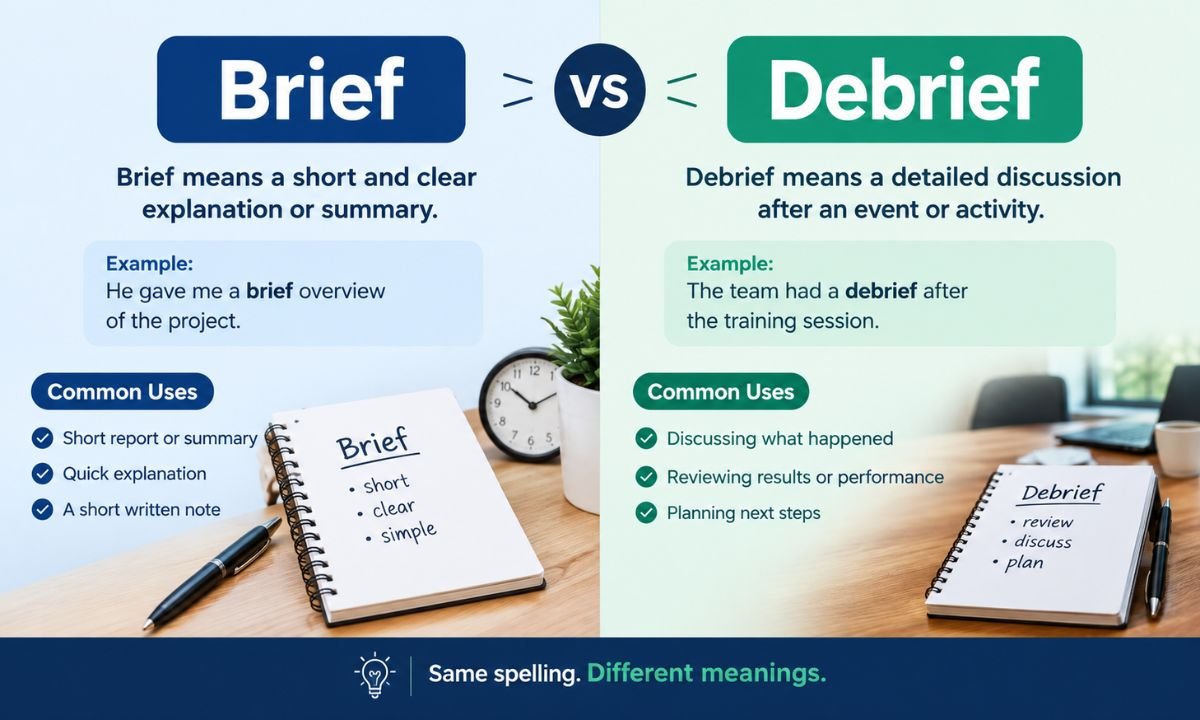
Two words, one shared root, and a world of difference in when you use them. “Brief” and “debrief” show up in courtrooms, cockpits, marketing meetings, and hospital wards, yet plenty of professionals still swap them by accident. That small mix-up can make an email sound off or a meeting invite confusing.
This guide breaks down both words in plain terms — what they mean, where they came from, and exactly when to reach for each one. You’ll also see how briefs and debriefs work together in real teams, from creative agencies to emergency responders, so the difference sticks for good.
Understanding the Term “Brief” in Communication
At its core, a brief is about giving someone what they need to know, and giving it fast. Teams use briefs to align before work starts, whether that’s a five-minute huddle or a thirty-page creative document.
A brief works because it strips away everything except the essentials: the goal, the constraints, and the first steps. Skip a proper briefing and people spend the first hour of a project guessing instead of building.
What Does “Brief” Mean? (Definition You Can Use Today)
“Brief” changes shape depending on how it’s used in a sentence. It can be a verb, a noun, or an adjective, and each version carries a slightly different job.
As a verb:
To brief someone means to give them the information or instructions they need before they act.
- “The pilot briefed the crew before takeoff.”
- “HR will brief new hires on the benefits package this afternoon.”
As a noun:
A brief is the document or summary itself — the thing you hand someone so they can get up to speed.
- “Send me the creative brief before Friday.”
- “The lawyer filed her brief with the court.”
As an adjective:
Here, brief simply describes something short — a brief pause, a brief conversation, a brief visit.
- “Keep your answer brief.”
- “We had a brief chat about the budget.”
| Form | Function | Example |
|---|---|---|
| Verb | To inform or instruct | “She briefed the board on Q3 results.” |
| Noun | A short summary or formal document | “The agency needs the client brief by Monday.” |
| Adjective | Short in duration or length | “It was a brief meeting.” |
Origins & Uses of “Brief” (Keep It Real)
The word traces back to the Latin brevis, meaning short. It moved through French into English centuries ago, first showing up in legal writing before spreading into everyday speech.
That legal connection stuck around longer than most people realize. Long before marketing teams had creative briefs, lawyers had case briefs — short, focused documents built to make a point without wasting the reader’s time.
Today the word covers a lot of ground:
- Military and aviation briefings before a mission or flight
- Creative and marketing briefs that set the direction for a campaign
- Legal briefs filed in court
- Everyday use, like “keep it brief” during a phone call
The common thread is efficiency. A brief exists so the reader doesn’t have to dig for what matters.
Legal Briefs: What They Really Are

A legal brief isn’t casual, and it isn’t short in the way people usually picture “brief” material. It’s a structured written argument that a lawyer submits to a court, laying out facts, precedent, and reasoning to support a client’s position.
Attorneys spend weeks building these documents. They cite prior rulings, anticipate counterarguments, and organize everything so a judge can follow the logic without re-reading paragraphs twice. The name comes from the same idea as everywhere else: a brief captures only what’s necessary to make the case, cutting anything that doesn’t serve the argument.
So when someone calls a fifty-page court filing a “brief,” that’s not a contradiction. It’s brief in substance — focused and purposeful — even if it’s long in page count.
What ‘Debrief’ Means in Different Fields
Add the prefix “de-” and the meaning flips direction. Where a brief prepares someone for what’s ahead, a debrief looks back at what already happened.
The word is much younger than “brief.” It entered English during the 1940s, largely tied to wartime intelligence work, where returning agents and pilots were questioned about their missions. From there it spread into business, healthcare, education, and just about any field where teams want to learn from experience.
Definition: What Does “Debrief” Mean?
To debrief someone is to gather information from them after an event, task, or mission has wrapped up. It’s a conversation built around one question: what actually happened, and what can we take from it?
- “The astronauts were debriefed after landing.”
- “Let’s debrief the sales team once the trial period ends.”
As a noun, a debrief refers to that same session or report — the meeting itself, or the summary that comes out of it.
Debriefing in Intelligence and Military Operations
This is where the word made its name. In military and intelligence settings, debriefing is a formal, sometimes intense process. Operatives, soldiers, or pilots sit down with commanding officers to walk through exactly what occurred during a mission.
The goals are specific:
- Confirm what actually took place versus what was planned
- Gather intelligence that wasn’t available before the mission
- Flag threats, failures, or unexpected obstacles
- Feed lessons back into training and future planning
Because lives and national security can be on the line, military debriefs tend to be structured, documented, and sometimes repeated across multiple sessions. Nothing about them is casual.
Debriefing in Business and Project Management
Outside the military, debriefing has become a standard part of how good teams operate. A project doesn’t really end when the deliverable ships — it ends once the team has talked through what worked and what didn’t.
A good business debrief might include:
- A review of the original goals versus the actual outcome
- Open discussion of what went smoothly
- Honest conversation about delays, errors, or miscommunication
- Specific, written takeaways for the next project
- Assigned owners for any follow-up actions
Skip this step often enough, and a team ends up making the same mistakes on every new project. Debriefs turn one-off experience into shared knowledge the whole team can use.
Brief vs Debrief: Linguistic & Functional Differences
Both words share a root, but they point in opposite directions on the timeline of a project. Here’s a side-by-side look at how they differ.
| Aspect | Brief | Debrief |
|---|---|---|
| Timing | Before the task or event | After the task or event |
| Purpose | Prepare, inform, instruct | Review, evaluate, learn |
| Direction of information | Flows from leader to team | Flows from team back to leader |
| Tone | Instructional | Reflective, sometimes investigative |
| Common settings | Meetings, creative work, legal filings | Military, healthcare, project reviews |
| Word origin | 16th century, from Latin brevis | Mid-20th century, built from “brief” |
The simplest way to remember it: a brief points forward, a debrief looks backward.
When to Brief vs When to Debrief
Timing decides which word — and which process — you need. If the work hasn’t started yet, you brief. If it’s already finished, you debrief.
When to Use a Brief
Reach for a briefing whenever a team needs direction before taking action. That includes:
- Kicking off a new project or campaign
- Preparing a team for a high-stakes event, like a product launch
- Onboarding a new employee
- Setting expectations before a client meeting
- Giving instructions before an operation, flight, or mission
Key Benefits of a Good Briefing
- Everyone starts with the same information, which cuts down on repeated questions
- Roles and responsibilities are clear from the outset
- Risks and constraints get flagged before they become problems
- Teams move faster because they’re not guessing at the goal
When to Use a Debrief
A debrief belongs at the close of a task, project, or event — any point where there’s something to learn from what just happened. Common moments include:
- Right after a product launch or campaign ends
- Following a training exercise or simulation
- After a customer complaint or service failure
- Once a sprint or project phase wraps up
- Following an emergency response or incident
Why Debriefing Matters
- It turns raw experience into documented lessons
- It surfaces problems that might not show up in a status report
- It gives quieter team members a structured chance to speak up
- It reduces the odds of repeating the same mistake next time
Practical Scenarios (Brief vs Debrief in Action)
Definitions only go so far. Seeing both processes play out in real settings makes the difference easier to apply on your own team.
Case Study 1: Creative Agency Launching a Campaign
Before any design work starts, the account team puts together a creative brief. It spells out the client’s goals, target audience, budget, tone, and deadline. Designers and copywriters use that single document to guide every decision, from color choices to headline copy.
Once the campaign goes live and runs its course, the same team gathers for a debrief. They pull performance data, compare it against the goals from the original brief, and talk through what the creative got right and where it fell short. Those notes shape the brief for the client’s next campaign.
Case Study 2: Emergency Response Team
Paramedics and firefighters receive a briefing as soon as a call comes in — the type of emergency, the address, known hazards, and anything dispatch has already confirmed. That briefing has to be fast and precise, because the team is often moving before the information even finishes coming through.
After the call is resolved, the crew debriefs, sometimes right in the truck on the way back to the station. They talk through decisions made under pressure, note anything that slowed them down, and flag equipment or communication issues. Serious incidents often get a more formal debrief later, involving supervisors and detailed reports.
Case Study 3: Software Development Sprint
At the start of a two-week sprint, a product manager briefs the development team on the features going into that cycle, the priority order, and any technical constraints. This keeps engineers from building the wrong thing or duplicating work.
When the sprint closes, the team holds a retrospective — essentially a debrief by another name. They discuss what slowed the sprint down, which tickets took longer than expected, and what process changes might help the next cycle run smoother. Many agile teams treat this step as non-negotiable, precisely because skipping it tends to produce the same bottlenecks sprint after sprint.
Quick Reference: Brief vs Debrief at a Glance
| Question | Brief | Debrief |
|---|---|---|
| When does it happen? | Before work begins | After work ends |
| What’s the goal? | Inform and prepare | Review and learn |
| Who talks the most? | The leader or organizer | The team or participants |
| What comes out of it? | Instructions, a plan, a document | Lessons, action items, a report |
Frequently Asked Questions
What is the difference between a brief and a briefing?
“Brief” often refers to the document or the short act of informing someone, while “briefing” usually describes the actual meeting or session where that information gets delivered.
What is the difference between a pre-brief and a debrief?
A pre-brief happens right before an activity to set expectations and roles, while a debrief happens after the activity to review what actually occurred.
What do you call a debrief after a meeting?
It’s still called a debrief, or sometimes a post-meeting review or retrospective, depending on the industry.
What does it mean to debrief?
To debrief means to question or discuss an event with someone after it has finished, in order to gather information and learn from the experience.
Conclusion
A brief and a debrief aren’t opposites so much as two halves of the same cycle. One sets a team up to succeed; the other makes sure that success or failure — actually teaches something. Skip the briefing and people wander in without direction. Skip the debrief and the same mistakes quietly repeat themselves, project after project.