
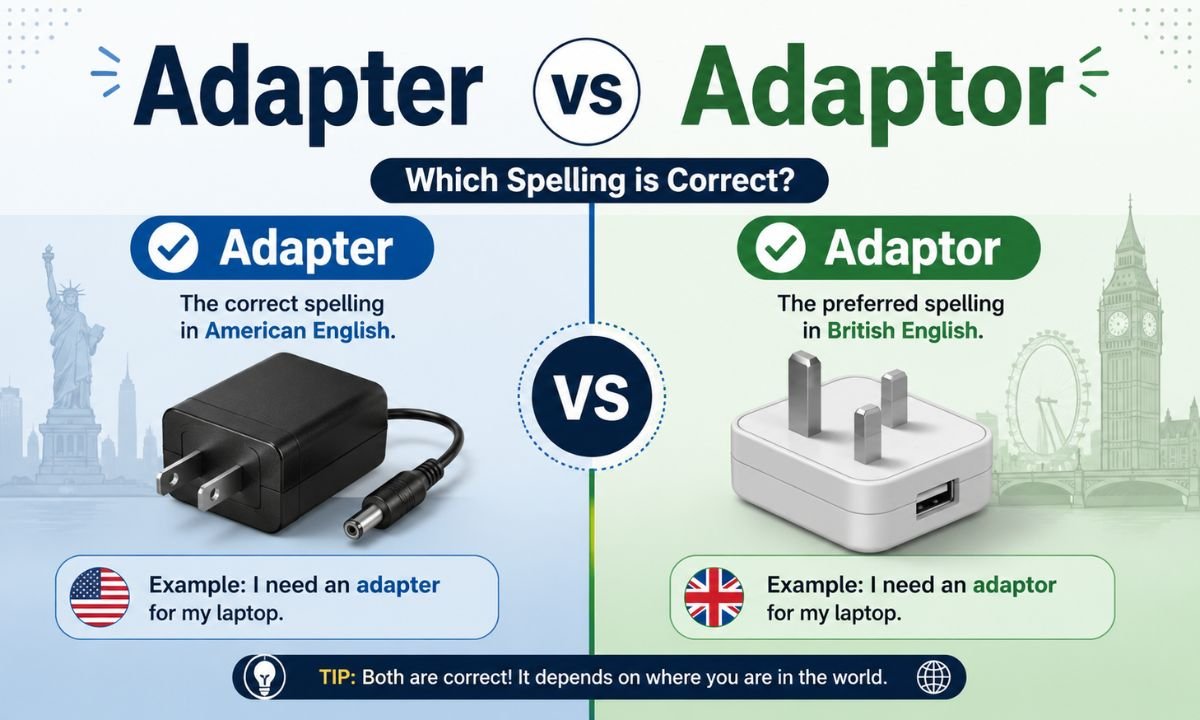
You’re standing in an airport shop, staring at a rack of travel plugs labeled “Universal Adaptor,” and your brain snags on the spelling. Is that a typo? Should it say “adapter”? You’re not imagining things, and you’re not wrong either way. Both spellings are correct English, and the confusion around them is older than the electrical socket itself.
This guide walks through where each spelling came from, how American and British English split on the word, what dictionaries and style guides actually say, and how to pick one spelling and stick with it — whether you’re writing a product listing, a manual, or a college paper.
Understanding “Adapter” vs “Adaptor”
Here’s the short answer, since you probably want it before anything else: adapter and adaptor are two spellings of the exact same word. They mean the same thing, they’re pronounced the same way, and neither one is a grammatical mistake.
The difference comes down to regional habit rather than rule. Writers in the United States lean toward “adapter.” Writers in the United Kingdom, and some other English-speaking countries, use “adaptor” more often — though even there, “adapter” has been closing the gap for decades. Neither the Oxford English Dictionary nor Merriam-Webster treats one as wrong; they list both, usually with one marked as more frequent than the other.
What actually matters for most people isn’t which spelling wins some imaginary contest. It’s consistency. Pick one spelling and use it throughout a single document, website, or product line. Switching between the two on the same page is what actually reads as careless.
The Core Meaning: What Both Words Actually Mean
Strip away the spelling debate, and the word itself is simple. An adapter (or adaptor) is a device, tool, or piece of software that lets two otherwise incompatible things work together. That could mean:
- A physical plug that lets a US charger fit a UK wall socket
- A cable that connects an old-style USB-A device to a newer USB-C laptop
- A software layer that lets one program talk to another it wasn’t originally built for
- A person who adjusts a novel or play into a new format, such as a screenwriter adapting a book for film
The common thread is compatibility. Something doesn’t fit, connect, or communicate on its own, and the adapter bridges that gap.
Definition
Adapter / Adaptor (noun): A device, mechanism, or person that enables two different systems, formats, or objects to function together by adjusting one to suit the other.
Grammatically, the word is a straightforward agent noun built from the verb “adapt” plus a suffix meaning “one that does.” English has two common suffixes for this job — “-er” and “-or” — and adapt happens to be one of the words that never fully settled on just one.
A Short History: How Both Spellings Came to Exist
The root goes back to the Latin verb adaptare, meaning “to fit to.” That passed into French as adapter before entering English in the 1600s as the verb “adapt.” The noun form describing a person or thing that adapts came later, and it’s here that the spelling split really begins.
English agent nouns generally follow one of two patterns. Words rooted in Latin verbs ending in -are or -ere often took the “-or” ending (actor, editor, inventor), following Latin convention directly. Words that felt more naturally English, or that passed through French first, tended to pick up “-er” (worker, teacher, writer). Adapter/adaptor sits right on that fault line, which is exactly why both forms took hold instead of one crowding out the other.
Historical Timeline
| Period | What Happened |
|---|---|
| 1600s | The verb “adapt” enters English via French, from Latin adaptare |
| Early 1800s | Early printed citations of “adaptor” appear, referencing mechanical fittings |
| Mid-to-late 1800s | “Adapter” begins appearing in parallel, gaining ground in technical and engineering writing |
| Early-to-mid 1900s | “Adaptor” becomes the more common form in British publishing and everyday UK writing |
| 1990s onward | “Adapter” overtakes “adaptor” even in British English, driven largely by global tech and electronics documentation |
| Today | “Adapter” dominates worldwide; “adaptor” survives mainly in UK-published material and some mechanical trade contexts |
Language data tools like Google’s Ngram Viewer back this up: “adaptor” held a lead in British texts for much of the twentieth century, then lost ground to “adapter” as electronics manuals, computing terminology, and international brands standardized on the shorter-feeling “-er” spelling.
Modern Usage in Different English Dialects=
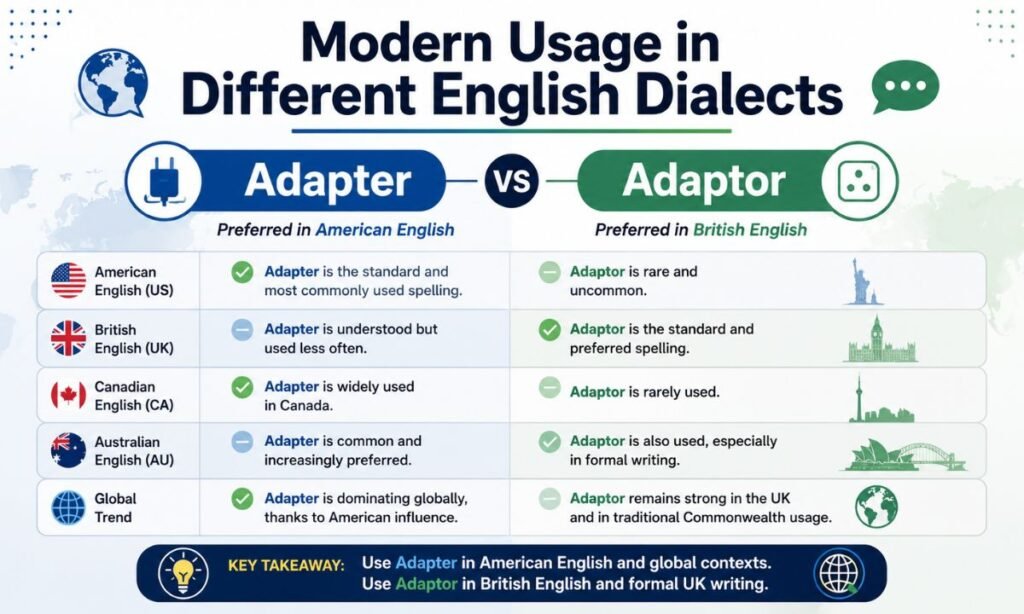
Spelling preference today has less to do with grammar rules and more to do with where you’re publishing and who’s reading.
American English
In the US, “adapter” is the standard spelling almost everywhere — packaging, manuals, journalism, and academic writing. Major style guides used by American publishers and news outlets default to it. A few real-world variations people search for:
- Adapter or adaptor charger — Product listings for phone and laptop chargers almost always say “adapter” in the US market.
- Adapter or adaptor Oxford Dictionary — Oxford lists both, but flags “adapter” as the more common form in current usage, especially for electronics.
- Connector adaptor — Even in the UK, many connector and cable products use “adapter” now, since global electronics brands write their packaging once and ship it everywhere.
- Adaptor plug — This phrase still shows up frequently in British and Australian retail, particularly for travel plug adaptors.
- Adapter or adaptor laptop — Laptop power bricks are near-universally labeled “adapter,” regardless of the manufacturer’s home country.
- Adaptor vs converter — These aren’t the same thing. An adapter changes the shape of a plug so it physically fits a socket; a converter changes the electrical voltage itself. A phone charger from Japan plugged into a European socket needs an adapter for the shape and possibly a converter for the voltage.
British English
“Adaptor” still appears regularly in the UK, especially in:
- Everyday retail language, like “travel adaptor” or “plug adaptor”
- Some educational and publishing contexts that follow older house styles
- Casual and regional writing where the older spelling never fully faded
That said, plenty of UK-based technology companies write “adapter” in their own technical documentation, because the electronics and computing industries settled on that spelling internationally long ago. British newspapers are split depending on the publication’s internal style guide, with some defaulting to “adapter” for anything tech-related and “adaptor” for more general or mechanical use.
Other Regions
Canada, Australia, New Zealand, and international English writing generally follow a mixed pattern. Canadian English often leans toward American spelling for tech terms while keeping some British habits elsewhere. Australian English shows a similar blend. In these regions, the deciding factor is usually the individual publisher, company, or brand style guide rather than a national standard — which is why you’ll see both spellings used by different outlets in the same country without either one being flagged as an error.
Real-World Contexts: Where You’ll See Each Spelling
Both spellings show up constantly once you start noticing them:
- Electronics packaging — Charger boxes, power bricks, and cable adapters
- User manuals — Setup guides for laptops, gaming consoles, and appliances
- Travel accessories — Universal plug adaptors sold in airports and luggage shops
- Software documentation — API “adapters” that connect one system’s data format to another
- Automotive and industrial parts — Hose adaptors, socket adaptors, and fitting adaptors in trade catalogs
- Film and publishing credits — “Screenplay adapted by” or references to a novel’s “adapter”
Notice that the mechanical and trade world leans slightly more toward “adaptor” in British contexts, while software, computing, and consumer electronics have converged almost entirely on “adapter” worldwide.
Types of Adapters (with Real Examples)
Adapters aren’t a single category of object. A few common types:
- Power adapters — Convert electrical current from a wall outlet into the voltage a device needs (laptop chargers, phone chargers).
- Plug adapters — Change the physical shape of a plug so it fits a different style of socket, without altering voltage.
- Connectivity adapters — Bridge two different cable or port standards, such as USB-C to HDMI, or Bluetooth dongles that add wireless capability to older hardware.
- Mechanical adapters — Physical fittings used in plumbing, automotive work, or tools, letting two differently sized or shaped parts connect.
- Software adapters — Code layers that translate data or requests between two systems that wouldn’t otherwise understand each other.
Case Study: Apple vs Amazon
Two large companies, two slightly different habits, both landing on the same core spelling.
Apple’s product pages and support documentation consistently use “adapter” — the “USB-C Power Adapter,” for instance, appears the same way whether you’re browsing the US, UK, or Australian version of Apple’s site. Apple treats spelling as part of brand consistency and doesn’t localize it by region.
Amazon, by contrast, is a marketplace rather than a single brand, so listings vary by seller. Search “phone adapter” or “phone adaptor” on Amazon’s UK site and you’ll find both spellings used across different sellers’ product titles, sometimes for the exact same item. This is a useful real-world reminder: even large platforms don’t enforce one spelling, which is exactly why picking your own standard matters more than chasing a “correct” answer.
Common Misconceptions and Grammar Myths
A surprising number of myths float around this word. Here are the ones worth clearing up.
Myth 1: “Adaptor” Is Wrong
Not true. “Adaptor” is a recognized, dictionary-listed spelling, not a misspelling of “adapter.” It’s simply less common globally today than it once was.
Myth 2: “Adaptor” Is Outdated
Partly true, partly overstated. “Adaptor” has declined in frequency, especially in tech writing, but it’s still actively used in British English, particularly for travel plugs and mechanical fittings. Calling it obsolete isn’t accurate.
Myth 3: “Adapter” and “Converter” Mean the Same Thing
This one causes real confusion, especially for travelers. An adapter changes plug shape so it physically fits a socket. A converter changes voltage so a device receives the right amount of electrical power. Plugging a high-wattage US hair dryer into a European socket with only a shape adapter, and no voltage converter, can damage the device or trip a circuit.
Myth 4: Mixing Spellings Looks Fine
It doesn’t, at least not in professional or published writing. Using “adapter” in one paragraph and “adaptor” three lines later reads as inconsistent editing, not stylistic flexibility. Search engines and readers alike respond better to one steady spelling throughout a piece.
How to Choose Which Spelling to Use
A few practical questions settle this quickly:
- Who’s your audience? Writing for a US audience, default to “adapter.” Writing specifically for a UK audience in a traditional or mechanical context, “adaptor” is a reasonable choice.
- What’s your industry? Tech, electronics, and software writing overwhelmingly favor “adapter” regardless of country.
- Does your organization already have a style guide? If your company, publication, or client has a documented preference, follow it over any general rule.
- When in doubt? Use “adapter.” It’s the more globally recognized spelling, it dominates technical documentation, and it won’t look out of place in either American or British contexts.
Professional Tip
If you’re producing content that will be read internationally — product descriptions, help documentation, marketing copy — “adapter” is the safer default. It reads naturally to American audiences and doesn’t look foreign or old-fashioned to British ones, since the spelling has become common in UK tech writing too. Save “adaptor” for cases where you’re specifically writing in a British voice for a British audience, such as UK-only retail copy for travel plugs.
Style Guide Recommendations
| Style Guide | Preferred Spelling | Notes |
|---|---|---|
| AP Style (US) | Adapter | Standard across American journalism |
| Chicago Manual of Style | Adapter | Lists adaptor as a recognized variant |
| Oxford style (UK) | Adapter / Adaptor | Both accepted; adapter increasingly common |
| Merriam-Webster | Adapter | Listed as the main entry; adaptor cross-referenced |
| Cambridge Dictionary | Adapter / Adaptor | Both listed as correct, region-dependent |
Quick Comparison Table
| Feature | Adapter | Adaptor |
|---|---|---|
| Region | Global standard, dominant in US | More traditional in UK, declining overall |
| Common in | Tech, electronics, software, general writing | Travel plugs, mechanical trades, older UK texts |
| Dictionary status | Primary entry in most dictionaries | Recognized variant, not an error |
| Style guide preference | AP, Chicago, most global brands | Some UK retail and publishing contexts |
| Meaning | Identical | Identical |
Linguistic Insight: Why English Allows Variants
English tolerates spelling variants far more comfortably than languages with a central regulating academy, like French or Spanish. Without one governing body deciding what’s “official,” spelling gets settled the way most of English does: through repeated use, dictionary editors tracking frequency, and publishers agreeing (loosely) on house styles.
Pairs like theater/theatre, color/color, and organize/organise follow the same pattern as adapter/adaptor — one spelling took root in American publishing, another persisted in British usage, and dictionaries on both sides simply recorded what people were actually writing rather than dictating a single correct form.
Adapter/adaptor is a slightly different case, though, because unlike those pairs, the split isn’t cleanly American versus British. “Adapter” has become the majority spelling in both dialects, which is part of what makes the word interesting to linguists studying how technical vocabulary spreads globally faster than older, more entrenched spelling habits.
Expert Insights: What Style Guides Say
Fowler’s Modern English Usage, a long-standing reference for British writers, notes that “adapter” is roughly three times more common than “adaptor” across both meanings of the word — the mechanical device and the person who adapts something. Fowler’s also dismisses the popular idea that “adapter” refers to people and “adaptor” refers to objects, calling it a distinction some writers wish existed but one that isn’t actually supported by how the words get used.
Grammar reference sites and style guide editors tend to converge on the same practical advice: since both spellings are correct and mean the same thing, consistency within a single piece of writing matters more than which variant you pick. A technical writer documenting a USB adapter for a global audience is better served by matching industry convention (“adapter”) than by trying to localize spelling for every regional reader.
Real-World Examples from Product Labels
Walking through a few actual labeling patterns makes the split concrete:
- A laptop charger sold in the US: “65W USB-C Power Adapter”
- The same charger model listed on a UK retail site: often still “Adapter,” sometimes “Adaptor” depending on the retailer
- A travel plug kit sold in a UK airport: “Universal Travel Adaptor,” almost without exception
- A car phone mount accessory: “Car Charger Adapter” in nearly all English-speaking markets
- A plumbing fitting catalog from a UK supplier: “Pipe Adaptor,” reflecting the trade’s older, more traditional spelling habits
Observation:
The pattern that emerges is fairly consistent: the newer and more globally distributed the product category, the more likely it uses “adapter.” The older, more locally rooted the trade or product category, the more likely “adaptor” survives.
Frequently Asked Questions
What is the difference between “adapter” and “adopter”?
They’re unrelated words that just look similar. An adapter connects or adjusts things to fit together; an adopter is someone who adopts something, like a pet or a new technology.
Which spelling is correct: adaptor or adapter?
Both are correct. “Adapter” is more widely used globally and dominates technical writing, while “adaptor” remains common in British English.
Is it a power adapter or a power adaptor?
Either is grammatically fine, but “power adapter” is the far more common spelling in product listings and manuals worldwide.
What is the difference between socket and adapter?
A socket is the fixed outlet a plug connects into; an adapter is the separate device that lets an incompatible plug fit into that socket.
Conclusion
“Adapter” and “adaptor” are two branches of the same word, not a right answer and a wrong one. If you’re writing for a US or global audience, or working in tech and electronics, “adapter” is the safer, more widely recognized choice. If you’re writing specifically British content in a traditional or trade context, “adaptor” still holds its ground.