
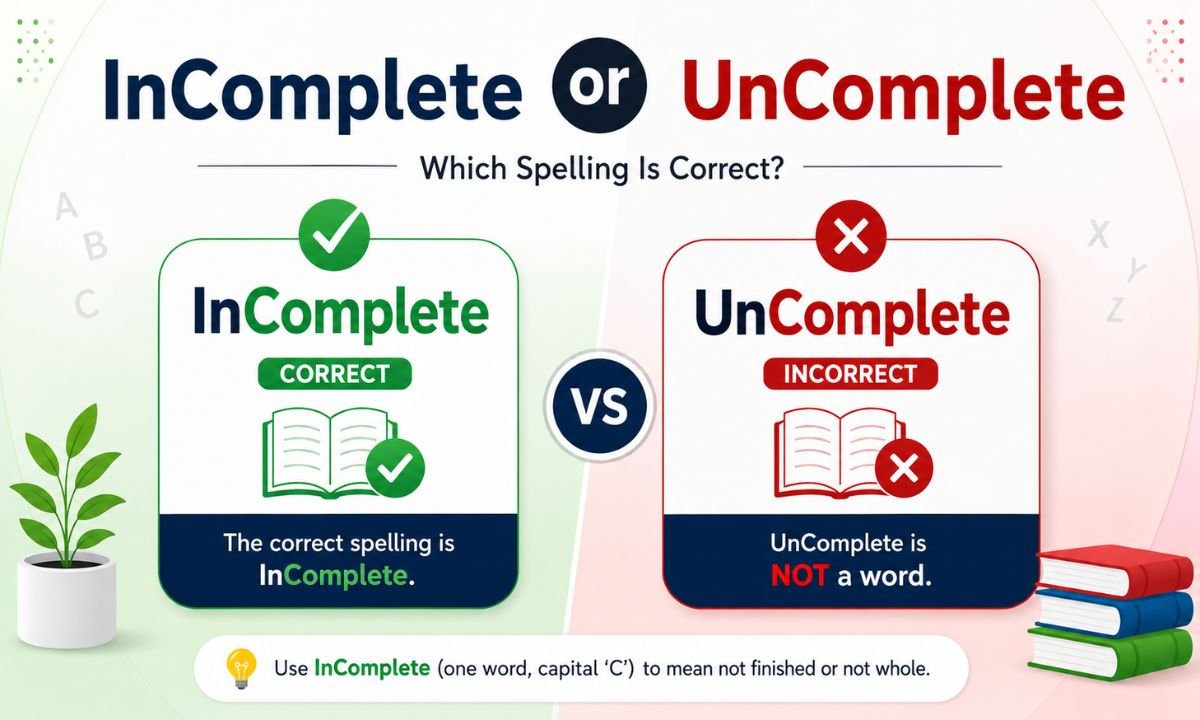
Every writer hits this wall at some point. You’re typing a sentence, you reach for the word that means “not finished,” and your fingers hover between two spellings: incomplete and uncomplete. Spell-check flags one of them. Your instinct tells you the other looks fine too. So which one actually belongs in your sentence?
The short answer is that “incomplete” is the word English speakers use. “Uncomplete” shows up occasionally, but it isn’t standard, and most editors, teachers, and grammar tools will mark it as wrong. This guide walks through why that’s the case, where the confusion comes from, and how to use “incomplete” correctly in every kind of writing — from a school essay to a business report.
Definition of “Incomplete” and “Uncomplete”
Incomplete is an adjective that describes something not finished, not whole, or missing one or more necessary parts. It applies to objects, documents, ideas, sets of information, and even people’s understanding of a topic. A form with a blank field is incomplete. A sentence missing a verb is incomplete. A data set with gaps is incomplete.
Uncomplete, by contrast, doesn’t have a settled place in modern dictionaries. Some historical texts used it centuries ago, and a handful of niche technical or poetic contexts still toy with it, but contemporary English speakers rarely produce it naturally. When people write “uncomplete,” they usually mean “incomplete” and have simply reached for the wrong prefix.
Here’s the distinction in plain terms:
| Word | Status | Typical Meaning | Recommended Use |
|---|---|---|---|
| Incomplete | Standard English | Missing parts, not finished, not whole | Always safe — formal and informal writing |
| Uncomplete | Nonstandard / rare | Attempted synonym for “not finished” | Avoid in nearly all writing |
| Uncompleted | Rare but grammatically valid | Not yet finished (verb-based) | Use sparingly; “incomplete” is usually smoother |
InComplete or UnComplete: Key Differences
The two words aren’t really fighting over meaning — they’re fighting over legitimacy. Both would, in theory, communicate “not complete.” But only one of them is recognized as proper English by dictionaries, style guides, and grammar checkers.
A few things separate them:
- Dictionary status: “Incomplete” appears in every major dictionary, including Merriam-Webster, Oxford, and Cambridge. “Uncomplete” typically does not appear as a headword, or appears only as an archaic variant.
- Frequency of use: “Incomplete” shows up constantly in books, news articles, academic papers, and everyday conversation. “Uncomplete” is a rarity — most native speakers never type it.
- Prefix logic: “In-” attaches naturally to Latin-rooted adjectives like complete, accurate, and visible. “Un-” typically pairs with Germanic-rooted verbs and participles, such as undo, untie, and unfinished.
- Reader perception: A reader who sees “uncomplete” pauses, even if only for a second, because the word looks unfamiliar. That pause interrupts the flow of your writing.
Why “Incomplete” Is the Correct Word
“Incomplete” earns its place in the language through centuries of consistent use. It follows a predictable pattern found across dozens of English adjectives that borrow the Latin negative prefix in-: inaccurate, inadequate, inconsistent, invisible, inactive. Complete itself comes from the Latin completus, so pairing it with in- fits the word’s own linguistic ancestry.
Beyond etymology, “incomplete” simply works. It’s short, familiar, and unambiguous. Teachers use it to mark unfinished assignments. Doctors use it to describe partial diagnoses. Engineers use it for unfinished builds. Because everyone already recognizes and expects this word, using it never distracts a reader from your message.
There’s also a practical argument: every grammar checker, from Microsoft Word to Grammarly, treats “incomplete” as correct without hesitation. That consistency across tools reflects a broader consensus among linguists and editors — this is the word the language has settled on.
Why “Uncomplete” Is Incorrect or Rare
“Uncomplete” isn’t a fabricated word exactly — it has popped up in older or regional texts — but it never became part of mainstream English. A few reasons explain why it never caught on:
- Redundant prefix pairing. English already had “incomplete” doing this job centuries before “uncomplete” could gain traction. Languages rarely keep two competing words for the same job once one wins out.
- Weak etymological fit. Since complete traces back to Latin, the Latin-style prefix in- fits more naturally than the Germanic un-.
- Lack of institutional support. Dictionaries, textbooks, and style guides never adopted it, so it was never taught in schools or reinforced through formal writing.
- Low exposure. Because native speakers rarely encounter “uncomplete” in books or media, they don’t internalize it as a real option, which keeps its usage rare.
So while “uncomplete” isn’t strictly impossible — language does allow unusual formations in creative or historical writing — it carries no authority in modern English. Using it in an email, essay, or report will likely read as a typo rather than a stylistic choice.
Common Mistakes and Confusions
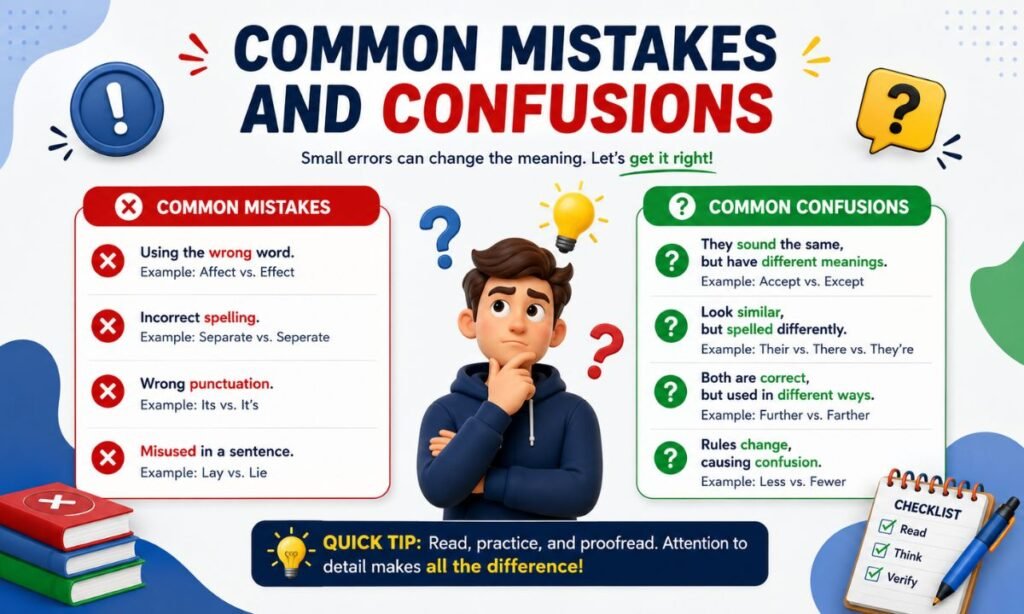
Confusion around this word pair tends to follow a few repeatable patterns. Recognizing them helps you catch the error before it reaches your reader.
- Assuming every “in-” word has an “un-” twin. Writers see pairs like unhappy/inhappy (only one works) and undo/indo (only one works) and wrongly generalize that both prefixes are interchangeable everywhere.
- Mixing up “incomplete” and “uncompleted.” These aren’t identical. “Incomplete” describes a state — something is missing pieces. “Uncompleted” leans toward an action not finished, like a race or a task. In most everyday writing, “incomplete” is still the smoother, more natural pick.
- Autocorrect gaps. Some devices and browsers don’t flag “uncomplete” immediately, especially in fast typing or voice-to-text situations, which lets the error slip through unnoticed.
- Non-native speaker patterns. Learners whose first language builds negatives with a single consistent prefix sometimes expect English to behave the same way, leading them to test “uncomplete” as a logical guess.
- Autocomplete and search habits. People frequently search “incomplete or uncomplete” simply because they’ve seen both forms somewhere online and want confirmation, which keeps the confusion circulating.
Examples of “Incomplete” in Sentences
Seeing the word in varied, realistic contexts helps cement correct usage.
- The construction crew left the building incomplete after the funding fell through, leaving scaffolding up for another year. (incomplete or uncompleted building)
- “She ran to the store” is a complete sentence, but “Because she ran to the store” is an incomplete sentence on its own, since it needs a main clause. (incomplete or uncomplete sentence)
- His medical file was incomplete, missing two years of lab results.
- The puzzle sat incomplete on the coffee table, three pieces still missing from the box.
- Her application was rejected because the form was incomplete.
- The novel remained incomplete at the time of the author’s death.
- The bridge repairs are still incomplete, and the detour signs remain in place.
A quick note on “uncompleted meaning”: it functions almost identically to “incomplete” but emphasizes an unfinished action rather than a missing part — think “uncompleted marathon” versus “incomplete puzzle.” Most style guides still recommend “incomplete” for general use because it reads more naturally in almost every context.
If you search incomplete or uncomplete on Reddit, you’ll find threads full of native and non-native speakers confirming the same thing: “incomplete” wins, and “uncomplete” gets flagged as odd or wrong nearly every time someone tries it in a sentence.
And if you’re hunting for an uncompleted synonym or an alternative to “incomplete” for variety in your writing, consider: unfinished, partial, deficient, lacking, fragmentary, or unresolved, depending on context.
Can “Uncomplete” Ever Be Used?
There are a few narrow situations where “uncomplete” appears without triggering an automatic red flag:
- Historical or archaic texts. Older writing, particularly from the 16th to 18th centuries, occasionally used “uncomplete” as a stylistic variant.
- Creative or poetic license. A novelist or poet might deliberately choose an unusual word for rhythm or tone, understanding readers will notice the deviation.
- Regional dialects. A handful of regional or non-standard dialects use “uncomplete” informally, though this doesn’t carry over into formal writing.
Outside of those cases, treat “uncomplete” as an error to correct, not a stylistic option to lean on. If your goal is clear, professional communication, “incomplete” is the only safe choice.
Linguistic Insight: Prefix “In-” vs “Un-“
English absorbed negative prefixes from two different language families, and that history explains most of the confusion.
- “In-“ comes largely from Latin and typically attaches to adjectives with Latin roots: incomplete, inaccurate, inadequate, inconsistent, invisible, insecure.
- “Un-“ comes from Old English and typically attaches to verbs, participles, and Germanic-rooted adjectives: undo, untie, unhappy, unfair, unfinished, unaware.
There’s no single rule that predicts which prefix a word will take — English vocabulary developed through centuries of borrowing, and usage settled unevenly. The only reliable method is familiarity: native speakers learn which prefix “sounds right” through repeated exposure, not through a formula. When in doubt, a quick dictionary check settles the question faster than trying to reason it out from prefix rules alone.
Expert Opinion on Correct Usage
Linguists and editors consistently point to usage frequency and dictionary recognition as the deciding factors in cases like this. A word doesn’t need to be logically “wrong” to be nonstandard — it just needs to fail to catch on among speakers and writers over time. “Incomplete” won that competition decisively centuries ago.
Professional editors apply a simple test: if a word would make a reader pause, reread, or question whether it’s a typo, it doesn’t belong in polished writing, regardless of whether a dictionary technically lists it somewhere. By that measure, “uncomplete” fails, and “incomplete” passes every time. Style guides from academic publishers to corporate communication manuals all point writers toward “incomplete” without exception.
Self-Assessment: Test Your Understanding
Try filling in the blank with the correct word before checking the answers below.
- Her essay was marked down for being ______.
- The ______ puzzle sat untouched for weeks.
- He submitted an ______ form and had to redo it.
- The building project remains ______ after the budget cuts.
- A sentence without a verb is considered ______.
Answers to Self-Assessment
- Incomplete
- Incomplete
- Incomplete
- Incomplete (or “uncompleted,” though “incomplete” reads more naturally)
- Incomplete
If you answered “incomplete” for all five, you’ve got the pattern down. Every one of these sentences calls for the standard word — there’s no situation here where “uncomplete” would be the better fit.
Frequently Asked Questions
Is uncomplete a real word in English
It has appeared historically, but it isn’t recognized as standard in modern dictionaries or everyday writing.
What is the correct word, incomplete or uncomplete
“Incomplete” is correct. Use it in all formal and informal writing.
Why do people say uncomplete instead of incomplete
They often assume every “in-” word has an “un-” equivalent, which isn’t true in English.
Can I use uncomplete in formal writing
No. Formal writing, academic papers, and professional documents should use “incomplete.”
What does incomplete mean in simple terms
It means something is missing parts or hasn’t been finished.
Are there other words like incomplete
Yes — unfinished, partial, deficient, and fragmentary all carry similar meanings.
How can I remember the correct word
Think of “complete” plus the Latin-style “in-,” the same pattern as inaccurate or invisible.
Is incomplete used in everyday conversation
Yes, it’s common in speech, writing, schoolwork, and professional communication alike.
Does incomplete have different meanings
Not really — it consistently means missing a part or not finished, across most contexts.
Why is learning this difference important
Using the correct word keeps your writing clear and avoids looking careless to readers.
How do dictionaries define incomplete
As an adjective meaning not complete, lacking necessary parts, or unfinished.
Can uncomplete ever be correct
Only in rare historical, poetic, or dialectal contexts — never in standard formal writing.
What prefix makes incomplete correct
The Latin-based prefix “in-,” meaning “not,” attached to “complete.”
Can incomplete be used in academic writing
Yes, it’s the standard and expected word in academic and professional contexts.
Is uncomplete considered archaic
Largely yes — its use is mostly limited to older or historical texts.
How to correct sentences with uncomplete
Simply replace “uncomplete” with “incomplete” wherever it appears.
Is incomplete a noun or adjective
It’s an adjective, describing a noun as unfinished or missing parts.
Can uncomplete cause confusion
Yes, it can make readers pause or assume a typo, weakening clarity.
Are there similar prefix mistakes
Yes — mix-ups like “irregardless” versus “regardless” follow the same pattern.
How to practice using incomplete correctly
Write sample sentences, read them aloud, and compare them against dictionary examples.
Conclusion
The debate over “incomplete or uncomplete” isn’t much of a debate once you look at how English actually works. “Incomplete” has centuries of consistent use, dictionary backing, and universal recognition behind it. “Uncomplete” survives only as a rare, largely historical variant that modern readers will likely mistake for an error.