
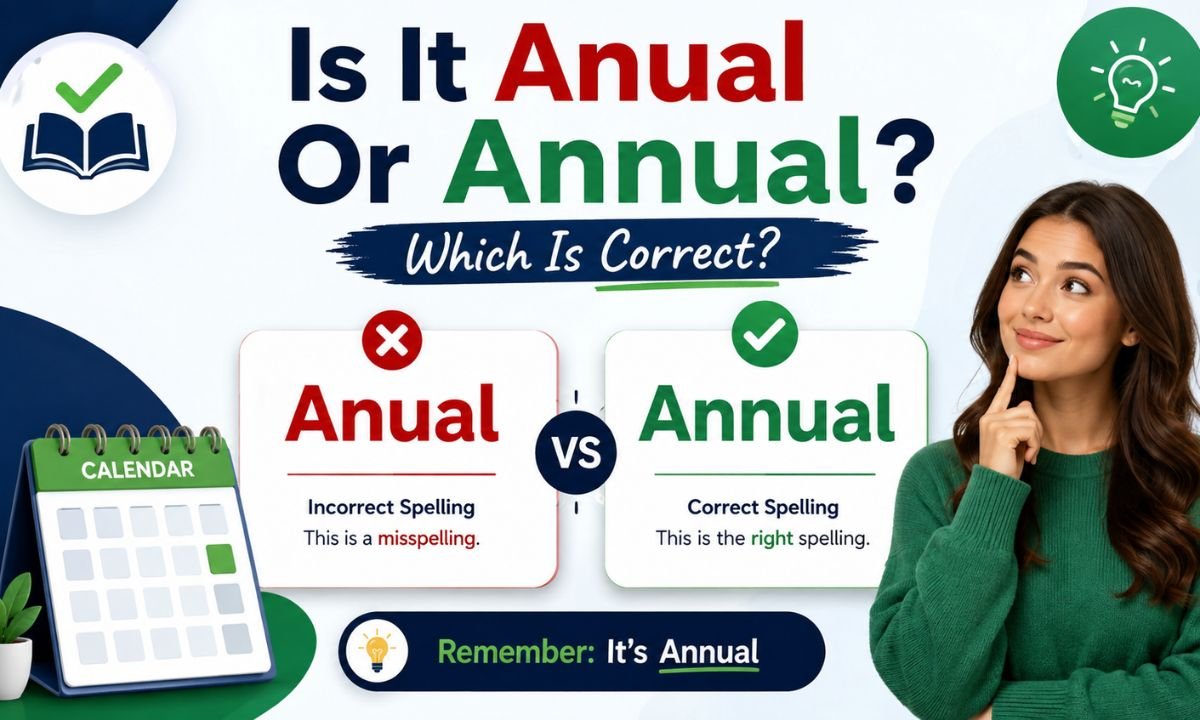
If you’ve ever typed “anual report” and watched a red squiggly line appear under it, you’re not imagining things. That word is wrong. The correct spelling is annual, with two n’s, and “anual” has no place in standard English.
This mix-up is more common than most people admit. It shows up in emails, school assignments, business reports, and social media posts. Part of the problem is pronunciation — the second “n” barely gets stressed when we say the word out loud, so it’s easy to drop when typing fast. Part of it is language crossover, since Spanish, Portuguese, and a few other languages spell the equivalent word with a single n.
Below, you’ll find a full breakdown of both spellings, why only one survives in English, and how to use “annual” correctly in real sentences.
Comparison Overview
| Feature | Anual | Annual |
|---|---|---|
| Correct in English | No | Yes |
| Part of speech | None (not a word) | Adjective, sometimes a noun |
| Meaning | No meaning in English | Happening once a year |
| Found in dictionaries | No | Yes |
| Common in | Spanish, Portuguese | English |
| Used in formal writing | Never | Always appropriate |
That table tells the whole story in one glance, but the reasoning behind it deserves a closer look.
Definition of Anual
“Anual” isn’t a recognized English word. Open any major English dictionary — Merriam-Webster, Oxford, Cambridge — and you won’t find an entry for it. It typically appears in writing for one of two reasons:
- A typing slip, where the writer meant to type “annual” but skipped a letter.
- Interference from another language, since “anual” is the correct spelling of the same concept in Spanish and Portuguese.
If you’re a bilingual writer, or if you learned Spanish before English, this mix-up makes complete sense. Your brain already has a working spelling stored for the concept of “yearly,” and it just happens to belong to a different language.
Definition of Annual
“Annual” is an adjective that describes something happening once a year, every year, or related to a twelve-month cycle. It comes from the Latin word annus, meaning “year,” by way of the Old French annuel.
Annual can also work as a noun in a narrower sense — referring to a publication or plant that completes its cycle within one year. A school annual (yearbook) and an annual flower (one that blooms and dies within a single growing season) both use this secondary meaning.
Typical contexts where you’ll see “annual” at work:
- Business: annual report, annual revenue, annual budget
- Events: annual conference, annual festival, annual gala
- Personal life: annual checkup, annual leave, annual salary
- Gardening and science: annual plant, annual rainfall
Main Differences Between Anual and Annual
The gap between these two words isn’t about tone or formality — it’s about whether the word exists at all in English. Here’s the breakdown:
- Legitimacy — Annual is a standard English word; anual is not.
- Origin — Annual traces back through Old French to Latin annus. Anual belongs to Spanish and Portuguese, not English.
- Usage — Annual appears in dictionaries, style guides, academic writing, and everyday speech. Anual appears almost exclusively as an error.
- Impact on credibility — Using “anual” in professional or academic writing signals a lack of proofreading, which can undercut an otherwise strong document.
You May Like: Inter Vs Intra: The Complete Guide to Two Prefixes That Trip Up Even Careful Writers
Spelling Rules Behind Annual
English kept the double n from the Latin root annus, and that pattern shows up across a whole family of related words: annually, annuity, anniversary, annum. Once you notice the pattern, the second n stops feeling optional.
A simple way to lock it in: say the word slowly and deliberately as “an-nu-al,” giving the n sound a bit of extra weight in your head even though you wouldn’t do that out loud. Writers who struggle with this spelling often benefit from linking it to a word they already spell correctly, like “anniversary,” which shares the same double-n root.
Grammar Guide
How each term is used in sentences
Since “anual” isn’t a real word, it never has a grammatical role — it’s simply an error wherever it appears. “Annual,” on the other hand, functions primarily as an adjective placed before a noun.
- Correct: The team celebrates its annual anniversary dinner every June.
- Incorrect: The team celebrates its anual anniversary dinner every June.
Worth noting: “annual” and “annal” are not the same word, even though they look close. An annal (usually used in the plural, “annals”) refers to a historical record of events, year by year — as in “the annals of medical history.” “Annual” describes frequency; “annal” describes a record or chronicle.
Common mistakes learners make
- Dropping the second n because it’s barely audible in speech.
- Confusing annual with biannual (twice a year) or biennial (once every two years).
- Mixing up annual with annal, especially in academic or historical writing.
- Assuming British and American English differ here — they don’t. Every English-speaking region spells it “annual.”
Simple rules to remember
- If it happens every year, the word is annual.
- Annual always carries two n’s, matching its Latin root annus.
- Anual belongs to Spanish and Portuguese — not English.
- When typing quickly, slow down on double letters; they’re where most errors happen.
Quick tips for writing and speaking

Read your sentence back before hitting send, especially in reports or emails where “annual” appears near the start. Spell-check tools catch most instances of “anual,” but they occasionally miss it inside compound phrases or unusual formatting, so don’t rely on software alone. If you’re prone to this error, add “annual” to a personal list of words you double-check by habit.
When to Use Each One
Use annual whenever you’re describing something that repeats once a year — a report, a checkup, a payment, a festival, a subscription renewal. It fits formal writing, casual conversation, business documents, and academic papers equally well.
There is no situation where “anual” is the right choice in English. If you’re writing in Spanish or Portuguese, “anual” is correct there, but the moment you switch to English, the second n comes back.
When NOT to Use Each One
Don’t use “anual” in any English-language context — formal, informal, spoken, or written. It will read as a typo or a spelling error every time.
Don’t use “annual” when you mean something happening twice a year (biannual or semiannual) or every two years (biennial). These related words get mixed up almost as often as anual and annual do, so it’s worth pausing to confirm which frequency you actually mean before you commit to a word.
You May Like: Hoodie or Hoody: Which Spelling Is Actually Correct?
Which One to Use (Decision Guide)
Ask yourself these questions in order:
- Am I writing in English? If yes, the word must be “annual.” There’s no exception.
- Does the thing I’m describing happen once every year? If yes, “annual” is the correct adjective.
- Am I referring to a record of past events organized by year? If yes, you likely want “annals,” not “annual.”
- Am I unsure whether I mean once a year or twice a year? Check the frequency before finalizing your word choice — annual, biannual, and biennial are not interchangeable.
Real-World Practical Examples
Anual Examples
None of these are correct — they’re included only to show what to avoid:
- ❌ We host an anual charity dinner every fall.
- ❌ The company’s anual revenue grew by 12 percent.
- ❌ Please submit your anual tax documents by April.
Annual Examples
- ✔️ We host an annual charity dinner every fall.
- ✔️ The company’s annual revenue grew by 12 percent.
- ✔️ Please submit your annual tax documents by April.
- ✔️ Her annual salary increased after the promotion.
- ✔️ The museum’s annual exhibit opens next week.
- ✔️ Employees receive twenty days of annual leave.
Self-Assessment (Fill in the Blanks)
Try filling in each blank with either “anual” or “annual”:
- The board meets for its _______ review every January.
- My gym offers a discount on _______ memberships.
- The historian studied the _______s of the ancient kingdom. (Hint: this one isn’t either word.)
- Her doctor recommended an _______ physical exam.
- The festival has become an _______ tradition in the town.
Answers
- Annual
- Annual
- Annals (a related but different word — not annual or anual)
- Annual
- Annual
Frequently Asked Questions
How do you spell “anual”?
“Anual” isn’t a correct English spelling at all — it’s a common misspelling of “annual,” which is the only accepted form in English.
Does annual mean yearly?
Yes. “Annual” means happening once a year or relating to a full year, making it interchangeable with “yearly” in most contexts.
What is the meaning of anual?
“Anual” has no meaning in English; it’s simply an error for “annual.” In Spanish and Portuguese, however, “anual” is the correct word for “yearly.”
Is annual spelled with one, n or two?
Two. “Annual” always takes a double n, reflecting its Latin root annus, meaning “year.”
Conclusion
The rule here doesn’t get more complicated the more you study it annual is correct, anual is not, and that holds true across every English-speaking region and every level of formality.
The confusion usually comes down to speed typing or a language crossover, not a genuine gap in the rules. Once the double n becomes automatic, this is one spelling mistake you won’t have to think about again.