
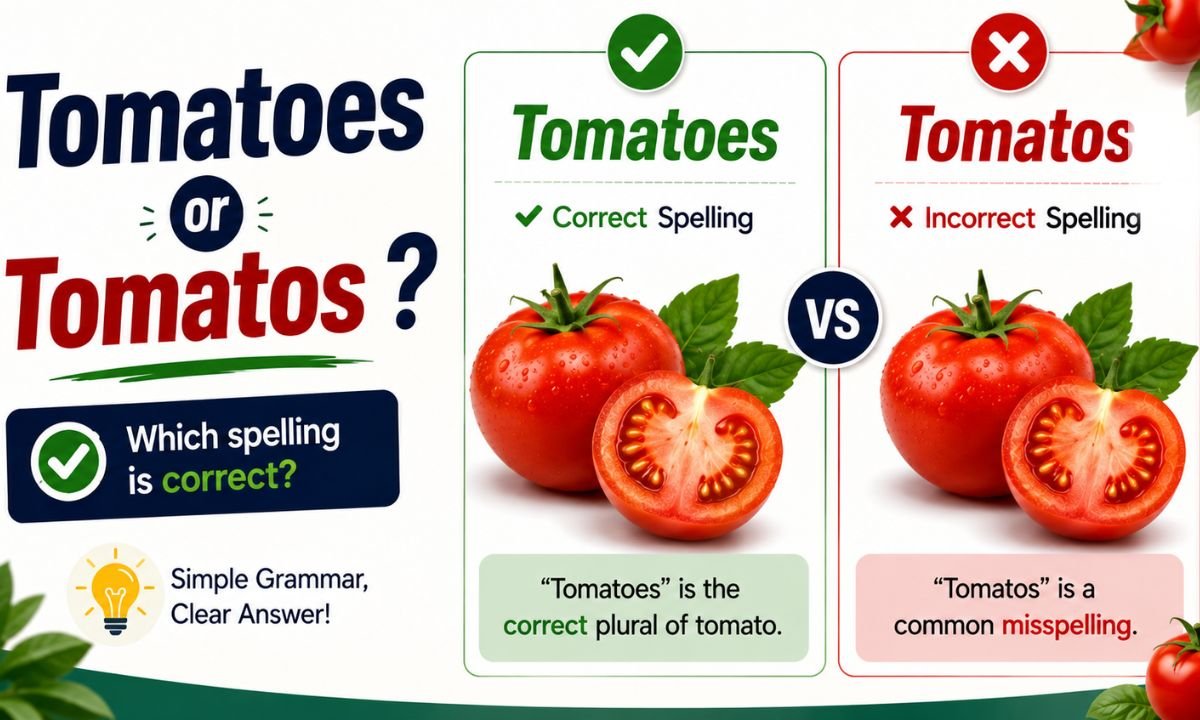
If you’ve ever typed “tomatos” into a text message, then stared at it wondering why it looks wrong, you’re not alone. This is one of the most Googled spelling questions in English, and the answer is shorter than you’d expect. Only one of these two words belongs in a dictionary. The other is a spelling mistake that happens to be extremely common.
This guide settles the question for good. You’ll get the grammar rule, the history behind it, real sentence examples, a comparison table, a short quiz to test yourself, and answers to the questions people ask most often about this word.
Comparison Overview
Before going deep into grammar rules, here’s the short version for anyone in a hurry.
“Tomatoes” is the correct, dictionary-approved plural of “tomato.” “Tomatos” is not a word. It’s a spelling error, usually caused by forgetting that certain English nouns ending in a consonant plus “o” take an “-es” ending instead of a simple “-s.”
Both American and British English agree on this. There’s no regional variation, no informal exception, and no context where “tomatos” becomes acceptable — not in a text message, not in a recipe blog, not in a school essay.
| Feature | Tomatoes | Tomatos |
|---|---|---|
| Status | Correct standard spelling | Common misspelling |
| Dictionary listed | Yes (Merriam-Webster, Oxford, Cambridge) | No |
| Used in US English | Yes | No |
| Used in UK English | Yes | No |
| Appropriate for formal writing | Yes | Never |
| Grammar rule followed | Consonant + “o” → add “-es” | Rule broken (missing “e”) |
Definition of Tomatoes
“Tomatoes” is the plural form of the noun “tomato,” a soft, round, red or yellow fruit that grows on a vine and is treated as a vegetable in cooking. Botanically, a tomato is a fruit because it develops from a flower and holds seeds. In the kitchen, most people call it a vegetable, since it’s usually served in salads, sauces, and savory dishes rather than desserts.
The word traces back to the Nahuatl word “tomatl,” used by the Aztecs long before European contact. Spanish colonizers adapted it into “tomate,” and English later borrowed the term and reshaped it into “tomato.” When English needed a plural, it followed a pattern common to other loanwords ending in a consonant plus “o,” landing on “tomatoes.”
You’ll see this word constantly in gardening articles, cookbooks, grocery lists, and everyday conversation. A gardener might say their tomatoes are ripening in July. A chef might list tomatoes as a key ingredient in a pasta sauce. In every one of these cases, “tomatoes” is the only spelling that fits.
Definition of Tomatos
There isn’t really a definition here, because “tomatos” isn’t a recognized English word. It doesn’t appear in Merriam-Webster, Oxford, Cambridge, or Collins. Spell-checkers flag it. Style guides don’t mention it except to warn against it.
The confusion is understandable, though. English pluralization has two competing patterns for nouns ending in “o”:
- Some add only “-s”: photo → photos, piano → pianos, kilo → kilos
- Some add “-es”: tomato → tomatoes, potato → potatoes, hero → heroes
Since “photos” and “pianos” are so common, plenty of writers assume every “o” word follows that same shortcut. Tomato happens to sit in the smaller, “-es” group, which is exactly why the mistake shows up so often — on menus, in text messages, and occasionally even in print.
If you’ve typed “tomatos” before, it wasn’t a sign of poor English skills. It was a reasonable guess based on a different, equally real spelling pattern. It’s just the wrong pattern for this particular word.
Main Differences Between Tomatoes and Tomatos
The core difference isn’t about meaning, tone, or region. It’s purely a matter of correct versus incorrect spelling.
- “Tomatoes” follows the standard English rule for nouns ending in a consonant + “o.”
- “Tomatos” drops the required “e,” breaking that rule.
- “Tomatoes” is accepted everywhere: academic papers, business writing, casual chats, recipes, and marketing copy.
- “Tomatos” is accepted nowhere as standard spelling, though it shows up frequently as a typo.
- Dictionaries list only “tomatoes.” None list “tomatos” as a valid variant, the way some list “echoes” and “echos” side by side.
You May Like: Hoodie or Hoody: Which Spelling Is Actually Correct?
Comparison Table
| Category | Tomatoes | Tomatos |
|---|---|---|
| Grammatical correctness | Correct | Incorrect |
| Dictionary status | Standard entry | Not listed |
| Regional acceptance (US/UK) | Accepted in both | Accepted in neither |
| Common usage | Recipes, gardening, retail, writing | Typing errors, casual typos |
| Formal writing | Required form | Should never appear |
| Search behavior | What people should type | What people often type by mistake |
Grammar Guide
English plurals aren’t as tidy as they look. Most nouns simply add “s” (cat → cats), but nouns ending in “o” split into two camps, and there’s no single formula that predicts which camp a word falls into. You mostly learn it by memorizing common examples.
Nouns ending in “o” that take “-es”: tomato → tomatoes, potato → potatoes, hero → heroes, echo → echoes, volcano → volcanoes (also volcanos, accepted as a minor variant)
Nouns ending in “o” that take only “-s”: photo → photos, piano → pianos, kilo → kilos, video → videos, logo → logos
Tomato sits firmly in the first group, alongside potato — which is worth remembering, since the two words rhyme and follow the exact same rule. If you can spell “potatoes” correctly, you already know how to spell “tomatoes.”
Tomatoes or tomatos UK
British English and American English don’t disagree here. Both use “tomatoes” as the only correct plural. The pronunciation of the singular word differs between the two — British speakers generally say “toh-MAH-toh,” while American speakers say “toh-MAY-toh” — but the spelling of the plural stays identical on both sides of the Atlantic.
Tomatoes or tomatos slang
“Tomatos” isn’t slang, and it isn’t an informal but accepted variant the way some casual contractions are. It’s simply a spelling error. Slang usually carries its own intentional identity — think “gonna” or “y’all.” “Tomatos” doesn’t function that way; it’s just tomatoes missing a letter.
Tomatoes or tomatos pronunciation
Spelling and pronunciation are separate issues here. Whether you say “tuh-MAY-toh” or “tuh-MAH-toh,” the written plural is still spelled “tomatoes.” Pronunciation differences don’t change spelling rules in this case.
Tomatoes or tomatos US
American English follows the same standard as British English: “tomatoes” is correct in every register, from casual texting to formal reports. US dictionaries such as Merriam-Webster list only “tomatoes.”
Plural of potato and tomato in English
Both words follow the identical pattern. Potato becomes potatoes, and tomato becomes tomatoes. Neither drops the “e” in standard English, and neither has “potatos” or “tomatos” as an accepted dictionary variant.
Tomatoes tomatos meaning
Both terms point to the same fruit-vegetable when people use them, but only “tomatoes” is the linguistically correct way to express that meaning in writing. “Tomatos” carries no separate meaning of its own — it’s simply an error that readers will interpret as “tomatoes” anyway, just with reduced credibility for the writer.
Tomato plural
To sum up the core grammar point in one line: the plural of “tomato” is “tomatoes,” formed by adding “-es” rather than a plain “-s.”
How each term is used in sentences
Tomatoes, used correctly:
- “I added diced tomatoes to the chili.”
- “Cherry tomatoes are sweeter than beefsteak tomatoes.”
- “The farmers market had crates of fresh tomatoes.”
Tomatos, only ever an error:
- “I added diced tomatos to the chili.” ❌
- “The farmers market had crates of fresh tomatos.” ❌
There’s no sentence where swapping in “tomatos” improves clarity, tone, or accuracy. It only introduces a mistake.
Common mistakes learners make
- Assuming every noun ending in “o” just adds “s,” based on words like photos or pianos.
- Autocorrect occasionally not catching the error, especially on older devices or in fast typing.
- Confusing pronunciation differences (British vs. American) with spelling differences, which don’t actually exist here.
- Writing “tomato’s” to mean more than one tomato, which is a separate mistake — that apostrophe form should only show possession, as in “the tomato’s skin.”
Simple rules to remember
- If a word rhymes with “potato” or “tomato,” it likely takes “-es” in the plural.
- When in doubt, check whether the singular ends in a consonant + “o.” Many (not all) of those words take “-es.”
- Run a quick spell-check before publishing anything — this particular typo is one spell-checkers catch reliably.
Quick tips for writing and speaking
- Say the word slowly and picture the spelling: to-MAY-toes. The rhythm can help you remember the “e.”
- Pair it mentally with potatoes; they’re pluralized the same way, and most people already spell potatoes correctly.
- If you’re proofreading, search your document for “tomatos” specifically before submitting or publishing.
When to Use Each One
Use “tomatoes” any time you’re referring to more than one tomato, in any context: recipes, gardening advice, grocery lists, essays, emails, product descriptions, or casual conversation. It’s the only correct choice, so there’s no scenario where you need to weigh it against an alternative.
There is no legitimate scenario for using “tomatos.” It should never appear in a finished piece of writing.
You May Like: Inter Vs Intra: The Complete Guide to Two Prefixes That Trip Up Even Careful Writers
When NOT to Use Each One
Don’t use “tomatos” anywhere — not in professional documents, not in marketing materials, not in social media captions, and not in casual texts if you want to be spelled correctly. Misspelling common food words can quietly undercut trust in a restaurant menu, a recipe blog, or a business listing, since readers notice small errors even when they don’t say anything.
Don’t second-guess “tomatoes” either. Some writers, after learning that a few “o” words only take “-s,” start doubting whether “tomatoes” needs the “e.” It does, every time.
Which One to Use (Decision Guide)
Here’s a simple way to decide, even if grammar isn’t your strong suit:
- Are you writing about more than one tomato? If yes, write “tomatoes.”
- Are you unsure how to spell it? Think of “potatoes” — same pattern, same ending.
- Does your sentence contain “tomatos”? Add the missing “e” before you hit send or publish.
That’s the entire decision tree. There’s no branching path, no exception to weigh, and no regional variant to consider.
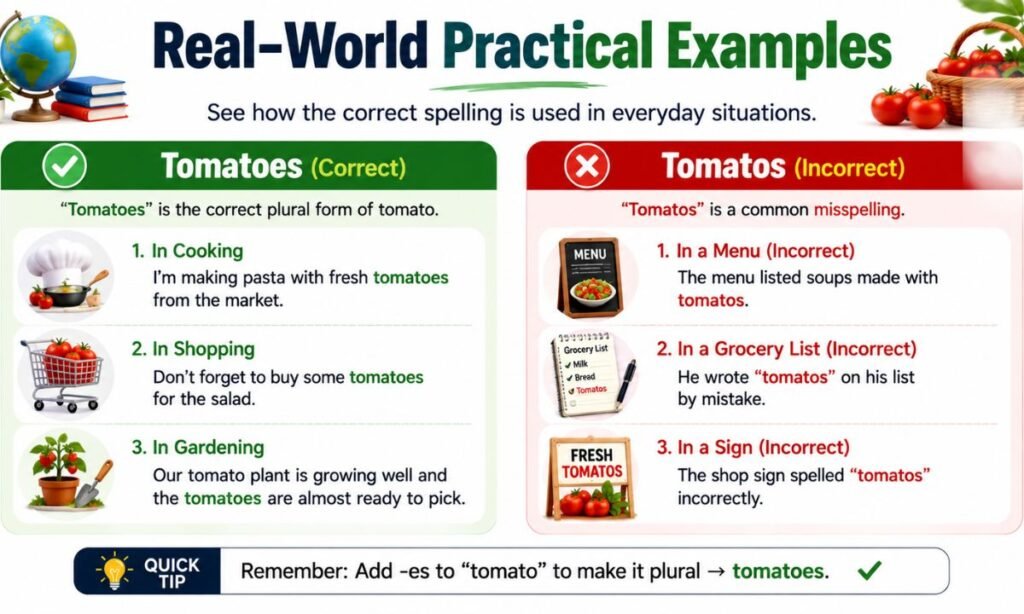
Real-World Practical Examples
Tomatoes Examples
- “The recipe calls for two cups of chopped tomatoes.”
- “My grandmother grows heirloom tomatoes every summer.”
- “The soup was made with roasted tomatoes and basil.”
- “Tomatoes are one of the most widely grown crops in home gardens.”
- “The salad had cucumbers, onions, and sliced tomatoes.”
Tomatos Examples
There are no valid examples, because the spelling is incorrect. The only place you’ll find “tomatos” is in typos, informal texts, or drafts that haven’t been proofread — such as “I need to buy tomatos” instead of the correct “I need to buy tomatoes.”
Self-Assessment (Fill in the Blanks)
Test what you’ve learned. Fill in each blank with either “tomatoes” or “tomatos.”
- I bought a bag of ripe _______ at the market.
- The plural of tomato is always spelled _______.
- She sliced the _______ for the sandwich.
- My uncle grows _______ in his backyard garden.
- The sauce needs three more _______ before it thickens.
- Autocorrect fixed my typo of “_______” back to the correct spelling.
- Fresh _______ taste better than canned ones.
- The farmer sold crates of _______ at the roadside stand.
Answers
- Tomatoes
- Tomatoes
- Tomatoes
- Tomatoes
- Tomatoes
- Tomatos (the only blank referring to the misspelled version itself)
- Tomatoes
- Tomatoes
If you got most of these right, the rule has already stuck: “tomato” always becomes “tomatoes” in the plural, no exceptions.
Frequently Asked Questions
What is correct, tomatos or tomatoes?
“Tomatoes” is correct. “Tomatos” is a misspelling and isn’t recognized by any standard dictionary.
Is it potatos or potatoes?
“Potatoes” is correct, following the same “-es” pattern as tomatoes. “Potatos” is incorrect.
Which is correct, tomato or tomatoe?
The singular is “tomato,” with no final “e.” The “e” only appears in the plural, “tomatoes.”
How do Americans spell tomatoes?
Americans spell it “tomatoes,” the same as British English. Pronunciation differs between the two, but the spelling doesn’t.
Conclusion
The debate between tomatoes and tomatos isn’t really a debate at all. “Tomatoes” is the correct, dictionary-recognized plural in both American and British English, while “tomatos” is a common but avoidable spelling mistake.
The confusion comes from English’s inconsistent rules for pluralizing words that end in “o,” but once you link tomato with potato — both taking the “-es” ending — the correct spelling becomes easy to remember for good.