
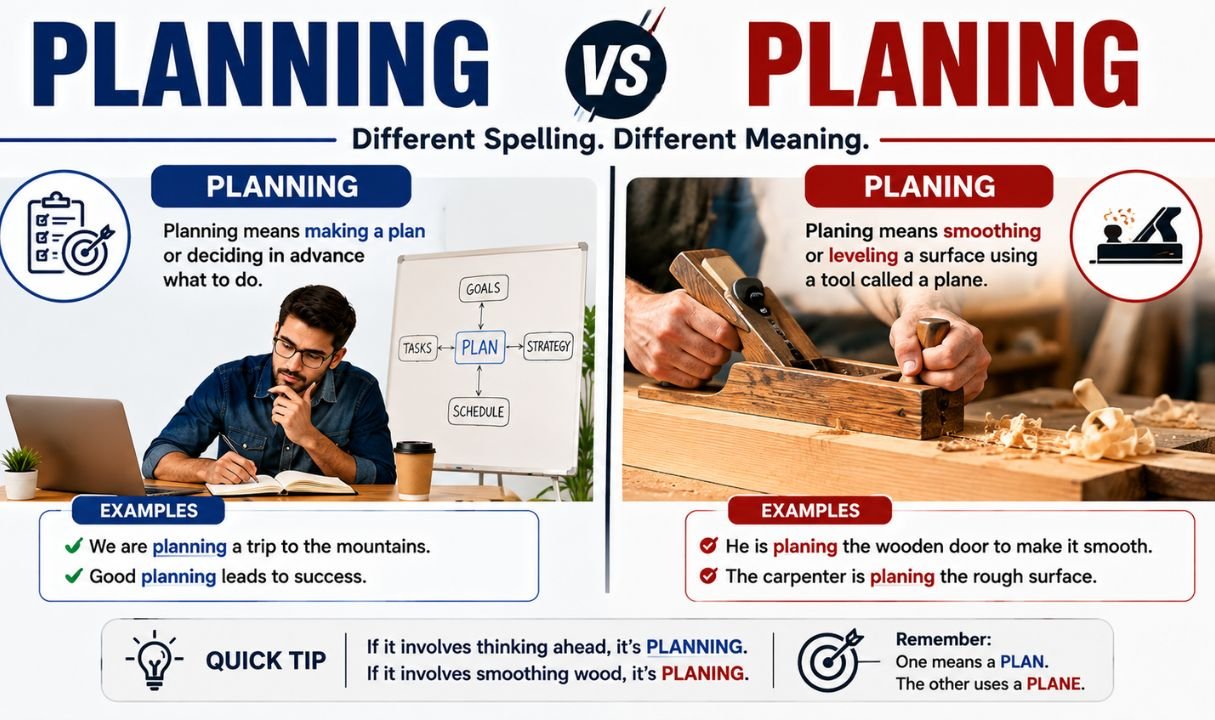
One extra letter. That’s all that separates two English words with almost nothing in common. Mix them up in an email to your boss, and you might accidentally tell her you’re sanding down a table instead of scheduling the quarterly budget review.
This guide breaks down exactly where planning and planing part ways, why so many writers swap them by accident, and how to keep them straight for good.
Quick Answer
Planning means preparing, organizing, or arranging something for the future — a trip, a business strategy, a birthday party. Planing means smoothing or shaving down a surface, almost always wood, using a tool called a plane. Same root sound, completely different jobs.
Examples
- She spent the weekend planning her sister’s baby shower.
- The carpenter is planing the tabletop to remove rough edges.
Planning vs Planing Meaning
1. Planning
Planning is the noun and gerund form of “to plan.” It describes the mental work of deciding what needs to happen and when: setting goals, mapping out steps, and preparing for something before it occurs. You’ll hear it in business meetings, school assignments, travel talk, and everyday conversation.
2. Planing
Planing comes from a completely different verb: “to plane.” It refers to using a hand plane or an electric planer to shave a thin layer off a surface, usually wood, so that it becomes smooth and level. Boats can also “plane” across water, skimming the surface rather than plowing through it, which is where the aviation and marine sense of the word comes from.
Examples
| Word | Sentence |
|---|---|
| Planning | The city council is planning a new park downtown. |
| Planing | He’s planing the door so it stops sticking in the frame. |
Planning vs Planing Difference
The gap between these two words isn’t about grammar — it’s about subject matter entirely. Planning belongs to the world of ideas, schedules, and strategy. Planing belongs to the world of tools, wood shavings, and physical surfaces.
Key Point
If you can replace the word with “preparing” or “organizing” and the sentence still makes sense, you need planning. If you can replace it with “smoothing” or “shaving down,” you need planing.
You May Also Like: Laying or Lying? The Simple Rule That Ends the Confusion for Good
Grammar Rule Depth
English doubles a final consonant when adding “-ing” to keep the vowel sound short. Plan has a short A sound, so it becomes planning. Plane already ends in a silent E, so that E simply drops before “-ing,” leaving one N: planing.
Planning
Plan (short vowel) → double the N → planning.
Examples
- We are planning next year’s marketing budget.
- Their planning paid off when the launch went smoothly.
Planing
Plane (silent E, long vowel) → drop the E, keep single N → planing.
Examples
- The mill is planing lumber for the new flooring order.
- Planing removes just a few millimeters at a time.
Why People Confuse Planning and Planing
Similar Spelling
Both words start with the same six letters. At a glance, especially in a hurry, the brain fills in the version it sees most often — which is usually “planning.”
Similar Pronunciation
Say them out loud and the difference is subtle. Many non-native speakers, and plenty of native ones, don’t hear the missing consonant clearly enough to catch the error while typing.
Lack of Awareness
Most people learn “planning” early in school and rarely encounter “planing” outside a workshop or a dentist’s office (root planing is a real dental term). When a rare word looks like a common one, the common word usually wins by default.
Typing Errors
Fast typing, autocorrect, and muscle memory all conspire against the second N. A missed keystroke is often the whole story.
The Origin of Planning and Planing
Planning Origin
Planning traces back to the noun “plan,” borrowed from French, which itself came from a word meaning a flat drawing or map. Over centuries, English speakers extended it to mean any organized scheme for the future, then added “-ing” to describe the ongoing act of making one.
Planing Origin
Planing comes from “plane,” the woodworking tool, which entered English from Old French and ultimately from Latin roots tied to flatness. A plane makes a rough surface flat, so “planing” describes exactly that action.
Planning in Everyday English
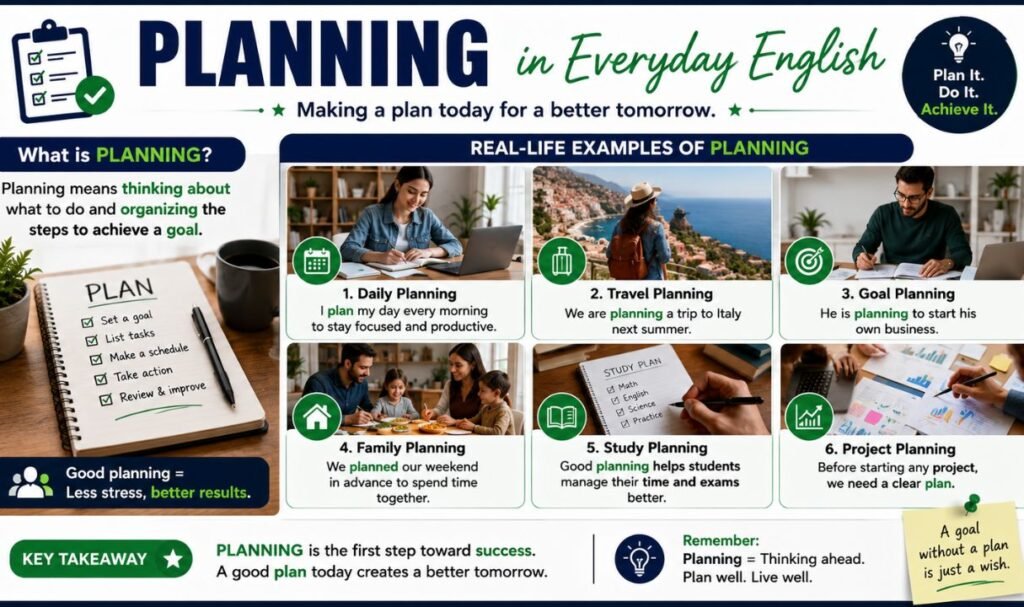
Personal Planning
This covers anything you organize in your own life — finances, health goals, holidays, or daily routines.
Examples
- I’m planning to start jogging three times a week.
- Financial planning early in your career makes a real difference later.
Business Planning
Companies use planning constantly, from quarterly forecasts to product launches.
Examples
- The team is planning a rebrand for next quarter.
- Strategic planning sessions happen every January.
Academic Planning
Students and educators plan lessons, semesters, and study schedules. Academic advisors often build entire careers around helping learners with course planning and long-term degree planning.
Planing in Technical Contexts
Woodworking
This is where planing lives most of the time. Carpenters plane rough boards to make them smooth and uniform before finishing.
Examples
- The joiner spent an hour planing the oak panel by hand.
- Planing too aggressively can remove more wood than intended.
Manufacturing
Industrial planing machines shape metal and wood components at scale, producing flat, even surfaces for parts that need to fit together precisely.
Examples
- The factory uses a planing machine to finish steel plates.
- Planing tolerances in manufacturing are measured in fractions of a millimeter.
Aviation Meaning
In boats and seaplanes, “planing” describes skimming across the surface of water once enough speed is reached, rather than pushing through it.
Example
- Once the speedboat hit planing speed, the ride smoothed out considerably.
Planning vs Planing in Professional Writing
Getting this wrong in a formal document can look careless, even if the reader understands what you meant.
Incorrect Example
“We are currently planing the new product rollout.”
Correct Version
“We are currently planning the new product rollout.”
Why It Matters
A single dropped letter can distract a reader, undercut your credibility, or in rare cases, genuinely confuse the meaning of a sentence. Proofreading catches this fast, but spell-checkers often miss it since both words are spelled correctly on their own — just for different meanings.
Planning vs Planing in Emails
Correct Examples
- “I’m planning to send the report by Friday.”
- “Let’s start planning the client presentation this week.”
Incorrect Examples
- “I’m planing to send the report by Friday.” (should be planning)
- “We need to start planing the roadmap.” (should be planning, unless you’re literally shaping wood)
Planning vs Planing in Social Media
Correct Usage
Casual posts about trips, events, or goals should always use planning: “Planning my next getaway already 🌴.”
Technical Usage
Woodworkers and craftspeople use planing correctly and often, especially in hashtags and captions showing their process: “Spent the afternoon planing this walnut slab.”
You May Also Like: Tying vs Tieing: Learn the Correct Spelling in Minutes
Planning vs Planing in News Writing
Examples
Business and government articles rely heavily on planning: city planning departments, planning permission, and economic planning are all standard phrases in journalism.
Example
A local paper might write: “The planning commission approved the new housing development on Tuesday,” never “planing commission,” which would be a factual and grammatical error.
Common Mistakes with Planning vs Planing
Mistake 1: Using Planing Instead of Planning
The most frequent error. Almost always a simple typo, not a knowledge gap.
Mistake 2: Forgetting the Double N
Writers who know the rule still sometimes rush and drop a letter, especially on mobile keyboards.
Mistake 3: Confusing Technical and General Meaning
Some writers assume planing is just an informal or shortened version of planning. It isn’t — the two describe entirely different activities.
Related Words and Expressions
Planning Related Words
Planner, plan, planned, unplanned, replanning, planning permission, family planning, city planning.
Planing Related Words
Plane, planer, planed, hand plane, electric planer, root planing, planing mill.
Real World Examples of Planning
Business Example
A startup founder planning a Series A funding round spends months preparing pitch decks and financial projections.
Travel Example
A family planning a two-week trip to Italy books flights, hotels, and museum tickets months in advance.
Education Example
A teacher planning next semester’s curriculum maps out units, assessments, and reading lists over the summer.
Event Example
A wedding planner spends a full year planning venues, catering, and guest logistics for a single event.
Real World Examples of Planing
Carpentry Example
A furniture maker planing a walnut tabletop removes thin layers until the surface feels perfectly smooth to the touch.
Construction Example
A crew planing floor joists ensures every board sits flush before the flooring goes down.
Manufacturing Example
A factory planing sheet metal components prepares parts for precise assembly on the production line.
Which Word Should You Use
Use Planning When
- You’re organizing an event, trip, or project
- You’re setting goals or making schedules
- You’re discussing strategy in business or government
Examples
- The board is planning next year’s budget.
- She’s planning a career change.
Use Planing When
- You’re working with wood, metal, or another surface
- You’re describing a boat or seaplane skimming water
- You’re discussing dental root planing
Examples
- He’s planing the edges of the shelf.
- The boat began planing across the lake.
Memory Trick for Planning vs Planing
Planning Has Double N
Think “next steps need planning” — two N’s, two ideas: preparing now for something later.
Planing Has One N
Think “one pass of the plane” — a single tool, a single N, shaving wood smooth.
Planning vs Planing Usage Trends
Search and usage data consistently show planning appearing far more often than planing across everyday writing, since preparation and scheduling come up constantly in work, school, and personal life. Planing stays common but narrow, concentrated in woodworking forums, construction sites, and dental care content.
Comparison Table
| Feature | Planning | Planing |
|---|---|---|
| Spelling | Double N | Single N |
| Root word | Plan | Plane |
| Meaning | Preparing, organizing | Smoothing a surface |
| Common field | Business, personal life, education | Woodworking, manufacturing, boating |
| Frequency | Very common | Rare, technical |
| Example | Planning a wedding | Planing a wooden door |
Planning Idioms and Expressions
Planning Ahead
Refers to preparing well before something is needed, such as saving money before a big purchase.
Strategic Planning
A structured process organizations use to set long-term goals and decide how to reach them.
Financial Planning
Managing income, savings, and investments with future needs in mind.
Planing Tools and Equipment
Hand Plane
A manual tool with a sharp blade used to shave thin layers off wood by hand.
Electric Planer
A powered version of the hand plane, used for faster, more consistent results on larger surfaces.
Industrial Planing Machines
Large-scale equipment used in factories to flatten and finish wood or metal stock at high volume.
Why Correct Spelling Matters
A single missing letter can shift a sentence from a business update to a woodworking note. In professional writing, that kind of slip can make a message harder to trust, even when the reader eventually figures out what was meant. Getting it right, every time, takes the guesswork out of your writing and keeps your message clear.
Exercises
Exercise 1: Choose the Correct Word
- We are ______ a company retreat next month. (planning/planing)
- He spent the afternoon ______ the wooden bench. (planning/planing)
- Their vacation ______ started three months in advance. (planning/planing)
- The dentist recommended root ______ for gum health. (planning/planing)
Exercise 2: Correct the Sentence
- “She is planing her thesis defense.” → She is planning her thesis defense.
- “The team spent hours planning the wood for the deck.” → The team spent hours planing the wood for the deck.
Frequently Asked Questions
What is correct, planing or planning?
Both are correct words, but they mean different things — planning means preparing, while planing means smoothing a surface.
How to remember planned vs planed?
Planned (double N) relates to preparation; planed (single N) relates to shaving wood smooth with a plane.
What does planing mean?
Planing means using a tool called a plane to smooth or shave down a surface, usually wood.
Are planning or are planing?
Neither is standard grammar on its own — the correct question form is usually “Are you planning…?” for preparation, or “Are you planing…?” only when discussing woodworking.
Conclusion
Planning and planing look almost identical, but they belong to entirely different worlds one lives in calendars and strategy meetings, the other in sawdust and wood shavings. Remembering the double N for preparation and the single N for smoothing surfaces is enough to avoid the mix-up for good. Next time your fingers rush ahead of your brain, pause for half a second and check which world your sentence belongs to.