
You’ve typed a sentence, stopped at that little hyphen, and asked yourself: does this need a dash or not? You’re not alone. “In-person” and “in person” trip up writers constantly, and the mistake shows up everywhere from job postings to college essays to company emails.
The good news is that the rule behind these two forms is short, stable, and easy to apply once you see the pattern. This guide breaks it down with plain examples, a comparison table, common mistakes, and a quiz so you can test what you’ve learned.
What Is the Difference Between In-Person and In Person?
Quick Answer
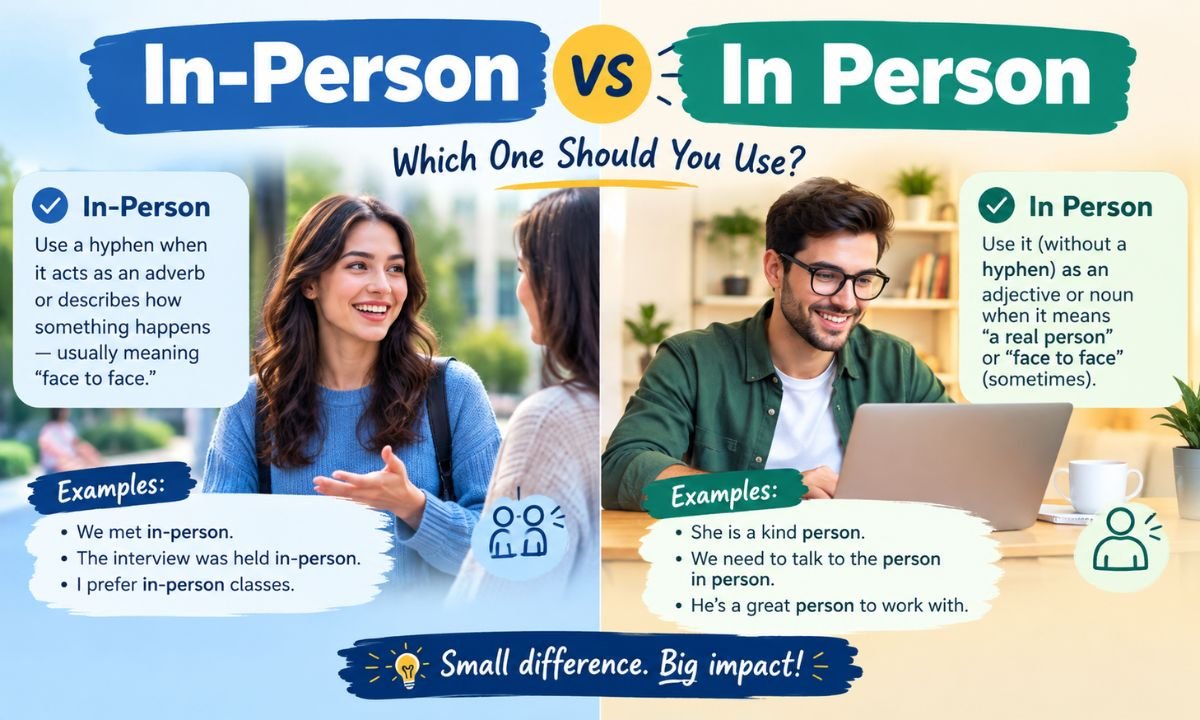
“In-person” (hyphenated) is an adjective. It sits before a noun and describes what kind of thing you’re talking about, like an in-person interview or an in-person class.
“In person” (two words, no hyphen) is an adverbial phrase. It comes after a verb and describes how an action happens, as in “She signed the contract in person.”
Why the Difference Matters
A missing or misplaced hyphen won’t stop someone from understanding you, but it does change how polished your writing looks. Resumes, business emails, and academic papers get read by people who notice these small details. A recruiter scanning a cover letter, an editor reviewing a manuscript, or a teacher grading an essay will catch it if “in person meeting” shows up without its hyphen, or if “the meeting was held in-person” carries one it doesn’t need.
Grammar accuracy also affects machine-read content. Style checkers, grammar plugins, and even search engines parse compound modifiers, so getting this right supports both readability and consistency across your writing.
Featured Snippet Answer
In-person is a hyphenated compound adjective used before a noun (an in-person event). In person is a two-word adverbial phrase used after a verb to describe how something is done (we met in person). The hyphen appears only when the phrase directly modifies a noun.
Understanding “In-Person” as an Adjective
When to Use In-Person
Use the hyphenated form whenever the phrase sits directly in front of a noun and answers the question “what kind?” This is the same pattern you see in other compound adjectives like “full-time job,” “high-quality service,” or “long-term plan.” The words team up to modify a single noun, and the hyphen shows the reader they belong together.
Whenever you can swap in a single-word adjective and the sentence still makes sense structurally, you’re probably looking at an adjective slot, and that’s where the hyphen belongs.
Example Sentences
- The company switched back to in-person meetings this quarter.
- She prefers in-person interviews over video calls.
- Our college offers both online and in-person classes.
- The in-person workshop filled up within a day.
- He signed up for an in-person training session.
Common Pattern
Notice that in every example above, “in-person” sits right before a noun: meetings, interviews, classes, workshop, session. That noun is the thing being described, and the hyphenated phrase tells you what type of thing it is. If you can point to the noun immediately after the phrase, hyphenate it.
Understanding “In Person” as an Adverbial Phrase
When to Use In Person
Use the two-word, unhyphenated form when the phrase describes how, where, or in what manner an action takes place, and it typically follows a verb. Think of it the same way you’d think of adverbs like “quickly” or “carefully.” “In person” tells you the manner in which something was done: face-to-face, physically present, not by phone or screen.
Example Sentences
- I’d rather explain this in person.
- He apologized in person instead of texting.
- Please pick up your certificate in person.
- We finally met in person after months of video calls.
- She delivered the news in person.
Common Pattern
In each sentence, “in person” follows a verb: explain, apologized, pick up, met, delivered. It’s answering “how” the action happened, not describing a noun. No noun sits directly after it needing modification, so no hyphen is required.
In-Person vs In Person: Side-by-Side Comparison
| Feature | In-Person | In Person |
|---|---|---|
| Part of speech | Compound adjective | Adverbial phrase |
| Position in sentence | Before a noun | After a verb |
| Function | Describes a noun | Describes an action |
| Hyphen | Yes | No |
| Example | an in-person appointment | met her in person |
| Question it answers | What kind? | How? |
Memory Trick
Ask yourself one question: is there a noun sitting right after this phrase? If yes, hyphenate it. If the phrase is describing an action and comes after a verb instead, leave the hyphen out. Some writers find it useful to substitute “face-to-face” into the sentence; if it reads naturally in that spot without needing a following noun, you’re dealing with the adverbial form.
Real-Life Example: How Businesses Use These Terms
Companies run into this distinction constantly in customer-facing writing. A retail chain announcing a return to physical operations might title a blog post “Our In-Person Shopping Experience Is Back,” using the hyphenated adjective because “experience” is the noun being described.
The same company, writing customer support copy, might say, “You can also return items in person at any store location,” where “in person” follows the verb “return” and describes how the action can be completed.
Universities do this too. A course catalog lists “in-person sections” and “online sections” side by side as adjectives describing class types. But the registration instructions might read, “Students must confirm attendance in person during orientation week,” where the phrase modifies the verb “confirm.”
HR departments run into the same split in job postings: “in-person interview process” as a noun modifier, followed later by “candidates will be evaluated in person” as a verb modifier, sometimes in the very same document.
Usage Trends and Language Data (2025–2026)
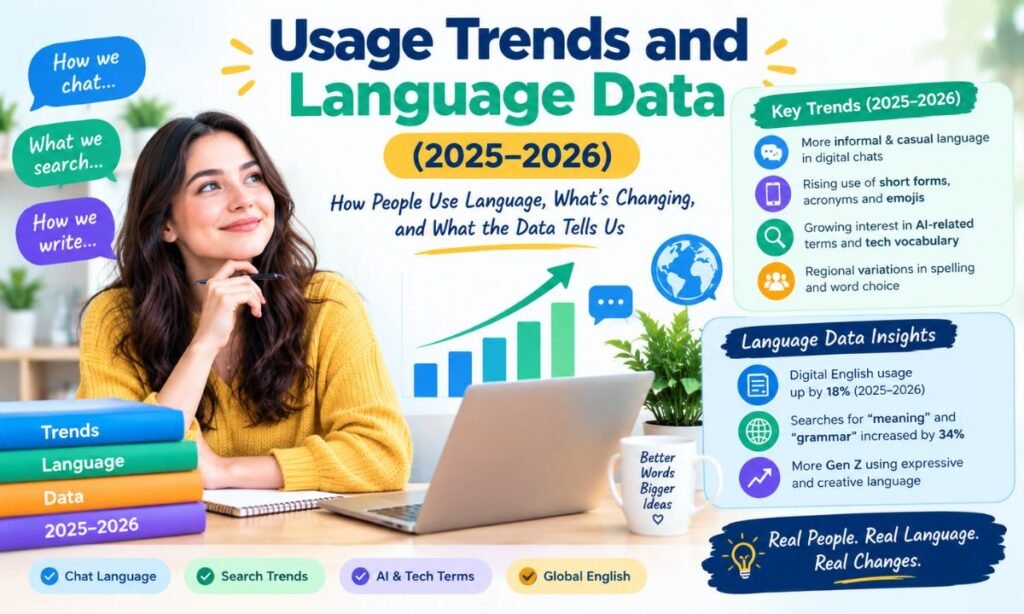
Remote and hybrid work reshaped how often these terms appear in everyday writing. Before 2020, “in person” was mostly reserved for describing meetings, interviews, and social encounters. Since then, both forms have surged in frequency across business communication, education, healthcare, and government writing, largely because organizations now need to explicitly distinguish physical activities from remote or virtual ones.
Style guides including the AP Stylebook and Chicago Manual of Style continue to support hyphenating compound modifiers before nouns, which keeps “in-person” as the standard adjective form. Meanwhile, corpus data from published news and business writing shows “in person” as an adverbial phrase remains the more frequently used variant overall, since actions described in the manner sense come up more often in casual and conversational writing than noun-modifying constructions.
Why This Matters
This shift means more writers are producing content where both forms appear in the same paragraph, sometimes the same sentence, which raises the stakes for getting the hyphen right. Automated grammar tools and AI writing assistants have also gotten better at flagging this specific error, so search engines and readers alike now treat correct hyphenation as a baseline signal of careful, professional writing.
Common Mistakes Writers Make
Mistake 1: Using In Person Before a Noun
Writing “an in person meeting” without the hyphen leaves the compound adjective incomplete. Readers briefly stumble because the two words don’t visually signal that they’re working together to modify “meeting.” Correct version: an in-person meeting.
Mistake 2: Using In-Person After a Verb
Writing “we met in-person last week” inserts a hyphen where none belongs, since the phrase is describing how the meeting happened, not modifying a noun. Correct version: we met in person last week.
Mistake 3: Hyphenating Everything
Some writers assume hyphenating the phrase everywhere is the safer bet. It isn’t. Overhyphenating creates the same confusion as underhyphenating, and it signals uncertainty rather than caution. The rule is positional, not optional.
Mistake 4: Mixing Formal and Informal Usage
Formal documents like contracts, academic papers, and press releases should follow the noun-versus-verb rule strictly. Casual writing such as texts or social captions is more forgiving, but consistency within a single piece of writing still matters. Switching between “in-person” and “in person” incorrectly within the same document reads as careless rather than casual.
How to Remember the Rule Every Time
Use “In-Person” If:
- A noun immediately follows the phrase
- You’re describing a type of meeting, class, event, interview, or session
- You could replace it with another compound adjective like “virtual” or “remote” in the same slot
Use “In Person” If:
- The phrase follows a verb
- You’re describing how, not what kind
- You could replace it with “face-to-face” and the sentence still flows the same way
One-Sentence Formula
If it’s followed by a noun, hyphenate it; if it’s following a verb, leave the hyphen out.
Mini Quiz: In-Person vs In Person
Test yourself with these fifteen quick questions. Answers appear after each one.
Quiz 1: Which One Describes a Noun?
Is “in-person” or “in person” the one that functions as an adjective before a noun? Answer: In-person.
Quiz 2: Fill in the Blank
“The office resumed ___ operations this week.” (in-person / in person) Answer: in-person.
Quiz 3: Quick Choice
Choose the correct form: “I’d like to discuss this ___.” (in-person / in person) Answer: in person.
Quiz 4: Fill in the Blank
“She attended the ___ session on Tuesday.” (in-person / in person) Answer: in-person.
Quiz 5: True or False
“In person” always requires a hyphen. True or False? Answer: False.
Quiz 6: Fill in the Blank
“He prefers to apologize ___ rather than by email.” (in-person / in person) Answer: in person.
Quiz 7: Spot the Correct Sentence
Which is correct: “We had an in person conversation” or “We had an in-person conversation”? Answer: We had an in-person conversation.
Quiz 8: Fill in the Blank
“Please submit the form ___ at the front desk.” (in-person / in person) Answer: in person.
Quiz 9: Grammar Check
In the phrase “in-person workshop,” what part of speech is “in-person”? Answer: Adjective.
Quiz 10: Fill in the Blank
“The university still offers ___ classes alongside online ones.” (in-person / in person) Answer: in-person.
Quiz 11: What Does It Describe?
In “she voted in person,” what does “in person” describe? Answer: The verb “voted” — it explains how the action was done.
Quiz 12: Fill in the Blank
“Candidates will complete the final round ___.” (in-person / in person) Answer: in person.
Quiz 13: Choose the Right Form
“The company is hosting an ___ event next month.” (in-person / in person) Answer: in-person.
Quiz 14: Quick Rule Test
If a phrase comes right before a noun, should you hyphenate it? Answer: Yes.
Quiz 15: Final Challenge
Correct this sentence: “We finally met in-person after two years of texting.” Answer: We finally met in person after two years of texting.
Frequently Asked Questions
Is in-person class hyphenated?
Yes. “In-person” modifies the noun “class,” so it takes a hyphen, as in “in-person class.”
Which is correct: “in person” or “in-person”?
Both are correct depending on context. Use “in-person” before a noun and “in person” after a verb.
Is “in person” a hyphen?
No. “In person” is written as two separate words without a hyphen when it functions as an adverbial phrase.
Does “in person” mean face to face?
Yes. “In person” means being physically present with someone rather than communicating remotely or online.
Conclusion
The hyphen between “in” and “person” isn’t decoration. It’s a signal that tells your reader exactly how the phrase is working in your sentence. Before a noun, it earns its hyphen as a compound adjective. After a verb, it drops the hyphen and works as an adverbial phrase describing manner.
Once you start checking for that noun-or-verb pattern, the choice becomes automatic. Read your sentence back, ask what the phrase is doing, and let that answer decide the hyphen for you.