
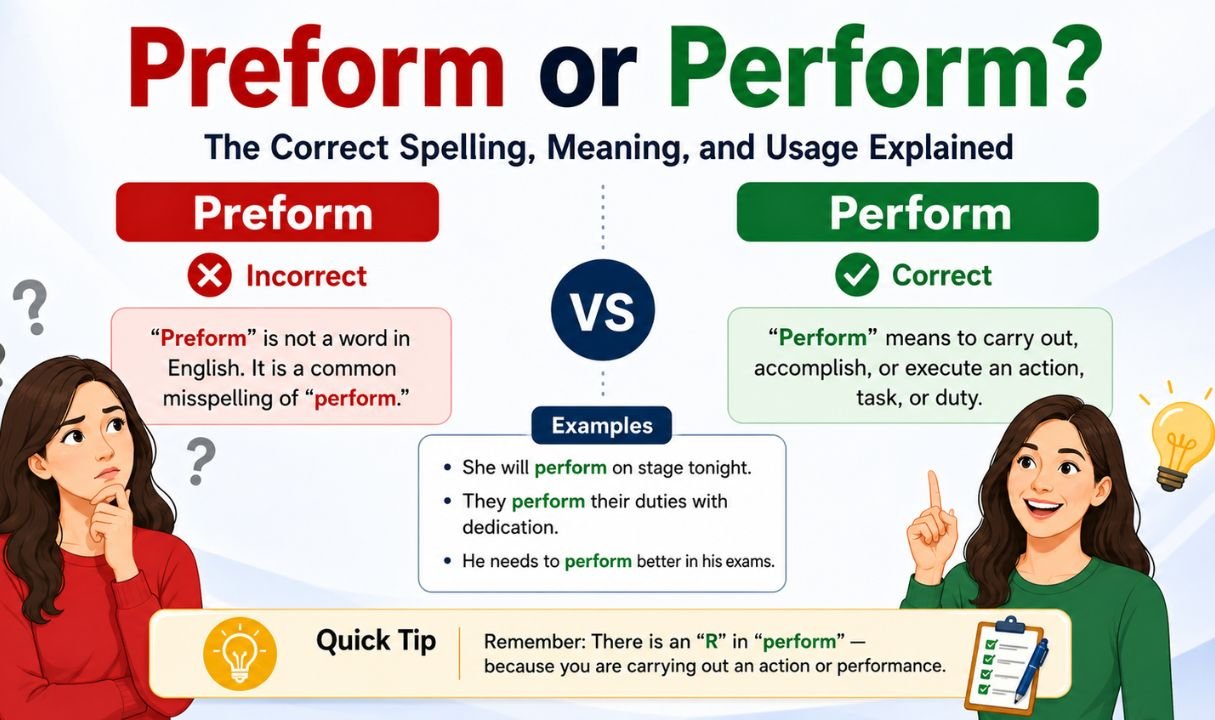
Perform is the word you almost always want. It means to carry out, execute, or display a task, skill, or duty. Preform is a rare technical term meaning to shape something in advance, mostly used in manufacturing and engineering.
Preform or Perform: Quick Answer
If you’re writing about doing a task, a job, a surgery, music, or any kind of action, use perform. If you’re writing about molding raw material into a rough shape before a final process, use preform. Ninety-nine percent of everyday writing needs “perform.”
| Word | Core Meaning | Common Field |
|---|---|---|
| Perform | To carry out an action or task | Everyday, business, arts |
| Preform | To shape something beforehand | Manufacturing, engineering |
Simple Examples
- She will perform the song at tonight’s concert.
- The surgeon will perform the operation on Monday.
- The factory preforms the plastic before molding it into bottles.
- Engineers preform metal components before welding them together.
Notice the pattern. Every “perform” example involves a live action happening now. Every “preform” example involves shaping raw material ahead of a later step.
Important Note
Preform is a real word, but it belongs to a narrow world. Outside manufacturing, engineering, and materials science, you will rarely need it. If you’re unsure which word fits your sentence, “perform” is correct roughly nineteen times out of twenty.
You May Also Like: Infact or In Fact? The Correct Way to Write It (With Examples)
Grammar Rules Explained Clearly
Perform Meaning and Rule
Perform traces back to Old French, built from a root meaning “through” combined with a word for “to furnish or complete.” That origin still shapes how it works today: performing means seeing an action through to completion. It functions as a transitive verb, meaning it takes a direct object, as in “perform a task” or “perform surgery.”
Its forms follow regular verb rules: perform, performs, performed, performing. The noun form is performance, and the person doing the action is a performer. These derived words show up constantly in reviews, job descriptions, and everyday speech.
Preform Meaning and Rule
Preform combines the Latin prefix “pre-,” meaning before, with “form,” meaning to shape. Put together, it literally means to shape in advance. It also follows regular verb conjugation: preform, preforms, preformed, preforming.
Unlike perform, preform doubles as a noun. In plastics manufacturing, a “preform” is the small tube-shaped piece of plastic that later gets blown into a bottle. This dual role as noun and verb is one reason the word confuses writers who only know it from context.
Why People Confuse Preform or Perform
Similar Spelling
The two words differ by exactly one letter: “e” versus “re” isn’t even the issue, it’s “per” versus “pre.” Because the letters p, r, and e appear in both, the eye can easily skip past the swap, especially when reading quickly.
Typing Mistakes
Fast typists sometimes transpose letters without noticing. “Perform” becomes “preform” through a simple slip of the fingers, and because both are real words, spell check won’t flag the error.
Lack of Word Familiarity
Most readers encounter “perform” daily but rarely see “preform” outside technical documents. That imbalance means many writers assume “preform” is simply a misspelling, when it’s actually a legitimate, separate word with its own meaning.
Autocorrect Issues
Autocorrect tools sometimes “fix” preform into perform, or vice versa, based on frequency data rather than context. If you write about manufacturing but your phone assumes you meant the common word, it can quietly introduce an error.
Phonetic Similarity
Spoken quickly, “per” and “pre” sound close enough that dictation software and casual speech can blur them. This phonetic overlap adds to the written confusion, particularly for non-native English speakers.
Deep Grammar Breakdown of Perform
Verb Forms of Perform
| Tense | Form |
|---|---|
| Base | perform |
| Third person singular | performs |
| Past | performed |
| Past participle | performed |
| Present participle | performing |
Perform as an Action Verb
Perform describes an action in progress or completed, never a static state. It pairs naturally with adverbs describing quality, such as “perform brilliantly” or “perform poorly,” which is one reason it dominates reviews and performance evaluations.
Collocations With Perform
Certain word pairings appear constantly with perform. Recognizing them helps you use the word naturally instead of forcing it.
- Perform a task
- Perform a duty
- Perform surgery
- Perform well or poorly
- Perform under pressure
- Perform a function
Real-World Usage of Perform
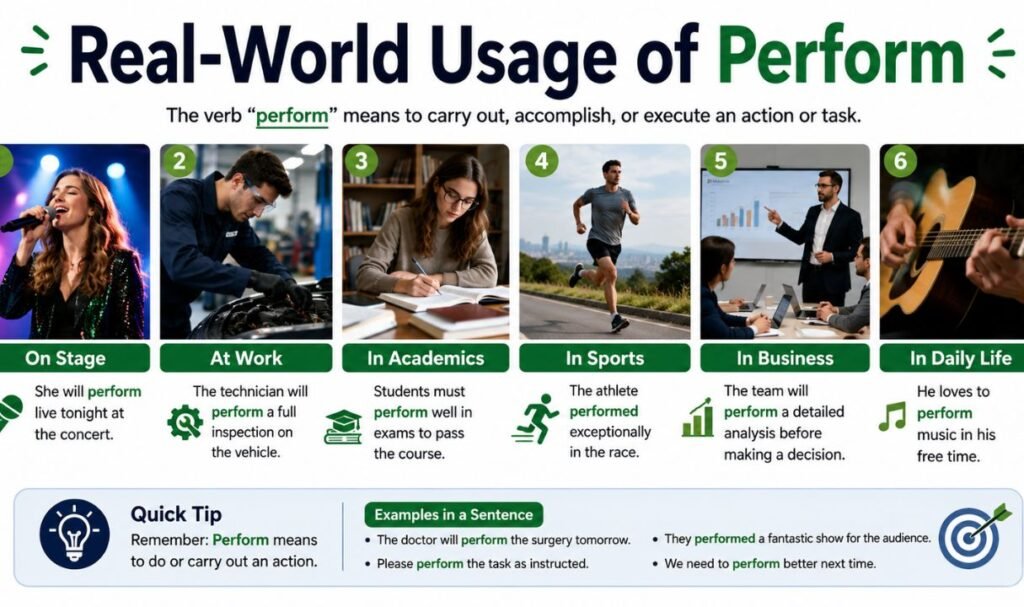
In Education
Teachers ask students to perform presentations, and schools track how classes perform on standardized tests. The word covers both live demonstration and measurable results.
In Healthcare
Doctors perform exams, procedures, and surgeries. This is one of the highest-stakes uses of the word, since a single letter swap to “preform” would be factually wrong and confusing in a medical record.
In Music and Entertainment
Musicians, actors, and dancers perform for audiences. This is the most familiar use of the word, tied directly to live artistic expression.
In Business
Companies track how a product or employee performs against targets. Performance reviews, quarterly performance, and performance metrics all stem from this core meaning.
In Technology
Software and hardware perform functions, and engineers benchmark how a system performs under load. Here the word describes operational behavior rather than human action.
Real-World Usage of Preform
In Manufacturing
Plastic bottle production is the clearest example. Factories preform small plastic tubes, which are later heated and blown into full-sized bottles. This two-step process improves consistency and speeds up mass production.
In Engineering
Engineers sometimes preform metal or composite materials into a rough shape before final machining, welding, or assembly. The preformed piece saves time and material waste during the final production stage.
Common Mistakes and Corrections
| Incorrect | Correct | Why |
|---|---|---|
| She will preform the song. | She will perform the song. | Singing is an action, not shaping material. |
| The team preformed well this quarter. | The team performed well this quarter. | Business results use “perform.” |
| The doctor will preform the surgery. | The doctor will perform the surgery. | Surgery is an action verb context. |
| The factory performs the plastic tubes. | The factory preforms the plastic tubes. | Manufacturing context needs “preform.” |
How to Remember the Difference
Think of the prefix “per-” as meaning “through,” as in following an action all the way through to the end. Think of “pre-” as meaning “before,” as in shaping something before its final stage. If your sentence describes doing something now, reach for perform. If it describes preparing material ahead of time, reach for preform.
You May Also Like: Training vs Trainning: Which Spelling Is Actually Correct
Preform or Perform in Academic and Professional Writing
Academic and business writing almost always calls for perform. Research papers discuss how variables perform under conditions, and reports describe how teams or systems performed. Preform only belongs in technical writing tied to manufacturing, materials science, or engineering documentation, so most professionals will never need to use it.
Related Word Confusions
Preform and perform aren’t alone. English has several near-identical word pairs that trip up even experienced writers, usually because a single prefix or letter changes the meaning entirely.
- Precede vs proceed: come before versus move forward
- Prescribe vs proscribe: recommend versus forbid
- Preposition vs proposition: a grammar term versus a suggestion or offer
Practice Exercises
Fill in the Blanks
- The engineer will ___ the metal before shaping it further.
- The band will ___ live at the festival this summer.
- Employees must ___ their duties on schedule.
- The factory ___ the plastic before molding it.
Choose the Correct Word
- The surgeon will (preform / perform) the transplant tomorrow.
- Workers (preform / perform) the rubber molds before curing them.
- The choir will (preform / perform) at the ceremony.
Advanced Examples for Clarity
Business Context
The sales team performed above target for the third straight quarter, and leadership credited the new incentive structure for the jump in results.
Sports Context
The sprinter performed her best time of the season in the final heat, shaving nearly half a second off her previous personal record.
Technical Context
Before final assembly, technicians preform the composite panels into a curved shape that matches the aircraft’s fuselage design.
Frequently Asked Questions
When should you use preform vs perform?
Use perform for any action, task, or display of skill. Use preform only when describing shaping material in advance, typically in manufacturing or engineering.
What does preform mean?
Preform means to shape or mold something before its final production stage. It can also work as a noun for the pre-shaped object itself.
What does perform mean?
Perform means to carry out, execute, or display a task, action, or skill. It’s the word used across everyday, professional, and artistic contexts.
Is “preform” or “performing” correct?
Neither word is automatically wrong, but they mean different things. “Performing” is the present participle of perform and fits actions in progress, such as “she is performing tonight.”
Is preform a word?
Yes. Preform is a legitimate English word, though it’s uncommon outside technical and industrial writing.
Conclusion
The choice between these two words comes down to one question: is something being done, or is something being shaped in advance? Perform covers almost every situation you’ll write about, from surgery to sales to singing on stage. Preform stays in its lane, describing raw material molded before a final production step.
Keep the prefixes in mind and the mix-up disappears. “Per-” means through, matching an action carried out to completion. “Pre-” means before, matching material prepared ahead of time. Once that distinction clicks, you’ll never second-guess which word belongs in your sentence again.