
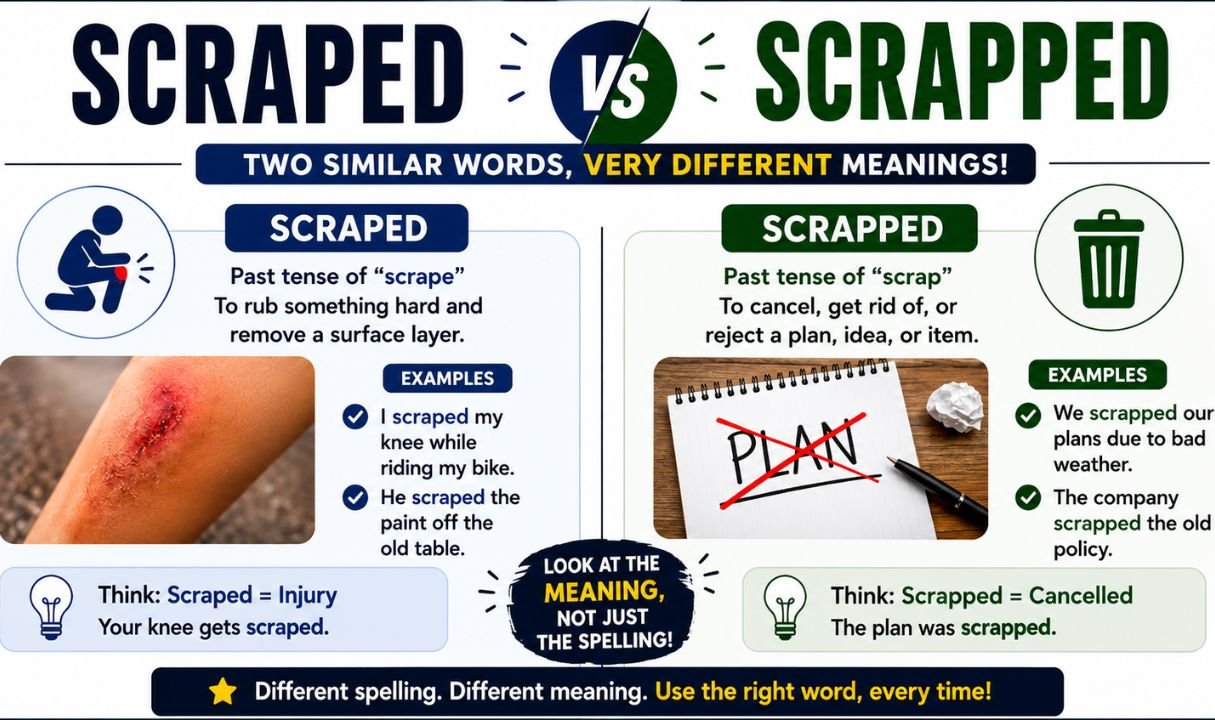
Scraped means something was removed, gathered, or rubbed from a surface, while scrapped means something was canceled, discarded, or thrown away entirely. One extra “p” is the only thing separating a grazed knee from a canceled project.
Quick Answer
- Scraped = past tense of scrape: to rub, remove, or collect by friction
- Scrapped = past tense of scrap: to cancel, discard, or abandon
Quick examples:
- He scraped the ice off his windshield before driving to work.
- The airline scrapped the route after two years of losses.
What Scraped Means
Scraped comes from the verb scrape, and it describes physical contact against a surface. Something is dragged, rubbed, or pulled across another surface, and material comes off in the process. This applies to skin, paint, ice, mud, and even digital information.
Examples:
- She scraped the burnt rice from the bottom of the pot.
- He fell off his bike and scraped his elbow.
- The tool automatically scraped prices from dozens of retail sites.
- We scraped through the exam with a passing grade, barely.
That last example shows a common extension of the word. Scraped through means someone barely managed to succeed, with no room to spare.
What Scrapped Means
Scrapped comes from the verb scrap, and it describes a decision rather than a physical motion. Something is judged not worth keeping, so it gets canceled, junked, or pulled from use. This covers projects, products, vehicles, policies, and plans.
Examples:
- The board scrapped the merger after the numbers fell apart.
- They scrapped the old car for parts.
- The airline scrapped three routes due to low demand.
- Engineers scrapped the prototype after it failed safety testing.
One meaning that most guides skip: scrapped can also describe a minor physical fight or scuffle, as in “the two kids scrapped in the schoolyard.” It is informal and less common than the cancellation sense, but it is a real, standing use of the word.
You May Also Like: Laying or Lying? The Simple Rule That Ends the Confusion for Good
Scraped vs Scrapped at a Glance
| Word | Root Verb | Core Meaning | Typical Use | Example |
|---|---|---|---|---|
| Scraped | scrape | Remove or collect via friction | Physical action, data extraction | Scraped mud off her boots |
| Scrapped | scrap | Cancel, discard, or abandon | Decisions, plans, disposal | Scrapped the marketing plan |
Memory shortcut: scraped involves an action against a surface. Scrapped involves a decision to end something.
The Spelling Rule Behind the Confusion
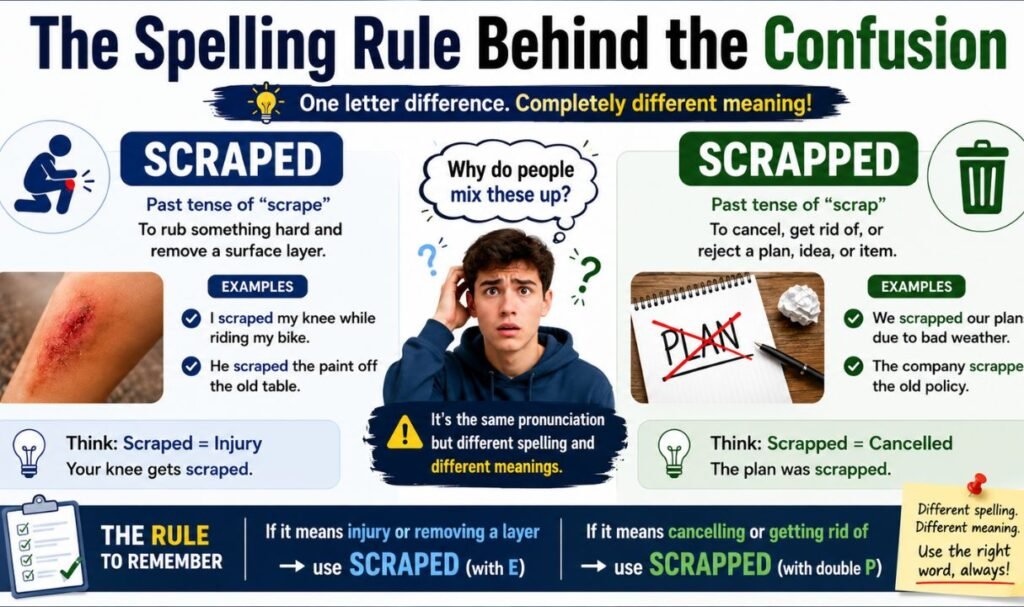
The two extra letters are not random. They follow a standard English spelling pattern that most writers never learned by name.
Scrape ends in a silent “e.” English drops that final “e” before adding “-ed,” which gives you scraped, with one “p” and a long A sound, like “scrayped.”
Scrap ends in a single consonant right after a short vowel. English doubles that final consonant before adding a suffix that starts with a vowel, which gives you scrapped, with two “p”s and a short A sound, like “scrapt.”
This same doubling rule explains why stop becomes stopped and plan becomes planned, while hope becomes hoped and bake becomes baked. Once you see the pattern, the spelling stops feeling arbitrary.
Why People Mix Them Up
A few things push writers toward the wrong word almost every time.
- Near-identical spelling. A single letter separates them, and it sits in the middle of the word where the eye skips over it fastest.
- Close pronunciation. In casual speech, the vowel difference between “scrayped” and “scrapt” often flattens out, especially at conversational speed.
- Autocorrect blind spots. Both words are spelled correctly on their own, so spellcheckers rarely flag the wrong one in context.
- Overlapping subject matter. Projects, plans, and physical objects show up in sentences using either word, so the surrounding vocabulary offers few clues.
Where the Words Come From
Scrape traces back to Old English scrapian and related Old Norse roots meaning to scratch or rasp with the fingernails or a rough tool. The physical, friction-based sense has stayed remarkably stable for centuries.
Scrap comes from the Old Norse word skrap, referring to small bits, scraps, or leftover material. Over time, English speakers extended that idea of a leftover fragment into the verb “to scrap,” meaning to reduce something to leftovers by getting rid of it entirely.
The etymology lines up cleanly with the modern split: scrape has always been about contact and removal, and scrap has always been about what happens to something once it is no longer wanted.
Scraped and Scrapped in Everyday Life
Both words show up constantly outside of formal writing, and the context almost always signals which one belongs.
- I scraped my knee skateboarding this afternoon.
- She scraped the frost off the car before school.
- We scrapped our weekend trip because of the storm warning.
- He scrapped his New Year’s resolution by the second week of January.
In texts and social posts, people also use scrapped loosely to mean “gave up on” something small, like a diet or a plan for the evening, not just a formal project.
Scraped and Scrapped in Business and Tech
Professional writing leans on these words heavily, and getting them backward in a report or email changes the entire message.
- Data teams scraped thousands of listings from competitor websites overnight.
- Leadership scrapped the product launch after the funding round fell through.
- The scraper scraped pricing data every hour to track market shifts.
- The startup scrapped its original name after a trademark dispute.
In data science and programming specifically, “scraped” is the standard term for automated collection of information from web pages, using tools often called scrapers. “Scrapped,” in that same industry, almost always refers to a canceled feature, sprint, or release rather than any kind of data collection.
You May Also Like: Infact or In Fact? The Correct Way to Write It (With Examples)
Common Mistakes with Scraped and Scrapped
Mistake 1: Writing “scraped” when you mean canceled. Incorrect: The company scraped the project after the budget cut. Correct: The company scrapped the project after the budget cut.
Mistake 2: Writing “scrapped” when you mean a physical action. Incorrect: He scrapped mud off his shoes before coming inside. Correct: He scraped mud off his shoes before coming inside.
Mistake 3: Ignoring context clues entirely. Before choosing either word, ask whether the sentence describes a physical surface or a decision to end something. That single question resolves nearly every mix-up.
Related Expressions Worth Knowing
Built from scrape:
- scrape by (barely manage financially or otherwise)
- scrape together (gather with difficulty, usually money)
- scrape off (remove a layer from a surface)
- scraper (a tool, or a program that collects web data)
Built from scrap:
- scrap metal (discarded metal collected for recycling)
- scrap paper (paper kept for informal notes)
- scrap an idea (abandon a plan before acting on it)
- scrap heap (a pile of discarded material, often used figuratively)
Quick Practice
Fill in the blank with scraped or scrapped.
- He ______ his knuckles while fixing the bike chain.
- The network ______ the show after one disappointing season.
- The tool ______ reviews from five different retail sites.
- They ______ the wedding plans and eloped instead.
Answers: 1. scraped 2. scrapped 3. scraped 4. scrapped
Frequently Asked Questions
What is the difference between scraped and scrapped?
Scraped describes a physical or digital action, like rubbing something off a surface or pulling data from a website. Scrapped describes a decision to cancel, discard, or abandon something.
What does scraped mean?
Scraped is the past tense of scrape, meaning to remove, collect, or barely manage something through friction or effort, as in “scraped by” or “scraped a knee.”
Which is correct, scrapped or scraped?
Both are correct spellings, but they are not interchangeable. Use scrapped for cancellations and discarded items, and scraped for physical removal or data collection.
What is the meaning of scrapped?
Scrapped means something was thrown away, canceled, or taken out of use, such as a project, a plan, or a vehicle sent for parts.
Can scraped and scrapped be used interchangeably?
No. Swapping them changes the meaning of the sentence, since one describes an action against a surface and the other describes a decision to end something.
Is there a British vs American spelling difference?
No. Both scraped and scrapped are spelled the same way in British and American English, with no regional variation.
Conclusion
The two words split cleanly once you know what to look for. Scraped belongs to surfaces, friction, and effort. Scrapped belongs to decisions, cancellations, and things left behind. Check whether your sentence involves a physical action or a choice to end something, and the right word follows almost automatically.