
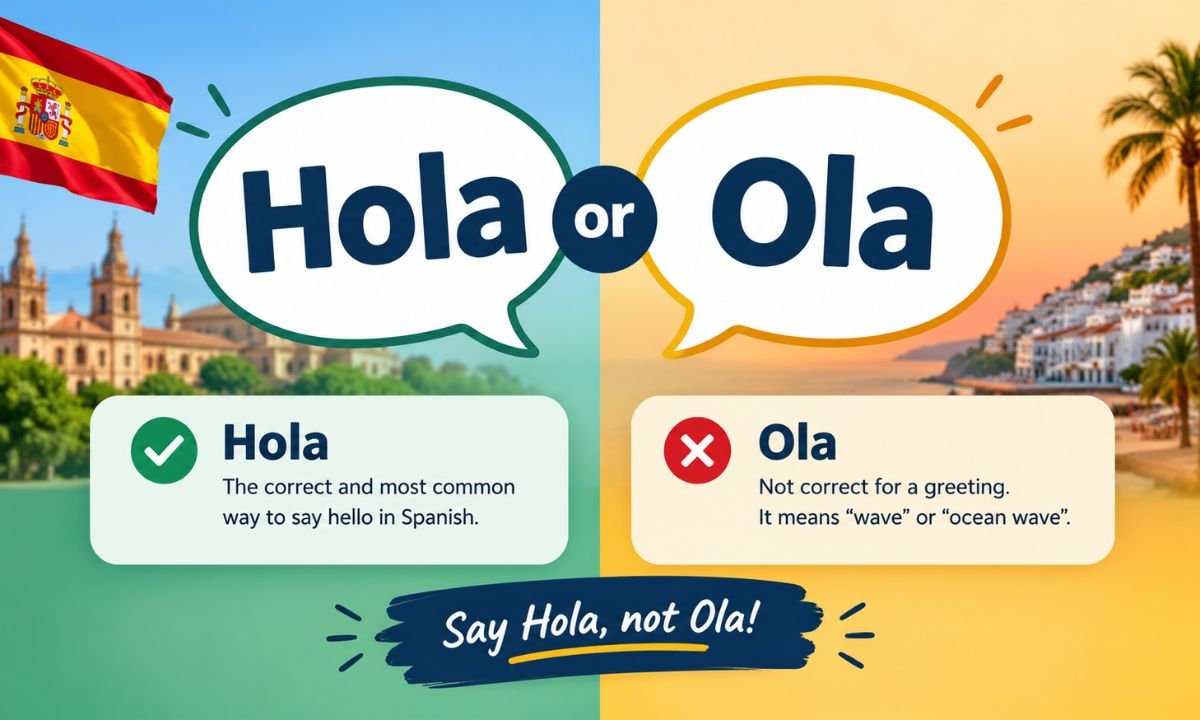
You’ve probably typed it a hundred times without thinking twice: “Hola, how are you?” But have you ever stopped mid-sentence and wondered if you dropped a letter? That one missing “h” is the difference between greeting a friend and talking about a sea wave.
This mix-up happens constantly, especially on social media, where autocorrect and fast typing turn a simple hello into something that reads a little strange to a native Spanish speaker. The good news is that once you understand where each word comes from and how they’re actually used, you’ll never second-guess yourself again.
Below is a full breakdown of hola and ola: their meanings, their history, how they’re pronounced, where they show up around the world, and the small mistakes that trip up even confident language learners.
What “Hola” Means and Why It Matters
“Hola” is the everyday Spanish word for hello. It’s short, friendly, and works in almost any casual setting, whether you’re greeting a neighbor, answering the phone, or opening a text message.
Grammatically, hola is an interjection, not a noun or a verb. That means it doesn’t change form depending on who you’re talking to. You say “hola” to one person or a room full of people, no conjugation required.
A few things make hola worth understanding beyond its basic definition:
- It’s one of the first words taught in any Spanish class, which means it’s also one of the words non-Spanish speakers borrow most often in English conversation.
- It sits comfortably between formal and informal speech. You wouldn’t open a legal letter with it, but you could absolutely use it with your boss in a relaxed office.
- Getting it right (or wrong) affects how a message lands. Swap the spelling for “ola,” and a friendly greeting turns into a comment about ocean waves.
Understanding hola properly isn’t just trivia. It shapes how confidently you communicate in Spanish, and how naturally you can borrow the word into English without sounding forced.
Origins of “Hola”: History, Evolution & Linguistic Roots
Where did “Hola” come from?
Linguists don’t fully agree on this one, and that’s part of what makes hola interesting. The Real Academia Española (RAE), Spain’s official language authority, classifies hola as a “voz expresiva,” meaning an expressive or exclamatory word rather than one with a clean, traceable root. The RAE draws a loose comparison to English “hello” and German “hallo,” both of which share a similar function and sound.
There’s also a long-running theory connecting hola to Arabic, specifically to the phrase “wa’llah,” an oath meaning “I swear by God.” Researchers who support this theory point to similar Romance-language interjections, like Spanish “hala” and Romanian “aoleu,” which also seem to trace back to expressions invoking the name of God. Under this view, hola started as an exclamation of surprise or emphasis centuries ago, then slowly softened into a greeting.
Not everyone buys this explanation. Arabist scholars like Federico Corriente have pushed back hard, calling these Arabic-origin claims “falsos arabismos,” or false Arabisms, arguing there’s no solid documentary evidence to support the link. Some etymologists instead point to Old French “holà” (a combination of “ho” and “là,” meaning roughly “hey there”) or Middle Dutch expressions used to call for attention.
The honest answer: nobody has pinned down a single, universally accepted origin. What we do know is that hola has functioned as an expression of surprise, a way to call attention, and eventually a greeting, and it’s been doing all three for centuries.
Why did the “H” become silent?
This part has a clearer answer. Spanish underwent a major sound shift starting around the late Middle Ages, where the Latin “f” sound at the beginning of many words gradually weakened into an aspirated “h,” and that aspirated “h” eventually disappeared from spoken Spanish altogether by the 16th and 17th centuries.
Words like Latin “farina” (flour) became Spanish “harina,” and the “h” simply stopped being pronounced, even though it stayed in the spelling. Hola followed a similar pattern, whether its root is Arabic, French, or something else entirely. Spanish kept the letter as a written convention but dropped the sound in speech, which is exactly why you pronounce it “OH-lah” instead of “HOH-lah.”
Cultural shift
Beyond the sound changes, hola’s role in Spanish-speaking culture shifted over time too. What may have started as an exclamation of surprise gradually became the default, all-purpose greeting used across Spain and Latin America. Today it carries almost no formality baggage. You’ll hear it in markets, offices, classrooms, and phone calls, which says a lot about how thoroughly it settled into daily speech.
Pronunciation Essentials: Why the “H” in Hola Is Silent
How to pronounce “Hola”:
Say it as two syllables: OH-lah.
- The “o” sounds like the o in “go,” but shorter and crisper than the English version.
- The “l” is pronounced clearly, tapping the tongue against the back of your top front teeth.
- The final “a” sounds like the a in “father,” never like the a in “cat.”
- The “h” is not pronounced at all. It’s there in writing only.
Why the H is silent
As covered above, Spanish lost its aspirated “h” sound centuries ago as part of a broader shift away from Latin “f” sounds. The letter survived in spelling for historical and etymological reasons, but modern Spanish speakers never voice it. This isn’t unique to hola. Plenty of Spanish words start with a silent h, including “hermano” (brother), “hora” (hour), and “hoy” (today).
Common mistakes to avoid
- Pronouncing the h with an English “h” sound, which immediately signals a non-native accent.
- Stressing the wrong syllable. The stress falls naturally on the first syllable, HO-la, not ho-LA.
- Adding an extra vowel sound, turning it into something closer to “ho-la-uh.”
- Confusing pronunciation with spelling. Hola and ola are pronounced identically, so mispronunciation isn’t usually the problem, misspelling is.
Hola Around the Spanish-Speaking World
Hola is universal across the more than twenty countries where Spanish is an official or dominant language, but tone, frequency, and pairing phrases shift depending on the region.
Regional Usage Table
| Region | How “Hola” Is Typically Used | Common Follow-Up Phrase |
|---|---|---|
| Spain | Casual, used constantly, even semi-formally | “¿Qué tal?” |
| Mexico | Warm and frequent, common in texting and calls | “¿Qué onda?” |
| Argentina | Common, often paired with a more melodic tone | “¿Cómo andás?” |
| Colombia | Friendly, used in both spoken and written greetings | “¿Cómo va todo?” |
| Caribbean (Cuba, PR, DR) | Fast-paced speech, hola often shortened in casual chat | “¿Qué bolá?” (Cuba) |
| United States (Spanish speakers) | Used bilingually, often mixed into English sentences | “Hola, how’s it going?” |
Important note
Even though the word doesn’t change spelling anywhere in the Spanish-speaking world, the follow-up questions and regional slang around it vary a lot. Someone from Mexico City and someone from Buenos Aires will both say “hola” the same way, but what comes right after can sound like two different languages to an outsider.
Variations
A few informal spins on the word show up in casual speech and texting:
- “Holi” — a cutesy, softened version often used between friends or in playful messages.
- “Holaa” or “Holaaa” — stretched out for emphasis or excitement, mostly in texting.
- “Ola k ase” — an intentionally misspelled, meme-style greeting popular in Spanish internet culture, used ironically rather than as a genuine spelling mistake.
Ola vs Hola: Exact Meaning & Key Differences
“Hola” = Hello
Hola functions as an interjection used to greet someone. It has no other meaning in standard Spanish.
“Ola” = Wave
Ola is a feminine noun that refers to a wave, most often a wave of water in the sea or ocean. It can also be used figuratively, the way English speakers say “a wave of applause” or “a wave of tourists.”
Side-by-side comparison
| Feature | Hola | Ola |
|---|---|---|
| Meaning | Hello, hi | Wave (ocean or figurative) |
| Part of speech | Interjection | Noun (feminine) |
| Pronunciation | OH-lah | OH-lah |
| Used as a greeting? | Yes | No |
| Grammatical article needed? | No | Yes (“la ola”) |
| Plural form | Not applicable | “olas” |
Real examples in sentences
- “¡Hola, María! ¿Cómo estás?” — “Hi, María! How are you?”
- “La ola golpeó la costa con fuerza.” — “The wave hit the coast hard.”
- “Hola a todos, bienvenidos al programa.” — “Hello everyone, welcome to the show.”
- “Una ola de calor llegó esta semana.” — “A heatwave arrived this week.”
Notice that “ola” always needs an article (“la ola,” “una ola,” “las olas”) because it’s a standard noun, while “hola” stands completely on its own.
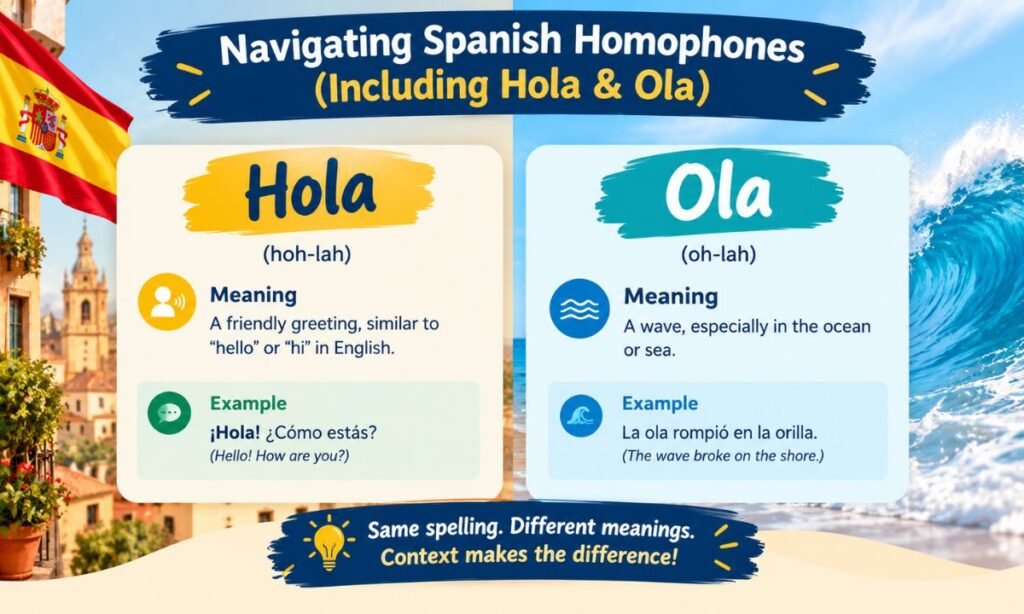
Navigating Spanish Homophones (Including Hola & Ola)
Why homophones exist in Spanish
Spanish has fewer homophones than English overall, but the ones that do exist tend to cluster around silent letters, especially the silent “h,” and around vowel combinations that sound identical despite different spellings. Because Spanish spelling is generally very phonetic and consistent, homophones stand out as the exceptions rather than the rule, which is exactly why hola and ola cause so much confusion. Learners expect Spanish spelling to match sound perfectly, so a pair like this feels like an exception to a rule they were told never breaks.
Other common Spanish homophone pairs
| Word 1 | Meaning | Word 2 | Meaning |
|---|---|---|---|
| Hola | Hello | Ola | Wave |
| Halla | Finds (from “hallar”) | Haya | Beech tree / may have (subjunctive) |
| Ay | Ouch, oh | Hay | There is / there are |
| Tubo | Tube, pipe | Tuvo | Had (past tense of “tener”) |
| Vaya | Goes (subjunctive) | Valla | Fence, billboard |
| Basto | Coarse, rough | Vasto | Vast |
Tips for learners:
- Read the whole sentence before deciding on meaning. Context almost always resolves the ambiguity instantly.
- Pay attention to whether an article is needed. Nouns like “ola” require one, interjections like “hola” don’t.
- When writing, double-check silent letters specifically. They’re the most common source of homophone mix-ups in Spanish.
- Practice by writing, not just speaking. Pronunciation confusion rarely happens, spelling confusion does.
Hola in Other Languages & Global Usage
Where “Hola” appears globally
Hola itself is Spanish, but close cousins and lookalikes show up across several languages, sometimes with entirely separate origins.
- Portuguese: “Olá” (with an accent mark) means hello, functioning almost identically to the Spanish word, though the two developed somewhat independently.
- English: “Hello” is a distant linguistic relative in sound and function, though not in direct etymology, and Germanic “hallo” plays a similar role.
- Filipino/Tagalog slang: Some casual Filipino greetings borrow “hala” and similar sounds, though this is coincidental rather than a direct connection to Spanish “hola,” reflecting Spain’s centuries of colonial influence in the Philippines.
- Global pop culture: “Hola” has become one of the most recognized Spanish words worldwide, appearing in English-language songs, TV shows, and marketing campaigns aimed at bilingual or Spanish-curious audiences.
Comparison table
| Language | Word | Meaning | Silent Letter? |
|---|---|---|---|
| Spanish | Hola | Hello | Yes (h) |
| Portuguese | Olá | Hello | No |
| English | Hello | Hello | No |
| German | Hallo | Hello | No |
| French | Bonjour / Salut | Hello | No |
How English Speakers Can Use “Hola” Naturally
When it feels natural
- Texting a friend who speaks Spanish, or a bilingual group chat.
- Casual social media captions, especially travel or food content.
- Greeting a Spanish-speaking coworker or customer in a relaxed setting.
- Language-learning practice, where using real vocabulary builds confidence.
When it feels forced
- Formal business emails to someone you don’t know well.
- Situations where you don’t actually speak or intend to speak any Spanish beyond the greeting, which can come across as performative rather than genuine.
- Professional documents, reports, or anything requiring a neutral, universally understood tone.
Examples of natural integration:
- “Hola! Just wanted to follow up on our chat from yesterday.”
- “Hola from Mexico City! The food here is incredible.”
- “Said hola to the new intern this morning, she seems great.”
Professional use
In customer-facing roles, especially in regions with large bilingual populations, opening a message with “hola” can build rapport quickly. Call centers, hospitality businesses, and retail brands operating in Spanish-speaking markets often train staff to greet customers this way. Outside of those contexts, though, sticking to “hello” in professional English communication is the safer, more universally appropriate choice.
Hola in Pop Culture, Media & the Internet
Key influences
Hola has worked its way deep into global media over the past few decades.
- Music: Countless Latin pop, reggaeton, and crossover songs open or feature the word prominently, helping cement it in the ears of non-Spanish-speaking listeners worldwide.
- Television and film: Bilingual characters and Spanish-language shows distributed internationally on streaming platforms have normalized hearing “hola” without subtitles.
- Advertising: Brands targeting bilingual or Hispanic audiences in the US frequently use “hola” in campaigns, banking on both recognition and warmth.
- Internet memes: The phrase “ola k ase,” an intentionally misspelled, exaggerated version of “hola, ¿qué haces?” (hello, what are you doing), became a widely recognized joke format across Spanish-language internet culture, poking fun at bad spelling and low-effort messages.
Case Study: Bilingual Social Media
Bilingual creators on platforms like Instagram and TikTok often open videos with a quick “hola” before switching into English, or vice versa. This works because the word requires zero translation for most viewers and instantly signals a friendly, informal tone. It’s become something of a shorthand for cultural warmth, similar to how “ciao” gets borrowed into English conversation even by people who don’t speak Italian.
Frequently Asked Questions
Which is correct, Ola or Hola?
“Hola” is correct when greeting someone. “Ola” is a real Spanish word too, but it means wave, not hello.
Is Ola the same as Hola?
No. They sound identical but mean completely different things: hola is hello, ola is wave.
Is it ola or hola in Mexico?
It’s hola everywhere Spanish is spoken, including Mexico. Ola is never used as a greeting in any Spanish-speaking country.
Does olá mean hello?
Yes, but that’s Portuguese, not Spanish. Olá (with an accent) is the Portuguese word for hello.
Conclusion
The difference between hola and ola comes down to a single silent letter, but that letter carries real weight. One word opens a conversation with warmth, the other describes water moving toward a shore. Once you understand the history behind that silent “h,” how the pronunciation works, and how the word travels across different Spanish-speaking regions, the confusion disappears for good.