
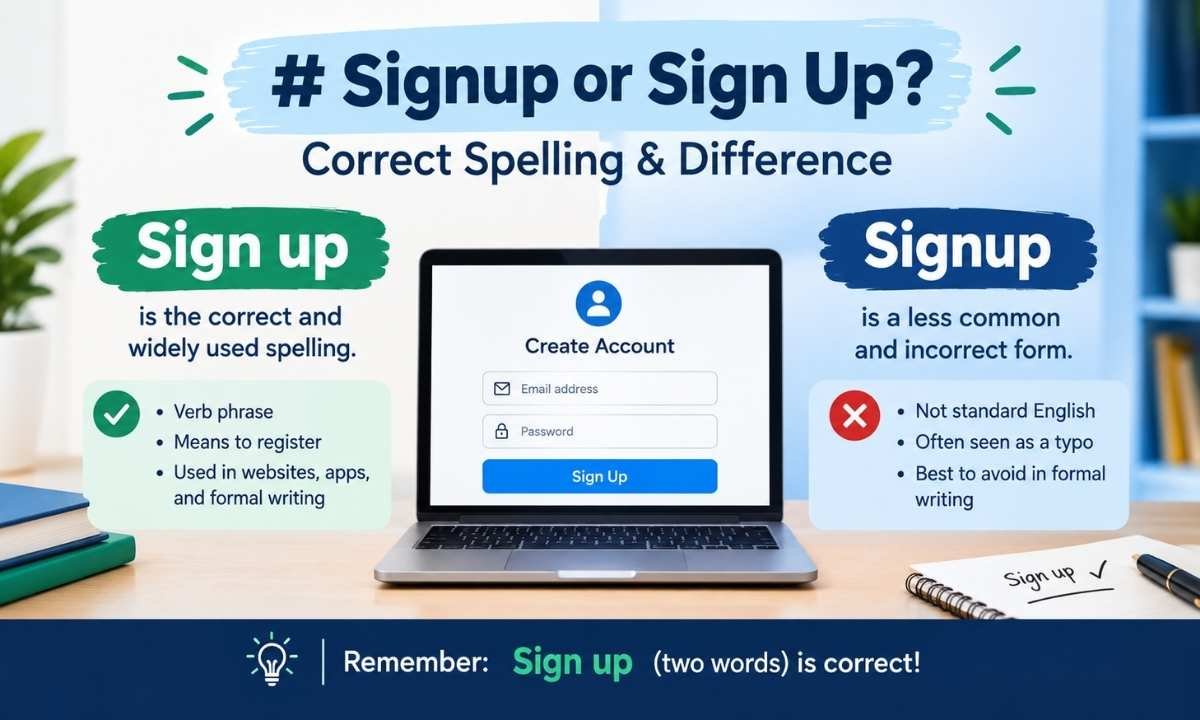
You are writing a quick email, a button label, or a school flyer, and you freeze. Is it “signup” or “sign up”? Both look fine on a screen. Only one of them is right in any given sentence.
The short version: the spelling depends on how the word works in the sentence. An action takes two words. A thing, such as a form, a page, or a list, takes a noun form.
This guide gives you the rule, the exceptions, and plenty of examples, plus the cases people search for most: Gmail, SignUpGenius, button text, plurals, and the hyphen. Every answer is checked against dictionary entries and style guidance, and points where writers disagree are marked.
Quick Answer
Use “sign up” (two words) as a verb. Use “sign-up” (hyphenated) or “signup” (one word) as a noun or adjective.
- “Please sign up before Friday.” (verb, two words)
- “The sign-up sheet is on the table.” (adjective, hyphenated)
- “Our signup page is live.” (adjective, one word, common in tech writing)
If you can replace the word with “register” or “enroll,” you need the two-word verb. If you can replace it with “registration,” you need the noun.
Meaning and Definition of Each Word
English forms many nouns from phrasal verbs. A phrasal verb is a verb plus a small word like up, out, or in. When the phrase turns into a thing, it usually gets a hyphen or fuses into one word. “Sign up” follows the same path as “log in” and “check out.”
1. Sign Up
Sign up is a phrasal verb. Merriam-Webster defines it as signing your name, as on a contract, to get, do, or join something, and gives examples such as signing up for insurance or classes. The dictionary dates the first known use to 1875, so this is no internet invention.
In practice, it means to commit, enroll, register, or volunteer.
- She decided to sign up for a pottery class.
- We signed up for the trial yesterday.
The phrase takes a preposition. You sign up for a service, with a company, or to do something. You also sign someone up, with the object in the middle: “I signed my sister up.”
2. Signup
Signup is the closed, one-word form. Grammarist describes it as a noun for a place, sheet, or other device where you commit to taking part, and as an adjective that describes that place or sheet.
You will see it all over software, app stores, and web addresses. Most product teams write “signup page,” “signup flow,” and “signup form” because the one-word version is shorter and easier to type into code.
Traditional dictionaries are more cautious. Merriam-Webster’s main entry lists the hyphenated sign-up as the noun and adjective. So “signup” is real and widely used, but it sits more comfortably in technical and product writing than in formal prose.
Sign-Up (Hyphenated): Noun or Adjective
The hyphenated sign-up is the form that style guides prefer for the noun and the adjective.
As a noun, it means the act of enrolling or the enrollment itself.
- Sign-ups for the spring league close on March 3.
- The sign-up was easier than I expected.
As an adjective, it describes another noun.
- A sign-up sheet
- A sign-up bonus
- A sign-up link
Writing Explained notes that AP-style usage keeps the hyphen and does not accept the one-word version in news copy. The hyphen also works as a visual clue. Compare “sixteen-year-old” or “shabby-looking”: the hyphen tells the reader that the group of words acts as a single describing unit.
A simple test helps. Say the sentence aloud. If the stress falls on the first syllable (“SIGN-up sheet”), you are using a noun or adjective. If both words get similar weight (“sign UP for it”), it is the verb.
Key Differences Between the Words
The three spellings differ in part of speech, in how they behave in a sentence, and in where they feel at home.
- Part of speech. “Sign up” is a verb. “Sign-up” and “signup” are nouns or adjectives.
- Conjugation. Only the verb changes form: signs up, signed up, signing up. The noun does not.
- Plural. Only the noun forms have a plural: sign-ups or signups.
- Typical setting. The verb appears everywhere. The hyphenated noun is favored in journalism and formal writing. The closed noun is favored in tech.
- Position in a sentence. The verb needs a subject (“They sign up”). The noun can be a subject or object (“The sign-up closed”).
One more difference trips people up. Because “signup” looks like a single word, writers sometimes use it as a verb. That is the most common error. “I need to signup” is wrong. It should be “I need to sign up.”
Signups or Sign-Ups: Which Spelling Is Correct?
Both plural spellings appear in print, and the right one follows your singular choice.
- If you write sign-up, the plural is sign-ups.
- If you write signup, the plural is signups.
Do not write “sign ups” as a noun. Two separate words in the plural reads as a verb followed by an adverb, and it confuses the sentence. “Sign ups for the event are open” looks like a command with a missing subject.
The verb keeps its own plural-looking form for a different reason: “she signs up” is simply third person singular. The s belongs to the verb, not to a plural noun. So you never write “she signs-up” or “she signups.”
Which one should you pick? For a newspaper, a school newsletter, a business report, or an academic paper, use sign-ups. For a product blog, a developer doc, or a startup site, signups is fine as long as you use it every time.
Comparison Table
| Feature | Sign up | Sign-up | Signup |
|---|---|---|---|
| Spelling | Two words | Hyphenated | One word |
| Part of speech | Verb (phrasal) | Noun, adjective | Noun, adjective |
| Meaning | To register or enroll | The act or form of enrolling | The act or form of enrolling |
| Takes a tense | Yes | No | No |
| Has a plural | No | Sign-ups | Signups |
| Best for | Any sentence with an action | News, formal, academic writing | Tech, product, web addresses |
| Example | “Sign up today.” | “The sign-up sheet is full.” | “The signup page loads fast.” |
Verb Forms Table: Sign Up, Signed Up, Signing Up
Only the two-word verb changes with tense. The particle “up” stays put and the first word carries the ending.
| Form | Spelling | Example |
|---|---|---|
| Base form | sign up | I will sign up tomorrow. |
| Third person singular | signs up | Maya signs up for every workshop. |
| Past tense | signed up | They signed up last week. |
| Past participle | signed up | We have signed up already. |
| Present participle | signing up | He is signing up right now. |
| Infinitive | to sign up | I want to sign up for the course. |
Notice that “signed up” and “signing up” never take a hyphen when they act as verbs. A hyphen appears only if the phrase turns into a describing word before a noun, as in “a signed-up member.” That use is correct but a little stiff, so most editors prefer “a registered member.”
Examples in Sentences
Seeing the words in action is the quickest way to lock them in.
Using Sign Up (Verb)
- You can sign up for the free plan without a credit card.
- I signed up for night classes in January.
- Are you signing up for the 10K run?
- Parents must sign up before the deadline.
Using Signup (Noun/Adjective)
- The signup was quick and required only an email address.
- Our signup form asks for a name and a password.
- Signups doubled after the discount went live.
- The signup page crashed when the traffic spiked.
- Use the signup link in the email you received.
The hyphenated versions read the same way. Just keep one spelling through an entire document.
Signup or Sign Up Gmail
If you search this phrase, you probably want to know what to call the process of making a Gmail address.
Google’s own help page says that to sign up for Gmail, you create a Google Account. That sentence uses the two-word verb correctly. The account you create then works across other Google products, such as YouTube, Google Drive, and Google Play.
So, in a sentence:
- Correct: “I want to sign up for Gmail.”
- Correct: “The Gmail signup page asks for your name and birth date.”
- Incorrect: “I want to signup for Gmail.”
The action is “sign up,” and the page you land on is the “signup page.” Interestingly, the button on Google’s flow reads “Create account,” not “Sign up.” That choice dodges the spelling question entirely and also avoids confusion with “Sign in,” a point covered later in this guide.
Always use Google’s own page when you create an account. Third-party sites that mimic the flow can collect your details, and Google’s help center explains the official steps.
Signup or Sign Up Online
Online, the same rule holds. You sign up for a newsletter, a webinar, a streaming service, or a bank’s mobile app. The page that collects your details is a sign-up page or signup page.
On the web, short wins. Buttons, menus, and URLs favor the compact one-word style, while body text favors the hyphen. Each works as long as you stay consistent within one page.
If you manage a site, put the rule in your style guide: sign up for the verb, signup for everything else.
Signup or Sign Up Genius
People often type “sign up genius” as three separate words. The tool’s own name is written as SignUpGenius, one word with capital letters at the start of each part.
SignUpGenius is a free online tool for building sign-up sheets for volunteer shifts, school events, sports leagues, and potluck dinners. The company’s site describes how organizers create a sheet, invite a group, and let people sign up online with reminders sent automatically.
Here is how the word choices play out:
- The brand: SignUpGenius (a proper noun, keep its spelling)
- The action: “I will sign up on SignUpGenius.”
- The thing you build: “I created a sign-up for the bake sale.”
- The sheet itself: “Add your name to the sign-up sheet.”
Brand names are the one place where the usual grammar rules step aside. The company chose its spelling, so you write it their way. Use “sign up” for the verb that surrounds it.
Signup vs Sign In vs Log In
These three phrases cause more mix-ups than the spelling itself, because they sound alike and people use them in the same menu.
- Sign up means to create a new account.
- Sign in and log in mean to access an account that already exists.
The Auth0 community explains the practical split well: signing up creates an account, while logging in only opens one that is already there. A sign-up flow can also log you in afterward, but a login flow cannot make a new account.
| Action | Verb phrase | Noun or adjective | Meaning |
|---|---|---|---|
| Create an account | Sign up | Sign-up, signup | First-time registration |
| Access an account | Log in or sign in | Login, sign-in | Return visit |
| Leave an account | Log out or sign out | Logout, sign-out | End the session |
The same grammar pattern repeats. “Log in” is the verb and “login” is the noun: “Log in to your account” but “Enter your login details.” The preposition is “in to” or “into” depending on the structure, and UX writers generally prefer “log in to.”
Pairs matter too. If you write “log in,” use “log out.” If you write “sign in,” use “sign out.” Mixing them, such as “log in” with “sign out,” makes an interface feel sloppy.
Signup Button or Sign Up Button?
For a button, you are labeling an action, so the verb form is the natural pick: Sign up.
Writers do use “signup button” in a sentence to describe the button itself:
- “Click the Sign up button.” (the label is the verb, the word “button” is the noun)
- “The signup button is green.” (the noun form describes the button)
Design writers have studied this closely. Several UX publications warn against placing “Sign in” and “Sign up” next to each other, since the two labels look nearly identical and people click the wrong one. A common fix is pairing Sign up with Log in, or pairing Sign in with Create account or Join.
A survey of 100 apps found 67 different wordings for the main call-to-action button. That variety shows there is no single rule. Still, a few habits hold up:
- Use the verb form on the button.
- Pick one style of capitalization and keep it, either “Sign up” or “Sign Up.”
- Do not pair “Sign in” with “Sign up.”
- Test a more specific label, such as “Start free trial,” when you care about clicks.
The one-word “Signup” on a button is not wrong in a legal sense, but it reads as a noun and can feel slightly off. The two-word verb is the safer choice.
Common Mistakes
| Mistake | Why it is wrong | Fix |
|---|---|---|
| I need to signup now. | Verb needs two words | I need to sign up now. |
| The sign up page is slow. | Adjective needs a hyphen or one word | The sign-up page is slow. |
| Three sign ups came in. | Plural noun is not two words | Three sign-ups came in. |
| She signs-up every year. | Verbs are not hyphenated | She signs up every year. |
| Please signup here. | One word used as a verb | Please sign up here. |
| Sign In to create an account | Wrong action word | Sign up to create an account |
Two other slips are worth a note. One is mixing styles on a page, such as “signup” in the heading and “sign-up” in the paragraph. The other is writing “SignUp” in ordinary text, which belongs only in code and brand names.
Tips to Remember the Difference
A few memory tricks save you from checking every time.
- The “I can do it” test. If the word is something a person can do, you need two words. “I can sign up.” You cannot “sign-up” a thing in the same way.
- The “the” test. If you can put “the,” “a,” or “this” in front of it, it is a noun or adjective: “the sign-up,” “a signup page.”
- The “register” swap. Replace the word with “register.” If it fits, use two words. If “registration” fits, use the noun form.
Here is a one-line shortcut: actions are open, things are closed. The verb stays apart, and the noun joins up.
Is Sign Up Hyphenated?
It depends on the part of speech.
- As a verb, no. “Sign up” never takes a hyphen. Writing “sign-up” for the verb is an error.
- As a noun or adjective, usually yes. The traditional spelling is “sign-up,” and AP-style guidance keeps the hyphen.
- As a closed word, sometimes. “Signup” is accepted in tech and product writing.
The hyphen belongs to the thing, not the action. Fix “Please sign-up here” by removing it, and fix “the sign up sheet” by adding it.
When to Use Each Word
Pick your spelling by purpose.
| Situation | Best choice | Example |
|---|---|---|
| Telling someone to join | Sign up | “Sign up for the webinar.” |
| News story or formal report | Sign-up | “Sign-ups rose by 12 percent.” |
| Product docs, UI, developer notes | Signup | “Signup flow, signup API” |
| Brand name | Follow the brand | SignUpGenius |
| Button label | Sign up | Sign up |
Whatever route you take, stay consistent. A reader will forgive either “sign-up” or “signup,” but will notice both appearing in the same article.
Grammar Rules
Here are the rules in plain language, so you can apply them without a dictionary.
Rule 1: Treat “sign up” as a phrasal verb. The two words together mean one thing. They stay separate, and the verb ending attaches to “sign.”
Rule 2: Do not hyphenate the verb. “Sign up,” “signs up,” “signed up,” and “signing up” always stay open.
Rule 3: Hyphenate or close the noun. The noun and the adjective take “sign-up” or “signup.” Pick one and keep it.
Rule 4: Add s to the noun for the plural. Sign-ups, signups. Never “sign ups” for a plural noun.
Rule 5: Separate the object. A pronoun goes between the two words: “Sign me up,” not “Sign up me.”
Rule 6: Pair your account words. Sign up goes with log in. Sign in goes with sign out or Create account.
Synonyms or Related Words
If you are tired of repeating “sign up,” these alternatives fit different contexts.
| Word | Best for | Example |
|---|---|---|
| Register | Formal events, official lists | Register for the conference. |
| Enroll | Courses, schools, programs | Enroll in the evening class. |
| Join | Clubs, communities, memberships | Join the book club. |
| Subscribe | Newsletters, channels, services | Subscribe to the weekly digest. |
| Opt in | Marketing consent | Opt in to email updates. |
| Create an account | Apps and websites | Create an account to continue. |
A note on tone. “Register” and “enroll” sound more formal, while “sign up” feels relaxed and works in almost any setting. Related nouns include registration, enrollment, membership, and subscription.
Signup or sign up Gmail
Let’s look at the Gmail question from a technical angle, since the web address itself uses the closed form.
Google’s account creation page sits at an address that ends in “signup.” That is a good example of how the one-word version thrives in URLs and code. A web address cannot contain a space, and a hyphen can look odd in a path, so “signup” is the natural choice.
This is why the same company can use both forms without contradiction:
- In the address: the closed form, because of how web paths work.
- In the help article: the two-word verb, because it describes an action.
- On the button: “Create account,” because that phrase is clearer and avoids a clash with “Sign in.”
So the spelling lesson from Gmail is simple. The process is “signing up.” The page is the “signup page.” The address can say signup.
Signup or sign up genius
The name shows up in emails, flyers, and group chats constantly, so it helps to know how to write it around the rest of your sentence.
When you invite people, write the verb clearly and the brand once. A volunteer coordinator might write: “Sign up for a shift using our SignUpGenius page. The sign-up sheet closes Friday at noon.” That sentence uses the brand, the verb, and the noun correctly in a short space.
One more detail. The tool lets organizers set slots, limit how many people join each one, and send reminders. When you describe that to your group, use the noun: “Your sign-up is confirmed,” not “Your sign up is confirmed.”
Summary
Here is everything in one place.
- Sign up (two words) is the verb. It means to register, enroll, or join.
- Sign-up (hyphenated) is the traditional noun and adjective, preferred by dictionaries and AP-style writing.
- Signup (one word) is the same noun or adjective, widely used in tech, URLs, and product copy.
- Verbs change form: signs up, signed up, signing up. Nouns do not.
- The plural of the noun is sign-ups or signups, never “sign ups.”
- For buttons, use the verb: Sign up. Pair it with Log in, not Sign in.
- SignUpGenius is a brand name, so keep its spelling.
Once you separate actions from things, the confusion disappears. Say what someone does with two words, and name what they fill in with a hyphen or a joined word.
Frequently Asked Questions
Is it signup or sign up?
Both are correct in different roles. Use “sign up” as a verb and “signup” or “sign-up” as a noun or adjective.
Is signup one word or two?
As a verb it is always two words: “sign up.” As a noun or adjective it can be one word, “signup,” or hyphenated, “sign-up.”
Is sign-up with a hyphen correct?
Yes, for the noun and adjective. It is the form dictionaries and AP-style writing prefer, but never use it as a verb.
What’s the plural of signup?
The plural is “signups,” or “sign-ups” if you use the hyphen. Avoid the two-word “sign ups” for a noun.
Should a button say sign up or signup?
A button should say “Sign up,” since it labels an action. Pair it with “Log in” to avoid confusion with “Sign in.”
Is signup or sign up right for Gmail?
Use “sign up” for the action (“sign up for Gmail”) and “signup page” for the page. Google’s own button simply reads “Create account.”