
You’re typing an email, a school essay, or a blog post about butterflies, and your fingers pause right before that tricky middle vowel. Is it “cocoon” or “cacoon”? Both look plausible on the page, and if you say them out loud fast enough, they practically sound the same.
This mix-up trips up students, content writers, and even people who write in English every single day. The good news is that the answer isn’t complicated once you see it laid out clearly, and by the end of this guide you won’t second-guess yourself again.
What Is the Correct Spelling: Cacoon or Cocoon?
Quick Answer
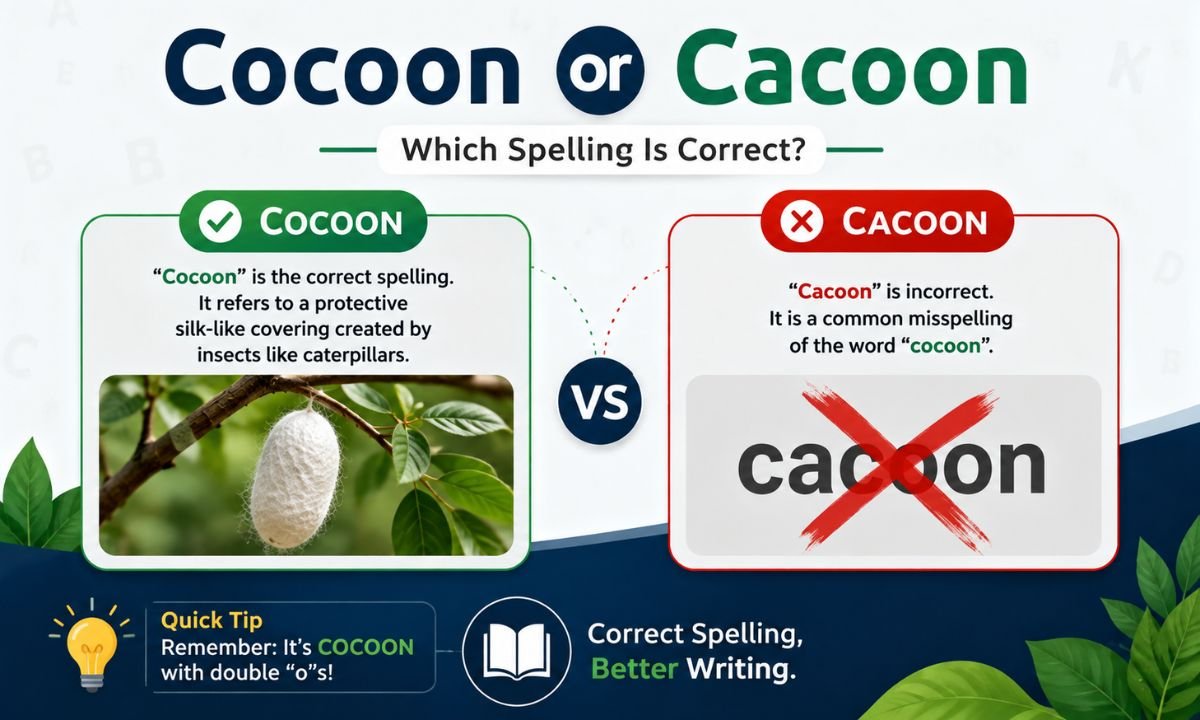
Cocoon is the correct spelling in standard English. It’s the word you’ll find in Merriam-Webster, Oxford, Cambridge, and every major dictionary. “Cacoon” is not an accepted alternative spelling for the insect casing, no matter how often it shows up in casual writing or social media captions.
There’s one small exception worth knowing: “cacoon” is a real word, but it belongs to a completely different subject — botany, not entomology. More on that shortly.
| Spelling | Status | Used For |
|---|---|---|
| Cocoon | Correct | Insect casings, protection, comfort, metaphor |
| Cacoon | Almost always a misspelling | A specific tropical plant/seed (rare, unrelated meaning) |
What Does Cocoon Mean?
At its core, a cocoon is the silky covering a caterpillar or other insect larva spins around itself before it transforms into an adult. It’s the protective shell that shelters the creature during one of the most dramatic changes in the natural world.
The word has also drifted into everyday speech. People “cocoon” themselves in blankets on a rainy weekend. Companies talk about giving customers a “cocooned” experience — safe, comfortable, shut off from outside noise. Neither of these uses has anything to do with insects, but both borrow the same image: something wrapped and protected.
Why Do People Write “Cacoon”?
Mostly because of sound. Say “cocoon” quickly and the first vowel can blur toward an “a” sound, especially in fast or casual speech. Add to that the fact that English is full of words where a single vowel swap doesn’t feel like it should matter — think “compliment” versus “complement” — and it’s easy to see why so many writers guess wrong.
Autocorrect doesn’t always save you either, which we’ll get into further down.
Understanding the Meaning of Cocoon
Literal Meaning
In biology, a cocoon is a case made of silk that certain insects — most famously moths — spin around their bodies before entering the pupal stage. Inside this casing, the larva undergoes metamorphosis, reorganizing itself almost entirely before emerging as an adult moth. It’s worth noting that butterflies typically form a chrysalis, not a cocoon, though many people use the two terms loosely in conversation. A chrysalis is a hardened outer shell the caterpillar’s own skin forms, while a cocoon is a separate silk wrapping the insect spins.
The cocoon serves a clear biological purpose. It shields the vulnerable, changing insect from predators, temperature swings, and moisture loss while its body breaks down and rebuilds.
Figurative Meaning
Outside the science classroom, “cocoon” describes any situation where someone wraps themselves in safety or comfort, often to avoid the outside world for a while. You’ll hear phrases like:
- “She cocooned herself at home after a stressful week.”
- “The retreat felt like a cocoon, far from emails and deadlines.”
- “He’s been in a bit of a cocoon since the move, not seeing many people.”
This figurative sense captures both the comfort and the isolation that come with pulling away and protecting yourself, sometimes temporarily, sometimes for longer.
Business and Lifestyle Usage
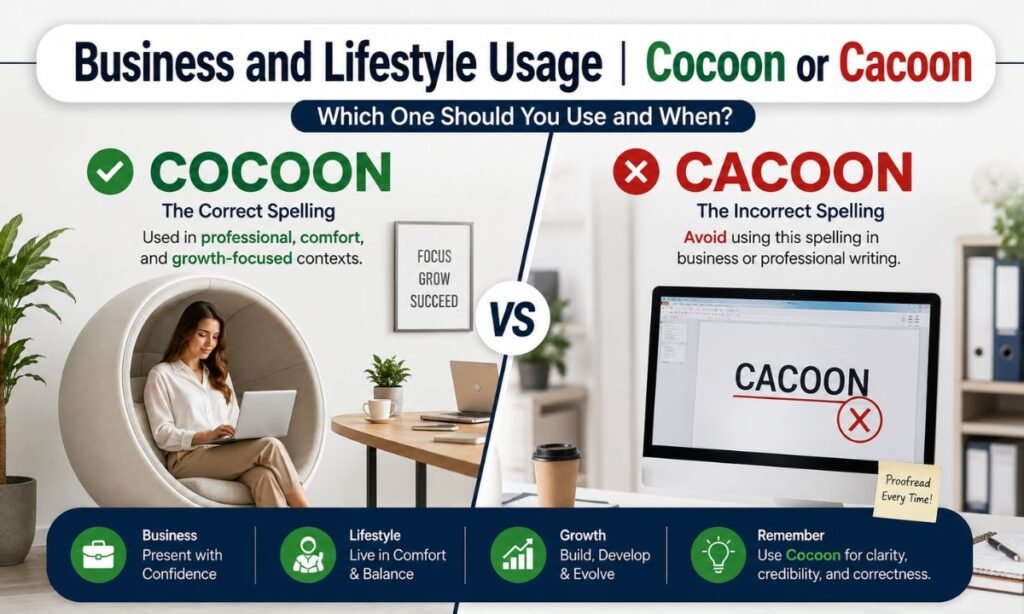
Marketers and lifestyle writers love this word because it carries an emotional shortcut. A “cocooning” trend in interior design might describe soft textures, warm lighting, and closed-off spaces meant to feel like a retreat from a hectic day. Wellness brands describe spa treatments as a way to “cocoon” clients in calm. Even home decor catalogs use “cocoon chair” to describe a rounded, enclosed seat that wraps around the sitter.
None of these uses change the spelling. Whether you’re talking about a caterpillar or a cozy reading nook, it’s still spelled with the double O.
Why the Spelling Confusion Happens
Similar Sound Patterns
English doesn’t always spell vowel sounds the way you’d expect. The unstressed first syllable in “cocoon” can come out sounding closer to “kuh” than a clean “co,” which nudges some writers toward guessing an “a.” This is the same reason people mix up words like “definitely” and “definately,” or “separate” and “seperate.” The ear hears one thing, and the hand writes another.
Influence of Regional Accents
Accent plays a role too. In some dialects and non-native speech patterns, the vowel distinction between “o” and “a” in unstressed syllables softens or nearly disappears. A word that’s crystal clear in one accent can sound genuinely ambiguous in another, which is part of why this particular spelling question gets searched so often across different English-speaking regions.
Auto-Correct Doesn’t Always Help
You might assume spell-check would catch this instantly, and often it does. But “cacoon” isn’t gibberish — it’s a real word tied to a real plant, so some spell-checkers and browser dictionaries won’t flag it as wrong. That means the software stays silent exactly when you need it to speak up, and the error slips through into a final draft, an email, or a published post.
Related searches people also have:
- Cocoon or cacoon pronunciation
- Cocoon meaning
- Cocoon or chrysalis
- Cocoon pronunciation
- Cocoon butterfly
- Cocoon animal
- Cocoon in Spanish (capullo)
Cacoon vs Cocoon: Side-by-Side Comparison
Dictionary Recognition
| Feature | Cocoon | Cacoon |
|---|---|---|
| Listed in major dictionaries (as the insect term) | Yes | No |
| Correct for biology/insects | Yes | No |
| Correct for figurative/comfort meaning | Yes | No |
| Real word in any context | Yes | Yes (botany — a tropical seed/vine, unrelated to insects) |
| Recommended for general writing | Yes | No |
Writing Recommendation
If you’re writing about insects, metamorphosis, comfort, isolation, or anything even loosely connected to the “wrapped and protected” idea, use cocoon. There’s no situation in everyday, academic, or professional writing where “cacoon” should replace it. Save “cacoon” for the rare case where you’re actually discussing the botanical seed pod — and even then, most readers will assume you made a typo unless you explain the context.
Real-Life Example: How a Small Spelling Error Can Affect Professional Writing
Picture a content writer submitting a blog post for a skincare brand’s “cacoon serum” campaign. The product name was meant to evoke comfort and protection — the cocoon idea — but the misspelling slipped past a rushed review and landed in the final headline. Readers noticed. Comments pointed out the typo, a few assumed the brand didn’t proofread its own materials, and the marketing team had to issue a correction days after launch.
That’s a small mistake with a real cost: wasted print materials, an awkward correction post, and a dent in how careful the brand looked to its audience. Spelling errors like this rarely sink a business on their own, but they chip away at credibility, especially in professional or academic writing where accuracy signals competence. A single wrong vowel won’t ruin a resume or a report, but it can be the detail that makes a reader trust the rest of the document a little less.
Language and Search Trends: Why Correct Spelling Matters in 2025–2026
Key Trends
Search data consistently shows spelling-confusion queries like “cacoon or cocoon” climbing every year, driven by a few overlapping trends:
- More people are writing in English as a second or third language, and searching for quick spelling confirmations rather than opening a full dictionary.
- Voice-to-text tools and mobile typing have increased phonetic spelling mistakes, since people type the way words sound rather than the way they’re written.
- Content creators and students increasingly rely on quick search answers instead of print dictionaries, favoring short, direct explanations over long grammar textbooks.
- AI writing tools have made more people conscious of getting details right before publishing, since a careless error stands out more in polished-looking content.
What This Means for Writers
Readers today skim faster and trust less. A misspelled word in the first paragraph of an article or email can make a reader question the accuracy of everything that follows, even if the actual information is solid. Getting foundational spelling right isn’t about perfectionism; it’s about not giving readers a reason to doubt you before they’ve even reached your main point.
How to Remember the Correct Spelling of Cocoon
Trick 1: Think of Two O’s for Protection
Picture the two O’s in “cocoon” as a pair of round, wrapped shapes — like the silk casing itself curling around the insect. Two O’s, two layers of protection. It’s a small visual anchor, but it sticks.
Trick 2: Associate It with Common Words
Cocoon rhymes and pairs naturally with other double-O words you already spell correctly without thinking: balloon, spoon, moon, raccoon. If you can spell “raccoon” without hesitation, you already know the pattern “cocoon” follows.
Trick 3: Visual Memory
Write the word by hand a few times, slowly, and picture an actual cocoon hanging from a branch each time you write the double O. Visual repetition tends to outlast rote memorization, especially for words your fingers want to type on autopilot.
Common Examples of Cocoon in Sentences
Biological Usage
- The caterpillar spent two weeks inside its cocoon before emerging as a moth.
- Scientists studied how temperature affects cocoon formation in silk moths.
- Inside the cocoon, the larva’s body breaks down and rebuilds almost entirely.
Everyday Usage
- After the long trip, all she wanted was to cocoon herself under a blanket with tea.
- The cabin felt like a cocoon, quiet and cut off from the rest of the world.
- He’s been cocooning at home this winter instead of going out much.
Professional Writing
- The spa’s new treatment room is designed to cocoon guests in warmth and quiet.
- Our onboarding process aims to cocoon new employees with support during their first month.
- The report described a “cocoon strategy,” where the company protected its core product line from competitors during the redesign.
Common Mistakes to Avoid
Mistake 1: Writing Cacoon
This is the single most common error tied to this word. Unless you’re specifically discussing the tropical Fevillea cordifolia plant, “cacoon” is a mistake, not a stylistic choice.
Mistake 2: Using Spellings Based on Pronunciation
English pronunciation is an unreliable guide to English spelling. Plenty of correctly spelled words don’t sound the way they’re written, and “cocoon” is one of them. Trust the dictionary form over the way the word feels in your mouth.
Mistake 3: Ignoring Spell Check Suggestions
Because “cacoon” is a legitimate word in a different context, some spell-checkers won’t underline it in red. Don’t assume silence from your spell-checker means you’re correct — when in doubt, look the word up directly rather than relying on software to catch every error.
Mini Quiz: Cocoon or Cacoon
Test yourself before you move on. Answers are below each question.
Quiz 1: Which spelling is correct?
A) Cacoon B) Cocoon
Answer: B — Cocoon
Quiz 2: Fill in the blank
“The caterpillar wove a silk ______ around itself.”
Answer: cocoon
Quiz 3: What is wrong spelling?
A) Cocoon B) Cacoon
Answer: B — Cacoon (except when referring to the tropical plant)
Quiz 4: Fill in the blank
“After a hard week, I just want to ______ myself in blankets.”
Answer: cocoon
Quiz 5: Meaning check
What does “cocoon” mean in a figurative sense?
Answer: A state of comfort, protection, or isolation from the outside world.
Quiz 6: Fill in the blank
“Moths and some other insects form a ______ before becoming adults.”
Answer: cocoon
Quiz 7: True or False
“Cacoon” is always incorrect in every context.
Answer: False — it’s a legitimate term for a specific tropical plant, though incorrect for insects.
Quiz 8: Fill in the blank
“The spa promises to ______ guests in comfort during their stay.”
Answer: cocoon
Quiz 9: Choose the correct option
Which word appears in Merriam-Webster as the standard spelling?
A) Cacoon B) Cocoon
Answer: B — Cocoon
Quiz 10: Fill in the blank
“Butterflies typically form a chrysalis, while moths form a ______.”
Answer: cocoon
Quiz 11: Spelling test
Spell the word correctly: /kəˈkuːn/
Answer: cocoon
Quiz 12: Fill in the blank
“The report used a ______ strategy to protect the company’s flagship product.”
Answer: cocoon
Quiz 13: Quick understanding
If someone writes “cacoon” while describing a butterfly’s transformation, is it correct?
Answer: No, it should be “cocoon.”
Frequently Asked Questions
What does cocoon mean?
A cocoon is the silky protective casing an insect, especially a moth larva, spins around itself before transforming into an adult. It’s also used figuratively to describe a state of comfort or isolation.
What is the meaning of “cacoon”?
Cacoon refers to a tropical plant and its seed, Fevillea cordifolia, found in Central and South America. It’s unrelated to insects and is not a valid spelling of “cocoon.”
What is the correct spelling of cocoon?
Cocoon, with a double O, is the correct spelling recognized by all major English dictionaries.
What does cocoon mean in life?
In a life or lifestyle context, “cocoon” describes a period of withdrawing into comfort, safety, or solitude, often before a personal change or simply as a form of rest.
Conclusion
The rule here is short and doesn’t need much hedging: write “cocoon,” not “cacoon.” The double O carries the word’s entire identity, from the silk casing wrapped around a caterpillar to the cozy blanket fort you build on a lazy Sunday. “Cacoon” survives only in a narrow botanical corner of the language, describing a tropical seed pod that has nothing to do with insects or comfort.