
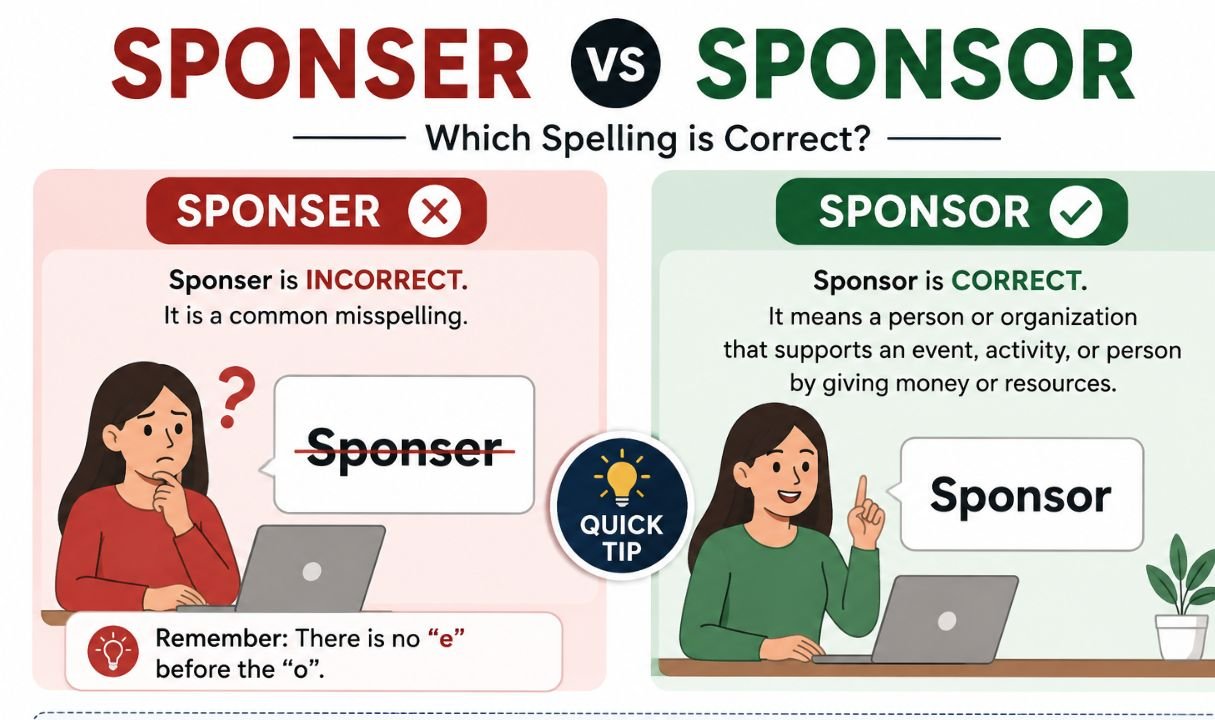
Type the word quickly and your fingers might land on “sponser” instead of “sponsor.” It happens to native speakers, students, marketers, and even people who write for a living. The word sounds like it could end in “-ser,” so the mistake feels natural. But only one spelling exists in English, and understanding why can save you from looking careless in emails, resumes, and business documents.
This guide breaks down the correct spelling, the meaning behind it, and how the word functions across sports, business, education, and recovery contexts. By the end, you’ll know exactly which form to use and why the other one never belongs in your writing.
What the Word Actually Represents
A sponsor is a person, company, or organization that provides support — usually financial, but sometimes in the form of goods, services, or guidance — to an event, project, individual, or cause. In return, the sponsor often receives recognition: a logo on a jersey, a mention in a program, or public association with something people care about.
The word traces back to Latin spondere, meaning “to promise” or “to pledge.” A sponsor was originally someone who vouched for another person, taking on responsibility for them. That sense of pledged responsibility still runs through every modern use of the word, whether we’re talking about a company funding a music festival or a mentor guiding someone through recovery.
“Sponser,” on the other hand, represents nothing. It has no entry in Merriam-Webster, Cambridge, Oxford, or any other recognized dictionary. It’s not a regional variant, not an older form, and not a British-versus-American spelling difference like “colour” and “color.” It’s simply an error that has spread because of how the word sounds when spoken.
How the Word Actually Works: Sponser vs Sponsor
Grammatically, “sponsor” functions as both a noun and a verb, and that flexibility is part of why it shows up so often in writing.
As a noun, it names the person or group giving support:
- The marathon had five corporate sponsors.
- She thanked her sponsor during the acceptance speech.
As a verb, it describes the act of giving that support:
- The bank agreed to sponsor the youth soccer league.
- Would your company consider sponsoring our conference?
“Sponser” cannot fill either role correctly, because it isn’t a word with an accepted grammatical function. Any sentence containing it is automatically flagged as incorrect by spell-checkers, style guides, and editors alike. If you swap “sponser” for “sponsor” in any sentence above, meaning stays intact — because “sponser” was never carrying meaning of its own. It was just a misspelling riding along on the correct word’s definition.
Why the Confusion Happens
English pronunciation rarely matches spelling exactly, and “sponsor” is a textbook example. Say the word out loud at normal speed and the second syllable softens into a quick, unstressed sound — a schwa — that could pass for either “-or” or “-er.” Your ear can’t always tell the difference, so your hand defaults to the pattern it knows best.
That pattern comes from words like teacher, writer, runner, and worker, where “-er” marks someone performing an action. English is full of these, so the brain assumes sponsor should follow suit. But sponsor didn’t evolve from an English verb the way “teach” became “teacher.” It arrived already complete from Latin, where the “-or” ending was built in from the start. Words like actor, director, governor, and senator share that same Latin lineage, which is why they also resist the “-er” pattern.
A few other factors keep the mistake alive:
- Fast typing. Muscle memory sometimes overrides correct spelling, especially in casual messages.
- Weak autocorrect. Some basic spell-checkers miss the error if the surrounding sentence looks grammatically fine.
- Rare exposure. People who don’t read or write the word often are more likely to guess at its spelling.
None of these explanations make “sponser” acceptable. They just explain why the mistake keeps showing up.
Correct Spelling Sponsor: Clear Visual Comparison
| Point of Comparison | Sponsor (Correct) | Sponser (Incorrect) |
|---|---|---|
| Dictionary status | Listed in Merriam-Webster, Cambridge, Oxford | Not listed anywhere |
| Word origin | Latin spondere, meaning “to promise” | No origin; a spelling error |
| Grammatical role | Works as noun and verb | Has no accepted role |
| Regional variation | Same in American and British English | Not a regional spelling |
| Formal writing use | Standard and expected | Always flagged as an error |
| Example sentence | The company will sponsor the event. | The company will sponser the event. ❌ |
Sponser vs Sponsor Sports
Sports writing produces more of this error than almost any other field, simply because sponsorship deals are everywhere in athletics. A jersey sponsor, a stadium sponsor, a title sponsor for a tournament — all of these need the correct spelling, especially in press releases and broadcast graphics where credibility matters. “Our team’s kit sponsor changed this season” is correct; “kit sponser” is not.
Is Sponser a Word
No. It doesn’t appear in any standard English dictionary, past or present. It isn’t slang, isn’t archaic, and isn’t used correctly anywhere in formal writing. Treat any instance of “sponser” you see online as a typo, not an alternative spelling.
Sponsor vs Sponsee
This is a genuinely different comparison, not a spelling issue. A sponsor gives support; a sponsee receives it. The term shows up most often in recovery programs, where an experienced member (the sponsor) guides someone newer (the sponsee) through a structured process. Confusing sponsor with sponsee changes who’s doing the helping.
Plural of Sponsor
Simple and regular: add an “s.” One sponsor, multiple sponsors. No apostrophe needed unless you’re showing possession, as in “the sponsors’ logos appeared on the banner.”
Sponsor Money
“Sponsor money” refers to the funds a sponsoring party contributes to an event, team, or individual. It’s common in casual business talk: “We’re still waiting on sponsor money before we can book the venue.”
Sponsor Examples
- A soft drink brand sponsoring a football tournament
- A university alumnus sponsoring a scholarship fund
- A tech company sponsoring a hackathon
- A local business sponsoring a youth sports team’s uniforms
To Sponsor Someone
Used as a verb with a person as the object, this phrase usually implies financial or advocacy-based support: “The senior partner agreed to sponsor her for the leadership program,” meaning she’ll receive guidance, funding, or a formal recommendation.
Sponsor Translate
If you’re translating the word for a non-English audience or checking usage across languages, stick with “sponsor” as your base English term. Most Romance languages retain a nearly identical spelling because of the shared Latin root, which is one more reason the “-or” ending is worth remembering.
How to Spell Sponsor Correctly (Practical Memory Approach)
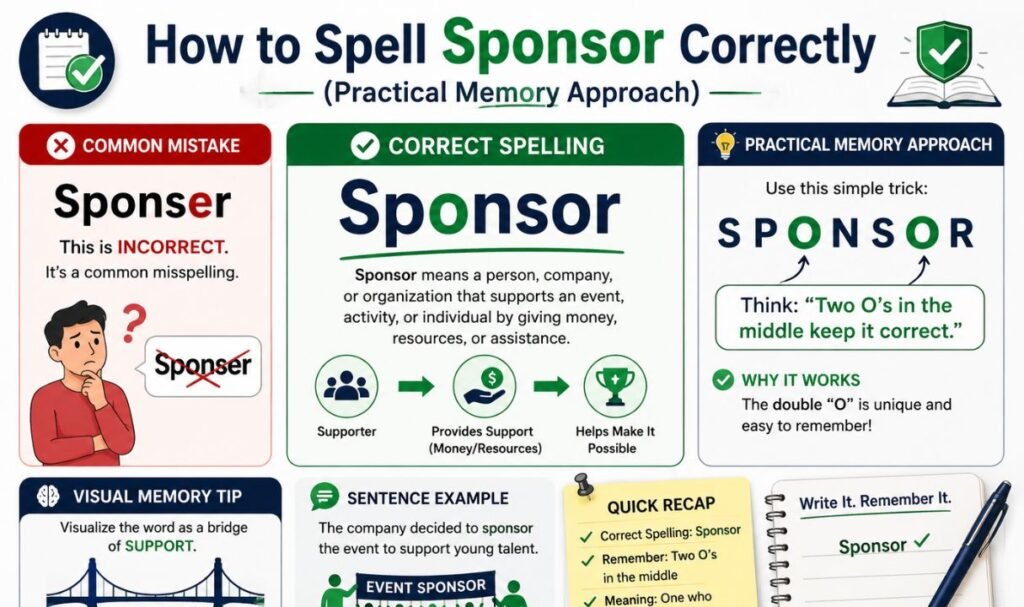
A few memory tricks tend to stick better than simply repeating the correct spelling:
- Pair it with similar “-or” words. Actor, director, governor, and supervisor all end the same way. If you trust those spellings, trust this one too.
- Hide “spoon” inside it. Sponsor contains the letters s-p-o-n, close enough to “spoon” that some learners use it as a quick visual anchor for the “o.”
- Link it to responsibility. A sponsor takes on responsibility, and both words share that “o” in the middle syllable.
- Break it into two chunks. Spon + sor. Saying it slowly in two pieces short-circuits the “-ser” habit your ear picks up at full speed.
- Run a find-and-replace check. If you’ve used “sponser” throughout a long document, search the file and fix every instance at once rather than trusting yourself to catch them individually.
How to Use Sponsor in English (Real Contexts and Examples)
The word adapts easily across formal and informal writing. Here’s how it typically appears:
- As a subject: The sponsor announced a new partnership this morning.
- As an object: We reached out to a potential sponsor last week.
- As a verb, present tense: Several airlines sponsor major golf tournaments.
- As a verb, past tense: The foundation sponsored twelve scholarships last year.
- As an adjective-like modifier: The sponsor agreement includes exclusivity clauses.
Notice that the spelling never shifts depending on tense or role. Sponsor, sponsors, sponsored, sponsoring — every form keeps the “-or” intact except when the “-ing” or “-ed” suffix is added, and even then, the root spelling doesn’t change to “-ser” under any circumstance.
Sponsor Definition With Real Examples Across Industries
The core meaning stays consistent, but the flavor shifts by field:
- Corporate events: A bank sponsors a business summit to gain visibility with attendees.
- Sports: An athletic brand sponsors a runner, covering gear and travel costs in exchange for logo placement.
- Broadcasting: A television program runs “brought to you by” segments naming its sponsors.
- Education: A company sponsors a research grant at a university, funding a specific study.
- Immigration: A citizen or employer sponsors a visa applicant, taking on legal responsibility for parts of the process.
- Recovery programs: An experienced member sponsors someone newer, offering guidance rather than money.
Across every one of these, the underlying idea holds steady: one party commits resources or backing so another party can succeed at something.
How Business Relationships Actually Work: Sponser vs Sponsor
In a business context, sponsorship is rarely a one-way gift. It’s a negotiated exchange. A company doesn’t fund a festival out of pure generosity — it wants visibility, brand association, or access to a specific audience. The agreement usually spells out:
- What the sponsor provides (cash, products, services, or a mix)
- What the sponsored party delivers in return (logo placement, mentions, exclusivity, data access)
- The length of the agreement and renewal terms
- Performance metrics, if the deal is tied to measurable exposure
Getting the spelling right matters more than it might seem in this setting, because sponsorship contracts, proposals, and pitch decks are formal documents. A misspelled word on a cover page can undercut an otherwise strong pitch before anyone reads past the title.
Types of Sponsors and Their Roles
| Sponsor Type | Typical Role |
|---|---|
| Title sponsor | Gets top billing; the event or venue is often named after them |
| Presenting sponsor | Second-tier visibility, usually listed as “presented by” |
| Official sponsor | Supplies products or services in a specific category, like beverages or apparel |
| Media sponsor | Provides advertising space or broadcast coverage instead of cash |
| In-kind sponsor | Donates goods or services rather than money |
| Community sponsor | Local businesses supporting smaller, community-level events |
Each type carries different expectations, but all of them fall under the same correctly spelled umbrella term.
Sponsor Synonyms and Related Vocabulary
Depending on context, these words can substitute for or accompany “sponsor”:
- Backer
- Patron
- Benefactor
- Financier
- Supporter
- Underwriter
- Guarantor (closer to the word’s original legal sense)
None of these carry the exact same weight in every situation, so swap carefully. “Patron” leans toward arts and culture, while “underwriter” suggests a more formal financial commitment.
Sponsor Forms and Variations in Usage
- Sponsor (base noun/verb)
- Sponsors (plural noun or third-person singular verb)
- Sponsored (past tense, or an adjective: a sponsored post)
- Sponsoring (present participle: the company is sponsoring three events this year)
- Sponsorship (the noun describing the overall arrangement or agreement)
All of these branch from the same correct root. None of them ever take the “-ser” spelling at any point in the word.
What Is a Sponsor in Recovery Contexts
In twelve-step and similar recovery programs, a sponsor is a peer, usually further along in recovery, who provides one-on-one guidance to someone newer to the program. This relationship isn’t financial. It’s built on shared experience, accountability, and steady support through difficult stages. A sponsor in this setting might help someone work through program steps, answer questions at odd hours, or simply be a consistent, trusted presence. The responsibility implied by the word’s Latin root — someone who pledges to stand behind another person — shows up clearly here, even without any money changing hands.
Common Mistakes People Make With Sponsor
- Writing “sponser” out of habit, especially in fast or informal typing
- Confusing sponsor with sponsee, reversing who is giving and who is receiving support
- Assuming “sponser” is a British spelling (it isn’t — both American and British English use “sponsor”)
- Forgetting the double role of the word as both noun and verb, leading to awkward sentence construction
- Overusing “sponsor” when a more precise word like “patron” or “backer” fits better
Practice Exercises: Sponser vs Sponsor
Fill in the Blank
- The company decided to ______ the charity run. (sponsor/sponser)
- We are grateful to our official ______ for this season. (sponsors/sponsers)
Error Identification
Find the mistake: “Our sponser provided all the equipment for the tournament.”
Sentence Correction
Rewrite correctly: “She is looking for a sponser for her art exhibition.”
Application
Write two original sentences using “sponsor” as a noun and two using it as a verb.
Marketing Context
Draft a short line a brand might use to announce a new sponsorship deal, using “sponsor” correctly at least twice.
Education Context
Write a sentence describing a company sponsoring a scholarship at a local university.
Sports Context
Write a sentence about a jersey sponsor for a football club.
Quick Recall Assessment
Without looking back at this article, write the correct spelling five times, then check your work.
Frequently Asked Questions
Which is correct, sponser or sponsor?
Sponsor is correct. Sponser is a common misspelling with no dictionary standing.
Who is a sponsor in a company?
A sponsor is a person or organization that provides financial or material support to a project, event, or individual, typically in exchange for recognition.
What does “sponsor” mean?
It means to financially or materially support someone or something, or the person/entity doing that supporting.
Is the word sponsor correct?
Yes, sponsor is the only accepted spelling in both American and British English.
Conclusion
The comparison between sponser and sponsor isn’t really a comparison at all — it’s a single correct word and a persistent typo. “Sponsor” carries a Latin root meaning “to promise,” functions as both noun and verb, and appears consistently across business, sports, education, and recovery contexts. “Sponser” has never had a place in any dictionary and never will, no matter how often pronunciation nudges people toward it.