
You typed it, stared at it, and something felt off. Was it “emaculate” or “immaculate”? That flicker of doubt is more common than most writers admit, and it usually strikes at the worst moment: mid-email, mid-essay, or mid-resume.
Here’s the good news. This mix-up has a clear, permanent fix. By the end of this guide, you’ll know exactly which word to use, why the other one trips people up, and how to lock the correct spelling into memory for good.
The Short Answer?
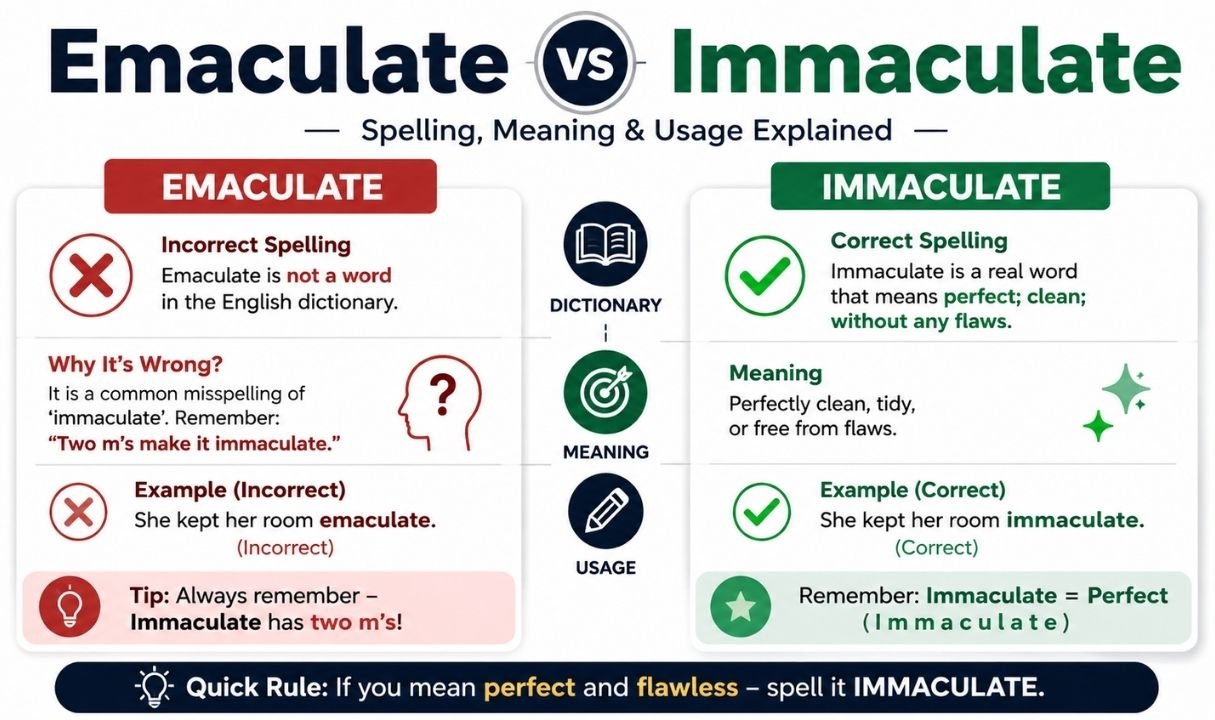
Immaculate is the correct word. It means perfectly clean, flawless, or free from any error or blemish.
Emaculate is not a standard English word. In nearly every case, it’s a misspelling of immaculate, though a handful of niche sources link it to “emaciate,” meaning extremely thin or weak from illness.
If you remember nothing else from this article, remember this: when in doubt, write immaculate.
Immaculate Meaning: What Does It Actually Mean?
Immaculate describes something with no flaws at all. No dirt, no mistakes, no imperfections of any kind. It’s one of those words that carries weight precisely because it doesn’t allow for “almost.”
A room can be clean. A room can also be immaculate, which is a step beyond clean, it means every surface, corner, and detail has been attended to.
Simple Breakdown
- Immaculate = perfectly clean or flawless
- Used for physical spaces, objects, records, performances, and even reputations
- Carries a positive, admiring tone
- Often signals extra effort or extreme care
1. Immaculate Definition in Grammar and Usage
A. Immaculate Definition (Grammar)
Immaculate is an adjective. It modifies nouns to show that something is spotless, without defect, or morally pure. Dictionaries such as Merriam-Webster and Oxford define it as free from flaw, error, or blemish, and, in a stricter sense, free from spot or stain.
Example:
The surgeon’s technique was immaculate, with not a single unnecessary movement.
Immaculate Adjective Meaning in Context
The word flexes across several settings:
- Physical cleanliness – an immaculate kitchen
- Performance or execution – an immaculate free kick
- Moral or reputational purity – an immaculate track record
- Appearance – an immaculate suit
Because it works in so many contexts, immaculate shows up constantly in writing that wants to sound precise rather than vague.
Is “Emaculate” a Real Word?
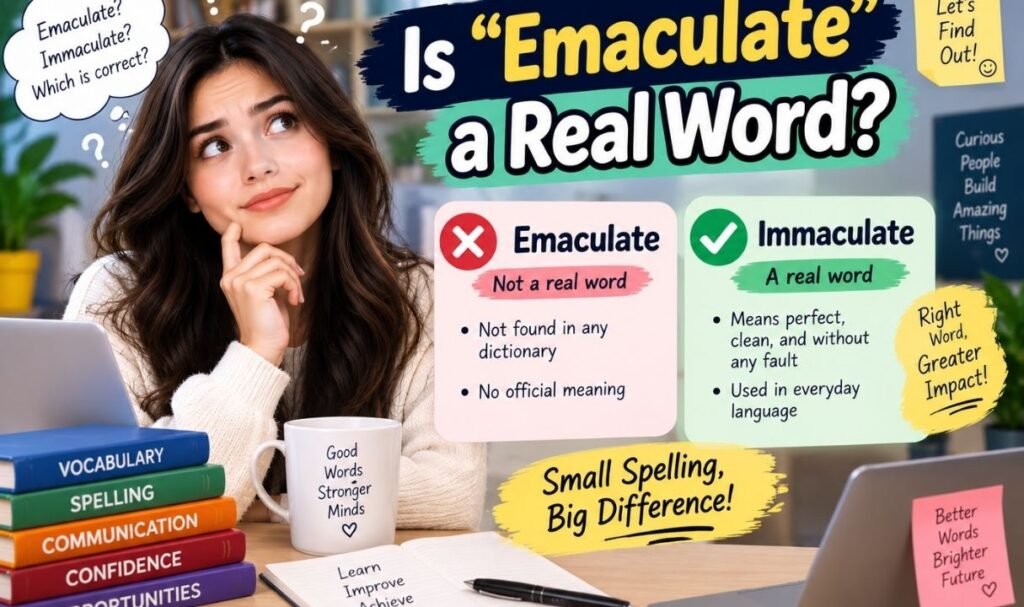
No. You won’t find “emaculate” listed as a standard entry in major dictionaries. It shows up so often in searches and casual writing that people assume it must be correct somewhere, but it isn’t recognized as standard English.
Two things usually happen when someone types “emaculate”:
- They meant immaculate and dropped the first “im-” by accident.
- They meant emaciated, a completely different word describing extreme thinness from illness or starvation.
Is emaculate a word?
Not in any dictionary that matters for formal writing. Treat it as a spelling slip, not an alternate form of immaculate.
Emaculate Meaning
Because “emaculate” isn’t a genuine dictionary word, it doesn’t have an official meaning. A few older or informal sources connect it loosely to thinness or a wasted, worn-down appearance, borrowing from “emaciate.” That’s the closest thing to a real definition it has, and it’s still not something you’d want to rely on in professional writing.
Why This Matters
Spelling errors like this one do more than look sloppy. In a resume, an email to a client, or a school paper, “emaculate” can quietly undercut your credibility even if the rest of the writing is strong. Readers notice, even when they can’t name what felt wrong.
Emaculate vs Immaculate Difference (Side-by-Side)
| Feature | Immaculate | Emaculate |
|---|---|---|
| Standard English word | Yes | No |
| Dictionary listed | Yes (Merriam-Webster, Oxford, Cambridge) | Not listed |
| Meaning | Perfectly clean, flawless, spotless | No official meaning; sometimes confused with “emaciated” |
| Word origin | Latin immaculatus (unstained) | No established etymology |
| Correct usage | Formal and everyday writing | Should be avoided entirely |
| Common cause of use | N/A | Typo or confusion with “immaculate” or “emaciate” |
Why Do People Misspell “Immaculate”?
Common Reasons
- The double “m” at the start feels unnatural next to the “im-” prefix, so writers drop a letter without noticing.
- Spoken English blurs the first syllable, making “im” sound closer to “e” in fast speech.
- Autocorrect sometimes fails to catch it because “emaculate” reads as a plausible word shape rather than obvious gibberish.
- People confuse it with “emaciate,” a real word with a similar sound but an opposite meaning.
Related Examples
This pattern isn’t unique to immaculate. English is full of words where a prefix quietly disappears in casual writing:
- “irregardless” instead of “regardless”
- “expresso” instead of “espresso”
- “excape” instead of “escape”
Each case follows the same logic: a sound gets simplified in speech, and the spelling drifts to match what the ear expects rather than what’s actually correct.
The Origin of “Immaculate” (This Makes It Stick)
Immaculate Word Origin
Immaculate comes from the Latin word immaculatus, built from two parts:
- im- meaning “not”
- macula meaning “spot” or “stain”
Put together, the word literally translates to “not stained” or “without spot.” That Latin root also gives English the word “macula,” still used in anatomy to describe a small spot or patch, such as the macula in the eye.
Why This Helps
Once you see the “im- + macula” structure, the double “m” stops being random. It’s two meaningful parts stacked together, not a typo waiting to happen. This is also why “Immaculate Conception,” the Catholic doctrine describing Mary being born free of original sin, uses the same root: it’s about being entirely without stain, in a spiritual sense rather than a physical one.
How to Spell Immaculate Correctly (Without Second Guessing)
Memory Hacks That Work
- Break it into chunks: im + macula + te
- Picture a spotless white room; the word literally means “without a spot”
- Link it to “Immaculate Conception,” a phrase most people have already heard and can spell correctly
- Say it slowly out loud, stressing the first syllable: im-MAC-u-late
Quick Checklist
- [ ] Starts with im-, not e-
- [ ] Has a double m right after the “i”
- [ ] Contains macula in the middle
- [ ] Ends in -ate, not -ute or -it
How to Use Immaculate in a Sentence (Real Examples)
Immaculate in a Sentence (Everyday Use)
Her presentation was immaculate, without a single typo or awkward slide.
Immaculate Example Sentences by Context
Cleanliness
- The hotel room was immaculate when we checked in.
- He kept his workshop immaculate despite working with sawdust all day.
Performance
- The gymnast delivered an immaculate routine and scored a perfect ten.
- The lawyer’s closing argument was immaculate, tightly reasoned from start to finish.
Appearance
- She showed up to the interview in an immaculate navy suit.
- The vintage car had an immaculate paint job, untouched by rust or scratches.
When to Use Immaculate in English
Best Situations
Immaculate works well when you want to signal that something goes beyond ordinary quality. Reach for it when describing:
- A space that’s been deeply, thoroughly cleaned
- A record, résumé, or reputation with zero blemishes
- A flawless performance, whether athletic, musical, or professional
- Clothing or grooming that looks perfectly put together
Avoid Overuse
Immaculate is a strong word, and strong words lose power when they’re sprinkled into every sentence. Save it for moments where “clean” or “neat” genuinely undersells what you’re describing. If everything in your writing is immaculate, nothing stands out as exceptional.
Immaculate vs Perfect vs Impeccable
These three words overlap, but they aren’t interchangeable.
Immaculate vs Perfect
“Perfect” is broader. It can describe anything with no faults, including abstract things like a plan, a score, or a moment. “Immaculate” leans more toward physical cleanliness or visible flawlessness, though it also extends to records and reputations.
Immaculate vs Impeccable
“Impeccable” focuses on taste, judgment, timing, or manners. You’d describe someone’s impeccable timing or impeccable style. “Immaculate” fits better for spaces, objects, and visible states of order.
Comparison Table
| Word | Best used for | Example |
|---|---|---|
| Immaculate | Cleanliness, visible flawlessness, records | An immaculate kitchen |
| Perfect | General absence of fault, broad use | A perfect score |
| Impeccable | Taste, manners, judgment, timing | Impeccable manners |
Words Similar to Immaculate (Synonyms and Antonyms)
Immaculate Synonym List
- Spotless
- Pristine
- Flawless
- Pure
- Unblemished
- Faultless
- Squeaky clean
Immaculate Antonyms
- Filthy
- Messy
- Stained
- Flawed
- Sloppy
- Blemished
Common Spelling Mistakes Like “Emaculate”
Other Grammar Spelling Errors
Immaculate isn’t alone in getting mangled. Some frequent lookalike mistakes include:
- “definately” instead of “definitely”
- “seperate” instead of “separate”
- “recieve” instead of “receive”
- “occured” instead of “occurred”
Why It Matters
Small spelling errors accumulate. One typo might be forgiven, but a pattern of them in a cover letter, report, or article suggests carelessness, even when the ideas behind the writing are sound. Getting words like immaculate right is a low-effort way to protect your credibility.
One Word, Big Impact
Candidate A
Someone writes: “The apartment was emaculate when we moved in.” A sharp-eyed reader stumbles on that word, and the sentence loses momentum before the point even lands.
Candidate B
Someone writes: “The apartment was immaculate when we moved in.” Same sentence, same meaning, but nothing pulls the reader’s attention away from the message.
One letter is the entire difference between writing that reads smoothly and writing that makes a reader pause for the wrong reason.
How to Remember the Spelling of Immaculate (For Good)
Proven Techniques
- Connect it to “immaculate conception,” a phrase you’ve likely seen spelled correctly many times
- Remember the Latin building blocks: im- (not) + macula (stain)
- Practice writing the word by hand a few times; muscle memory helps more than people expect
- Read it aloud slowly, separating each syllable: im-mac-u-late
Spelling Confusion Immaculate
Confusion around this word tends to fade quickly once someone learns the Latin root. Before that, though, it’s an easy trap: the “im-” prefix sounds soft in casual speech, so the brain quietly edits it out. Once you’ve seen the breakdown (not + stain), the correct spelling tends to stick without much extra effort.
Key Takeaways (Quick Breakdown)
- Immaculate is the correct, dictionary-recognized word.
- Emaculate is not standard English and is almost always a typo or confusion with emaciate.
- Immaculate means perfectly clean, flawless, or free from any blemish.
- The word comes from Latin: im- (not) + macula (stain).
- Use immaculate for cleanliness, performance, appearance, and reputation.
- Save it for genuinely flawless situations so it keeps its impact.
Frequently Asked Questions
Can you say immaculately clean?
Yes. “Immaculately” is the adverb form, and “immaculately clean” is a common, correct phrase used for emphasis.
Is immaculate a compliment?
Yes. Calling something immaculate is high praise, suggesting exceptional care, cleanliness, or precision.
Why does immaculate mean what it means?
It comes from Latin immaculatus, meaning “not stained,” built from “im-” (not) and “macula” (stain).
What does immaculate mean in slang?
In casual or slang use, “immaculate” often describes something impressively good, stylish, or well-executed, such as an outfit or a skillful play in sports.