
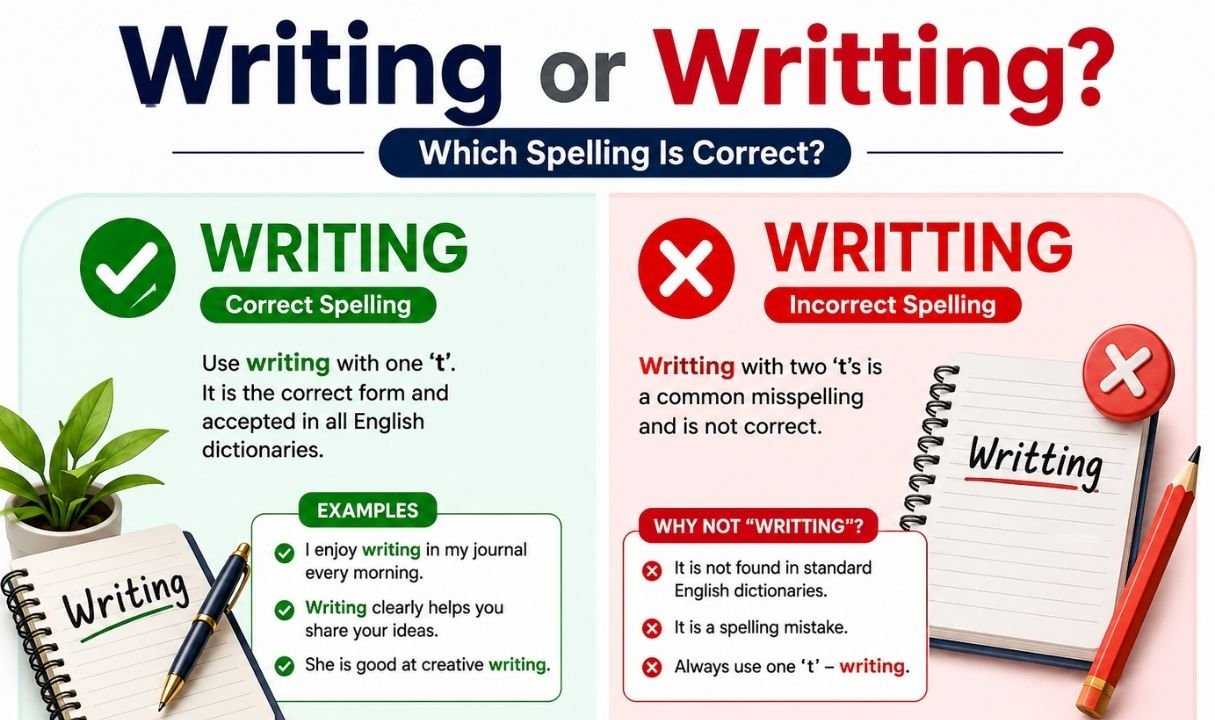
If you’ve ever typed “writting” and then stared at it, unsure whether the extra “t” belongs there, you’re not alone. This is one of the most searched spelling questions in English, and the answer is shorter than the confusion around it suggests.
Writing is correct. Writting is a misspelling. There’s no context, dialect, or grammar rule that makes “writting” acceptable in standard English.
That said, knowing the right answer and knowing why it’s right are two different things. This guide covers both, along with real examples, the history behind the word, common slip-ups, and how the spelling behaves across different types of writing — from emails to news articles to text messages.
Writing or Writting – Quick Answer
Here’s the short version, since some readers just need confirmation before hitting send on an email:
- Correct spelling: writing
- Incorrect spelling: writting
- Word type: present participle / gerund of the verb “write”
- Used in: British English and American English equally
The rule that governs this comes down to one thing: “write” ends in a silent “e.” When you add “-ing” to a verb that ends in a silent “e,” standard practice is to drop the “e” and attach the suffix directly. Write becomes writing. No letter gets doubled.
Examples
- She is writing a letter to her grandmother.
- I’ve been writing since I was ten years old.
- Writing clearly is harder than most people expect.
- He spent the afternoon writing his college essay.
- Good writing takes practice, not talent alone.
Notice that in every sentence above, “writing” functions either as a verb (describing an ongoing action) or as a noun (referring to the activity or the output itself). “Writting” never appears in any dictionary, style guide, or grammar reference, because it simply isn’t a word.
The Origin of Writing or Writting
To understand why “writing” looks the way it does, it helps to go back to where the word came from.
The verb “write” traces to the Old English word writan, which originally meant to scratch, carve, or etch marks into a surface. Long before pen and paper were common, people literally carved symbols into wood, bone, or stone to record information. Over centuries, as writing tools changed, the meaning shifted from carving to the broader act of putting words down, whether by hand, typewriter, or keyboard.
As English evolved, spelling conventions settled around a simple pattern: verbs ending in a silent “e” drop that “e” before taking an “-ing” ending. This is the same pattern you see in:
- make → making
- hope → hoping
- write → writing
Compare that to a different category of verbs — ones with a short vowel sound followed by a single consonant, where the final consonant doubles instead:
- run → running
- sit → sitting
- stop → stopping
“Write” doesn’t belong to that second group. Its vowel sound is long (it rhymes with “kite,” not “knit”), and it already ends in a silent “e.” Because of that, the doubling rule that produces words like “sitting” and “running” was never supposed to apply here. The mistaken spelling “writting” happens when someone applies the wrong rule to the wrong verb.
It’s worth noting that this silent-e pattern isn’t unique to “write.” English has dozens of verbs that behave the same way, and once you see the pattern, it becomes much easier to predict correct spelling without memorizing every word individually. Consider a few more examples:
- drive → driving (not “drivving”)
- believe → believing (not “believing” with a doubled letter)
- shine → shining (not “shinning”)
- smile → smiling (not “smilling”)
In each case, the silent “e” quietly disappears once “-ing” is attached. No letters get doubled, and nothing else in the word changes. “Writing” simply follows this same, very common rule.
Here’s why the confusion is so common, based on how people actually search and type this word:
- I am writing or writting — this phrasing shows up constantly in search bars, usually from someone drafting a sentence in real time and second-guessing the spelling mid-thought.
- Writing or writting grammar — learners searching this are usually trying to understand the rule itself, not just get a quick yes-or-no answer.
- Writing or writting in english — a common phrasing among non-native English speakers comparing spelling conventions from their first language.
- Writing or writting examples — searched by people who want to see the correct form used in real sentences before applying it themselves.
- Writing or writings — a related but different question, since “writings” (plural noun) refers to written works or documents, not the verb form.
- Written or writen — the past participle follows a similar pattern; “written” is correct, and “writen” (one “t”) is the incorrect version, just as “writting” (two t’s) is incorrect in the other direction.
- Writing in English — a broader phrase used by ESL learners looking for general guidance on English writing conventions.
- Writing styles — often searched alongside spelling questions, since people learning to write correctly are frequently also exploring different formats and tones.
British English vs American English Spelling
One of the more reassuring facts about this word is that geography doesn’t matter here. Unlike words such as “colour” versus “color” or “organise” versus “organize,” writing is spelled the same way everywhere English is used.
| Region | Spelling Used | Notes |
|---|---|---|
| United States | writing | No regional variant exists |
| United Kingdom | writing | No regional variant exists |
| Canada | writing | Follows standard English rule |
| Australia | writing | Follows standard English rule |
| India | writing | Follows standard English rule |
So if you were hoping “writting” might be a British spelling or some accepted regional variant, it isn’t. Every major English-speaking country and every recognized dictionary — Merriam-Webster, Oxford, Cambridge — lists only one accepted spelling: writing.
This consistency actually makes the word easier to learn than many others in English. You don’t need to remember which country you’re writing for. One spelling works across every context, every audience, and every publication.
Which Spelling Should You Use?
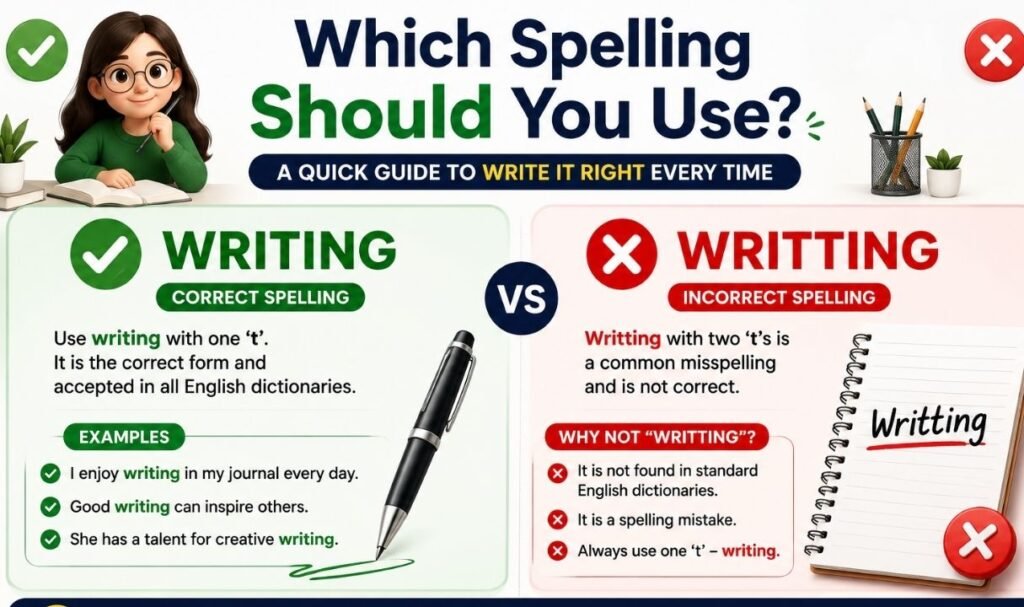
Always use “writing.” There is no situation — formal, informal, academic, casual, or professional — where “writting” is acceptable. It isn’t a regional variant, an older form of the word, or an alternate spelling used in specific industries. It’s a typo that happens to follow a predictable pattern.
If you’re trying to decide how to use “writing” correctly in a sentence, it helps to remember its two main jobs:
- As part of a verb phrase, describing an action in progress (present continuous tense): “I am writing,” “She was writing,” “They will be writing.”
- As a noun (gerund), referring to the activity or product itself: “Writing takes patience,” “Her writing improved a lot this year.”
Examples
- Correct: The teacher is writing comments on every essay.
- Incorrect: The teacher is writting comments on every essay.
- Correct: Creative writing helped him process difficult emotions.
- Incorrect: Creative writting helped him process difficult emotions.
- Correct: Please review my writing before I submit it.
- Incorrect: Please review my writting before I submit it.
A simple test you can run in your head: if you’re ever unsure, picture the base verb “write” and just add “-ing” directly, keeping the silent “e” dropped. You’ll land on the correct spelling almost every time.
Common Mistakes with Writing or Writting
Spelling mistakes rarely happen randomly. They usually come from a pattern the brain has picked up somewhere else and applied incorrectly. Here are the three most common reasons “writting” keeps showing up.
Mistake 1: Applying the Consonant-Doubling Rule Where It Doesn’t Belong
English does double final consonants in some “-ing” forms, but only under specific conditions: a short vowel sound followed by a single consonant, usually in a one-syllable word (or a stressed final syllable). Words like “hop” (hopping), “run” (running), and “plan” (planning) follow this rule. “Write” has a long vowel sound, so it doesn’t qualify. People memorize the doubling rule from earlier examples and then misapply it here.
Mistake 2: Typing Too Quickly Without Reviewing
A large share of “writting” typos aren’t really grammar mistakes at all — they’re keyboard slips. Because “t” and “i” sit near each other, and because “-ting” endings appear frequently in English (getting, sitting, putting), fingers sometimes default to a double “t” out of habit rather than thought. This is especially common in texting, social media captions, and quickly drafted emails.
Mistake 3: Confusing Related Word Forms
Some people mix up “writing” with other forms of the verb, like “written” or “writer,” and end up blending spelling patterns. For example, someone unsure about “written or writen” might overcorrect in the opposite direction on a different word and land on “writting.” Keeping the full verb pattern straight helps:
| Base Form | Present Participle | Past Participle | Noun (Person) |
|---|---|---|---|
| write | writing | written | writer |
Seeing the full set together usually clears up the confusion faster than memorizing each form separately. A useful habit is to say the sentence out loud before typing it. Hearing “I am writing a letter” versus silently guessing at the spelling often makes the correct form easier to recall, since the ear naturally links “writing” to its base verb “write” rather than to unrelated words that double their consonants.
Proofreading tools and spellcheckers will almost always flag “writting” automatically, so a quick pass through a spelling checker before sending important messages can catch this error before anyone else sees it. Still, relying on autocorrect alone isn’t a complete fix, since some messaging apps and comment sections don’t run spellcheck at all.
Writing or Writting in Everyday Examples
Spelling mistakes don’t stay confined to one type of communication. They show up differently depending on where you’re writing and how quickly you’re doing it.
Email is one of the most common places this mistake appears, largely because people draft messages fast and rarely proofread before hitting send.
- Correct: “I am writing to follow up on our meeting.”
- Incorrect: “I am writting to follow up on our meeting.”
In professional email, a spelling slip like this can undercut an otherwise polished message. Recipients notice small errors more than writers expect, especially in first-contact emails, client communication, or job applications.
News
Published journalism holds a higher editorial standard, so “writting” almost never appears in professionally edited news content. When it does slip through, it’s usually in reader comments, social captions attached to news posts, or quickly published blog updates rather than the edited article body itself.
- Correct: “The reporter spent months writing the investigative piece.”
Social Media
Social platforms are where spelling rules loosen the most, and “writting” shows up more frequently here than almost anywhere else, mixed in with intentional abbreviations and casual tone.
- Correct: “Currently writing my first blog post, wish me luck!”
- Incorrect: “Currently writting my first blog post, wish me luck!”
Because captions and comments are often typed on a phone without spellcheck catching every error, this is a high-frequency zone for the mistake — even among people who know the correct spelling and just aren’t reviewing what they typed.
Formal Writing
In academic papers, business reports, legal documents, and any formal context, “writting” is treated as a clear error that can affect how a reader judges the writer’s credibility.
- Correct: “This report focuses on improving technical writing skills across the department.”
Formal contexts carry less tolerance for spelling slips, since readers often equate careful spelling with careful thinking.
Writing or Writting – Google Trends & Usage Data
Search behavior around this word tells its own story. “Writing or writting” consistently appears as a comparison-style query, meaning people are actively unsure which version is correct rather than searching out of curiosity. This pattern is typical of spelling confusion driven by pronunciation — since “writing” and a hypothetical “writting” sound nearly identical when spoken aloud, the ear gives no clue about which spelling is right.
Search interest for this term tends to spike around:
- Back-to-school periods, when students are drafting essays and assignments
- Weekday work hours, aligning with professional email and report writing
- Periods of increased content creation, such as when more people are blogging, freelancing, or applying for writing-related jobs
Countries Where the Query Appears Often
Based on general search patterns for spelling-comparison queries like this one, interest tends to concentrate in:
- India — a large base of English learners and students searching grammar clarifications
- United States — high volume of everyday writing tasks across school and work
- United Kingdom — steady interest from students and professionals alike
- Philippines — strong presence of ESL learners and content writers
- Pakistan — growing number of students and freelance writers searching English usage questions
- Nigeria — increasing search volume tied to education and remote writing work
This spread reflects a broader pattern: countries with large populations of English learners, students, and content professionals tend to generate the highest volume of spelling-clarification searches like this one.
Comparison Table: Writing vs Writting
| Feature | Writing | Writting |
|---|---|---|
| Correct spelling | Yes | No |
| Found in dictionaries | Yes (Merriam-Webster, Oxford, Cambridge) | No |
| Used in British English | Yes | No |
| Used in American English | Yes | No |
| Acceptable in formal writing | Yes | No |
| Acceptable in academic writing | Yes | No |
| Common cause | Correct application of silent-e rule | Misapplied consonant-doubling rule / typo |
| Appears in professional editing | Yes | Never passes editorial review |
The table makes the comparison clear: there’s no scenario column where “writting” gets a “yes.”
Frequently Asked Questions
Which is right, writting or writing?
Writing is correct. Writting is a common misspelling and isn’t recognized in any standard English dictionary.
Is it written or writen?
Written is correct. Writen (with one “t”) is incorrect; the past participle of “write” always uses a double “t.”
Which spelling is correct, writer or writter?
Writer is correct. Writter is not a word — the noun form of “write” never doubles the “t.”
What is the grammatically correct way to write?
For the present participle, use “writing” (drop the silent “e” and add “-ing”). For the past participle, use “written.” Both follow standard English verb-formation rules.
Conclusion
The spelling question here has a firm, simple answer: writing is correct, and writting is not a recognized word in English, regardless of country, context, or formality level. The confusion mostly traces back to a spelling rule mismatch — people apply the consonant-doubling pattern from words like “sitting” and “running” to a verb that doesn’t follow that pattern, since “write” already ends in a silent “e” that simply gets dropped before adding “-ing.”